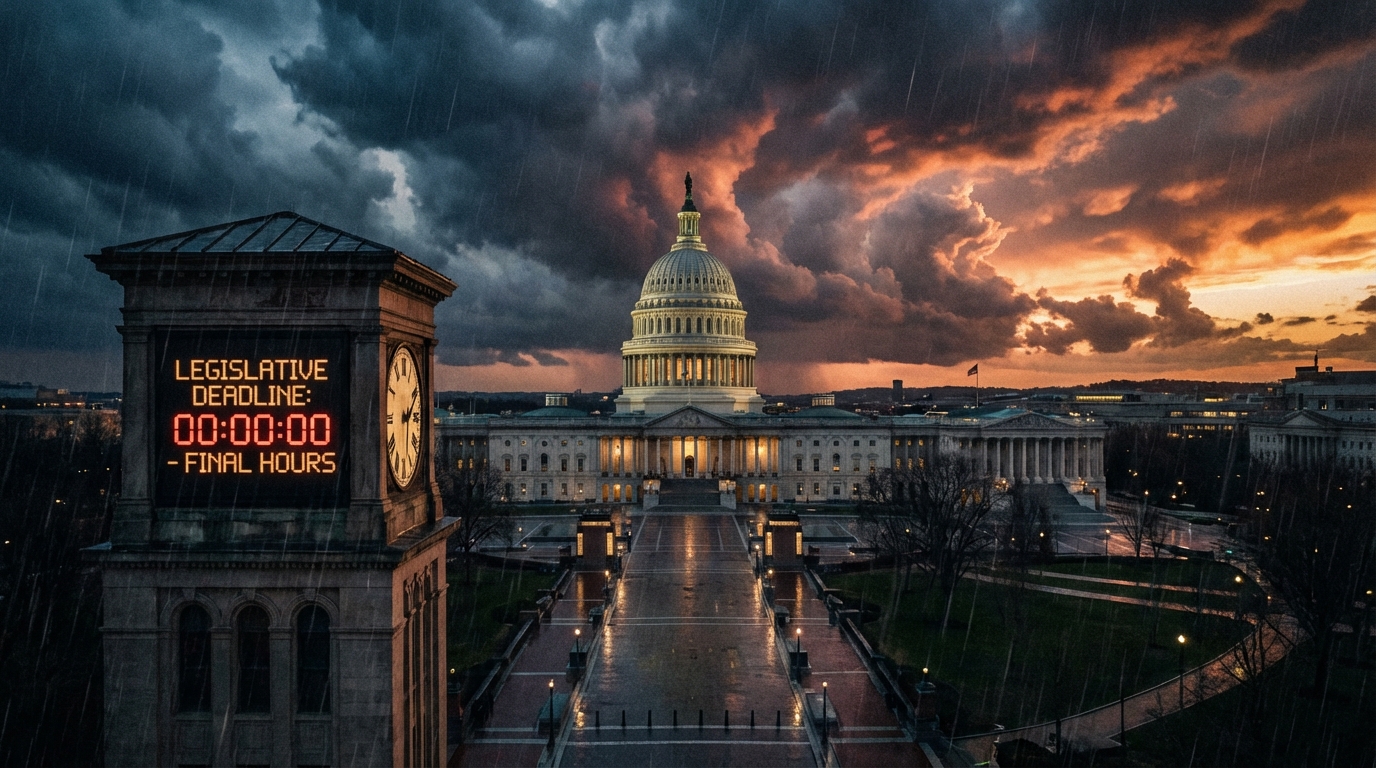
Is the Government Shutting Down Again? A 2026 Fiscal Outlook
Is the Government Shutting Down Again: A 2026 Fiscal Outlook
Editor’s Note: The following article describes a hypothetical future scenario regarding the 2026 fiscal cycle.
As of late January 2026, the United States faces a statistically high probability of a government funding lapse following recent leadership transitions. With President Donald Trump in office and Senator John Thune serving as Senate Majority Leader, the legislative branch is racing against a deadline to pass necessary spending bills. Market indicators reflect significant skepticism regarding a timely resolution; prediction platforms such as Kalshi and Polymarket placed the odds of a shutdown between 73% and 76% on January 28, according to reporting attributed to the Bergen Record. These figures suggest that despite the shift in political control, fiscal stability remains tenuous. Consequently, citizens and federal employees are once again asking: is the government shutting down again?
TL;DR
- High Probability of Lapse: Prediction markets estimate a 73% to 76% chance of a government shutdown as of late January 2026 (Bergen Record).
- Critical Deadlines: A Senate vote is scheduled for January 29, with the final funding expiration set for midnight on January 30 or 31 (Bergen Record; The News Journal).
- Political Friction: Negotiations are stalled by demands from Senate Minority Leader Chuck Schumer for the firing of DHS Secretary Kristi Noem (Bergen Record).
- Historical Context: This standoff follows a record-breaking 43-day shutdown that occurred during the 2025 fiscal cycle (The News Journal).
Legislative Scenarios Comparison
The following table outlines the potential pathways for the current funding cycle compared to the historical context of the 2025 shutdown.
| Option | Best for | Pros | Cons | Pricing/Cost |
|---|---|---|---|---|
| Passage of Spending Bills | Operational Stability | Maintains government services; Avoids “reduction in force” protocols. | Requires resolving high-level personnel disputes (e.g., DHS Secretary status). | Standard Appropriations |
| Continuing Resolution (CR) | Buying Time | Provides a temporary buffer for negotiations (e.g., the House’s Sep 2025 attempt). | Often fails in the Senate (e.g., the 44-48 rejection in Sep 2025); prolongs uncertainty. | Short-term Funding |
| Partial Shutdown (2026 Risk) | Political Leverage | Forces negotiation on specific policy riders (e.g., ICE funding). | Disrupts specific agencies; creates administrative burden; halts non-essential services. | Lost Productivity (Unknown Total) |
| Full Shutdown (2025 Event) | N/A (Historical Event) | None identified in retrospect. | Record-breaking 43-day duration; severe breakdown of budgetary process. | High Economic & Operational Costs |
The Current Political Landscape (January 2026)
To address the impending expiration of funds, legislative leadership has initiated procedural moves to bring spending measures to the floor. Senate Majority Leader John Thune scheduled a critical Senate vote regarding these spending bills for Thursday, January 29, leaving a narrow window for passage before the weekend deadline (Bergen Record). The proximity of this vote to the January 31 cutoff indicates that negotiations have remained fluid. The outcome of this specific vote is the primary determinant of whether operations will continue uninterrupted into February.
The appropriations process is further complicated by escalating political friction between Senate Democrats and the new administration’s cabinet officials. Senate Minority Leader Chuck Schumer has publicly urged President Trump to fire Kristi Noem, the Secretary of Homeland Security, introducing personnel disputes into the broader governance debate (Bergen Record). Such conflicts often strain the bipartisan cooperation required to secure votes for spending packages in a closely divided Senate.
While President Trump retains the authority to address personnel grievances regarding Secretary Noem, the legislative mechanics rely heavily on Majority Leader Thune’s scheduling strategies. The demand for Noem’s termination by the Senate Minority Leader introduces a partisan obstacle that could complicate the passage of the spending bills. Consequently, the outlook for fiscal stability in early 2026 appears fragile.
Historical Precedent: The 2025 Shutdown
The current legislative anxiety is deeply rooted in the events of the previous year. The 2025 government shutdown established a significant new benchmark for legislative lapses in federal funding. According to reporting from January 2026, the shutdown lasted for 43 days, a duration explicitly categorized as “record-breaking” relative to prior historical events. This extended gap in appropriations surpassed previous records, indicating a severe breakdown in the budgetary process during that fiscal cycle (The News Journal).
The destabilization of the 2025 funding cycle centered on a critical deadline established earlier in the fiscal year. Current funding for the Federal Government was scheduled to expire after Tuesday, September 30, 2025. As this date approached, legislative maneuvering intensified. Legal analysts noted the urgency of this deadline, warning contractors and agencies of the impending cutoff if a resolution was not enacted (Wiley Rein).
The House of Representatives initially succeeded in advancing a temporary legislative solution. On September 19, 2025, the House passed a continuing resolution by a narrow margin of 217-212. This measure was designed to extend government funding through November 21. However, legislative progress collapsed when the measure reached the Senate. By September 26, the Senate had voted down the continuing resolution with a tally of 44-48, effectively halting the momentum generated by the House (Wiley Rein).
Operational Impacts and Agency Preparations
The financial and operational toll of legislative deadlock was starkly illustrated by the events following the September 30, 2025, funding expiration. While specific total dollar figures for the 2025 event are still being assessed, the extended lapse in appropriations historically creates compounding economic costs. As of late January 2026, the federal government faces renewed financial peril with another funding deadline scheduled for midnight on January 30. To avoid a partial shutdown, the Senate is required to pass six of the 12 annual spending bills necessary for the 2026 budget (The News Journal).
In anticipation of such funding gaps, federal agencies are required to update and implement contingency plans. Departments like the HHS, USDA, and EPA have existing contingency frameworks derived from previous fiscal years. Prior to the September 2025 deadline, the Office of Management and Budget (OMB) instructed agencies to prepare “reduction in force plans” specifically for employees in areas where funding was expected to lapse. This directive suggested a focus not just on temporary furloughs, but on potential structural adjustments depending on the duration of the funding gap (Wiley Rein).
Publicly available documentation from the Department of Health and Human Services (HHS), the U.S. Department of Agriculture (USDA), and the Environmental Protection Agency (EPA) referenced fiscal year plans to guide operations during the hiatus. For instance, the EPA website hosted a document specifically labeled as a “March 2025 Contingency Plan,” indicating that agencies were relying on existing frameworks to manage the disruption (Wiley Rein).
Policy Disputes: The DHS Bottleneck
The political dynamics driving these shutdowns remain consistent, often centering on specific contentious policy areas rather than broad fiscal disagreements. For instance, the looming 2026 deadline was complicated by disputes over Department of Homeland Security (DHS) funding, with Senate Minority Leader Chuck Schumer vowing to oppose legislation related to Immigration and Customs Enforcement (ICE). While the specific triggers for the 2025 record-breaking shutdown are not detailed in the immediate retrospective, the 2026 negotiations suggest that agency-specific policy riders continue to jeopardize budgetary continuity (The News Journal).
The Department of Homeland Security (DHS), which oversees travel safety and border operations, is currently at the center of significant political friction. Senate Minority Leader Chuck Schumer has explicitly urged President Donald Trump to fire DHS Secretary Kristi Noem, adding a layer of administrative complexity to the funding negotiations (Bergen Record). These targeted legislative conflicts mirror the dynamics that led to the 2025 shutdown, where partisan disagreements prevented the passage of broader spending packages.
Conclusion
Ultimately, while a definitive closure has not yet been confirmed, the convergence of high prediction market odds and legislative brinkmanship points toward a likely disruption. The scheduling of the Senate vote for January 29 represents the final legislative mechanism to avert a shutdown, but the tight timeline leaves little room for error or amendment. If the Senate fails to advance the measure or if the House cannot reconcile the bill in time, a funding lapse will occur at midnight on January 31.
The cycle of funding crises suggests that record-breaking durations may become a more common feature of modern governance if structural disagreements persist. The unprecedented length of the 2025 event highlights the intensifying difficulties Congress faces in passing annual spending bills within the standard legislative calendar. As observers look to the immediate results of Senator Thune’s scheduled vote to gauge the final trajectory of these negotiations, the recurring question remains: is the government shutting down again?
FAQ
Will social security and veterans benefits stop if the government shuts down again? Mandatory spending programs, such as Social Security, typically continue operations during a funding lapse. However, administrative support may be impacted depending on specific agency guidelines. The Office of Management and Budget (OMB) has instructed discretionary agencies to prepare “reduction in force plans” for staff where funding is expected to lapse. For example, agencies like HHS and USDA utilized Fiscal Year 2024 plans to guide operations for their specific entities (Wiley Rein).
How does the January 2026 leadership change affect the probability of a future shutdown? Despite the shift in political control with President Donald Trump in office and Senator John Thune serving as Senate Majority Leader, fiscal stability remains tenuous. Prediction markets such as Kalshi and Polymarket placed the odds of a shutdown between 73% and 76% on January 28, suggesting that leadership changes have not alleviated the skepticism regarding a timely resolution (Bergen Record).
What specific dates should I watch for the next government funding deadline? Senate Majority Leader John Thune scheduled a critical Senate vote regarding spending bills for Thursday, January 29. The final deadline for the funding lapse is set for midnight on January 30 or January 31, depending on the specific legislative cutoff (Bergen Record; The News Journal).