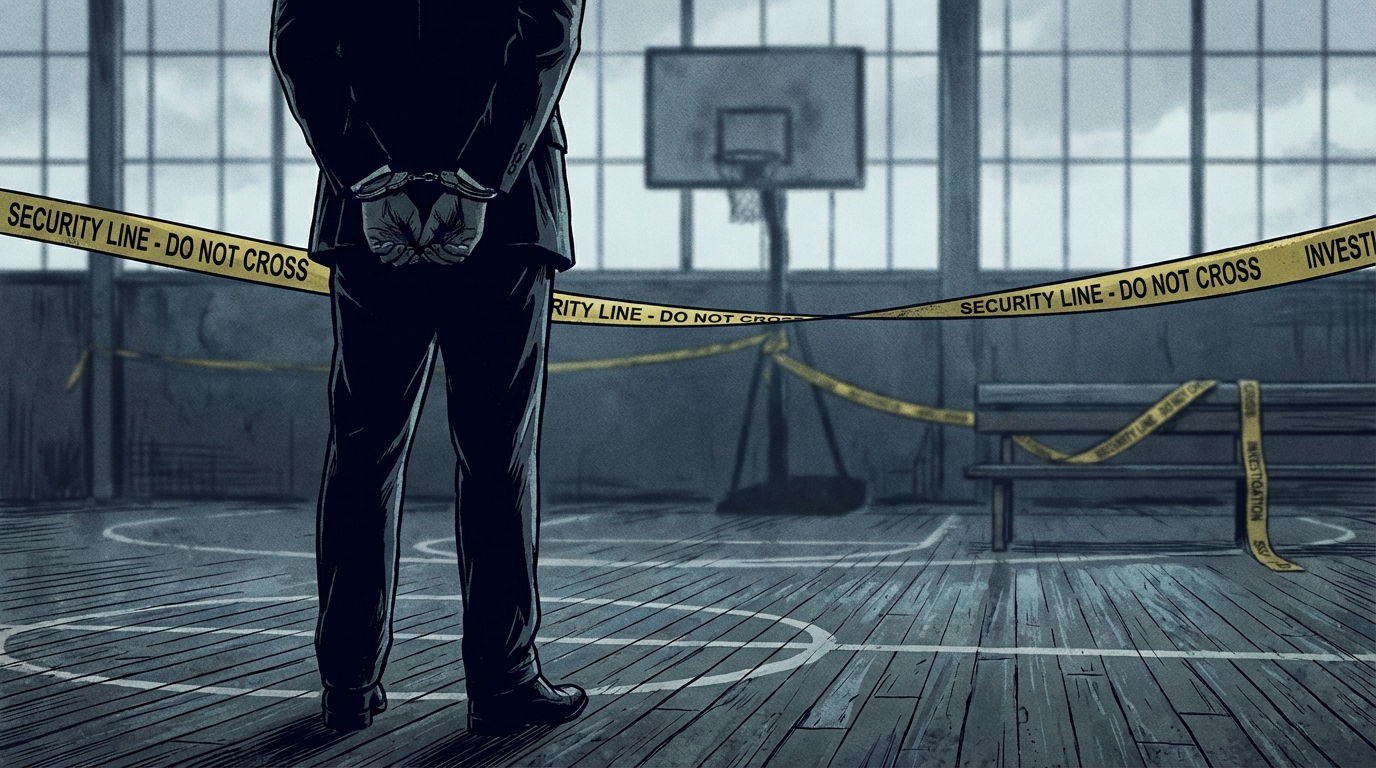
Tuskegee Coach Handcuffed: Security Dispute at Morehouse
The post-game handshake line is one of the most enduring traditions in college athleticsa moment designed to decompress the tension of competition and display mutual respect. However, on a Saturday night in Atlanta, that tradition descended into chaos, resulting in a disturbing visual that has since rippled across the sports world. Following a hard-fought Division II contest between Tuskegee University and Morehouse College, the tuskegee coach handcuffed and escorted off the floor was not a belligerent fan or a trespasser, but Benjy Taylor, the leader of the visiting program.
What should have been a standard exit from the court turned into a flashpoint for a broader conversation about policing, authority, and safety in collegiate sports venues. The incident, captured on video and disseminated widely, shows a security officer escorting a cuffed Taylor past the stands. The optics were jarring: a head coach, dressed in a suit, treated like a criminal threat in front of his players, his family, and a gymnasium full of spectators. The catalyst for this escalation was not a fight started by the coach, but rather his plea for security to do their jobs.
A Breakdown of Game Management Protocols
The sequence of events leading to the detainment of Coach Taylor paints a picture of a severe breakdown in game management and security protocols. According to reports, the atmosphere following Morehouse’s 77-69 victory was charged, as is typical in rivalry games. However, the situation escalated when non-basketball personnel began to encroach on the court.
Tuskegee Athletic Director Reginald Ruffin provided crucial context to the confusing scene. He described a “security breach” where members of the Morehouse football team had intermingled with the basketball teams during the handshake line. This is a direct violation of standard conference security protocols, which are designed to keep the court clear to prevent altercations. According to Yahoo Sports, Taylor approached a security officer to request that the football players be removed from the line to ensure the safety of his student-athletes.
Instead of adhering to the request to clear the floor, the interaction turned volatile. Ruffin noted that while Taylor was understandably animatedadvocating for the safety of his team in a hostile environmenthe was reasonable. The security officer, however, perceived Taylor’s urgency as aggression. In a baffling turn of events, the officer’s response to a coach reporting a security hazard was to neutralize the coach rather than the hazard. This decision to prioritize control over the coach rather than order in the arena is now the subject of intense scrutiny.
The Use of Force and “Aggression”
The justification reportedly offered by the security officer for the use of handcuffs was that Taylor was being “very aggressive” and acting as “the aggressor.” This characterization is frequently contested in interactions between law enforcement and Black men, where passionate advocacy is often misconstrued as a physical threat. Video footage of the incident shows Taylor clearly upset, yelling and gesturing, but at no point does he appear to physically lunge at or threaten the officer.
Taylor later expressed his shock at the escalation. “I am at a loss for words and I am upset about how I was violated and treated today,” Taylor stated. His primary concern remained the safety of his roster. He explained that the football players were following right behind him and his team, yelling obscenities, creating a “very dangerous situation.” By handcuffing the head coach, the security officer effectively decapitated the leadership of the visiting team during a volatile moment, arguably making the situation significantly more dangerous for the Tuskegee players left behind without their advocate.
The psychological impact of such an event cannot be overstated. For the student-athletes witnessing their mentora figure of authority and respectbeing physically restrained and marched away, the message is chilling. It reinforces a narrative that professional stature offers no shield against arbitrary policing. As noted in coverage by WSFA, Taylor was never charged with a crime, further highlighting the unnecessary nature of the detainment. He was released shortly after and allowed to travel home with his team, leaving many to wonder why handcuffs were introduced in the first place if no arrestable offense had occurred.
Legal Ramifications and Civil Rights Involvement
The aftermath of the incident has moved swiftly from the sports pages to the legal arena. Recognizing the severity of the violation, Benjy Taylor has retained Harry Daniels, a nationally renowned civil rights attorney known for handling high-profile cases of police misconduct. The legal team is currently investigating all avenues, including a likely civil lawsuit against the security firm, the venue, or the specific officers involved.
In a press release, Daniels did not mince words regarding the treatment of his client. “It would be bad for a police officer to treat anyone like this,” Daniels said. “But to do it to a man like Coach Taylor, a highly respected professional and role model, to put him in handcuffs, humiliate him and treat him like a criminal in front of his team, his family and a gym full of fans is absolutely disgusting and they need to be held accountable.”
The involvement of a civil rights attorney signals that this is not being viewed merely as a misunderstanding, but as a violation of civil liberties. The legal argument will likely hinge on the proportionality of the force used and the lack of probable cause for detainment. If Taylor was simply asking for the enforcement of conference rules, the officer’s reaction represents a gross overreach of authority. The legal team has emphasized that the Morehouse football players’ behavior was the actual catalyst for danger, yet the law enforcement response was directed entirely at the whistleblower.
The Role of Security in HBCU Athletics
This incident forces a hard look at the state of security in HBCU (Historically Black Colleges and Universities) athletics and college sports at large. Security personnel are employed to facilitate a safe environment, yet frequently, there is a disconnect between game management and law enforcement. Officers assigned to games may not be familiar with the nuances of coaching interactions or the high emotions inherent in competitive sports.
The tuskegee coach handcuffed scenario is an extreme outlier, but it sits on a spectrum of over-policing that often targets Black bodies in public spaces. In many collegiate venues, coaches yell, stomp, and aggressively gesture at referees and officials without fear of being shackled. The threshold for what constitutes a “threat” appears to have been lowered drastically in this instance, raising questions about implicit bias.
Furthermore, the failure to manage the crowdspecifically the Morehouse football playerssuggests a fundamental lapse in venue preparation. Protocol dictates that only authorized personnel should be on the floor post-game. When security fails to maintain that perimeter, the burden often falls on coaches to protect their players. Penalizing a coach for stepping into that void is a perverse inversion of responsibility.
Moving Forward: Accountability and Policy
As the investigation proceeds, the Southern Intercollegiate Athletic Conference (SIAC) faces pressure to review its security mandates. It is insufficient to simply have rules on paper regarding handshake lines; there must be competent personnel to enforce them without resorting to unlawful detention. The conference must determine how a visiting head coach became the target of security measures while unauthorized individuals roamed the court.
For Tuskegee University, the support for Taylor has been unequivocal. The administration views the treatment of their coach as an affront to the institution itself. The emotional toll on Taylor, who has led the program since 2019, is significant. His statement about being “heartbroken” for his players to witness the event underscores the deep communal ties within HBCU sports, where coaches often serve as surrogate fathers and mentors.
The coming weeks will likely bring body-camera footage or further witness testimony that could clarify the exact exchange between Taylor and the officer. However, the baseline factsa coach asking for help and receiving handcuffsremain damning. The legal battle led by Harry Daniels will aim to ensure that this visual does not become a normalized part of the game, and that those responsible for the safety of the athletes are held to a standard of competence that was clearly absent in Atlanta.
Frequently Asked Questions
Why was the Tuskegee coach handcuffed during the game? Coach Benjy Taylor was handcuffed by security after the game against Morehouse. Reports indicate he was asking officers to remove Morehouse football players who were encroaching on the court and the handshake line. The officer reportedly perceived Taylor’s impassioned request as aggressive behavior.
Was Coach Benjy Taylor charged with a crime? No. Despite being handcuffed and escorted off the court, Benjy Taylor was not charged with any crime. He was released shortly after the incident and was able to travel home with his team.
What legal actions are being taken regarding the incident? Benjy Taylor has hired prominent civil rights attorney Harry Daniels, along with attorneys Gregory Reynald Williams and Gerald Griggs. They are investigating the incident and pursuing potential civil litigation for the violation of Taylor’s rights and the humiliation he suffered.
What was the “security breach” mentioned by the Athletic Director? Tuskegee AD Reginald Ruffin stated that members of the Morehouse football team had entered the court area and were intermingling with basketball players during the post-game handshake. This violated conference protocols and created the hostile environment that Taylor was attempting to address when he was detained.
Conclusion
The image of the tuskegee coach handcuffed and led away from his team is a stark reminder of the fragility of dignity in the face of unchecked authority. What occurred at Morehouse was not merely a sports controversy; it was a failure of protocol and a violation of civil liberties. As the legal process unfolds, the sports community must reckon with how a plea for protection was answered with the cold steel of handcuffs, and ensure that the sanctity of the gameand the safety of its leadersis never compromised in this manner again.