Analyzing the Hypothetical Shahed-139 in Maritime Security
The Hypothetical Shahed-139 and Maritime Security Scenarios
Projected escalations in the maritime domain underscore a shifting security environment in the Arabian Sea and the Strait of Hormuz. In a near-future simulation, a series of coordinated events involving Iranian naval forces and unmanned aerial systems challenges the established defensive postures of US naval assets. These modeled incidents, ranging from high-speed interdictions of commercial shipping to aerial engagements with carrier strike groups, highlight the growing complexity of asymmetric warfare. As analysts scrutinize the technical capabilities of established platforms like the Shahed-136, questions regarding the potential emergence of next-generation systems such as a hypothetical Shahed-139 have begun to circulate within defense circles. This article examines the operational details of these potential engagements, the verified technical specifications of Iran’s loitering munitions, and the economic implications of countering these evolving threats.
TL;DR
- Scenario Escalation: A projection posits a US F-35C shooting down an Iranian drone threatening a carrier strike group, while a separate incident involves a Mohajer drone and gunboats harassing a commercial tanker [1].
- Technical Reality: Current threats are defined by the Shahed-131 and Shahed-136, which utilize commercial engines and carbon fiber composites to reduce radar visibility and enhance range [2].
- Economic Asymmetry: The engagement highlights the financial disparity of using fifth-generation stealth fighters to intercept low-cost, mass-produced loitering munitions [1].
Scenario: A Modeled Maritime Escalation
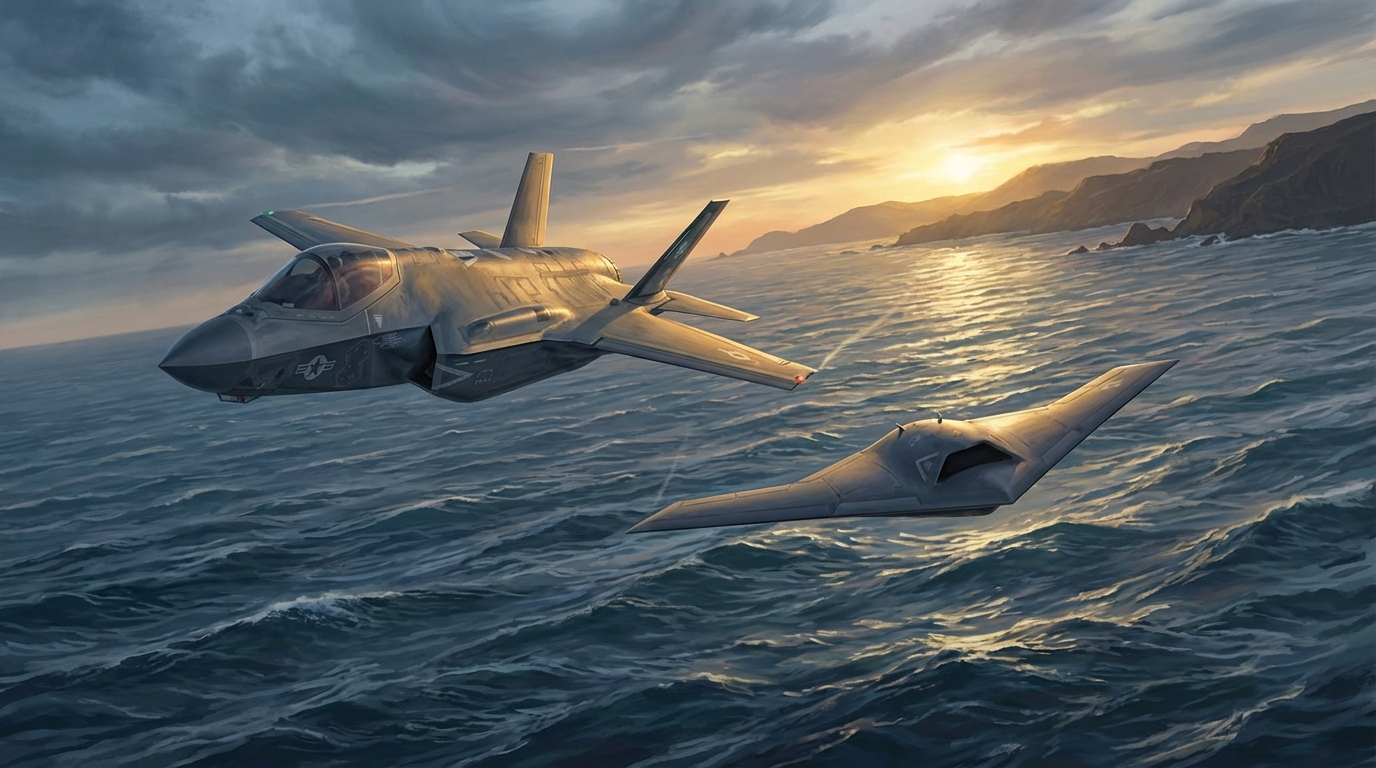
In this security simulation, tensions in the maritime domain spike when US naval forces engage an unmanned aerial system in the Arabian Sea. An F-35C fighter jet, launched from a US aircraft carrier, shoots down an Iranian drone approximately 500 miles from the Iranian coast. The scenario posits that the engagement occurs after the drone aggressively approaches the carrier group despite initial de-escalatory measures. The strike is authorized to protect the carrier and its personnel [1].
The intercept distance suggests the drone possesses significant range or was deployed from a forward maritime platform. While the specific model remains unidentified in this vignette, the operational behavior indicates a willingness to risk assets to probe defenses. The drone’s failure to respond to warnings prompts the F-35C crew to execute the shoot-down [1].
Separately, a second incident unfolds in the Strait of Hormuz. An Iranian Mohajer drone conducts an overflight of a US-flagged chemical tanker. Following the surveillance run, two Iranian gunboats approach the merchant vessel at high speeds. The fast-attack craft threaten to seize the tanker, escalating the encounter beyond routine surveillance [1].
Coordinated Multi-Domain Threats
The synchronization between aerial surveillance and surface threats is demonstrated clearly during the modeled Strait of Hormuz incident. The Mohajer, a platform associated with reconnaissance, coincides with surface-level aggression against commercial shipping. Following the drone’s overflight, the approach of the gunboats necessitates a rapid response from US military assets. A US destroyer, alongside Air Force aircraft, moves to provide defensive support, deterring the gunboats and ensuring the safety of the tanker [1].
These back-to-back incidents reveal a tactical pattern where aerial assets probe defenses or provide overwatch for maritime interdiction. This multi-domain pressure complicates the defensive landscape, requiring integrated responses from surface destroyers and air assets to maintain freedom of navigation in critical chokepoints [1].
Technical Anatomy of the Shahed Series
To understand the trajectory of Iranian drone development, one must examine the established technical specifications of the Shahed-131 and Shahed-136. These models serve as the baseline for the current threat environment.
The Shahed-131 measures approximately 2.6 meters in length with a wingspan of 2.2 meters. Powered by a Wankel engine producing roughly 38 horsepower, it balances fuel efficiency with thrust for long-range loitering. This model carries a light explosive payload of around 10 kilograms, limiting its use to smaller tactical targets [2].
The Shahed-136 evolves this design by scaling up size and destructive capacity. This variant expands the airframe to 3.5 meters in length with a 2.5-meter wingspan. The propulsion system is upgraded to a two-stroke engine generating up to 50 horsepower. Consequently, the payload capacity increases significantly, allowing the Shahed-136 to carry upwards of 40 kilograms of explosives [2].
Material Science and Stealth Characteristics
A critical factor in the operational effectiveness of these drones is the use of specific materials to enhance survivability. Manufacturers employ carbon fiber composites in the construction of both the Shahed-131 and Shahed-136. This provides durability while keeping the overall weight manageable for the low-horsepower engines [2].
Crucially, the material helps reduce radar visibility. By substituting metallic components with composites, these drones lower their radar return signal. The reduction in Radar Cross-Section (RCS) is amplified by the compact physical dimensions of these platforms. These low-observable characteristics force defensive assets to rely on higher-fidelity sensors. If a drone engaged by an F-35C shares these features, the intercept tests the fighter’s advanced sensor fusion capabilities [2].
Speculation on Future Iterations
While operational engagements highlight the continued threat, specific model identification remains a challenge in combat scenarios. The ambiguity regarding the specific drone intercepted in the simulation complicates the assessment of whether newer iterations are active. This has led to speculation regarding a hypothetical “Shahed-139.”
Current available intelligence does not provide verified technical specifications for a model with the Shahed-139 designation. If the developmental trend established between the 131 and 136 holds true, a successor model would likely feature dimensions exceeding 3.5 meters and a payload capacity greater than 40 kilograms. However, without specific data points confirming the engine type, dimensions, or payload, any claims regarding its capabilities remain speculative. The verified lineage rests on the documented specifications of the 131 and 136 variants [2].
The Economic Asymmetry of Naval Defense
The scenario involving the interception highlights a significant economic disparity in modern naval warfare. The engagement requires the deployment of a fifth-generation stealth fighter to neutralize a comparatively low-cost aerial threat. The operational cost of launching carrier-based aircraft and expending precision munitions vastly exceeds the production cost of expendable drones [1].
The propulsion systems of the Shahed seriessimple Wankel or two-stroke enginesare commercially available and inexpensive compared to Western military-grade turbine engines. While the exact cost-exchange ratio of the specific sortie is difficult to calculate, the asymmetry remains doctrinally relevant. Reliance on advanced interceptors to counter mass-produced threats imposes a sustainability challenge for naval battle groups operating in contested waters [2].
Comparison Table
The following table outlines the verified characteristics of the primary unmanned systems discussed in the context of these maritime operations.
| Option | Best for | Pros | Cons | Cost |
|---|---|---|---|---|
| Shahed-131 | Tactical strikes on smaller targets | Low radar visibility (carbon fiber), fuel efficient Wankel engine [2] | Limited payload (10kg), smaller range/size [2] | Low (Commercial components) |
| Shahed-136 | Strategic strikes requiring higher explosive yield | Higher payload (40kg+), extended range, carbon fiber construction [2] | Louder acoustic signature (two-stroke engine), larger profile [2] | Low (Mass produced) |
| Mohajer | Surveillance and reconnaissance (ISR) | Capable of directing surface assets, proven surveillance platform [1] | Distinct profile, primarily non-kinetic in this context [1] | Unknown |
| ”Shahed-139” | Hypothetical heavy strike | Speculative: Likely increased payload and range based on lineage [2] | Speculative: Likely larger RCS and acoustic signature [2] | Unknown |
Pros and Cons of Iranian Loitering Munitions
Pros
- Low Observability: Carbon fiber composites reduce radar visibility, complicating detection by standard air defense networks [2].
- Cost Efficiency: Powered by commercially available engines (38-50hp), allowing for mass production at a fraction of the cost of defensive missiles [2].
- Scalability: The design evolution from the 131 to the 136 demonstrates a modular approach to increasing payload capacity [2].
Cons
- Acoustic Vulnerability: Internal combustion engines produce distinct acoustic and thermal signatures detectable by sensors despite low radar visibility [2].
- Limited Speed: Reliance on low-horsepower piston engines limits speed, making them susceptible to interception by fast jets like the F-35C [1].
- Payload Limitations: The 10-40kg payload range is effective for harassment but small compared to ship-launched cruise missiles [2].
Conclusion
The scenario described serves as a stark reminder of the evolving maritime security landscape. The combination of aggressive drone overflights and surface harassment indicates a synchronized effort to challenge US naval presence. While the specific model engaged by the carrier strike group in this projection remains unconfirmed, the technical baseline of the Shahed-131 and Shahed-136 suggests a threat environment defined by low-cost, composite-constructed munitions. As intelligence communities monitor for the potential emergence of advanced platforms like the Shahed-139, the burden on US and allied naval forces to provide overwatch for merchant shipping is likely to increase, narrowing the margin for error between safe passage and armed conflict.
FAQ
How does the hypothetical Shahed-139 differ from the Shahed-136? Current intelligence does not provide verified specifications for a “Shahed-139.” However, based on the evolution from the Shahed-131 to the Shahed-136, a successor would likely exceed 3.5 meters in length and carry a payload greater than 40 kilograms. Until specific data points are confirmed, such capabilities remain speculative [2].
What defensive systems are effective against these drones? In the described simulation, effective defenses included the F-35C Lightning II fighter jet, which utilized advanced sensors to intercept a drone, and a destroyer providing surface support. US Air Force assets also contributed to the defensive network [1].
Why are composite materials used in the Shahed series drones? Carbon fiber composites enhance the durability of the airframe while keeping the weight manageable for small engines. Additionally, these materials absorb or scatter radar energy, significantly reducing the drone’s radar visibility and complicating detection [2].
What is the significance of the F-35C intercept in this scenario? The intercept is significant because it takes place 500 miles from the Iranian coast, indicating long-range capabilities or a forward deployment platform. It also highlights the economic asymmetry of using a fifth-generation stealth fighter to shoot down a low-cost unmanned aerial system [1].