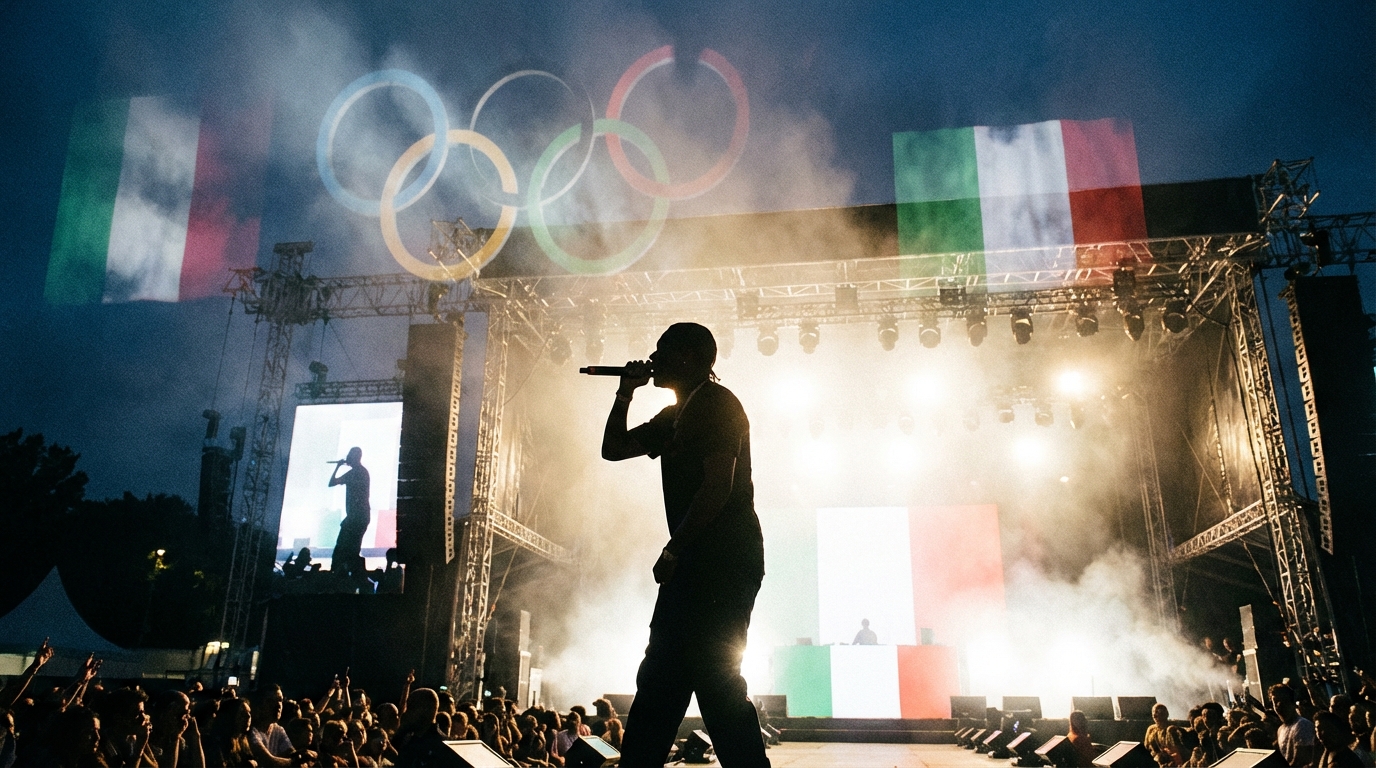
Ghali Calls Out Milano-Cortina 2026 Olympics as 'Great Theater'
The intersection of high-stakes international athletics and geopolitical activism is rarely a comfortable place, but it is exactly where Ghali has chosen to park his career. As the countdown begins for the Milano-Cortina 2026 Winter Olympics, the narrative was supposed to be one of snowy peaks, infrastructure updates, and national unity. Instead, the Italian-Tunisian rapper has thrown a wrench into the carefully calibrated machinery of Olympic public relations. By labeling the upcoming ceremonial proceedings as a “Great Theater” that obscures the grim realities of warspecifically the ongoing devastation in GazaGhali has forced a conversation that the organizers likely hoped to avoid until the torch was safely extinguished.
This is not merely a celebrity outburst; it is a calculated confrontation between the sanitization of global entertainment and the raw, bloody reality of current events. For an artist who has spent the last year transforming from a chart-topping pop star into a polarizing political figure, this latest move signals that the stage at the Sanremo Festival was not the end of his protest, but merely the dress rehearsal.
The Great Theater of Hypocrisy
The catalyst for this latest investigative inquiry into the ethics of entertainment is a social media intervention that struck with the precision of a lyrical diss track. According to recent reports, Ghali took to Instagram to dismantle the facade of the Olympic preparations. His critique was not subtle. He described the pageantry surrounding the gamesand specifically his potential involvement or the involvement of the music industryas a distraction mechanism.
The core of his argument rests on the dissonance between celebrating human achievement in sports while ignoring human destruction in war zones. As detailed by Corriere della Sera, the artist lamented the “great theater” of the event, suggesting that the glitz of the ceremony serves to blind the public to the rubble in Palestine. This is a direct challenge to the International Olympic Committee’s (IOC) long-standing, albeit frequently failing, policy of neutrality. The Olympics sells itself as a pause in global conflictthe ancient tradition of the ekecheiria or Olympic Truce. However, critics like Ghali argue that silence is not neutrality; silence is complicity.
This specific outburst is significant because it targets the “One Year to Go” celebrations and the looming 2026 ceremonies. Usually, artists tapped for these roles are vetted for compliance and safety. They are expected to sing anthems of vague unity, not deliver indictments of foreign policy. By breaking this unwritten contract before the games even begin, Ghali is testing the boundaries of what a modern cultural ambassador is allowed to say.
Gianni Rodari and the Poetry of Dissent
To understand the depth of this protest, one must look beyond the Instagram captions and into the cultural references Ghali employs. He is not just shouting slogans; he is citing the canon of Italian literature to make his point. In his critique, he referenced “Promemoria” (Memorandum), a famous poem by Gianni Rodari.
Rodari is a titan of Italian culture, known primarily for children’s literature but deeply respected for his antifascist roots and moral clarity. The poem “Promemoria” lists things that are easy to dolike making a comet or a machineand contrasts them with things that are difficult to do, specifically “making peace.” As noted by literary analysis from Libreriamo, the poem underscores that peace requires active, laborious construction, whereas war is often the result of passive negligence or active greed.
By invoking Rodari, Ghali bridges the gap between the “Old Italy” of post-war moral reconstruction and the “New Italy” of multi-ethnic identity. He is claiming the moral high ground by aligning himself with one of the country’s most beloved literary figures. This is a savvy rhetorical maneuver. It makes it difficult for his detractors to dismiss him simply as an “angry rapper” without also dismissing the humanistic values of Rodari. He is effectively saying that the desire for peaceand the anger at its absenceis a fundamental Italian value, not a radical import.
The Sanremo Precedent and the Arab Anthem
This confrontation cannot be viewed in isolation. It is the continuation of a narrative arc that began in earnest at the 2024 Sanremo Festival. It was there that Ghali, accompanied by an alien mascot, utilized the massive platform of Italy’s most-watched television event to utter the phrase “Stop Genocide.” That moment caused a diplomatic incident, drawing the ire of the Israeli ambassador to Italy and sparking a debate on state television censorship.
Now, turning his eyes toward the Olympics, Ghali has doubled down. Reports from La Repubblica indicate that his vision for participation involves bringing an “Arab anthem” to the ceremony. This is a loaded proposition. In a political climate where the Italian government has shifted rightward and immigration remains a hot-button issue, proposing to center Arab identity at the quintessentially Italian event of the Winter Games is an act of defiance.
The concept of an “Arab anthem” in this context is likely not a national anthem of a specific state, but a sonic representation of the Mediterranean reality that Italy often tries to repress. Ghali, born in Milan to Tunisian parents, embodies the demographic shift of the country. By insisting on this representation, he is refusing to be the “safe” immigrant who entertains without challenging the status quo. He is demanding that his heritageand the heritage of thousands of new Italiansbe recognized not just as a backstory, but as a central pillar of modern Italian culture.
Ghali vs. The Corporate Machine
The tension here lies in the conflicting objectives of the stakeholders. The organizers of Milano-Cortina 2026 want a spectacle that drives tourism, satisfies sponsors, and presents a cohesive image of Italy to the world. They need stars like Ghali because he captures the youth demographic and dominates streaming charts. Without him, the lineup risks looking archaic. However, with him, they risk political volatility.
This dynamic reflects a broader trend in Western media where corporations desire the “cool” factor of hip-hop and street culture but fear the political baggage that often comes with it. We saw similar tensions in the US with the NFL and Colin Kaepernick, or the debates surrounding various Super Bowl halftime shows. The difference here is the geopolitical specificity. The war in Gaza is a polarizing topic across Europe, and Italy is no exception.
Data from Google Trends shows that interest in Ghali spikes significantly whenever he intersects his music with political statements. This suggests that the public is not just listening to his beats; they are listening to his message. For the Olympic committee, this is a nightmare scenario. If they silence him, they are accused of censorship and racism. If they give him the mic, they risk an unscripted protest broadcast to billions of viewers.
The Risk of Performative Activism?
An investigative eye must also turn to the artist himself. Is this genuine activism, or is it brand building? In the age of social media, outrage is a currency. However, Ghali’s track record suggests a level of sincerity that exceeds standard marketing ploys. He has consistently risked alienation from mainstream media channelsRAI executives were visibly panicked after his Sanremo commentsto maintain his stance.
Furthermore, the financial incentives usually align with silence. Artists generally make more money by being palatable to everyone. By alienating a portion of the audience and potentially scaring off corporate sponsors like those attached to the Olympics, Ghali is taking a financial risk. This lends credibility to his claims. When he calls the ceremony “theater,” he is biting the hand that feeds the entertainment industry, acknowledging that he is part of the cast but refusing to read the script provided.
The Future of the 2026 Ceremony
As we look toward February 2026, the question remains: Will Ghali actually perform? If the contract is already signed, the organizers are in a bind. Canceling him now would turn him into a martyr for free speech and amplify his message tenfold. Keeping him on the bill requires a level of trust that currently does not exist between the artist and the institution.
We may see a compromisea sanitized performance where the “Arab anthem” is musically present but lyrically vague. Or, we may see a total rupture, where Ghali withdraws or is removed, sparking yet another cycle of public debate. What is certain is that the illusion of the Olympics as a non-political space has been shattered. The “Great Theater” has been exposed, and the audience is now watching the backstage drama with more interest than the show itself.
Frequently Asked Questions
Why is Ghali criticizing the 2026 Winter Olympics? Ghali has criticized the Olympic ceremonies as being “Great Theater” that distracts from real-world suffering, specifically the ongoing conflict and humanitarian crisis in Gaza. He views the celebration as hypocritical while genocide and war continue unchecked.
What is the significance of the poem “Promemoria”? Ghali quoted Gianni Rodari’s “Promemoria” to highlight the contrast between the ease of mechanical creation and the difficulty of making peace. Rodari is a celebrated anti-fascist Italian writer, and invoking him grounds Ghali’s protest in a deep Italian moral tradition.
Has Ghali protested at major events before? Yes. The most notable instance was at the 2024 Sanremo Music Festival, where he used his platform to say “Stop Genocide” on stage. This led to significant controversy involving the Israeli ambassador and Italian state broadcaster RAI.
What does Ghali mean by an “Arab Anthem”? Ghali has expressed a desire to bring an “Arab anthem” to the Olympic stage. This represents his Tunisian heritage and the broader Arab-Italian community, challenging the traditional, often monocultural representation of Italy at international events.
Conclusion
The controversy surrounding Ghali and the Milano-Cortina Games is a microcosm of a world where entertainment can no longer be easily separated from politics. The rapper has drawn a line in the snow, demanding that we look past the fireworks and medals to see the human cost of the era we live in. Whether he takes the stage in 2026 or is sidelined by the powers that be, he has already achieved his goal: he has disrupted the script. In doing so, he has reminded us that while the Olympics may be about physical endurance, the true test of our time is moral endurance.