US Secures Custody of Key Suspect in Benghazi Attack
Justice Has No Expiration Date: The Long Shadow of Benghazi
It is often said that the wheels of justice grind slowly, but in the case of the United States Department of Justice, they grind exceedingly fine. Nearly fourteen years have passed since the smoke cleared over the diplomatic compound in Libya, yet the dossier on the tragedy has never been closed. In a stunning development that bridges the gap between past geopolitical traumas and present-day accountability, federal authorities have secured the custody of a man believed to be a central architect of the violence.
For the families of the fallen, time does not heal all wounds, but answers can provide a necessary salve. The recent announcement by the Department of Justice is more than a headline; it is a testament to the institutional memory of the American intelligence apparatus. The benghazi attack remains a scar on the national psyche, a moment where the vulnerabilities of diplomatic service were laid bare in the most brutal fashion. Today, however, the narrative shifts from one of loss to one of retribution and the rule of law.
The Arrest: Closing the Net on the Benghazi Attack
In a press briefing that stunned Washington, Attorney General Pam Bondi confirmed that a high-value target is now on American soil. The operation, a coordinated effort between the FBI, military assets, and international partners, culminated in the extraction of a suspect who had long evaded capture. According to Reuters, the arrest took place earlier this week, signaling a breakthrough in an investigation that many assumed had gone cold.
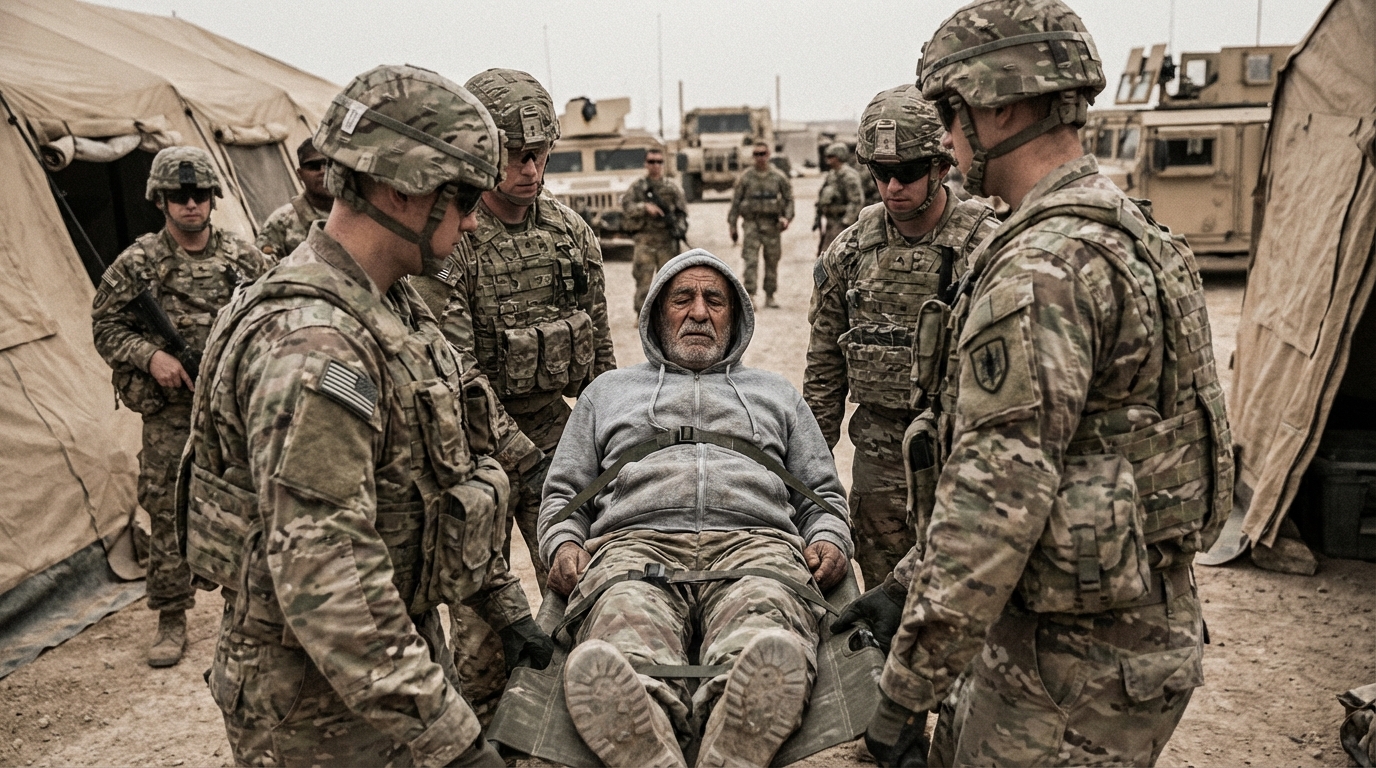
This is not merely a symbolic victory. The individual in question is alleged to have played a command-and-control role during the assault, directing the flow of militants who breached the consulate walls. The visual evidence of this transfer of custody is strikinga juxtaposition of frail age and military precision.
As seen in the image above, the suspect, appearing elderly and requiring medical transport, was moved under heavy security. This visual underscores the reality of long-term counter-terrorism: the targets age, the world changes, but the indictment remains valid. The relentless pursuit of those responsible for the benghazi attack proves that the United States does not recognize a statute of limitations on the murder of its diplomats.
A Night of Chaos: September 11, 2012
To understand the magnitude of this arrest, one must revisit the harrowing events of September 11, 2012. What began as a protest in Cairo evolved into a coordinated, military-style assault in Benghazi, Libya. The target was the U.S. Special Mission Compound, a temporary diplomatic outpost. Inside were U.S. Ambassador J. Christopher Stevens and Foreign Service Information Management Officer Sean Smith.
The timeline of that night is etched in the memories of the intelligence community. At approximately 9:40 PM local time, armed assailants breached the main gate. They utilized arson as a primary weapon, setting fire to the main building where Stevens and Smith were sheltering in a safe room. The resulting smoke inhalation proved fatal. The attack did not end there; it migrated to a nearby CIA annex, where a mortar attack hours later claimed the lives of CIA contractors and former Navy SEALs Tyrone Woods and Glen Doherty.
This was not a spontaneous mob event, as was initially and controversially theorized in the immediate aftermath. Subsequent investigations revealed a level of tactical planning that pointed to established extremist networks. The recent arrest reported by KATU suggests that the Department of Justice has finally isolated the specific leadership nodes responsible for coordinating those mortar strikes and the initial breach.
The Long Road to Extradition
Tracking a terrorist suspect across the fractured landscape of North Africa is a logistical nightmare. Libya, in the years following the ouster of Muammar Gaddafi, became a patchwork of warring militias, tribal alliances, and ungoverned spaces. For American investigators, this meant that traditional law enforcement methods were impossible. You cannot simply serve a warrant in a war zone.
The FBI’s strategy relied on human intelligence (HUMINT), signals intelligence, and infinite patience. They had to wait for the suspect to make a mistake or for the geopolitical tides to shift enough to allow for an extraction. The extradition process itself is fraught with legal complexities. Bringing a foreign national to the U.S. to face trial requires navigating international treaties and ensuring that the chain of custody preserves the admissibility of evidence.
Attorney General Bondi’s announcement highlights the cooperation of specific, undisclosed foreign partners who facilitated the transfer. As noted in coverage by Fox News, the suspect has been extradited specifically to face U.S. charges, likely including conspiracy to provide material support to terrorists and resulting in death. This legal framework ensures that the accused will face a federal judge and a jury, granting them the due process that they denied their victims.
Political Echoes and the Role of the DOJ
The Benghazi attack was never just a security failure; it became a defining political event of the early 21st century. It sparked arguably the most contentious congressional hearings in modern history, heavily impacting the career of then-Secretary of State Hillary Clinton and fueling the rise of conservative media narratives regarding the “Deep State” and bureaucratic incompetence.
With the announcement coming from Attorney General Bondi, a figure closely associated with the Trump administration, the political resonance is unavoidable. However, it is crucial to view this through the lens of institutional persistence rather than partisan timing. The FBI agents who built the case file have likely been working on it through the Obama, Trump, Biden, and subsequent administrations. The bureaucracy of justice, often maligned, is the engine that kept this case alive.
This arrest allows for a factual revisiting of the event, stripped of the immediate heat of an election cycle. It provides an opportunity to examine the command structures of the militia groups involved, such as Ansar al-Sharia, with the clarity of hindsight and the precision of courtroom evidence.
The Challenge of Prosecuting Terror on US Soil
Bringing a suspect to the United States is only the first half of the battle. Securing a conviction in a federal court presents unique challenges. Unlike military tribunals, civilian courts require a high standard of evidence. Prosecutors must prove beyond a reasonable doubt that the individual in custody is not just a member of a hostile group, but was specifically responsible for the acts resulting in American deaths.
Defense attorneys will likely argue that the chaotic nature of the Libyan civil war makes identification unreliable. They may challenge the circumstances of the interrogation or the reliability of witnesses who may have been paid informants. However, the Department of Justice has a strong track record in these high-stakes terrorism trials. Previous convictions of figures involved in the 1998 embassy bombings and the 1993 World Trade Center bombing demonstrate that the federal court system is capable of handling complex, extraterritorial terrorism cases.
The prosecution will likely rely on a combination of forensic evidence, intercepted communications, and potentially the testimony of other captured militants who have turned state’s evidence. The goal is to establish a direct causal link between the suspect’s orders and the deaths of Stevens, Smith, Woods, and Doherty.
A Message to the World
Ultimately, the value of this arrest extends beyond the courtroom. It is a strategic communication to enemies of the state. The message is simple: You may hide in the desert, you may change your name, and you may wait for the world to move on, but the United States will not forget.
This doctrine of “long-arm jurisdiction” is a cornerstone of American counter-terrorism policy. It serves as a deterrent, warning potential aggressors that an attack on a diplomatic outpost carries a lifetime risk of capture. Whether it takes two years or twenty, the file remains open.
As the legal proceedings begin, the families of the Benghazi four will once again be thrust into the spotlight. It is a painful process, but one that offers the hope of finality. The benghazi attack changed the way America conducts diplomacy in dangerous regions, leading to fortified embassies and stricter security protocols. Now, it serves as a reminder that while buildings can be rebuilt and policies rewritten, the demand for justice is immutable.
Frequently Asked Questions
Q: Who were the victims of the 2012 Benghazi attack? A: The attack resulted in the deaths of four Americans: U.S. Ambassador J. Christopher Stevens, Information Officer Sean Smith, and CIA security contractors Tyrone Woods and Glen Doherty.
Q: Why has it taken so long to arrest this suspect? A: Investigating terrorism in a destabilized region like Libya is incredibly difficult. It requires years of intelligence gathering, tracking, and waiting for a window of opportunity to execute an arrest without endangering U.S. forces, compounded by the lack of a stable Libyan government to assist in extradition.
Q: What charges will the suspect likely face? A: While the specific indictment details may vary, suspects in similar cases usually face charges of conspiracy to provide material support to terrorists, killing a person in the course of an attack on a federal facility, and using a firearm during a crime of violence.
Q: Is this the first arrest related to the Benghazi attack? A: No. There have been previous captures and convictions, such as Ahmed Abu Khattala, who was captured in 2014 and later convicted on terrorism charges. This recent arrest represents another layer of the leadership structure being dismantled.
References
- Fox News: Benghazi Terror Suspect Extradited
- KATU: Bondi Announces Arrest of Key Participant
- Reuters: US Arrests Benghazi Suspect