The Tibia in Alpine Skiing: Analyzing Lindsey Vonn's Crash
The silence that befalls an alpine course immediately following a high-speed crash is unlike any other quiet in sports. It is a heavy, frozen silence, punctuated only by the crackle of race radios and the collective held breath of spectators. When Lindsey Vonn, the most decorated female skier in history, pushed out of the start gate for the 2026 Winter Olympics, the world watched with a mixture of nostalgia and trepidation. We were not just watching an athlete; we were watching a study in biological defiance. However, as physics asserted its dominance on the icy slopes, the narrative instantly shifted from a fairytale comeback to a harsh reminder of human fragility, specifically focusing on the tibia, the weight-bearing pillar of the lower leg that has defined Vonn’s medical history as much as her medals have defined her trophy case.
The Cortina Context: A Legacy on the Line
The backdrop of this event was not merely a race; it was a statement. Vonn’s decision to compete in 2026 was met with skepticism by medical professionals but embraced by the sporting community. The allure of the mountain is a siren song that few can resist, even after retirement.
According to a report by NBC News, Vonn’s return was driven by a desire to close her career on her own terms, a sentiment that resonates deeply in a sport where careers are often cut short by catastrophic injury rather than voluntary retirement. Yet, the mountain does not negotiate with legacy. The crash that ensued was a violent reminder of the forces at play. While the initial collective gasp was for her safety, the analytical mind immediately went to the structural integrity of her legs, particularly the right tibia, which has seen more hardware than some hardware stores.
The Tibia as the Fulcrum of Alpine Risk
To understand the severity of the situation, one must understand the biomechanics of alpine skiing. The skier is essentially a projectile moving at speeds exceeding 70 miles per hour, attached to two long levers (skis) via rigid plastic boots. These boots are designed to protect the ankle and foot, effectively locking them in place to transfer energy to the ski edges. However, this rigidity creates a stress transfer point.
When a skier catches an edge or decelerates rapidly, the force cannot dissipate through the ankle. Instead, it travels up. The tibia becomes the fulcrum. In what is commonly known as a “boot-top fracture,” the top of the rigid ski boot acts as a breaking point against the shinbone. For an athlete like Vonn, whose history includes comminuted fractures and extensive reconstruction, the tibia is not just a bone; it is a battleground of calcification and titanium.
The structural load on the tibia during a downhill turn can exceed several times the skier’s body weight. When that load shifts from a controlled carve to an uncontrolled impact, the bone is subjected to torsion and bending forces that defy evolutionary design. This biological reality is what makes the downhill discipline the most dangerous event in the Winter Games.
Voices from the Piste: Solidarity in Danger
In the aftermath of the crash, the reaction from the skiing fraternity was telling. Rather than criticism for taking an unnecessary risk, there was a closing of ranks. The psychology of the downhill racer is distinct; they accept that their skeletal system is part of the equipment, liable to break in service of speed.
As detailed in coverage by ESPN, fellow skiers rallied behind Vonn, validating her call to race despite the outcome. This solidarity highlights a cultural acceptance of trauma in the sport. The consensus among the elite is that the risk of a tibial fracture is the price of admission. They argued that the spirit of the Olympics is defined by the attempt, not the safety of the wager.
This perspective, however, clashes with the medical reality. Orthopedic surgeons often view the cumulative damage to the tibial plateau and shaft as a precursor to long-term mobility issues. The cartilage damage associated with tibial plateau fractures, for instance, leads to early-onset osteoarthritis, a condition Vonn has publicly battled. Yet, the adrenaline of the start gate often silences the aching of the joints.
No Regrets: The Gladiator Mentality
Perhaps the most compelling aspect of this narrative is Vonn’s own reaction. In the hours following the incident, the narrative could have turned to regret. Instead, it turned to defiance.
According to CNN, Vonn expressed “no regrets” regarding her participation. This statement is crucial for understanding the psyche of the super-elite athlete. For Vonn, the integrity of her spirit appears to hold a higher value than the integrity of her tibia. This “gladiator mentality” drives viewership and inspires fans, but it also raises ethical questions about the governance of the sport. Should there be a medical cutoff? At what point does the risk of permanent disability outweigh the spectacle of competition?
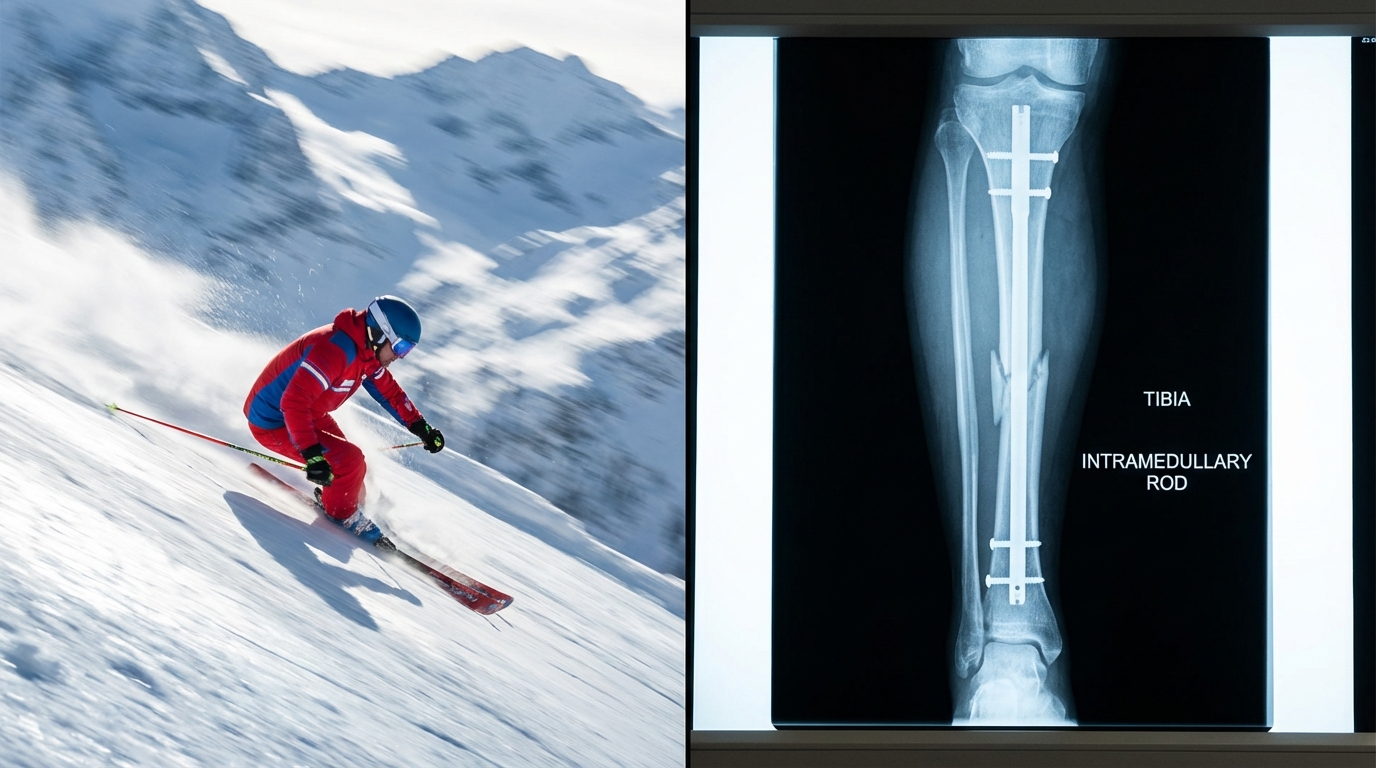
The crash in 2026 serves as a case study for these questions. Vonn, equipped with a knee replacement and a history of fractures, tested the absolute limits of modern sports medicine. Her ability to even stand in the start gate was a testament to surgical advancementsspecifically intramedullary nailing, where a metal rod is inserted into the hollow center of the tibia to stabilize fractures. These rods allow for faster return to activity, but they create a complex scenario when new trauma occurs. A bone with a rod inside breaks differently than a virgin bone; the stress risers change, and the surgical repair becomes exponentially more difficult.
The Future of Protection
As we analyze the fallout, the conversation must inevitably turn to technology. If the human tibia has reached its limit against the forces of modern skiing, the equipment must evolve. We have seen the introduction of cut-resistant base layers and airbag vests for spinal protection. However, protecting the lower leg remains a challenge.
Stiffening the boot increases performance but endangers the bone. Softening the boot saves the bone but compromises control, which in turn could lead to crashes. It is a zero-sum game of physics. Engineers are currently experimenting with release bindings that are sensitive to multi-directional torque, attempting to free the boot from the ski before the tibia snaps. Until these technologies are perfected and universally adopted, the shinbone will remain the sacrificial lamb of the Super-G.
Frequently Asked Questions
Q: Why is the tibia so prone to injury in skiing specifically?
A: The tibia acts as the main weight-bearing connection between the knee and the foot. In skiing, the rigid boot immobilizes the ankle, meaning any twisting force (torque) or forward bending force applied to the ski is transferred directly to the shaft of the tibia. If the binding doesn’t release the ski in time, the bone absorbs the energy, often resulting in a spiral or boot-top fracture.
Q: Can a skier return to professional competition after a tibial rod surgery?
A: Yes, many skiers, including Lindsey Vonn, have returned after such surgeries. The procedure, known as intramedullary nailing, stabilizes the bone internally. While it allows for a return to sport, the leg may never have the exact same shock absorption or flexibility, and the presence of the rod can complicate future injuries.
Q: Did Lindsey Vonn’s previous injuries contribute to the 2026 crash?
A: While it is difficult to attribute a specific crash solely to past injuries, previous trauma can affect proprioception (the body’s sense of position) and muscle strength balance. However, in downhill skiing, external factors like ice conditions, visibility, and course layout are often the primary drivers of accidents, regardless of medical history.
Q: What is a “boot-top” fracture?
A: This is a specific type of break where the top edge of the stiff ski boot acts as a fulcrum. When a skier lands back-weighted or hits an obstacle, the force snaps the tibia and often the fibula right at the top line of the boot. It is one of the most common fracture patterns in alpine sports.
Conclusion: The Unbreakable Resolve
The 2026 Winter Olympics will be remembered for many things, but Lindsey Vonn’s crash will stand as a stark monument to the brutality of alpine skiing. It strips away the glamour of the podium and reveals the raw, mechanical violence inherent in the sport. We analyze the trajectory, the snow conditions, and the equipment, but ultimately, the story always returns to the anatomy.
The human body is resilient, capable of healing and adapting, but it is not indestructible. Vonn’s journey is a testament to the fact that while titanium rods can reinforce the tibia, nothing can reinforce the human desire to compete quite like the heart of a champion. As the snow settles in Cortina, the debate on safety will continue, but the image of Vonnbroken but unbowedremains the enduring symbol of the games.