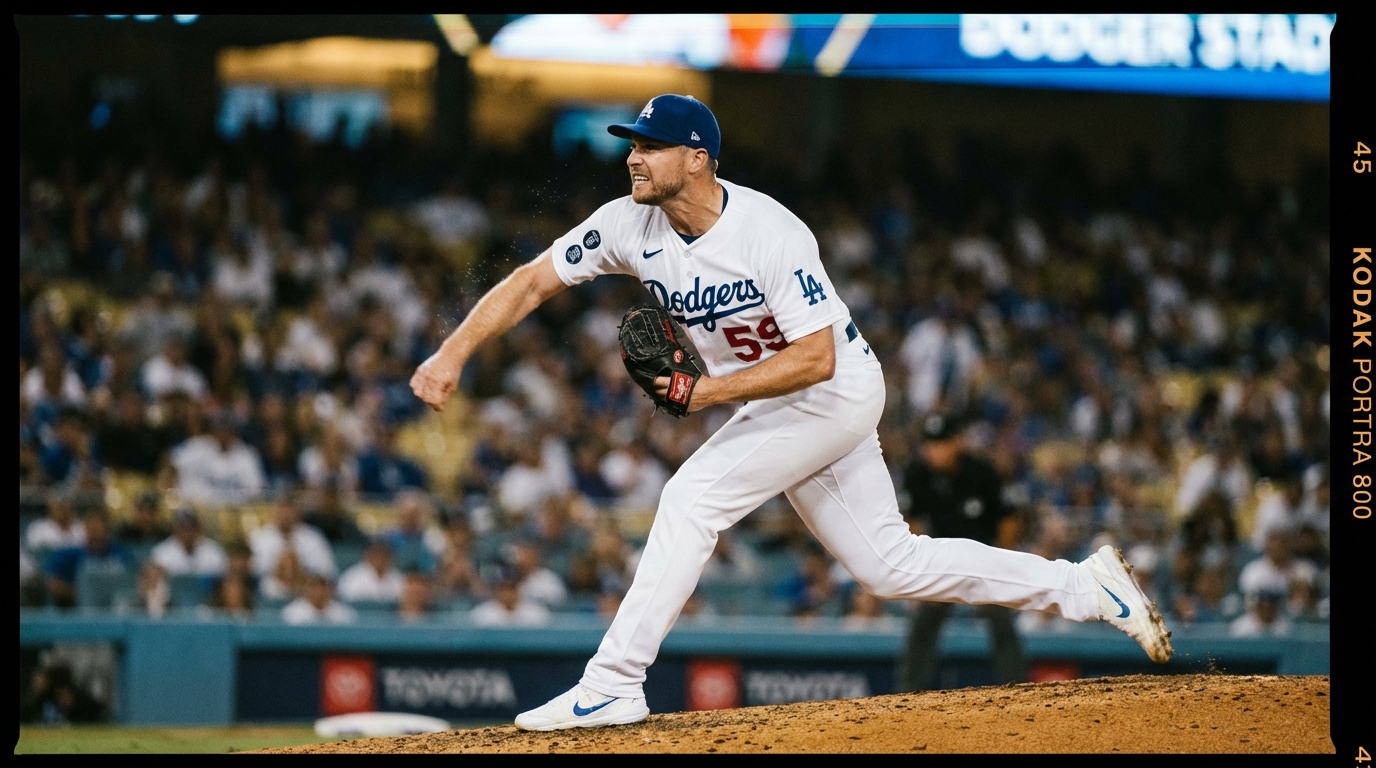
Dodgers Re-Sign Reliever Evan Phillips to One-Year Deal
The modern Major League Baseball bullpen is less a collection of pitchers and more a finely tuned ecosystem of high-velocity mechanics and spin rates. For the Los Angeles Dodgers, maintaining the equilibrium of that ecosystem is paramount to their perennial championship aspirations. In a significant move to preserve their late-inning stability, the Dodgers have officially re-signed right-handed reliever Evan Phillips to a one-year contract. This transaction, while expected by many insiders, required a corresponding roster move that highlights the ruthless mathematics of roster construction: the designation of catcher Ben Rortvedt for assignment.
TL;DR
- The Deal: The Dodgers and Evan Phillips agreed to a one-year contract, avoiding potential arbitration hearings and keeping the right-hander in Los Angeles.
- The Cost: To clear a spot on the 40-man roster, catcher Ben Rortvedt was designated for assignment (DFA).
- The Impact: Phillips retains his role as the primary high-leverage option, often deployed as a “fireman” to extinguish threats in the 7th, 8th, or 9th innings.
- The Strategy: The move prioritizes elite pitching depth over catching redundancy, signaling the team’s confidence in their current backstops.
Analyzing the Return of the Fireman
For the past several seasons, Phillips has evolved from a waiver-wire pickup into one of the most feared relievers in the National League. His journey is emblematic of the Dodgers’ player development machine, which identifies specific pitch characteristicsin Phillips’ case, a devastating sweeperand maximizes them. By securing a one-year deal, as reported by ESPN, the Dodgers avoid the uncertainty of the open market and the potentially contentious arbitration process.
Phillips’ value lies not just in his ERA, but in his versatility. Unlike traditional closers who are often reserved strictly for the ninth inning with a three-run lead, Phillips has been utilized as a “fireman.” Manager Dave Roberts has shown a willingness to deploy him in the highest-leverage moment of the game, regardless of the inning. This flexibility is a luxury that few teams possess, and retaining it was clearly a priority for the front office.
The contract structure suggests a mutual desire for continuity. For the Dodgers, it locks in a known quantity who thrives under the bright lights of Dodger Stadium. For Phillips, it provides financial security and a continued role on a World Series contender. According to Yahoo Sports, this signing is part of a broader effort to maintain the core of a bullpen that has consistently ranked among the league’s best in ERA and WHIP.
The Roster Casualty: Ben Rortvedt
Every roster addition necessitates a subtraction, and in this instance, the odd man out was Ben Rortvedt. The decision to designate Rortvedt for assignment was likely a calculated risk based on the team’s catching depth. Rortvedt, known for his defensive prowess and framing ability, found himself blocked by the Dodgers’ primary catching tandem.
As detailed by MLB Trade Rumors, the DFA process gives the Dodgers a few options: they can trade Rortvedt within seven days, release him, or attempt to pass him through waivers and outright him to the minor leagues. Given the scarcity of quality catching around the league, it is highly probable that another team will claim him or trade for his services. This move illustrates the sheer depth of the Dodgers’ organization; a player of Rortvedt’s caliber is considered surplus simply because the pitching need was deemed more immediate.
Comparison Table: Roster Management Options
The Dodgers had several pathways to address their bullpen and roster crunch. Here is how the chosen path compares to alternatives.
| Option | Best for | Pros | Cons | Pricing/Cost |
|---|---|---|---|---|
| Re-sign Phillips (1-Year) | Immediate Contention | Retains elite talent; cost certainty; maintains bullpen chemistry. | Requires a 40-man roster cut (Rortvedt); short-term control only. | Market Rate (Arbitration avoidance) |
| Multi-Year Extension | Long-term Stability | Locks down the player for prime years; potentially lower AAV. | Higher risk if performance declines; reduced roster flexibility. | High upfront commitment |
| Trade for Reliever | Prospect Preservation | Could acquire a cheaper arm; shakes up the roster. | Costs prospect capital; unknown chemistry fit; Phillips leaves. | Variable (Prospects + Salary) |
| Internal Promotion | Budget Management | Extremely low cost; develops farm system. | High variance in performance; unproven in playoffs. | League Minimum |
Pros and Cons of the Transaction
Pros:
- Bullpen Stability: The team retains its best high-leverage arm without disrupting the pitching hierarchy.
- Versatility: Phillips can pitch in the 7th, 8th, or 9th innings, allowing the manager to dictate matchups based on the opposing lineup rather than rigid roles.
- Club Control: A one-year deal mitigates long-term risk associated with the volatility of relief pitchers.
- Message to Clubhouse: Re-signing key contributors reinforces a culture of rewarding performance.
Cons:
- Loss of Depth: Losing Ben Rortvedt thins the organizational catching depth, which is a premium position.
- Roster Flexibility: The 40-man roster remains tight, meaning future additions will require further difficult cuts.
- Reliever Volatility: Even elite relievers can have down years; investing heavily in the bullpen is always inherently risky.
Evan Phillips and the Strategic Blueprint
The re-signing of Evan Phillips is more than just a transaction; it is a reaffirmation of the Dodgers’ pitching philosophy. The team has moved away from the archaic model of a designated “closer” who only pitches the ninth inning with a lead of three runs or fewer. Instead, they utilize a leverage-based model. If the heart of the opponent’s ordersay, the 2-3-4 hittersis due up in the eighth inning of a one-run game, that is the game’s critical pivot point. That is when Phillips enters.
This strategy requires a pitcher with a specific mental makeup. They must be ready to warm up at a moment’s notice and enter with runners on base. Phillips has excelled in this environment, stranding inherited runners at an elite rate. By securing his return, the Dodgers ensure that they have the tactical weapon necessary to execute this game plan against elite offenses in October.
Furthermore, the move to DFA Rortvedt suggests the Dodgers are comfortable with their internal catching options or have identified other emergency depth pieces in the minor leagues. It is a classic “win-now” move: sacrificing a depth piece at a position of strength (or at least sufficiency) to secure a necessity at a position of volatility.
Financial and Market Context
The economics of this deal are standard for arbitration-eligible relievers, yet significant in the context of the Dodgers’ payroll. By agreeing to a one-year deal, both sides bypass the arbitration hearing room. Hearings can be contentious, with teams arguing why a player is worth less while the player argues their worth. Avoiding this process preserves the relationship between the player and the front office.
From a market perspective, high-leverage relievers are expensive. Had Phillips reached free agency, the bidding war would likely have driven the priceand the termhigher than the Dodgers would prefer. This one-year contract acts as a bridge, giving the Dodgers elite production for another season while Phillips gets another year to build his resume for a potentially larger multi-year contract in the future.
FAQ
Q: Why did the Dodgers choose to DFA Ben Rortvedt specifically? A: The Dodgers likely viewed Rortvedt as the most expendable player on the 40-man roster relative to their needs. With a solidified catching tandem already in place, Rortvedt’s lack of minor league options or his specific skill set made him the odd man out to accommodate Phillips.
Q: Will Evan Phillips be the official closer for the Dodgers? A: While Phillips often finishes games, the Dodgers typically avoid officially naming a “closer.” He will likely continue to be used in the highest-leverage situations, whether that occurs in the 8th or 9th inning. This committee approach allows for better matchup optimization.
Q: Can another team sign Ben Rortvedt now? A: Yes. Because he was designated for assignment, he is now subject to waivers. Any other MLB team can place a claim on him. If he clears waivers, the Dodgers can send him to the minor leagues, but given the demand for catchers, a claim or trade is likely.
Q: Does this contract cover only the regular season? A: The one-year contract covers the entirety of the upcoming season, including the regular season. Postseason pay is determined differently (via player shares of the gate), but contractually, he is secured as a member of the team for the full league year.
Conclusion
The decision to re-sign Evan Phillips is a testament to the Dodgers’ commitment to fielding a championship-caliber pitching staff. In a league where bullpen volatility can derail even the most potent offenses, securing a proven, high-leverage arm provides a safety net that is invaluable during the long summer months and the pressure-cooker of the postseason. While the departure of Ben Rortvedt is an unfortunate consequence of the roster crunch, it is the price of doing business for a team loaded with talent. As the Dodgers look toward the future, the sight of Phillips jogging in from the bullpen will remain a comforting image for fans and a terrifying one for opposing hitters.