Stan Wawrinka vs De Minaur: A Clash of Styles in Rotterdam
In the cavernous, neon-lit arena of the Rotterdam Ahoy, the echoes of tennis history are often drowned out by the squeak of sneakers from the sport’s youngest prodigies. Yet, amidst this relentless changing of the guard, Stan Wawrinka remains a steadfast, immovable objecta testament to the enduring efficacy of raw power in an era increasingly defined by athletic attrition. As the Swiss maestro prepares to step onto the indoor hard courts, his presence is not merely ceremonial; it is a defiant statement against the dying of the light. The narrative surrounding his return to Rotterdam is not just about a single match; it is an investigative look into the mechanics of longevity, the economics of the modern tour, and the sheer stubbornness required to wield one of the heaviest racquets in history against opponents who were in grade school when he won his first major.
The Geometry of the Rotterdam Clash
There is a specific acoustic quality to a Wawrinka groundstroke that distinguishes it from the rest of the toura heavy, thudding resonance that signals a ball struck with immense mass. However, in Rotterdam, physics will collide with friction. The matchup against Alex de Minaur is not simply a contest of skill; it is a battle of conflicting philosophies. De Minaur, often dubbed “The Demon,” represents the pinnacle of modern defensive counter-punching. His game is predicated on the refusal to miss, a style that turns the court into a shrinking box for his opponents.
For Wawrinka, the challenge is architectural. To defeat a player like De Minaur, one cannot simply rely on waiting for an error. The Swiss must construct points with the precision of a master builder, utilizing the indoor conditions to his advantage. Indoor courts remove the variable of wind, allowing for cleaner ball strikinga factor that historically aids Wawrinka’s high-risk, high-reward backhand. According to recent analysis by Last Word on Sports, the key to this encounter lies in Wawrinka’s ability to shorten the points. If the rally count extends beyond six shots, the probability of success tilts heavily toward the Australian’s legs. If Wawrinka can terminate points within the first four strikes, utilizing his serve and the “1-2 punch,” he neutralizes the speed differential.
The Economics of the Grind
Why does a three-time Grand Slam champion continue to subject his body to the rigors of the tour long after his financial security is assured? The answer lies partly in the competitive ecosystem fostered by tournaments like the ABN AMRO Open. While passion is the primary fuel, the structural economics of the ATP 500 level provide the necessary infrastructure for veterans to justify the travel, the coaching costs, and the physical therapy required to stay match-fit.
An examination of the financial incentives reveals the high stakes involved even in the early rounds. As detailed in the prize money breakdown by BetMGM, the payout structure at Rotterdam is designed to reward consistency. For a player of Wawrinka’s stature, the prize money is secondary to the ranking points, yet the purse indicates the tournament’s prestige. It ensures that the field remains elite, forcing Wawrinka to maintain a level of play that rivals the top 20, regardless of his current ranking integer. This economic reality creates a “survival of the fittest” environment where past reputation earns no points on the scoreboard; only current form pays the bills.
The Anatomy of the One-Handed Backhand
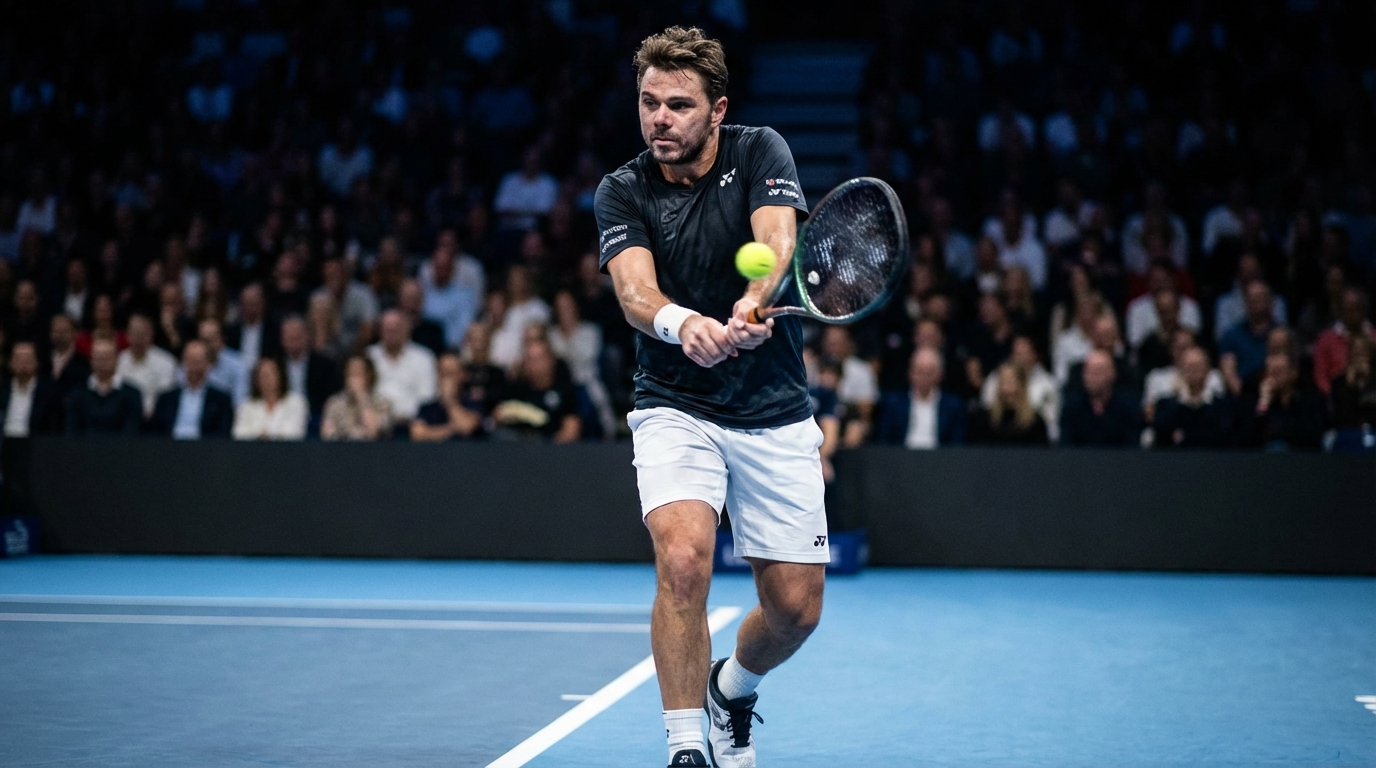
The aesthetic appeal of Wawrinka’s game has always centered on his one-handed backhand, a stroke that has been described as everything from “violent” to “poetic.” In the context of the 2026 season, this shot is an endangered species. The modern game, dominated by the biomechanical efficiency of the two-hander, rarely sees the sweeping arcs that Wawrinka produces. Against De Minaur, this wing becomes the focal point of the tactical battle.
De Minaur will likely target the Wawrinka backhand high and deep, attempting to push the Swiss behind the baseline where his offensive leverage is minimized. Wawrinka’s counter-strategy must involve taking the ball on the risea risky proposition that requires impeccable timing. When he is confident, Wawrinka drives through the ball, creating angles that defy the geometry of the court. When he is hesitant, the one-hander can become a liability, leaking unforced errors under the pressure of De Minaur’s relentless retrieval skills. The match will likely be decided in the ad-court, where Wawrinka’s ability to rip the backhand down the line can open up the entire court.
The Physical Toll and the ‘Stanimal’ Spirit
Investigating Wawrinka’s late-career renaissance requires acknowledging the physical toll. Multiple knee surgeries and foot issues have robbed him of the explosive first step that characterized his 2014-2016 peak. However, what he has lost in speed, he has attempted to replace with “old man strength”a density of shot that pushes opponents back physically. This is the essence of the “Stanimal” persona: a refusal to be bullied.
The mental aspect of this cannot be overstated. Facing players like De Minaur or Arthur Fils requires a mental fortitude that transcends tennis. As noted in coverage by the ATP Tour, the younger generation plays with a fearlessness born of having nothing to lose. Wawrinka, conversely, plays with the burden of legacy. Every loss is analyzed as a potential signal of retirement; every win is celebrated as a defiance of time. This psychological weight makes his performance in Rotterdam a fascinating case study in sports psychology. He is not just playing an opponent; he is playing against the inevitable narrative of decline.
The Indoor Hard Court Variable
Rotterdam’s surface is distinct. It is not as fast as the grass of Wimbledon, nor as gritty as the clay of Roland Garros. It is a medium-pace indoor hard court that rewards a flat ball trajectory. This suits Wawrinka’s mechanics perfectly. His strokes have less topspin than Nadal’s but more weight than Federer’s. On this surface, the ball skids through the court, rewarding his ability to hit through the line of the ball.
However, the indoor environment also amplifies the intensity. The noise is trapped; the lights are stark. For a veteran, this can be exhausting. For a younger player like De Minaur, it is energizing. The outcome may well depend on who controls the tempo. If Wawrinka can turn the match into a slugfest, trading heavy blows from the baseline, the conditions favor him. If the match becomes a track meet, with De Minaur moving Wawrinka from corner to corner, the indoor surface will feel like a cage.
The Verdict: A Question of Time
Ultimately, the investigative lens on this match reveals a broader truth about professional sports. We watch athletes like Wawrinka not because we expect them to be what they were ten years ago, but because we are fascinated by how they adapt to what they are now. The adaptation is the story. He has shifted from being a physical anomaly who could outlast Djokovic in five sets to a tactical surgeon who must win quickly and decisively.
The clash in Rotterdam is a microcosm of this evolution. It pits the memory of the “Stanimal” against the reality of the 2026 tour. Whether he advances past De Minaur or falls to the younger man’s speed, the significance of his participation remains undiminished. He is the bridge between the golden era of the Big Three and the chaotic potential of the Next Gen. As long as he is in the draw, the heavy artillery of the one-handed backhand remains a threat that no player, regardless of their ranking or youth, can afford to ignore.
Frequently Asked Questions
Q: Why does Stan Wawrinka perform well on indoor hard courts like Rotterdam? A: Indoor hard courts eliminate wind and sun variables, allowing for cleaner ball striking. This benefits Wawrinka’s high-risk, high-reward game, particularly his one-handed backhand, which requires precise timing that is easier to find in controlled indoor conditions.
Q: How does the prize money at ATP 500 events impact veteran players? A: While top veterans like Wawrinka are wealthy, the prize money at ATP 500s sustains the high costs of their professional ecosystemtravel, coaching, physio, and logistics. It ensures that competing remains a viable profession rather than a costly hobby during the twilight of a career.
Q: What is the main tactical disadvantage Wawrinka faces against Alex de Minaur? A: The primary disadvantage is movement. De Minaur is one of the fastest players on tour, capable of extending rallies indefinitely. Wawrinka, at this stage in his career, struggles with lateral movement and endurance in long rallies, making De Minaur’s defense a direct counter to Wawrinka’s power.
Q: Has Stan Wawrinka ever won the Rotterdam Open? A: Wawrinka has a strong history at the ABN AMRO Open, including winning the title in 2015. His game has historically translated very well to the specific conditions of the Rotterdam Ahoy arena.
Conclusion
As the tournament progresses, the tennis world watches with bated breath, not just for the scores, but for the moments of brilliance that remind us why we watch. Stan Wawrinka may no longer be the favorite every time he steps on the court, but he remains the most dangerous underdog in the draw. In the end, his battle in Rotterdam is a victory for the sport itself, proving that while speed fades, classand a world-class backhandis permanent.