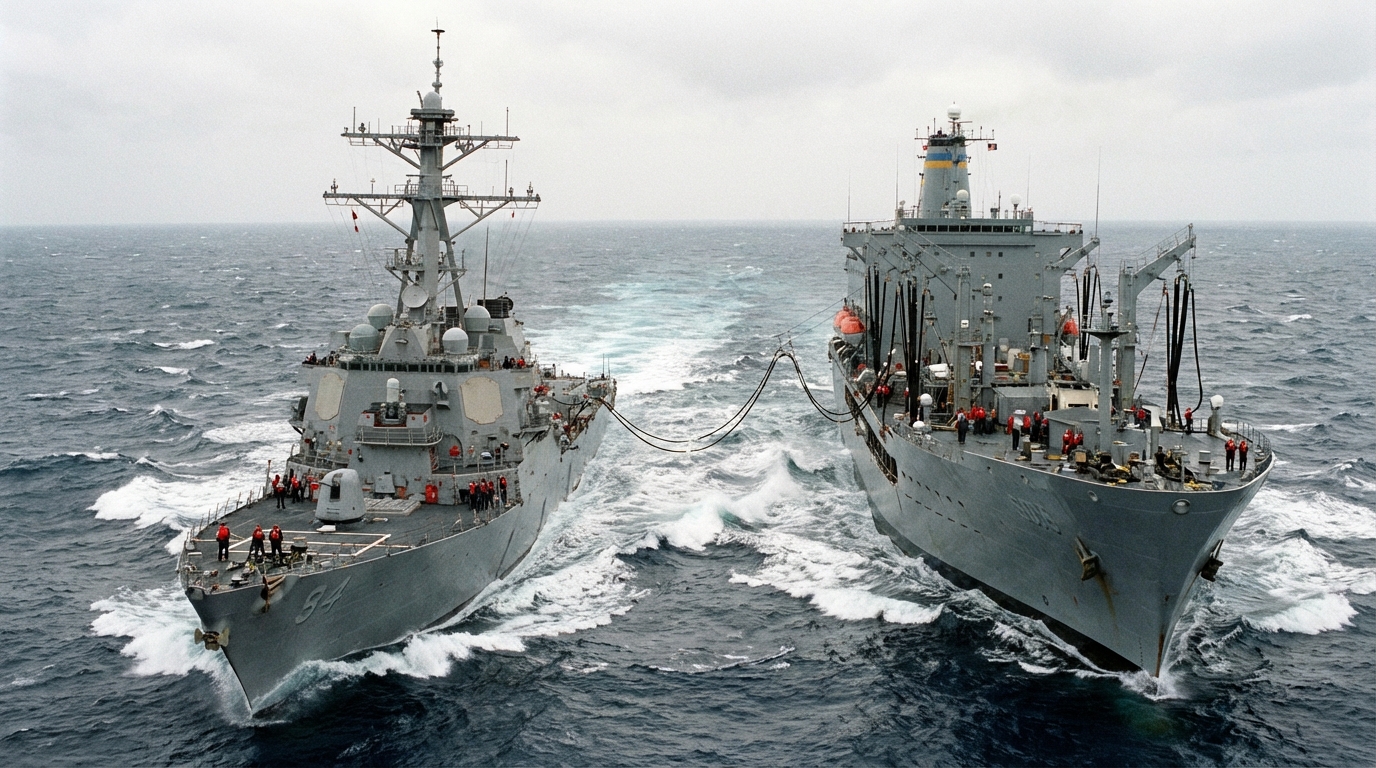
US Navy Ships Collide Off Colombia: Farragut and Laramie
The waters of the Caribbean, typically associated with calm trade winds and commercial transit, became the stage for a jarring naval mishap this week. In an incident that has sent ripples through the Pentagon and maritime strategy circles alike, two us navy ships collided off the coast of Colombia, marking a troubling start to the Navy’s expanded operations in the Southern Hemisphere. The collision involved the guided-missile destroyer USS Farragut and the fleet replenishment oiler USNS Laramie, two vessels critical to the United States’ projection of power in the region.
While early reports indicate that the damage was contained and loss of life was fortunately avoided, the event serves as a stark reminder of the unforgiving nature of high-seas operations. As the dust settles and the salt spray clears, the focus shifts from damage control to a deeper investigation into how two technologically advanced vessels could make contact in the open ocean. This incident is not merely a navigational error; it is a stress test of the Navy’s current operational doctrine during a period of aggressive strategic buildup.
TL;DR
- The Incident: The USS Farragut (destroyer) and USNS Laramie (supply ship) collided off the coast of Colombia.
- The Human Cost: Two sailors reportedly sustained minor injuries, but no fatalities occurred.
- The Context: The ships were deployed as part of a “Trump build-up” aimed at increasing pressure and counter-narcotics operations in the region.
- The Consequence: Both ships remain seaworthy, but an investigation has been launched to determine the root cause, raising questions about operational fatigue.
- The Bigger Picture: This event echoes past naval collisions, forcing a review of safety protocols during surge deployments.
The Collision: Anatomy of a Caribbean Mishap
According to initial reports, the incident occurred as the vessels were operating in close proximity, a necessity for naval logistics but a maneuver fraught with peril. Fox News reported that the collision resulted in minor injuries to two sailors, a fortunate outcome given the displacement and mass of the ships involved. The USS Farragut, an Arleigh Burke-class destroyer designed for high-speed maneuverability and combat, made contact with the USNS Laramie, a Kaiser-class oiler that serves as a floating gas station for the fleet.
Naval collisions often occur during Replenishment at Sea (UNREP), a complex evolution where two ships steam alongside each other at matching speedsoften less than 200 feet apartto transfer fuel and munitions. While the Navy has not explicitly confirmed the collision happened during an UNREP, the involvement of a supply ship strongly suggests logistics were at play. The sheer hydrodynamic forces between two massive hulls moving in parallel can create a suction effect, known as the Venturi effect, which pulls the ships together if not corrected by precise helm commands.
Despite the impact, the structural integrity of the fleet appears intact. Both vessels were determined to be seaworthy following an initial damage assessment, allowing them to continue their mission or return to port under their own power. However, the psychological and administrative impact is immediate. Investigations of this magnitude usually involve a “safety stand-down” or a rigorous review of bridge recordings, watch bills, and training logs to identify whether mechanical failure or human error was the primary culprit.
Strategic Context: The “Trump Build-Up”
The timing of this accident is inextricably linked to the geopolitical climate of early 2026. The ships were not merely on a routine patrol; they were part of a larger strategic puzzle. As noted by Bloomberg, the vessels were in the Caribbean to support a “Trump build-up.” This surge in naval presence is aimed at projecting power near South America, likely focusing on enhanced counter-narcotics operations and exerting diplomatic pressure on regional adversaries like Venezuela.
This context is vital for understanding the risk factors. Surge operations often require accelerated deployment schedules, potentially cutting into training time or forcing crews to operate at a higher tempo than usual. When the political directive is to “flood the zone” with assets, the strain on the logistical chainrepresented here by the USNS Laramieincreases exponentially. Every destroyer patrolling for drug runners or monitoring airspace requires frequent refueling, increasing the frequency of dangerous ship-to-ship interactions.
The Wall Street Journal confirmed the location near South America, placing the incident squarely in a zone of heightened diplomatic tension. When military assets are used as tools of foreign policy signaling, the margin for error shrinks. A collision is not just a safety hazard; it is a potential embarrassment that adversaries can exploit to question the competency of the U.S. Navy.
Operational Risks and Systemic Strains
This incident forces a re-evaluation of the balance between operational requirements and navigational safety. The U.S. Navy has spent years trying to reform its surface warfare community following the tragic collisions of the USS Fitzgerald and USS John S. McCain in 2017. Those investigations revealed systemic issues: sleep deprivation, lack of training, and a culture that prioritized mission accomplishment over basic seamanship.
While the Farragut-Laramie incident appears less severe, it raises the question: Are the old habits returning? The “Trump build-up” implies a rapid expansion of presence. Historically, rapid expansions strain the fleet. The USNS Laramie, manned largely by civilian mariners under the Military Sealift Command, operates differently than a combatant ship. Integrating these two distinct culturesthe warfighting urgency of a destroyer crew and the merchant marine discipline of a supply shiprequires constant practice.
If the investigation reveals that fatigue or a lack of proficiency played a role, it could trigger a new wave of congressional hearings and oversight. The Navy cannot afford to have its assets damaging each other, especially when the strategic goal is to demonstrate strength and readiness to the world.
Comparison Table: Naval Deployment Strategies
To understand the choices naval commanders face when deploying forces like the Farragut and Laramie, it is helpful to compare the different operational models used to sustain presence.
| Option | Best for | Pros | Cons | Pricing/Cost |
|---|---|---|---|---|
| Surge Deployment | Rapid response to crises or political signaling (e.g., Caribbean build-up). | Maximizes immediate firepower; demonstrates resolve; overwhelms local adversaries. | High crew fatigue; reduced maintenance time; higher accident risk due to tempo. | High (Fuel, logistics, overtime) |
| Rotational Deployment | Routine patrols and long-term alliance maintenance. | Predictable schedules; better training cycles; lower stress on equipment. | Slower response to sudden threats; predictable patterns for adversaries. | Medium (Standard operating budget) |
| Forward Basing | Continuous presence in critical regions (e.g., Japan, Bahrain). | Zero transit time; deep familiarity with local waters; strong local integration. | High geopolitical cost; assets are static targets; heavy dependence on host nations. | Very High (Infrastructure and housing) |
Weighing the Strategic Cost
The decision to surge ships into the Caribbean comes with distinct advantages and disadvantages, which are illuminated by this collision.
Pros of Aggressive Forward Deployment:
- Deterrence: A visible armada, including destroyers like the Farragut, acts as a physical deterrent to illicit trafficking and hostile state actors.
- Readiness: Real-world operations provide experience that simulations cannot match, hardening crews for potential combat.
- Interdiction: Increased presence leads to higher seizure rates of narcotics and better intelligence gathering on regional movements.
Cons of Aggressive Forward Deployment:
- Material Fatigue: Constant operation degrades ship systems, leading to mechanical failures that can contribute to accidents.
- Human Error: As seen in this incident, high operational tempo can lead to mistakes in judgment or communication during complex maneuvers.
- Resource Diversion: Focusing heavily on the Caribbean may pull critical assets, like the limited number of fleet oilers (Laramie), away from other hotspots like the Indo-Pacific.
FAQ
Q: What caused the USS Farragut and USNS Laramie to collide? A: The official cause is currently under investigation. However, collisions between such vessels often occur during replenishment operations or transit in formation, where proximity and hydrodynamic forces create significant risks.
Q: Were there any severe injuries or fatalities? A: No. According to Fox News, two sailors suffered minor injuries, but there were no fatalities, and the injuries were not life-threatening.
Q: What is the “Trump build-up” mentioned in reports? A: This refers to a strategic initiative to increase U.S. military presence in the Caribbean and South American waters, likely to combat drug trafficking and exert pressure on political adversaries in the region.
Q: Are the ships still operational? A: Yes. Both the USS Farragut and USNS Laramie were deemed seaworthy after the collision and have not been reported as disabled, though they will likely require repairs.
Conclusion
The news that us navy ships collided in the Caribbean is a sobering punctuation mark on the current strategic escalation in the region. While the physical damage to the USS Farragut and USNS Laramie may be repairable, the incident exposes the fragile line between projecting power and overextending resources. As the Navy continues to support the administration’s “build-up” in the Southern Hemisphere, the safety of its sailors must remain paramount.
This collision should serve as a cautionary tale. In the pursuit of strategic dominance and border security, the fundamental laws of seamanship cannot be ignored. The investigation’s findings will be criticalnot just for assigning blame, but for ensuring that the fleet remains capable of navigating the treacherous waters of 21st-century geopolitics without inflicting wounds upon itself.