John Tesh to Perform Roundball Rock at 2026 NBA All-Star Game
In the pantheon of sports history, there are plays that define eras and players who define games, but rarely does a piece of instrumental music hold as much cultural weight as the frenetic, driving violin staccato of “Roundball Rock.” For a generation of basketball fans, that sound is Pavlovian. It signals Michael Jordan’s tongue wagging, Reggie Miller’s trash talk, and the absolute zenith of the NBA’s popularity in the 1990s. Now, as the league pivots toward a new media landscape, it is reaching back into its sonic vault. John Tesh, the composer behind the anthem, is set to return to center court, bridging the gap between the golden age of broadcast television and the streaming future of the NBA.
This is not merely a nostalgia act; it is a calculated deployment of intellectual property. The announcement that Tesh will perform his masterpiece live during the 2026 NBA All-Star festivities represents a convergence of media rights, pop culture endurance, and the unique celebrity of Tesh himself. As the NBA prepares to return to NBC, the network and the league are betting that the road to the future is paved with the synthesized brass of the past.
The Resurrection of a Sonic Brand
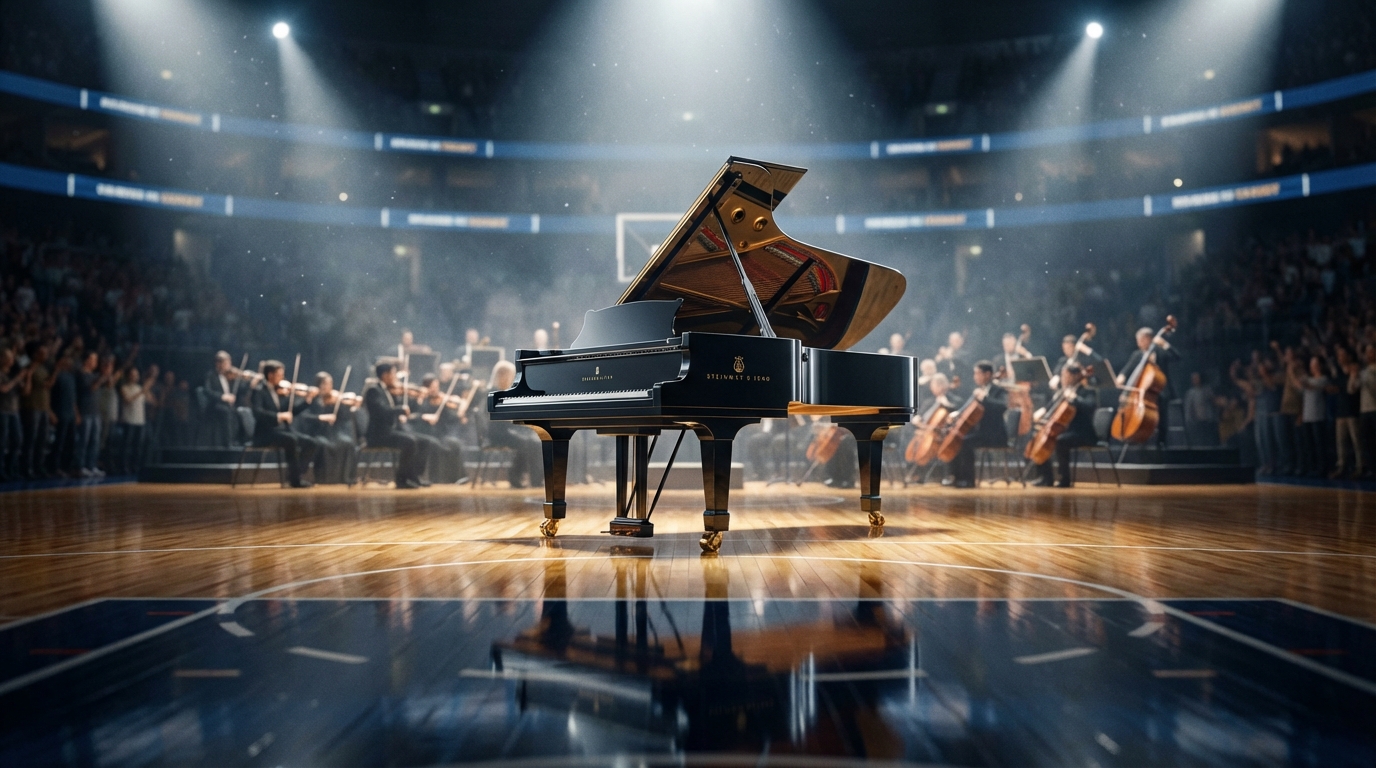
The news broke with a mixture of amusement and genuine excitement: John Tesh will take the stage at the Intuit Dome in Los Angeles for the 75th NBA All-Star Game. While the headline act for the player introductions is the legendary rapper Ludacris, the inclusion of Tesh offers a different, perhaps more potent, form of energy. According to a report by ESPN, Tesh is scheduled to perform “Roundball Rock” live, accompanied by a full orchestra, serving as the backdrop for the player introductions alongside Ludacris.
This specific booking is a masterstroke of timing. The 2025-2026 season marks the beginning of the NBA’s new 11-year media rights deal, which sees games returning to NBC for the first time in over two decades. For NBC, “Roundball Rock” is not just a song; it is a brand identifier as powerful as the peacock logo itself. By putting Tesh on stage at the league’s premier showcase event, the NBA is explicitly acknowledging that the “NBA on NBC” era holds a mythical status among fans.
The performance is slated for Sunday, February 15, 2026, prior to the tip-off. While Ludacris brings the Atlanta hip-hop pedigree and broader mainstream appeal, Tesh brings the emotional architecture of the sport. As noted by People, the pairing of Ludacris and Tesh creates a unique duality: one artist represents the cultural cool of the NBA, while the other represents its broadcast soul.
The Answering Machine That Changed Sports Media
To understand the magnitude of this return, one must understand the origin of the composition. The lore of “Roundball Rock” is almost as famous as the tune itself. Tesh, a classically trained pianist and former anchor for Entertainment Tonight, famously conceived the melody while staying at a hotel in Europe. Lacking a piano or a tape recorder, he called his own answering machine back in the United States and scatted the melody into the phone to ensure he wouldn’t forget it.
That lo-fi voicemail was eventually transcribed and produced into the high-octane orchestral piece that debuted in 1990. For twelve years, it ran roughly 12,000 times on NBC broadcasts. It became the soundtrack for the Chicago Bulls’ dynasty. When NBC lost the NBA rights to ABC/ESPN in 2002, the song went into a form of hibernation, though Tesh smartly retained the rights.
Over the last two decades, the song has refused to fade away. It has been parodied on Saturday Night Live, used in memes, and licensed for various non-NBA projects. However, its return to its rightful homeprofessional basketballhas always been the endgame. The 2026 performance is the culmination of this cultural persistence. It validates Tesh’s transition from TV host to new-age musician to a figure of genuine sports folklore.
Strategic Nostalgia in the Streaming Era
The decision to feature John Tesh is indicative of a broader trend in sports marketing: the weaponization of nostalgia to secure viewer loyalty. The modern sports media landscape is fragmented. Viewers are split across cable, streaming services like Peacock and Amazon Prime, and social media clips. In this fractured environment, familiar audio cues serve as anchors.
The NBA is currently in a transition phase. The superstars who defined the last 15 yearsLeBron James, Stephen Curry, Kevin Durantare nearing the end of their careers. The league is handing the torch to a new generation led by Victor Wembanyama, Anthony Edwards, and Shai Gilgeous-Alexander. By bringing back the theme music of the Michael Jordan era, the NBA is subconsciously reassuring older fans that despite the new faces and the new platforms, the product remains the same.
According to NBA.com, the entertainment lineup for the 2026 All-Star Game is designed to celebrate the league’s history while looking forward. The Intuit Dome, the Los Angeles Clippers’ new high-tech arena, represents the future of fan engagement with its “Wall of Sound” and biometric concessions. Placing Tesh and his orchestra in this hyper-modern setting creates a fascinating juxtapositiona bridge between the analog warmth of 90s broadcast TV and the digital precision of the 2020s.
The Mechanics of the Performance
What can viewers expect from the performance itself? Tesh is no stranger to live spectacle. His “Live at Red Rocks” concert remains a staple of PBS pledge drives, proving he knows how to command a large stage. The All-Star Game performance will likely lean into the grandeur of the composition.
Reports suggest a “Grand Pop Orchestra” will accompany Tesh. This elevates the performance from a simple DJ track to a symphonic event. In the context of the All-Star Game, which has often struggled to find the right tone for its entertainmentoscillating between awkward pop performances and disjointed medleysan orchestral rendition of the sport’s most famous theme song is a safe but high-impact bet. It guarantees crowd participation. When that driving beat kicks in, the reaction inside the Intuit Dome is likely to be visceral.
Furthermore, the collaboration with Ludacris offers an interesting creative challenge. Will the two performances be distinct, or will there be a mash-up? Ludacris, known for his high-energy anthems like “Move B***h” and “Stand Up,” operates at a tempo that could surprisingly complement the driving rhythm of “Roundball Rock.” If the NBA production team manages to weave these two disparate musical threads together, it could produce a viral moment that transcends the game itself.
The Business of Sound
Beyond the applause and the memes, there is a significant business story here regarding music rights and licensing. Tesh’s ownership of “Roundball Rock” has been a lucrative annuity. By licensing the song back to NBC for the upcoming rights deal, Tesh has secured his legacy and his bank account.
The revival of the song also speaks to the value of sonic branding. Fox Sports has its NFL theme; CBS has its March Madness theme. But none have the crossover pop-culture appeal of Tesh’s composition. NBC’s competitors, particularly ESPN, have struggled to create a sonic identity as enduring for their NBA coverage. By reclaiming this asset, NBC immediately re-establishes its credibility as a broadcaster of basketball. The performance at the All-Star Game serves as a massive, free advertisement for the network’s upcoming coverage, reminding millions of viewers that the “NBA on NBC” is back.
A Full Circle Moment for Tesh
For John Tesh personally, this performance is a victory lap. Often unfairly maligned in the 90s as the epitome of uncoola tall, blonde, New Age pianist hosting a gossip showTesh has outlasted his critics. He has embraced the campiness of his public persona while maintaining his bona fides as a musician.
His willingness to perform the song live, rather than just letting the recording play, demonstrates a showmanship that fits the NBA’s ethos. The NBA is a star-driven league that values personality and flair. Tesh, in his own unique way, possesses both. He understands that he is part of the show, not just the background noise. When he sits at the keyboard at the Intuit Dome, he won’t just be playing a song; he will be conducting the collective memory of millions of basketball fans.
Conclusion
The 2026 NBA All-Star Game promises to be a spectacle of modern athletics, but its most talked-about moment may well be a musical throwback. The return of John Tesh to the NBA stage is a testament to the enduring power of a great melody and the deep grooves of nostalgia that run through sports culture. As the league embraces its future with new rights deals and new arenas, it is wisely keeping one foot planted in its glorious past. When the orchestra swells and that familiar rhythm takes over the Intuit Dome, it will be clear: Roundball Rock is not just a song; it is the heartbeat of the game.
Frequently Asked Questions
Q: When is John Tesh performing at the NBA All-Star Game? A: John Tesh is scheduled to perform on Sunday, February 15, 2026, at the Intuit Dome in Los Angeles, as part of the player introductions for the 75th NBA All-Star Game.
Q: Why is “Roundball Rock” significant to the NBA? A: “Roundball Rock” was the theme song for the “NBA on NBC” broadcasts from 1990 to 2002. It is widely considered the most iconic theme music in basketball history and is associated with the Michael Jordan era.
Q: Who else is performing at the 2026 All-Star Game? A: Alongside John Tesh, rapper and actor Ludacris has been announced as a headliner for the entertainment portion of the event, specifically during the player introductions.
Q: Did John Tesh really write the NBA theme song on an answering machine? A: Yes. Tesh came up with the melody while traveling, called his home answering machine, and sang the tune into the phone so he wouldn’t forget it before he could get to a piano.