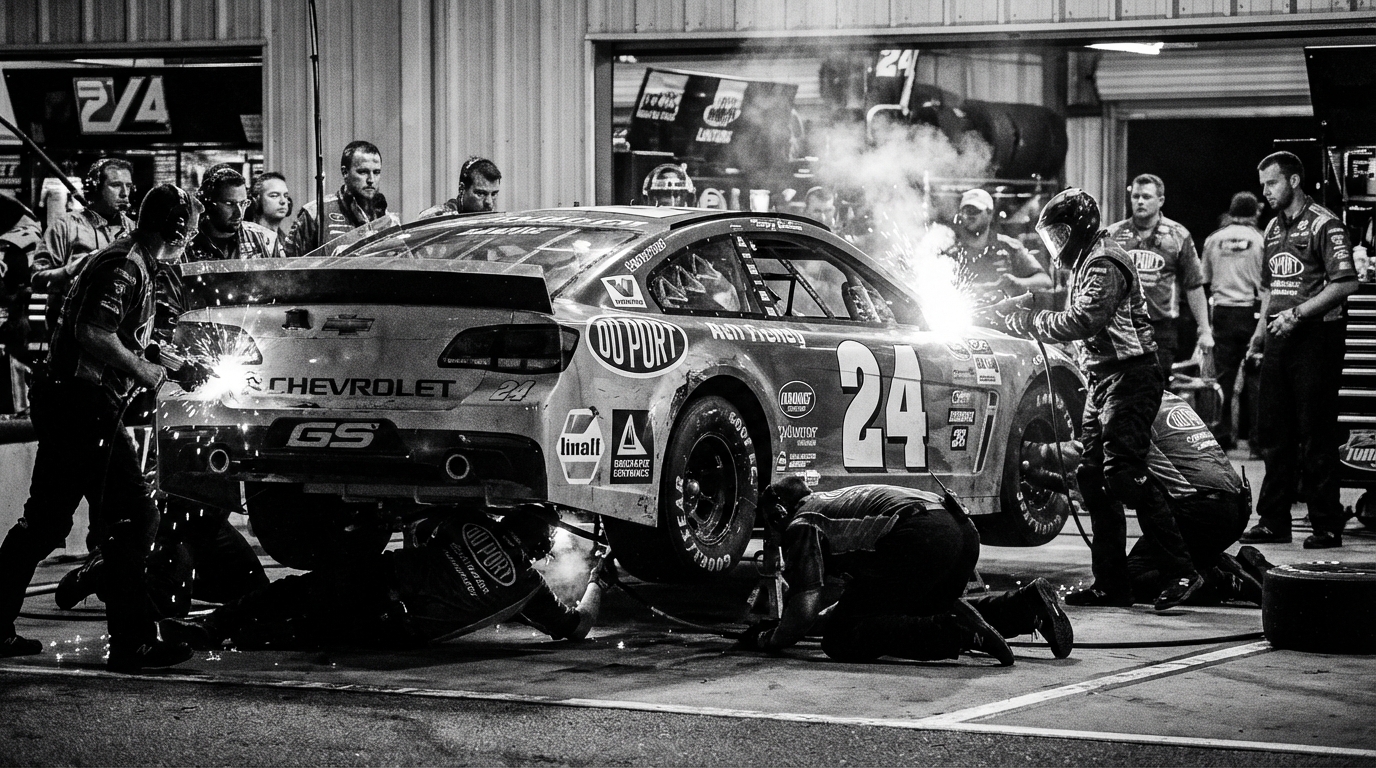
William Byron's Daytona 3-Peat Bid Hit by Practice Crash
The air at Daytona International Speedway is always thick with anticipation, but this year, the tension surrounding the No. 24 garage is palpable. William Byron arrived in Florida with the weight of history on his shoulders, aiming to accomplish a feat that has eluded the sport’s greatest legends: winning the Daytona 500 three consecutive times. However, the path to immortality is rarely a straight line. Following a disastrous incident in practice, Byron’s pursuit of the “three-peat” has shifted from a coronation march to a desperate scramble for survival. The narrative has abruptly changed from dominance to recovery, forcing the Hendrick Motorsports team to dig deep into their reserves before the green flag even drops.
TL;DR
- William Byron wrecked his primary car during Daytona 500 practice, forcing a switch to a backup vehicle.
- No driver in NASCAR history has ever won three consecutive Daytona 500s; legends like Richard Petty and Sterling Marlin failed in their attempts.
- The switch to a backup car mandates that Byron will start the race from the rear of the field, regardless of his qualifying speed.
- Modern “Next Gen” car assembly makes backup cars more competitive than in previous eras, but the loss of track position is critical.
- The incident serves as a stark reminder of the volatility of superspeedway racing.
The Incident That Shook the Paddock
The week began with high hopes and statistical probabilities favoring the defending champion. However, the unforgiving nature of superspeedway racing struck early. During a crucial practice session, chaos unfolded on the backstretch. As detailed in recent reports, a multi-car tangle collected the No. 24 Chevrolet, causing significant damage to the chassis and bodywork. The severity of the impact was enough to compromise the integrity of the primary vehicle, leaving crew chief Rudy Fugle with no choice but to retire the car.
According to ESPN, the wreck forces Byron to a backup car for his Daytona 500 three-peat bid. This is not merely a logistical headache; it is a competitive penalty. By NASCAR rule, switching to a backup car after qualifying (or in this case, prior to the Duels but necessitating a change from the inspected primary) usually results in the driver surrendering their starting position to drop to the rear of the field for the pace laps. For a driver relying on track position to dictate the flow of the draft, this is a significant handicap.
The Curse of the Three-Peat
To understand the magnitude of Byron’s challenge, one must look at the graveyard of previous attempts. The Daytona 500 is notoriously difficult to win once, let alone three times in succession. The variables are endless: aerodynamic instability, engine failures, and the dreaded “Big One.”
History suggests that the third attempt is where the racing gods intervene. Motorsport.com notes that every Daytona 500 three-peat bid has been derailed, often in spectacular fashion. Richard Petty, the King himself, won back-to-back but faltered on the third try. Cale Yarborough and Sterling Marlin faced similar fates. Marlin, perhaps the most recent heartbreak before this era, looked dominant in 1996 before mechanical gremlins ended his streak.
For Byron, the wreck in practice feels like an omen echoing these past failures. It is the first crack in the armor of a team that has looked invincible on superspeedways for the past 24 months. The psychological impact of losing the primary carthe machine specifically massaged and wind-tunnel tested for this specific eventcannot be overstated. It forces the driver to question the feel of the replacement vehicle at 200 mph while surrounded by a pack of 39 other cars.
Technical Fallout: The Next Gen Variable
In previous eras of NASCAR, a backup car was often a “mule”an older chassis with a generic setup, lacking the specialized tweaks of the primary. However, the Next Gen car (Gen-7) has altered this dynamic. With modular components and single-source suppliers, a backup car is theoretically identical to the primary.
Despite the modular similarities, the “human element” of assembly remains. The primary car had been fine-tuned for weeks. The backup must be prepared in hours. NASCAR.com reports that while Byron is pursuing his third straight win, the team now faces a race against the clock to replicate the setup that made them favorites. The nuances of wheel alignment, shock packer gaps, and body panel fits can mean the difference between leading the line and getting sucked back into the turbulent air of the mid-pack.
Comparison Table: Primary vs. Backup Car
| Option | Best For | Pros | Cons | Pricing/Cost |
|---|---|---|---|---|
| Primary Car | Qualifying & Race Dominance | Optimized aerodynamics, wind-tunnel tested, driver confidence. | High risk if damaged (no replacement without penalty). | High (Development time) |
| Backup Car | Emergency Recovery | Modular parts allow for near-identical specs in Next Gen era. | William Byron must start at the rear; limited practice time to shake down. | High (Labor overtime) |
| Hybrid Repair | Minor Damage | Retains starting spot; keeps primary chassis. | Structural integrity concerns; often slower due to drag. | Varies |
The Strategic Pivot
Starting at the rear changes the entire complexion of the first stage of the race. Instead of controlling the lanes from the front, Byron will be forced to navigate the treacherous “accordion effect” at the back of the pack. This is where checks up happen most frequently, and where multi-car pileups often originate.
The strategy for the No. 24 team must shift from aggression to patience. They cannot win the race on Lap 1, but they can certainly lose it. Byron will need to rely on his spotter and his Hendrick Motorsports teammatesKyle Larson, Chase Elliott, and Alex Bowmanto help bridge the gap to the front. However, in the closing laps of the Daytona 500, teammates often become rivals. If Byron manages to survive the climb through the field, he will have burned more fuel and used more tire life than the leaders who enjoyed clean air.
Pros and Cons of the Backup Scenario
Pros
- Reduced Pressure: Starting in the back removes the immediate target from Byron’s back during the opening laps.
- Conservative Strategy: Forces the team to play the long game, potentially saving fuel while riding in the draft.
- Equipment Freshness: The backup car has zero laps of wear on the engine and driveline components.
Cons
- Track Position: Surrendering a qualifying spot is devastating at Daytona, where track position often dictates pit strategy.
- Unknown Handling: Byron will have limited time to diagnose if the backup car has a “tight” or “loose” condition before the race starts.
- Historical Odds: No driver has ever overcome such a late-week setback to secure a third consecutive win in this specific event.
FAQ
Q: Has anyone ever won the Daytona 500 in a backup car? A: Yes, it has happened, though it is rare. Matt Kenseth (2009) is a notable example of a driver who won the rain-shortened Daytona 500 after moving to a backup car. However, doing so while attempting a three-peat adds a layer of pressure Kenseth did not face.
Q: Why does William Byron have to start at the rear? A: NASCAR rules stipulate that if a team switches to a backup chassis after the primary has undergone initial inspection or qualifying, the driver must drop to the rear of the field for the start of the race. This is to prevent teams from building “qualifying specials” and then switching to “race specials” without penalty.
Q: Does the Next Gen car make backup cars better? A: Generally, yes. Because the parts are supplied by single-source vendors (like chassis from Dallara), the variance between two chassis is much smaller than when teams hand-built their own frames. However, the setup and assembly quality still depend on the team.
Final Analysis
The story of the 2026 Daytona 500 has shifted from a coronation to a comeback. William Byron possesses the talent and the equipment to win, even from the back of the pack. Hendrick Motorsports is the most successful organization in the sport’s history for a reasonthey thrive on adversity. Yet, the statistics are stubborn. The “three-peat” is the white whale of stock car racing because it requires three years of perfection in a race designed to create chaos. By wrecking in practice, Byron has already used up his margin for error. Sunday will reveal if the No. 24 team can rewrite the record books, or if the curse of Daytona remains unbroken.
References
- ESPN: Wreck forces Byron to backup car
- NASCAR: William Byron pursuing third straight win
- Motorsport: How every Daytona 500 three-peat was derailed