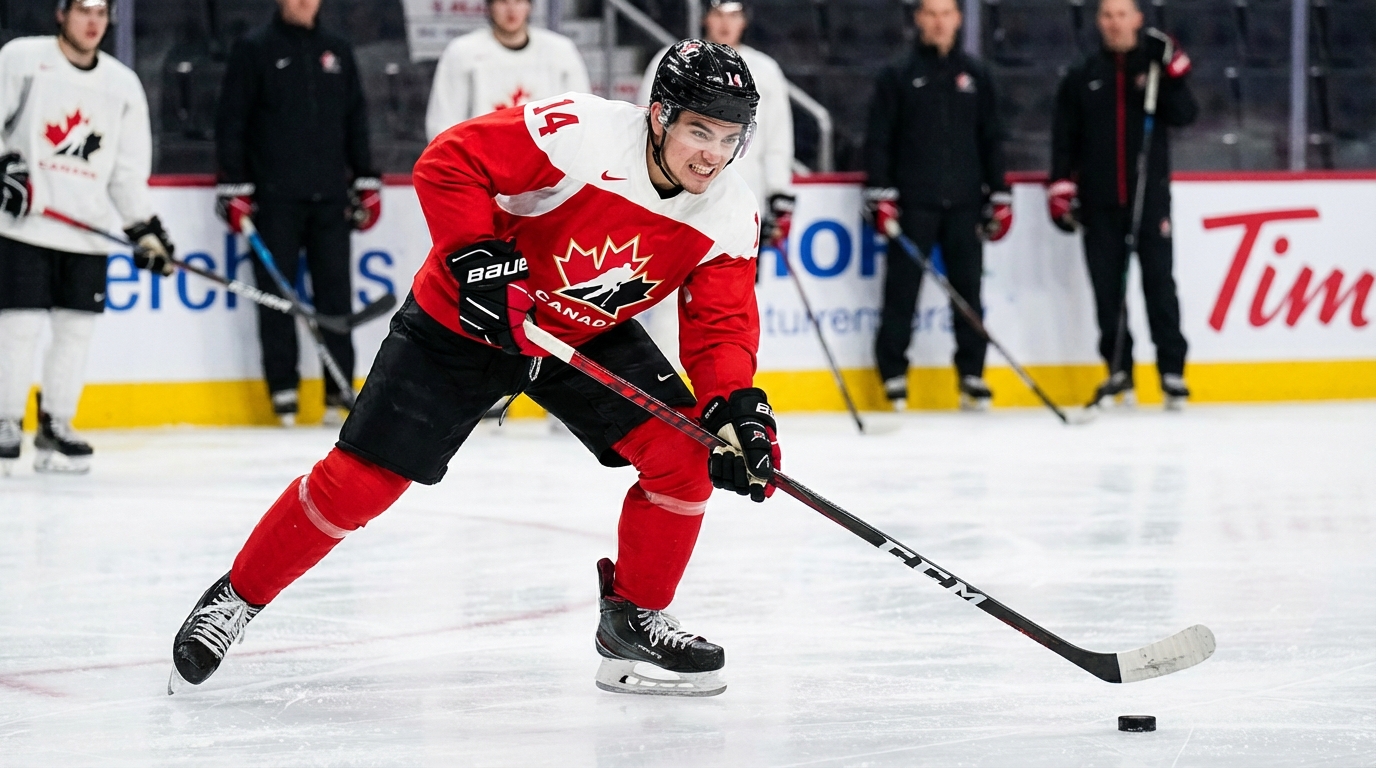
Nick Suzuki's Battle for a Spot on Team Canada's Roster
The weight of the ‘C’ on a Montreal Canadiens jersey is often described as the heaviest burden in hockey, yet Nick Suzuki has carried it with a poise that belies his age. As the undisputed leader of a franchise navigating a complex rebuild, Suzuki has grown accustomed to being the focal point of every offensive strategy and the primary answer to every media inquiry. However, the dynamics shift drastically when the context moves from the Bell Centre to the international stage. In the rarefied air of a best-on-best tournament, even an NHL All-Star can find themselves fighting for a fourth-line role or, worse, a seat in the press box. The current discourse surrounding Team Canada’s lineup decisions offers a fascinating case study in roster construction, pitting the future of Canadian hockey against its established, gritty past.
TL;DR
- Roster Squeeze: Nick Suzuki is currently the 13th forward or “bubble” player for Team Canada, facing a potential scratch.
- The Marchand Factor: The return of Brad Marchand from injury/rest could push Suzuki out of the lineup, favoring experience and grit over Suzuki’s playmaking.
- Montreal’s Stake: While Canadiens fans want to see their captain play, the experience of practicing with elites is valuable for Suzuki’s leadership growth.
- Tactical Shift: The decision signals a preference for specialized roles (agitators/checkers) in the bottom six rather than stacking playmakers.
The Hierarchy of Elite Talent
To understand the precarious position Nick Suzuki finds himself in, one must first appreciate the sheer density of talent available to Canadian selectors. In Montreal, Suzuki is the engine. On the national squad, he is a componenta highly precision-engineered component, certainly, but one that must fit into a machine already overflowing with high-octane parts. According to recent reports, the coaching staff is weighing the value of Suzuki’s cerebral, two-way game against the chaotic, disruptive energy provided by veterans.
This is not an indictment of Suzuki’s skill set. Rather, it is the classic dilemma of All-Star team construction: do you build a fourth line of scorers who can adapt to checking roles, or do you select natural grinders who can elevate their game? Suzuki falls into the former category. His game is predicated on vision, patience, and smart positioning. These are assets that make him a first-line center in the NHL, but they are also traits abundant in Canada’s top nine forwards.
The Brad Marchand vs. Nick Suzuki Debate
The immediate threat to Suzuki’s ice time comes in the form of Boston Bruins captain Brad Marchand. As noted by USA Today, the potential return of Marchand creates a direct conflict for the final roster spots. Marchand brings a specific elementagitation combined with elite finishingthat is rare even at this level. If Marchand is healthy, the coaching staff may view his “pest” attributes as more valuable in a checking line role than Suzuki’s playmaking ability.
This potential swap has generated significant buzz. While Suzuki represents the new guardclean, efficient, and technically soundMarchand represents the old-school mentality of winning through attrition and psychological warfare. For a tournament format where a single game can decide a medal, coaches often default to the known quantity of veteran grit. This leaves Suzuki, despite his readiness and preparation, on the outside looking in.
Comparison Table: Roster Options
The following table breaks down the tactical implications of choosing between a lineup featuring Suzuki versus one reintegrating Marchand.
| Option | Best For | Pros | Cons | Cost/Impact |
|---|---|---|---|---|
| Start Nick Suzuki | Possession & Stability | Elite defensive responsibility; high hockey IQ; lower penalty risk. | Lacks the physical “bite” of a traditional grinder; less experienced in international “pest” roles. | High upside for future core chemistry. |
| Start Brad Marchand | Agitation & Clutch Scoring | Proven big-game performer; disrupts opponents psychologically; existing chemistry with veterans. | Higher risk of penalties; recovering from physical maintenance; older legs. | Short-term gain, potential discipline risk. |
| Rotation Strategy | Tournament Endurance | Keeps fresh legs available; allows tactical adjustments based on opponent style. | Can disrupt line chemistry; tough on player rhythm. | Balanced approach. |
The Montreal Perspective and Leadership Growth
For the Montreal Canadiens, having their captain involved in this conversation is a double-edged sword. On one hand, there is the pride of representation. On the other, there is the risk of injury and the psychological toll of being a healthy scratch. However, looking deeper into the team dynamics discussed by Sportsnaut, the value for Suzuki lies in the environment itself. Being surrounded by the absolute best in the world offers a masterclass in preparation and execution that he can bring back to the Canadiens’ locker room.
Suzuki is currently shepherding a young core in Montreal, including top prospects and developing stars. His exposure to the leadership styles of players like Sidney Crosby or Nathan MacKinnon is invaluable. Even if he watches from the press box, the daily practices and the intensity of the locker room during a high-stakes tournament accelerate his maturation as a captain. He is learning what it takes to win not just games, but championships.
Pros and Cons of Suzuki’s Current Status
The situation presents a complex mix of benefits and drawbacks for the player and his NHL club.
Pros:
- Elite Company: Practicing daily with the world’s best elevates personal standards and habits.
- Rest vs. Wear: If scratched, Suzuki avoids the physical toll of grinding tournament games while maintaining conditioning.
- Motivation: Being on the bubble often fuels competitive fires, potentially leading to a stronger NHL finish.
- Versatility: He remains the ultimate insurance policycapable of slotting into center or wing on any line if injury strikes.
Cons:
- Rhythm Disruption: Sitting out games can disrupt the timing of a player used to logging 20+ minutes a night.
- Confidence Hit: While unlikely for a player of Suzuki’s mental fortitude, being deemed “surplus” can be a psychological hurdle.
- Missed Exposure: Less ice time means fewer opportunities to cement a spot for the 2026 Olympic roster.
The Tactical Fit: Why Suzuki Still Matters
Despite the noise surrounding Marchand, one cannot discount what Suzuki brings to the table. As highlighted in coverage by Yahoo Sports, Suzuki and Team Canada are in a constant state of readiness. Suzuki’s game is built on reliability. In a tournament where a single defensive lapse can lead to elimination, a coach’s trust is the most valuable currency. Suzuki rarely cheats for offense. He is always on the right side of the puck.
If the coaching staff decides that they need to lock down a lead against a high-flying opponent, Suzuki might actually be the preferred option over a more volatile player. His ability to kill penalties and win faceoffs provides a safety net that pure scorers do not offer. The narrative that he is simply “waiting for Marchand” ignores the fact that Suzuki offers a completely different tactical look. It is not just about who is better in a vacuum; it is about what specific tool is needed to dismantle the specific opponent of the night.
FAQ
Q: Is Nick Suzuki guaranteed to be scratched if Marchand returns? A: Not necessarily. While Marchand is the likely replacement, coaches may opt to rest a different forward or rotate players based on the specific matchup and fatigue levels.
Q: How does this impact Suzuki’s chances for the 2026 Olympics? A: Being selected for the 4 Nations/current roster pool is a massive vote of confidence. Even if he plays a limited role now, being “in the room” puts him ahead of other competitors for 2026 spots, provided he continues his strong NHL play.
Q: Does Suzuki’s role with Team Canada affect his captaincy in Montreal? A: Only positively. The experience gained from witnessing the leadership dynamics of a “super-team” will translate directly to how he leads the developing Canadiens core.
Q: What is Suzuki’s primary advantage over other bubble players? A: His positional versatility (center/wing) and his defensive reliability. He is a low-risk option who can be trusted in the final minute of a game, which is rare for a young offensive star.
Conclusion
The debate over Nick Suzuki and his place in the national lineup is a testament to the embarrassment of riches enjoyed by Canadian hockey. Whether he is skating on the fourth line or watching from the sidelines, his inclusion in this elite group validates his ascension to the upper echelon of the sport. For the Montreal Canadiens, the outcome of this specific roster battle is secondary to the long-term benefit of their captain absorbing the culture of winning. Suzuki may currently be fighting for inches on the international stage, but the mileage he gains from this experience will be measured in years of leadership for his club.