2026 Olympic Medal Count: US Strategy vs Norway Model
It is the morning of February 19, 2026, and the air in the Italian Dolomites is crisp, carrying the tension that only the final week of the Winter Games can generate. For the casual viewer, the spectacle is about the triple corks and the photo finishes. But for the United States Olympic & Paralympic Committee (USOPC) and the intricate network of sponsors and development programs backing them, the focus is singular, ruthless, and numerical: the olympic medal count. As we wake up to the latest standings, the narrative is no longer just about athletic heroism; it is about the return on investment in a global sporting arms race.
The obsession with the leaderboard is not merely a matter of national pride; it is the metric that determines funding cycles for the next four years. Today, as the sun rises over Cortina d’Ampezzo, the United States sits in a precarious but promising position. The frantic refresh of the tally board reveals a team that has overcome early stumbles to mount a significant mid-Games comeback. However, looking at the raw data requires us to peel back the layers of what actually generates these medals. Is it the sheer volume of American talent, or is it a system designed to extract gold at any cost?
The American Surge: February 19 Assessment
The narrative of the 2026 Games shifted dramatically in the last 48 hours. According to the latest updates from USA Today, the United States has capitalized on a series of high-stakes finals to bolster their standing. The medal count is not just a list; it is a validation of the “podium potential” strategy employed by US governing bodies. We have seen American athletes deliver under immense pressure in disciplines that were previously considered toss-ups.
The specific breakdown of these victories tells a story of diversification. As detailed by the Chicago Tribune, the US roster of medalists has expanded beyond the traditional strongholds of snowboarding and freestyle skiing. We are seeing a resurgence in disciplines that require immense technical infrastructure, such as sliding sports and alpine events. This broad-spectrum success is critical. For the US to maintain its status as a sporting superpower, it cannot rely solely on the brilliance of individual superstars; it requires depth across the board.
However, this success comes with a caveat. The pressure to contribute to the olympic medal count weighs heavily on every athlete donning the stars and stripes. In the mixed zones, the relief on the faces of silver and bronze medalists often looks remarkably like the relief of someone who has just avoided a layoff. This is the reality of a system where funding is inextricably linked to results. The US model is a high-performance machine, but machines require constant fuel, and in this case, the fuel is precious metal.
The Norwegian Anomaly: System vs. Spirit
While the US celebrates its hard-fought victories, the shadow of Norway looms large over the Games. It is a recurring theme in Winter Olympic history: a nation with a population smaller than Minnesota consistently punching well above its weight class. To understand why the US often finds itself chasing the Norwegians, we must look at the fundamental differences in philosophy.
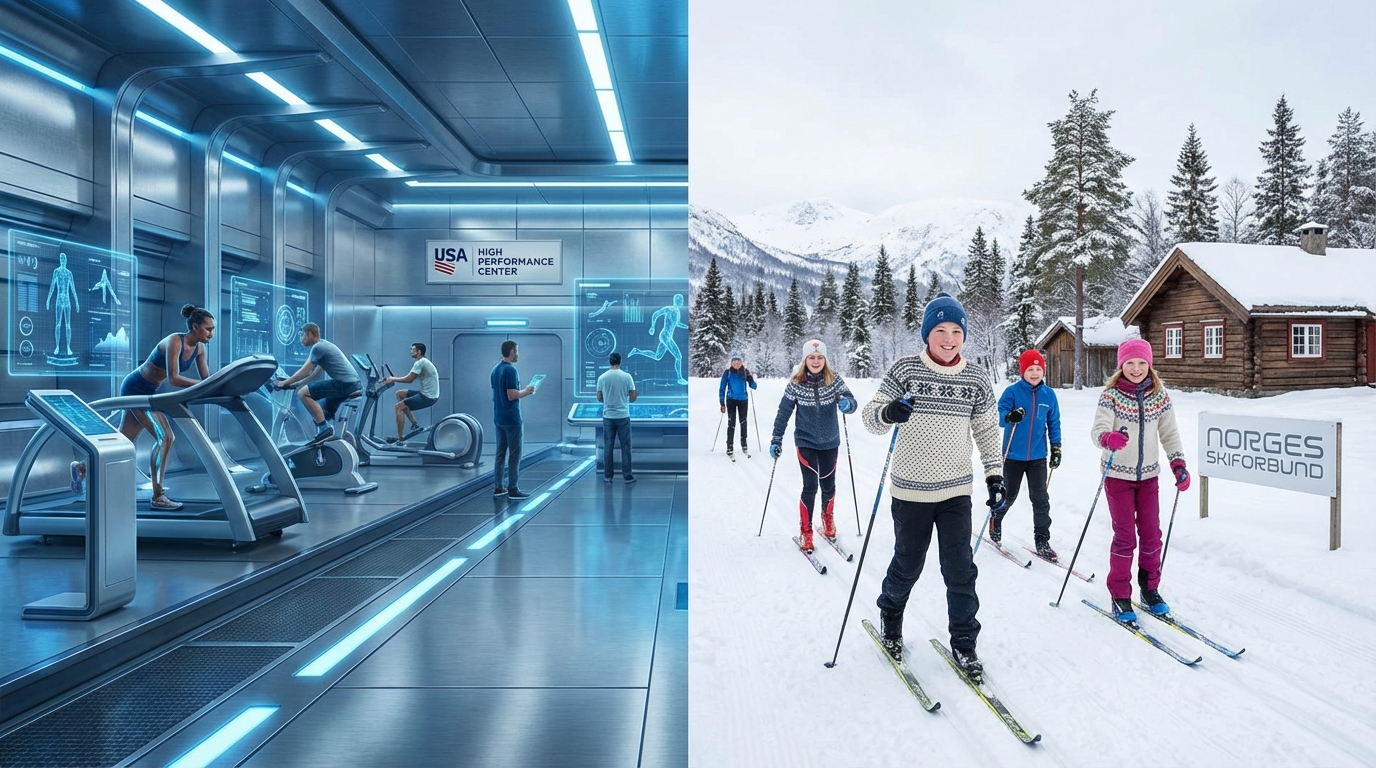
The Norwegian model is the antithesis of the American youth sports industrial complex. As analyzed by Huddle Up, the Norwegian approach is predicated on the “Children’s Rights in Sport” doctrine. They do not keep score or rank children until they are 13 years old. There is no travel ball, no national rankings for ten-year-olds, and a distinct lack of the burnout-inducing specialization that plagues American youth sports. Yet, here they are in 2026, once again threatening to top the tables.
This creates an uncomfortable paradox for American observers. We are conditioned to believe that competition, early specialization, and cutthroat selection are the fires that forge champions. Norway proves that community, joy, and multi-sport development might actually be better fuels. When we look at the olympic medal count, we are not just comparing athletic performances; we are comparing societal values. The US buys medals through massive private investment and collegiate pipelines. Norway grows them through local clubs and a refusal to treat children like mini-professionals.
The Economics of the Podium
To truly investigate the significance of the medal tally, one must follow the money. In the United States, the Olympic movement is privately funded, a unique structure compared to the state-sponsored systems of China or the lottery-funded systems of the UK. This places a unique burden on the olympic medal count as a marketing tool. Sponsors buy into the dream of gold. When the count dips, the value of the sponsorship inventory potentially dips with it.
This economic reality creates a funneling effect. Resources are directed toward sports with high medal yields. It is why we see massive investment in snowboarding and swimming (in the Summer Games), where an individual can win multiple medals, and perhaps less relative focus on team sports where a roster of twenty athletes yields only one tally in the count. The “cost per medal” analysis is a grim but necessary part of the USOPC’s post-game audit.
In Milano-Cortina, we are seeing the results of targeted spending. The technical improvements in equipment, the use of data analytics in training, and the biomechanical optimization of athletes are all expensive endeavors. When an American skier shaves a hundredth of a second off their time to snatch a bronze, that hundredth of a second likely cost millions of dollars in aggregate development. It raises the question: Is the medal count a measure of athletic prowess, or a measure of economic efficiency in sports science?
The Psychological Toll of the Tally
The relentless focus on the count also impacts the mental health of the athletes. In previous Games, we witnessed high-profile athletes buckling under the weight of expectation. In 2026, the conversation has shifted slightly toward resilience, but the underlying stress remains. When the media narrative focuses heavily on whether the US is “winning” the Games, individual accomplishments can be diminished if they don’t result in Gold.
A fourth-place finish is an incredible athletic featbeing the fourth-best human on Earth at a specific task. Yet, in the context of the olympic medal count, a fourth-place finish is a non-event. It contributes nothing to the table. This binary definition of successpodium or nothingcan be toxic. We are seeing a generation of athletes pushing back against this, emphasizing personal bests and the experience of competition, but the institutional machinery is slow to change.
The Final Weekend: Projections and Reality
As we head into the final weekend of the 2026 Games, the math becomes tighter. The remaining eventstechnically demanding disciplines in skating, the final runs in bobsled, and the marquee hockey finalsoffer the last opportunities to shift the standings. The US team has historically finished strong, often relying on the depth of their squad to pick up medals in events where other nations lack a deep bench.
However, the variables of weather, injury, and judging subjectivity always play a role. A sudden warm front in the mountains or a subjective judging call in figure skating can swing the count by two or three medals. This volatility is what makes the race fascinating, but it also highlights the absurdity of placing so much national self-worth on a metric subject to so much variance.
Frequently Asked Questions
Q: How is the official Olympic medal count determined? A: The International Olympic Committee (IOC) does not officially rank countries, but the standard convention used by most media outlets and national bodies is to rank by the number of Gold medals first. If there is a tie in Golds, Silver is used as the tiebreaker, followed by Bronze. However, many US media outlets historically rank by “Total Medals” (Gold + Silver + Bronze), which can sometimes lead to a different leader on the board compared to the rest of the world.
Q: Why does Norway consistently perform so well in the Winter Olympics? A: Norway’s success is attributed to a combination of geography, culture, and policy. They have a long winter season, a culture deeply embedded in skiing, and a “Joy of Sport” youth model that prohibits scorekeeping and ranking for children under 13. This prevents early burnout and encourages high participation rates, creating a massive talent pool relative to their small population.
Q: Does the US government pay athletes for winning medals? A: The US government does not directly fund the USOPC. However, under the “Operation Gold” program, the USOPC pays athletes bonuses for medal wins. As of recent cycles, these amounts were roughly $37,500 for Gold, $22,500 for Silver, and $15,000 for Bronze, though these figures are subject to change each quadrennial.
Q: What happens if the US performs poorly in the medal count? A: A poor showing often triggers an internal review within the USOPC and individual National Governing Bodies (NGBs). This can lead to leadership changes, restructuring of training programs, and a reallocation of grants and funding away from underperforming sports toward those with higher medal potential for the next cycle.
Conclusion: The True Weight of Gold
As the flame prepares to be extinguished in Milano-Cortina, the final olympic medal count will be etched into the record books. The US will likely leave with a haul that justifies the investment to the stakeholders and provides a momentary dopamine hit of patriotism to the public. But as we tally the gold, silver, and bronze, we must remain cognizant of the machinery beneath the surface.
The count is a valid metric of elite performance, but it is an incomplete metric of sporting health. The contrast between the American and Norwegian models displayed at these Games serves as a reminder that there is more than one path to the podium. While the US chases the count with the ferocity of a corporation chasing quarterly earnings, other nations remind us that the foundation of Olympic success can also be built on the simple, unquantifiable joy of play. Whether we learn from that, or simply throw more money at the problem for 2030, remains the true test of our sporting culture.