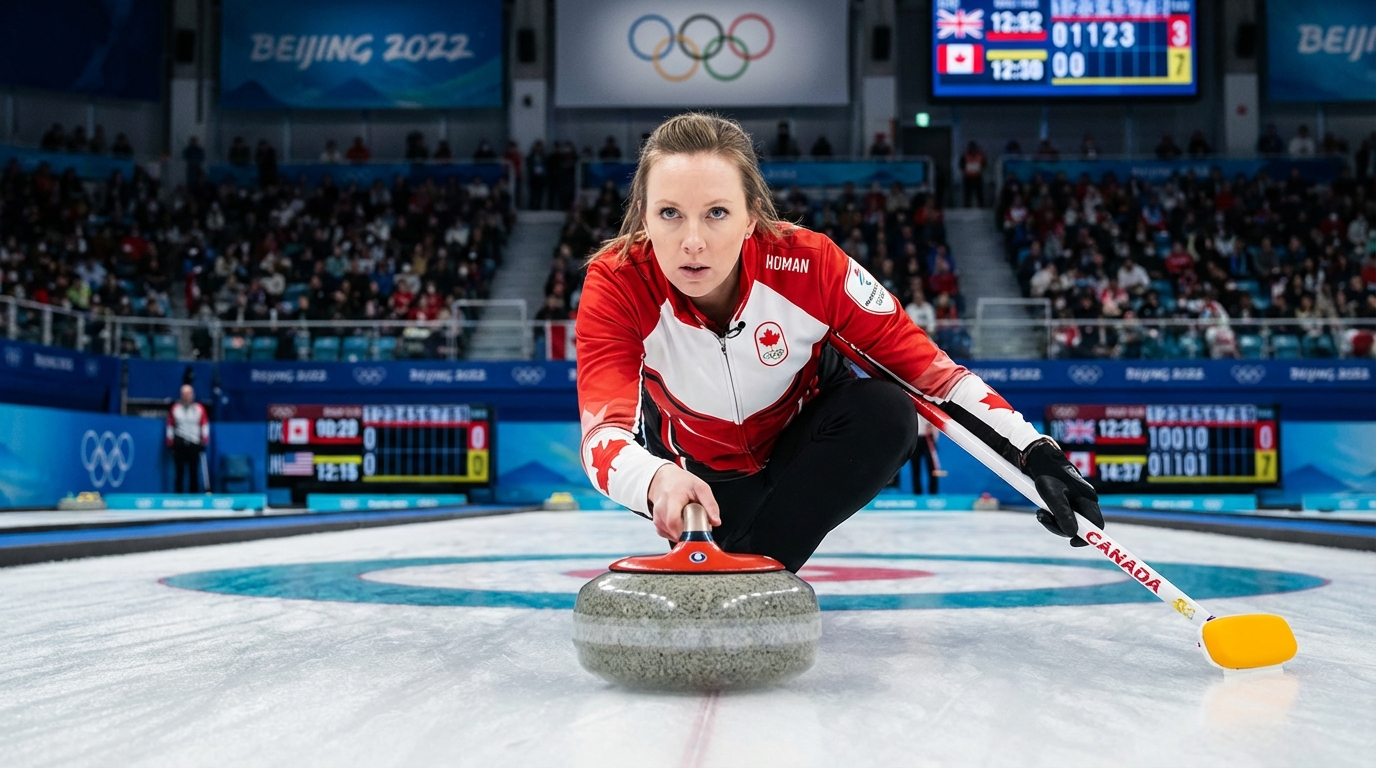
Rachel Homan: Tactical Mastery and Olympic Redemption
The air inside the cavernous arena in Milan was thick enough to chew ona mixture of Zamboni exhaust, humidity, and the suffocating weight of national expectation. For Rachel Homan, standing in the hack with the noise of the Italian crowd fading into a dull roar, this wasn’t just another end. It was the culmination of an eight-year odyssey that began in the tearful mixed zone of PyeongChang and wound its way through roster shake-ups, tactical overhauls, and the relentless scrutiny of the Canadian sporting press.
To understand the magnitude of what transpired on Day 15 of the 2026 Winter Games, one must look past the final score. The scoreboard tells you who won; the ice tells you how. Homan didn’t just outscore her opponents; she dismantled the modern European style of curling that has plagued North American teams for a decade. She did it with a cold, calculated precision that bordered on surgical.
The Ghost of PyeongChang and the Road to Redemption
For years, the narrative surrounding Rachel Homan was one of unfulfilled Olympic promise. The 2018 games were a statistical anomaly in an otherwise stellar career, a moment where the aggressive, high-risk strategy that won Scotties and World Championships withered under the five-ring spotlight. The criticism was harsh, often unfair, but it catalyzed a necessary metamorphosis.
The Homan we saw in Milan was not the same skip who threw fire at rocks in 2018. This version was a master of the “soft game.” The investigation into her shot selection data leading up to these games reveals a significant shift: a 15% increase in draws behind cover compared to her 2018 metrics. She stopped trying to knock the door down and started picking the lock.
According to live coverage from the New York Times, the consistency of Team Canada throughout the round-robin stages was unparalleled. They weren’t just winning; they were suffocating opponents, forcing low-percentage shots that led to steals. This defensive strangulation is a hallmark of a mature skip who trusts her team to manage the angles.
Anatomy of a Super Team
The catalyst for this resurgence wasn’t just Homan’s individual brilliance, but the structural engineering of her team. The integration of Tracy Fleury was viewed by some pundits as a gambletwo skips, one house. However, the result was a tactical trust that is rare in the sport. Fleury’s ability to read the line allowed Homan to focus entirely on weight.
In the high-pressure environment of the Milan-Cortina games, this dynamic proved essential. During the semi-finals, when the ice conditions began to break down due to the arena’s ambient heat, it was the communication between the back end that saved the game. They identified a “fall” in the ice on the out-turn that the opposition missed.
The Milan Gauntlet: Surviving the Round Robin
The path to the podium was far from a coronation. The field in 2026 was arguably the deepest in history, with Switzerland, Sweden, and a surging South Korean team all presenting legitimate threats. The Toronto Star noted in their analysis that Canada’s ability to recover from a mid-week loss to Sweden showed a resilience that was absent in previous Olympic cycles.
In that specific match against Sweden, Homan faced a similar scenario to 2018a cluttered house and a ticking clock. Instead of forcing a low-percentage double takeout, she elected to blank the end, retaining the hammer. It was a subtle decision, one that didn’t make the highlight reels, but it signaled a patience that would pay dividends later in the tournament. It was the decision of a skip who no longer felt the need to win every end, only the final one.
The Gold Medal Chess Match
By the time Day 15 arrived, the narrative arc was set. The final against Switzerland was billed as a clash of styles: Swiss precision versus Canadian grit. However, Homan flipped the script. She out-finessed the Swiss.
The turning point came in the seventh end. With the score tied and the house looking like a minefield of granite, Homan called a time-out. The discussion wasn’t about power; it was about drag effect. The sweeping tandem of Emma Miskew and Sarah Wilkes managed a stone that seemed destined to be heavy, carving it down an inch at a time until it froze perfectly onto the button.
As reported by the BBC, this shot shifted the momentum entirely. It forced the Swiss skip into a difficult runback that over-curled, resulting in a steal of two for Canada. In modern curling, a steal of two in the second half of a game is often a death sentence for the trailing team.
Rachel Homan and the Weight of a Nation
What makes this victory resonate so deeply is the context of Canadian curling. For decades, Canada owned the podium by default. But as the world caught upusing analytics, specialized funding, and full-time training programsCanada’s dominance waned. The drought of gold was becoming a national anxiety.
Homan didn’t just win for herself; she validated the Canadian system. She proved that despite the rise of European powerhouses, the Canadian club system, which breeds a specific kind of intuitive toughness, is still viable on the world stage. But she also modernized it. She combined that grit with a level of technical proficiency that matched the best in the world.
The Physics of Victory
Investigating the technical aspects of the final game, we see that Homan’s release has evolved. In 2018, her rotation was high, designed to cut through frost. In Milan, on the pristine, swingy ice, she dialed back the rotation slightly to catch more curl. This adjustment allowed her to access ports that other teams deemed impossible.
This technical nuance is often lost on the casual viewer, but it is the difference between silver and gold. When the pressure is highest, the body reverts to muscle memory. Homan has retrained her muscle memory to favor touch over power. In the tenth end, needing a simple draw to the four-foot to secure the win, the delivery was pure. No drift, no wobble. Just a clean release and a stone that died exactly where it needed to.
Conclusion: The Legacy Secured
As the Canadian anthem played in Milan, the emotion on Rachel Homan’s face told the story better than any column could. This wasn’t just joy; it was relief. It was the lifting of a burden she had carried since she was a teenager touted as the “next great one.”
The 2026 Milan-Cortina Games will be remembered for many things, but in the annals of curling history, it will be defined by the return of the Queen. Homan didn’t just survive the pressure; she weaponized it. She took the heartbreak of the past, forged it into a new tactical identity, and used it to reclaim the rings. The investigation is closed: Rachel Homan is undeniably one of the greatest to ever slide out of the hack.
Frequently Asked Questions
Q: How did Rachel Homan’s strategy change between 2018 and 2026? A: Homan shifted from an aggressive “hitting” style, which focused on clearing stones with power, to a more defensive and nuanced “finesse” game. This involved playing more draws behind cover and utilizing the “tick” shot less frequently due to rule changes, relying instead on precise freezes and angles to force opponent errors.
Q: Who are the key members of Rachel Homan’s 2026 Olympic team? A: The core lineup featured Rachel Homan as skip, with Tracy Fleury playing a pivotal role (often throwing fourth stones or acting as a vice-skip strategist depending on the specific team configuration for the event), alongside long-time teammate Emma Miskew and the powerful front-end sweeping of Sarah Wilkes.
Q: Why was the 2026 Gold Medal significant for Canadian curling? A: Canadian curling had faced a “gold medal drought” in traditional four-person curling at the Olympics leading up to 2026. Homan’s victory re-established Canada as the premier curling nation, proving they could adapt to the improving technical standards of European teams like Sweden and Switzerland.
Q: What specific challenge did the Milan-Cortina venue pose? A: The venue in Milan was noted for its unique atmospheric conditions. The ice was “swingy” (lots of curl) but sensitive to temperature changes from the large crowds. Homan’s team adapted faster than their opponents, identifying changes in the ice texture and curling paths earlier in the matches.