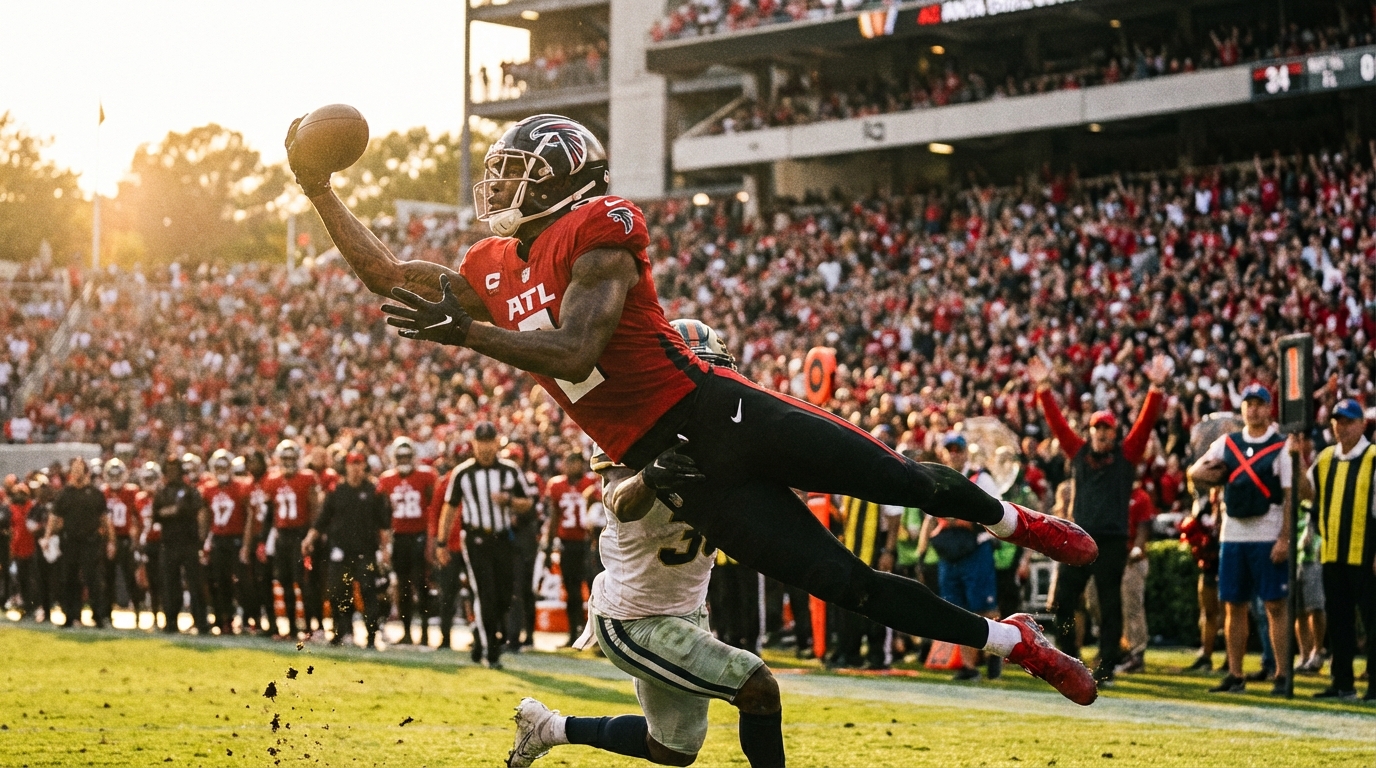
Falcons Place Franchise Tag on Kyle Pitts: Key Analysis
The trajectory of Kyle Pitts has been one of the most fascinating case studies in modern NFL roster construction, oscillating between generational hype and schematic purgatory. When the Atlanta Falcons selected him fourth overall in 2021, the vision was to deploy a “unicorn”a player who defied the traditional boundaries of the tight end position. Now, entering a pivotal offseason, that vision has collided with the hard realities of the salary cap. In a move that defines the franchise’s immediate future, the Falcons have opted to place the franchise tag on Pitts, ensuring that their enigmatic playmaker remains in Atlanta rather than testing the open market.
TL;DR
- Franchise Tag Applied: The Falcons utilized the non-exclusive franchise tag on Kyle Pitts, preventing him from becoming an unrestricted free agent.
- Cost Efficiency: By tagging him as a tight end rather than a wide receiver, Atlanta secures a lower salary cap number for the upcoming season.
- Market Interest: Reports indicated that teams like the San Francisco 49ers were monitoring Pitts as a potential high-profile target had he reached free agency.
- Contract Deadline: Both sides have until mid-July to negotiate a long-term extension, otherwise Pitts will play on the one-year guaranteed tender.
- Quarterback Stability: The move ensures Pitts remains a primary weapon for Kirk Cousins as the Falcons look to capitalize on their offensive investments.
The Strategic Logic Behind the Tag
The decision to tag Pitts was not unexpected, but it signals a specific administrative strategy from the Falcons’ front office. According to a report by ESPN, the organization officially placed the franchise tag on the tight end, a move that effectively blocks him from negotiating with other teams without severe compensation. This mechanism is often used by teams to buy time. For Atlanta, it bridges the gap between the promise Pitts showed as a rookiewhen he eclipsed 1,000 receiving yardsand the inconsistency that plagued his subsequent seasons due to injuries and quarterback instability.
From a financial standpoint, the logic is undeniable. The franchise tag value for tight ends is significantly lower than that of wide receivers. By designating Kyle Pitts as a tight end, the Falcons are capitalizing on a positional pay disparity that favors the team, even if Pitts frequently lines up in the slot or out wide. This allows the team to retain a premium athletic talent at a sub-premium price point relative to his ceiling.
The Shadow of Free Agency and External Interest
Had the Falcons allowed Pitts to reach the open market, the bidding war would likely have been intense. Despite a lack of eye-popping statistics in recent years, NFL evaluators still view him as a mismatch nightmare. Speculation was already mounting regarding potential landing spots. As noted by Yahoo Sports, the San Francisco 49ers were identified as a potential suitor. The concept of pairing Pitts with George Kittle in Kyle Shanahan’s offense represents the kind of “positionless football” that keeps defensive coordinators awake at night.
The 49ers’ interest underscores a critical point: the league views Pitts’ struggles as a product of his environment rather than a lack of talent. By using the tag, Atlanta not only retains a key asset but also prevents a conference rival from acquiring a weapon that could have shifted the balance of power in the NFC. It forces the league to wait at least one more year before getting another crack at the former Florida Gator.
Valuation and the “Weapon” Debate
The friction point in these negotiations often comes down to positional definition. Is he a tight end, or is he a wide receiver? The distinction is worth millions. The Falcons’ move is a calculated risk. As analyzed by SI, tagging Pitts is the “logical move” because it mitigates risk for the team. If Pitts explodes for 1,200 yards and 10 touchdowns under the guidance of Kirk Cousins, the Falcons will happily pay a premium for a long-term extension next year. If he continues to hover around 600 yards with inconsistent impact, the team can move on without the burden of a massive multi-year guarantee.
However, this approach puts the onus entirely on the player. Pitts must now prove that he can be the focal point of the offense. With a stable quarterback situation for the first time since his rookie year, the excuses regarding poor ball placement and erratic coaching are gone. The 2024-2025 season effectively becomes a referendum on his career trajectory.
Comparison Table: Contract Options for Kyle Pitts
The following table breaks down the scenarios Atlanta faced regarding Pitts’ contract status.
| Option | Best For | Pros | Cons | Pricing/Cost |
|---|---|---|---|---|
| Franchise Tag (TE) | The Falcons | Retains player control; lower cost than WR tag; “prove-it” year. | Can cause player frustration; fully guaranteed for one year. | ~$12-13M (Estimated TE Tag) |
| Long-Term Extension | Kyle Pitts | Financial security for player; cap flexibility for team (back-loaded). | High risk for team if performance declines; locks up cap space. | Likely $15M+ APY |
| Open Market | Other Teams (e.g., 49ers) | True market value discovery; player chooses destination. | Falcons lose asset for nothing (except comp pick); bidding war. | Market rate (High) |
| Trade & Sign | Rebuilding Teams | Falcons get draft capital; player gets fresh start. | Loss of primary offensive weapon; creates hole at TE. | Varies based on trade return |
Pros and Cons of the Franchise Tag
Pros
- Cost Control: The tight end franchise tag is one of the most affordable tags in the NFL, allowing Atlanta to allocate resources to other needs like defense or offensive line depth.
- Evaluation Window: It grants the coaching staff one full season to see how Pitts meshes with Kirk Cousins before committing $60M+ to a long-term deal.
- Asset Protection: Prevents a high-draft-capital player from walking away for free, maintaining the team’s depth chart integrity.
- Negotiation Leverage: Keeps the Falcons in the driver’s seat for extension talks up until the July deadline.
Cons
- Player Dissatisfaction: Players generally dislike the tag because it lacks long-term security. This can lead to holdouts or strained relationships.
- Cap Hit: Unlike a long-term deal where the Year 1 cap hit can be minimized, the franchise tag counts fully against the cap immediately.
- Grievance Risk: There is always a risk that a player like Pitts files a grievance arguing he should be tagged as a wide receiver, which would cost the team significantly more.
- Short-Term Fix: It kicks the can down the road. If he plays well, his price only goes up next year.
FAQ
Q: What is the difference in cost between the Tight End and Wide Receiver franchise tag? A: The difference is substantial. While exact figures fluctuate with the salary cap, the Wide Receiver tag is typically $8-10 million more expensive than the Tight End tag. This is why the positional designation of hybrid players like Pitts is so contentious.
Q: Can Kyle Pitts still sign a long-term deal with the Falcons? A: Yes. The placement of the franchise tag merely extends the window for negotiation. The Falcons and Pitts have until mid-July to agree on a multi-year extension. If no deal is reached by then, he must play the season on the one-year tag salary.
Q: Why was San Francisco considered a destination for Pitts? A: As reported by Yahoo Sports, the 49ers are always looking to exploit mismatches. Pitts’ ability to play receiver in a tight end’s body fits Kyle Shanahan’s scheme perfectly, potentially serving as a long-term successor or complement to George Kittle.
Q: Does the franchise tag guarantee Pitts will play for Atlanta this year? A: It guarantees that if he plays, it will be for Atlanta (unless traded). However, players on the tag can technically hold out, though the new CBA makes holdouts financially punitive and less likely.
Conclusion
The decision to place the franchise tag on Kyle Pitts is a defining moment for the Atlanta Falcons’ new regime. It is a move rooted in caution but driven by potential. By securing Pitts for another season, the Falcons have preserved the core of their passing attack, ensuring that their investment in a veteran quarterback is supported by elite athleticism on the perimeter. While the rumors of a departure to the 49ers offered a tantalizing “what if,” the reality remains in Atlanta. The upcoming season will be the ultimate test: can Pitts finally transcend the “unicorn” label and become the dominant statistical force he was drafted to be, or will the debate over his value continue to loom over the franchise?