The Blizzard of 78: How It Compares to Modern Storms
It hangs over the collective consciousness of New England like a phantom limba memory of whiteout conditions, buried highways, and a silence so profound it deafened an entire region. For nearly half a century, every flake that falls in Rhode Island and Massachusetts is measured against the blizzard of 78. Today, as meteorological models align in a terrifyingly familiar formation, we are forced to ask: have we learned the lessons of the past, or are we doomed to repeat the paralysis of that historic February? With alerts screaming across screens from Providence to Boston, the ghost of ‘78 is no longer just a story told to children; it is a very real benchmark for the atmospheric violence currently churning off the coast.
TL;DR
- Historical Echoes: The current Nor’easter shares critical low-pressure characteristics with the blizzard of 78, raising concerns about severity.
- Technological Leap: Unlike the surprise of ‘78, outlets like WPRI are providing granular, hour-by-hour warnings, allowing for preemptive shutdowns.
- Infrastructure Stress: While plowing technology has improved, the sheer volume of vehicles and population density in Southern New England creates new logistical nightmares.
- Visual Confirmation: Early imagery suggests snowfall rates could rival historical records, creating dangerous whiteout conditions.
The Anatomy of a Whiteout
To understand the threat facing Southern New England today, one must look at the mechanics of the storm. The blizzard of 78 was not merely a snowstorm; it was a meteorological bomb that stalled off the coast, pumping moisture inland for over 30 hours. According to recent analysis by Turn to 10, the current system is displaying a similar hesitation in its track. When a Nor’easter stalls, the snowfall totals cease to be measured in inches and start being measured in feet. The investigation of these pressure systems reveals that the “blocking high” to the norththe atmospheric wall that traps the stormis as robust today as it was decades ago.
The difference, however, lies in the warning. In 1978, many commuters went to work in the morning expecting a manageable snow event, only to be trapped on Route 128 by the afternoon. Today, the narrative is different. The alerts are pervasive. As reported by WPRI, the “weather alert” status was triggered well in advance, warning of a “blizzard tonight.” This lead time is the single greatest divergence from history. We are not being ambushed; we are being besieged with full knowledge of the enemy at the gates. Yet, knowing the storm is coming does not necessarily immunize the region from its impact.
Comparison Table: The Historic vs. The Modern
| Feature | The Blizzard of ‘78 | The Modern Nor’easter (Current Event) | Pros (Modern Context) | Cons (Modern Context) | Economic Cost/Impact |
|---|---|---|---|---|---|
| Forecasting | Rudimentary; surprise timing caught millions off guard. | Advanced satellite modeling; days of lead time. | High preparation time; pre-emptive bans. | ”Boy who cried wolf” syndrome causes fatigue. | High (Shutdowns start early). |
| Communication | Radio and TV (limited reach once power failed). | Smartphones, constant push alerts, social media. | Instant dissemination of emergency orders. | Misinformation spreads quickly online. | Variable (Data networks usually survive). |
| Infrastructure | Lower population density; limited plow tech. | High density; advanced chemical treating/plowing. | Roads cleared faster post-storm. | More cars on the road equals more potential traps. | Extremely High (Billions in lost productivity). |
| Resilience | Communities relied on wood stoves/analog tech. | Heavy reliance on electricity and internet. | Better emergency coordination. | Vulnerability to power grid failure is critical. | Unknown (Depends on grid stability). |
A Visual Testimony of Power
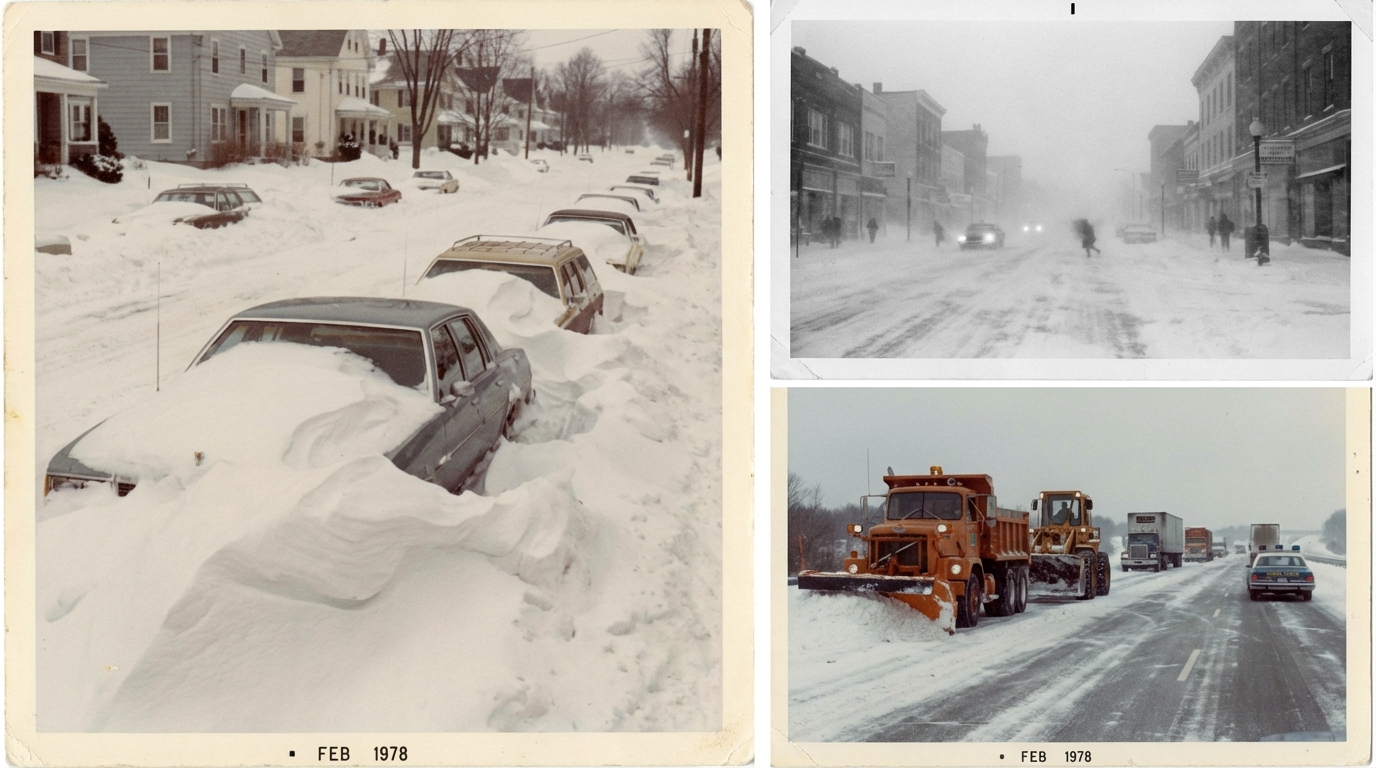
There is a visceral quality to a true blizzard that data cannot capture. It is the visual of a familiar landscape erased. In 1978, the defining images were of cars buried up to their antennas on the freeway. Today, as we look at the developing situation, the visuals are strikingly similar. The Providence Journal has begun curating photos from the storm that show the early stages of this transformation. The whiteout conditions described in the blizzard of 78 are manifesting again, turning recognizable landmarks into abstract shapes of grey and white.
These images serve as evidence for the investigative observer. They confirm that despite global climatic shifts, the specific geography of New England remains a perfect catching mitt for Atlantic moisture. The photos show snow bandingintense, narrow corridors of heavy precipitationthat can drop three to four inches of snow an hour. This is the rate at which mechanical removal becomes impossible. No plow can keep pace with that volume, a lesson learned tragically in the late 70s and one being relearned by municipal planners today.
Pros and Cons: Modern Storm Response
The evolution of storm management since the blizzard of 78 offers a mixed bag of advancements and new vulnerabilities.
Pros
- Precision Forecasting: As seen in the Turn to 10 reports, meteorologists can now predict snowfall totals within specific zip codes, allowing resources to be deployed surgically.
- Communication Grid: Emergency management can reach 99% of the population instantly through cellular alerts, preventing the “trapped commuter” scenario.
- Equipment Capability: Modern plows and pre-treatment brines prevent ice bonding, making the post-storm cleanup significantly faster than the weeks-long dig-out of 1978.
Cons
- Grid Dependency: Modern heating and communication systems are entirely dependent on electricity. In ‘78, a wood stove kept you alive; today, a power outage during a blizzard is an immediate life-safety crisis.
- Just-in-Time Economy: Grocery stores no longer hold massive backstock. Panic buying, triggered by the alerts mentioned by WPRI, empties shelves in hours, leaving unprepared residents vulnerable.
- False Security: The comfort of modern SUVs often emboldens drivers to venture out in conditions that would have kept 1970s sedans in the driveway, leading to more rescues.
The Human Element and Economic Paralysis
Beyond the meteorology, the comparison to the blizzard of 78 is a study in sociology and economics. In 1978, the economy was more localized. Today, a shutdown in Southern New England ripples through global supply chains. The decision to close schools and ban travel is not taken lightly, yet the memory of ‘78 forces the hand of governors. The risk of stranded motorists freezing to death on interstates is the nightmare scenario that drives current policy.
However, we must investigate the cost of this caution. Frequent “historic” alerts that fail to materialize can lead to public apathy. If the storm described by the Providence Journal underperforms, the next warning might be ignored. This psychological game is as dangerous as the wind chill. The balance between necessary vigilance and alarmism is delicate. In 1978, the lack of alarm was the killer. Today, the excess of alarm might be the economic killer.
FAQ
Q: Was the Blizzard of ‘78 truly the worst storm in New England history? A: In terms of impact and paralysis, yes. While other storms have produced higher snowfall totals in isolated areas, the combination of wind, duration, and the number of people stranded on roadways makes the blizzard of 78 the benchmark for severity.
Q: How does the current storm warning system differ from 1978? A: In 1978, forecasting relied on limited satellite data and slower computer models. Today, supercomputers run ensemble models providing probabilistic outcomes days in advance, and alerts are pushed directly to personal devices rather than relying on scheduled TV or radio broadcasts.
Q: What defines a storm as a “blizzard”? A: A storm is officially a blizzard not just because of snow amount, but due to wind and visibility. It requires sustained winds or frequent gusts of 35 mph or greater and falling or blowing snow that reduces visibility to less than a quarter-mile for at least three hours.
Q: Why do officials declare travel bans earlier now than in the past? A: The lessons of ‘78 showed that once cars are stuck, plows cannot operate, compounding the disaster. Early bans ensure roads remain clear for emergency equipment and snow removal, preventing the gridlock that defined the 1978 catastrophe.
The Verdict
As the winds howl and the snow piles up against the doorframes of New England, the comparison remains valid. The blizzard of 78 was a tragedy of timing and technology. The current storm is a test of our modern resilience. We have the data, we have the machinery, and we have the communication networks. But nature, in its rawest form, remains undefeated. Whether this event enters the history books alongside the giant of ‘78 depends not just on the inches fallen, but on how well we heed the ghosts of the past.