
Stagflation-Risk-Convergence: A US Regime Shift in 2026
Stagflation Risk Convergence: The US Economy Faces a Regime Shift That Defies Conventional Policy Response
The convergence of deteriorating labor market data, persistent inflation, unresolved trade policy transmission, and a geopolitical energy shock has moved the United States into a macroeconomic configuration that defies conventional policy response. This is not a single disappointing data print or a transient supply disruption. The simultaneous arrival of these forces each independently significant, collectively destabilizing represents a regime shift toward stagflation, a condition in which the Federal Reserve’s dual mandate of price stability and maximum employment pulls in opposite directions. For equity investors, portfolio allocators, and anyone whose assumptions rest on continued US growth, the stagflation-risk-convergence now visible in the data carries implications that are structural rather than cyclical.
The labor market deterioration was sudden and severe. According to TreasurySpring, February 2026 non-farm payrolls showed the US economy unexpectedly losing 92,000 jobs, against a consensus expectation of a 55,000 gain a miss of nearly 150,000 jobs. The unemployment rate rose to 4.4%. A single month of job losses does not constitute a recession, but the magnitude of the miss, combined with the direction of the trend, signals that the labor market is no longer absorbing the cumulative weight of restrictive monetary policy, tariff uncertainty, and weakening demand.
On the inflation side, the picture is equally uncomfortable. Core PCE the Fed’s preferred inflation gauge rose for a second consecutive month in January 2026, reaching 3.1%, as reported by TreasurySpring. That figure sits well above the Fed’s 2% target and, critically, it reflects conditions before the full pass-through of tariff costs to consumer prices. TreasurySpring noted explicitly that “we still haven’t seen the full effect of tariffs feeding through, meaning inflation may have remained well above the 2% target for some time, even without the effects of the war in Iran on energy prices.” The 3.1% reading likely understates the inflationary pressure already embedded in the pipeline.
The Iran-driven energy shock adds a volatile and unpredictable layer. TreasurySpring reported that the war in Iran is expected to increase inflation, though the size and duration of the impact remain uncertain. Energy costs feed directly into consumer prices and indirectly into production costs across nearly every sector. If rising energy costs erode household purchasing power while the labor market is simultaneously shedding jobs, the feedback loop into consumption and corporate earnings could be significant.
For anyone building portfolios, modeling earnings, or allocating capital on the assumption that the US economy will muddle through with moderate growth and gradually declining rates, the evidence from the past several weeks demands a reassessment of that baseline.
The Highest-Signal Data Points: What the Numbers Actually Show
February 2026’s employment report delivered one of the most significant downside surprises in recent memory. The swing of 147,000 jobs from forecast from an expected gain of 55,000 to an actual loss of 92,000 arrived alongside an inflation backdrop moving in the opposite direction from what a weakening labor market would typically suggest. These figures challenged the prevailing soft-landing thesis on both fronts simultaneously.
The following table summarizes the key data releases and their divergence from consensus expectations:
| Indicator | Consensus Expectation | Actual | Surprise |
|---|---|---|---|
| Non-Farm Payrolls (Feb 2026) | +55,000 | 92,000 | 147,000 |
| Unemployment Rate (Feb 2026) | Not specified in sources | 4.4% (up slightly) | Upside miss |
| Core PCE (Jan 2026, m/m trend) | Not specified in sources | 3.1% (second consecutive rise) | Above target |
Consensus estimates for the unemployment rate and core PCE were not explicitly stated in the available evidence. The NFP consensus of +55,000 and the actual print of 92,000 are directly sourced from TreasurySpring. The unemployment rate is described as having “risen slightly,” and core PCE is characterized as having risen “for a second consecutive month,” both per the same source.
It is important to distinguish verified hard data from forward-looking inference. The NFP miss, unemployment uptick, and core PCE level are confirmed data points drawn from official releases as reported by TreasurySpring. However, two significant inflationary forces tariff pass-through and the Iran conflict’s energy price premium remain largely in the realm of estimation. TreasurySpring noted that “we still haven’t seen the full effect of tariffs feeding through,” meaning the inflation already observed at 3.1% may not yet reflect the full impact of trade policy. The magnitude of additional price pressure from tariffs is not quantified in any available source and should be treated as uncertain.
Similarly, the inflationary impact of the conflict in Iran on energy prices is acknowledged but unquantified. TreasurySpring described the war’s expected effect on inflation as uncertain in both “size and duration.” Consumer affordability in the face of rising energy costs was flagged as a key forward-looking concern, but this remains an analytical inference rather than a measured outcome. J.P. Morgan Asset Management published an FOMC commentary for March 2026 that might have provided additional institutional analysis, but its substantive content was inaccessible due to institutional investor gating, leaving a gap in the available analytical landscape.
The net effect of February’s data was a decisive repricing of rate expectations. Prior to the Middle East conflict, traders had been pricing in slightly over two rate cuts for the remainder of 2026, even as Fed members signaled only one cut, according to TreasurySpring. After the March 2026 FOMC meeting, market expectations shifted to one cut at most, with the possibility of no cut at all. A rate hike was characterized as a “low probability event,” but the fact that it entered the discussion at all reflects how fundamentally the data altered the macro outlook.
Four Transmission Chains: From Macro Shock to Market Impact
The stagflationary data cluster emerging in early 2026 transmits to equity markets through at least four distinct but interconnected channels. Each chain begins with a specific macroeconomic trigger and propagates through financial conditions into corporate fundamentals and asset prices.
Chain 1: Sticky Inflation, Elevated Discount Rates, Growth Stock Compression
Core PCE at 3.1%, rising for a second consecutive month, forced the March 2026 FOMC to hold rates steady. Markets repriced from slightly over two expected rate cuts down to one cut at most or potentially none. This repricing mechanically raises the discount rate embedded in long-duration equity valuations, compressing the present value of future cash flows for growth stocks whose value depends heavily on earnings years into the future. TreasurySpring further noted that tariff effects had “not yet fully fed through” to inflation, suggesting the upward pressure on rates may persist or intensify, making any near-term easing even less likely.
Chain 2: Job Losses, Consumer Spending Weakness, Earnings Downgrades
A deteriorating labor market directly threatens household income and consumer confidence, which in turn weighs on discretionary spending the largest component of US GDP. TreasurySpring flagged “consumer affordability” as a key consideration for the FOMC, noting uncertainty about whether increased energy prices might undermine the US growth story. If consumer spending decelerates, corporate revenue growth follows, creating the conditions for analyst earnings downgrades that typically precede further equity selloffs. Second-order effects include rising consumer credit delinquencies and potential inventory destocking as firms adjust to weaker demand signals.
Chain 3: Tariff Pass-Through Plus Energy Shock, Input Cost Surge, Margin Squeeze
The evidence points to a dual cost shock hitting corporate margins simultaneously. Tariff effects had not yet fully fed through to prices, meaning businesses were either absorbing higher input costs or had yet to pass them to consumers. Layered on top, the Iran conflict introduced an energy price spike whose “size and duration” remained uncertain, per TreasurySpring. For import-dependent sectors retailers, manufacturers relying on foreign components, transportation and logistics this combination creates a margin vise: costs rise from both trade policy and energy markets while pricing power is constrained by weakening consumer demand. The inability to fully pass through costs implies margin compression even before any revenue deceleration materializes.
Chain 4: Fed Paralysis and Institutional Uncertainty, Volatility Premium, Broad Risk Asset Derating
Perhaps the most corrosive transmission channel is the one rooted in policy uncertainty itself. Cutting rates to support a weakening labor market risks further entrenching inflation already at 3.1% and rising. Holding rates steady allows economic deterioration to deepen. Compounding this, TreasurySpring reported that Fed Chair Jay Powell was pledging to stay on until a DoJ investigation concluded or was dismissed, while Senator Thom Tillis was attempting to block the nomination of Kevin Warsh as Powell’s successor. This leadership uncertainty layered atop the policy paralysis raises the volatility premium investors demand for holding risk assets. When the central bank cannot credibly signal its reaction function, option-implied volatility tends to rise, credit spreads widen, and equity risk premiums expand across the board.
These four chains do not operate in isolation. Wider credit spreads from Chain 4 raise corporate borrowing costs, which discourage capital expenditure a second-order effect that feeds back into Chain 2 by reducing business investment and hiring. Margin compression from Chain 3 makes firms less willing to hold inventory, triggering destocking cycles that further depress industrial activity. The convergence creates a self-reinforcing repricing dynamic in which each channel validates and intensifies the others.
The Fed’s Impossible Bind: Why Conventional Tools Cannot Resolve This Crisis
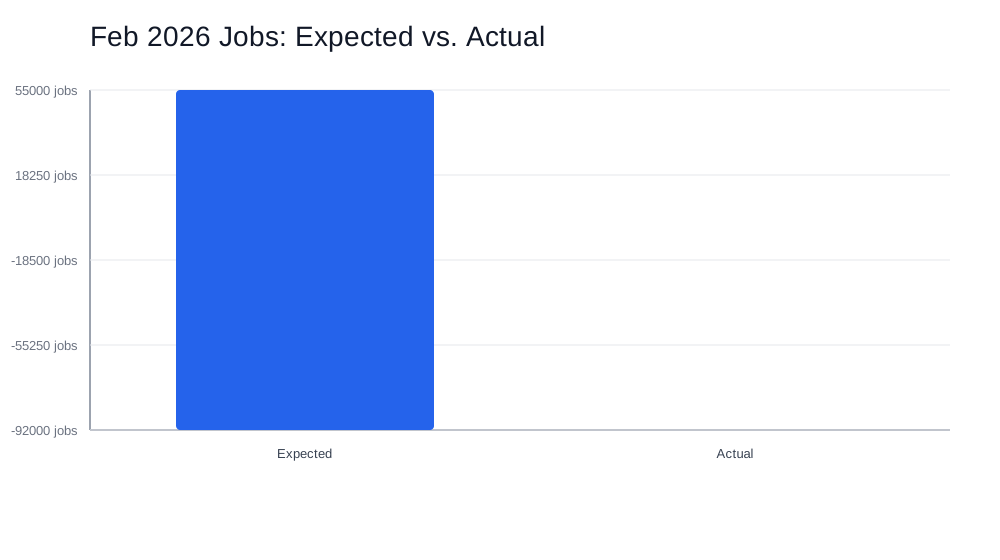
The US economy lost 92K jobs in Feb 2026 against a consensus expectation of +55K a miss of nearly 150,000 jobs.
The Federal Reserve’s dual mandate has rarely produced a more intractable policy dilemma than the one visible in early 2026. Inflation too high to justify easing, and a labor market too fragile to absorb further tightening. The Fed cannot move in either direction without aggravating one side of its mandate.
This paralysis was reflected clearly in the March 2026 FOMC meeting outcome. The narrowing of rate expectations from two cuts to one-or-none in a matter of weeks illustrates how rapidly the policy window has closed.
What makes this episode particularly resistant to conventional monetary tools is the supply-side nature of the inflationary pressures. TreasurySpring noted that tariff effects had not yet fully fed through to consumer prices as of March 2026, meaning inflation may have remained well above the 2% target for some time even without the additional impact of the Iran conflict on energy prices. Rate increases are designed to cool demand-driven inflation by reducing borrowing and spending; they are far less effective and potentially counterproductive when price increases originate from supply disruptions such as tariffs and energy shocks. Raising rates into a supply-side inflation would further suppress an already weakening labor market without meaningfully addressing the source of rising prices.
Historical parallels offer some framing, though each has important limitations. The 1970s stagflation, driven by oil embargoes and wage-price spirals, ultimately required the Volcker-era rate shock to break inflation at the cost of severe recession and unemployment above 10%. The 2022 hiking cycle managed to bring inflation down from over 9% without triggering a recession, but that episode was primarily demand-driven, with a historically tight labor market providing a cushion. The current configuration differs from both: the labor market is already deteriorating, inflation is being fed by multiple supply-side channels simultaneously, and the geopolitical backdrop adds a layer of unpredictability that neither prior episode fully parallels.
The political dimension compounds the Fed’s operational challenge. Warsh’s voting history has been characterized as hawkish, but he has recently shifted toward a more dovish stance aligned with the President’s preference for rate cuts, according to TreasurySpring. The uncertainty over Fed leadership introduces a governance risk on top of the macroeconomic bind: markets cannot be confident about the reaction function of a central bank whose leadership is contested and whose next chair may hold materially different policy views.
The danger of this moment lies not in any single data point but in the simultaneous convergence of multiple shocks. TreasurySpring flagged consumer affordability as a key consideration, noting that while there remains “a strong belief in the US growth story,” that narrative may be tested by the cumulative weight of these pressures. Until the uncertainties narrow the full magnitude of the Iran conflict’s inflationary impact, how much additional inflation will result from tariffs still working through the system, and whether the DoJ investigation will resolve in a way that stabilizes Fed governance the policy paralysis is likely to persist.
Sector Vulnerability and Portfolio Positioning Under Stagflation
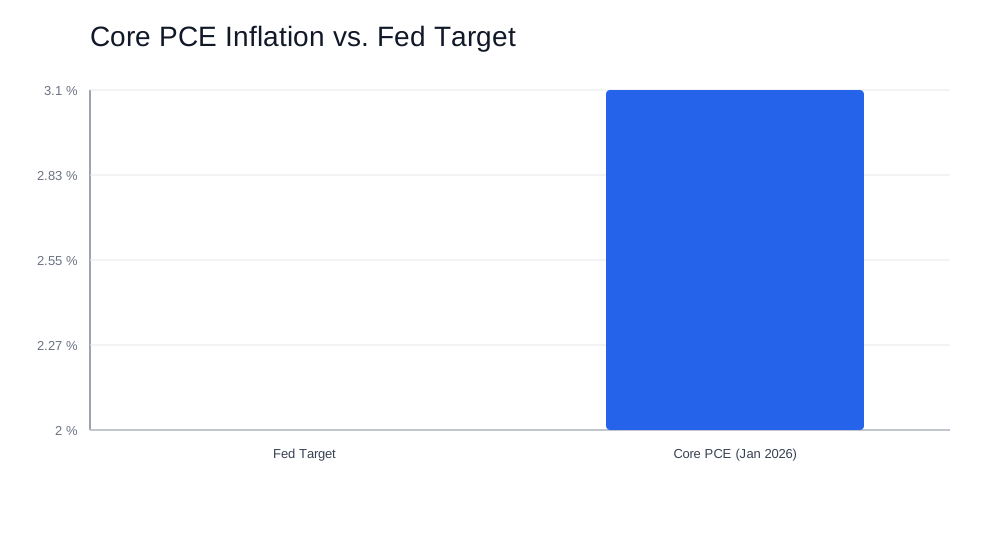
Core PCE reached 3.1% in Jan 2026, well above the Fed’s 2% target and before full tariff pass-through or Iran-driven energy price effects.
The macroeconomic backdrop creates a textbook stress test for equity portfolios. With the March 2026 FOMC meeting effectively removing the monetary relief valve that growth-oriented equities depend on, the combination of sticky inflation, weakening employment, elevated rates, and unresolved supply-side shocks defines the environment against which sector vulnerability and resilience can be mapped.
An important caveat: the framework below is analytical inference based on how different business characteristics interact with stagflationary pressures. It is not a verified outcome. Actual sector performance will depend on the magnitude and duration of the Iran conflict’s inflationary impact, the pace at which tariffs feed through, and whether consumer affordability deteriorates further.
Vulnerable sectors share a common profile: sensitivity to discount rates, dependence on imported inputs, or reliance on debt markets that may not ease. High-duration growth stocks particularly unprofitable or early-revenue technology and biotech names face compressed valuations when the market prices in one cut or no cut for the rest of 2026. Import-dependent consumer discretionary and industrial companies confront a margin squeeze from two directions: tariff costs that have yet to fully pass through and rising energy input prices. Companies carrying significant leverage face refinancing risk in an environment where the Fed has signaled no urgency to cut.
Resilient sectors tend to share pricing power, low import exposure, and strong free-cash-flow generation. Consumer staples and healthcare companies can typically pass through input cost increases because demand for their products is relatively inelastic. Defense contractors benefit from government spending commitments largely insulated from consumer affordability pressures. Energy producers and commodity-linked businesses are direct beneficiaries of the inflationary impulse.
| Sector / Category | Pricing Power | Import / Tariff Exposure | Duration Sensitivity | Net Stagflation Exposure |
|---|---|---|---|---|
| High-growth tech / biotech | Low | ModerateHigh | Very High | Highly Vulnerable |
| Consumer discretionary (import-heavy) | LowModerate | High | Moderate | Vulnerable |
| Industrials (import-dependent) | Moderate | High | Moderate | Vulnerable |
| Leveraged corporates (cross-sector) | Varies | Varies | Varies | Vulnerable |
| Consumer staples | High | LowModerate | Low | Resilient |
| Healthcare | High | Low | LowModerate | Resilient |
| Defense | High | Low | Low | Resilient |
| Energy producers | High | Low | Low | Resilient |
| REITs (inflation-escalator leases) | ModerateHigh | Low | Moderate | Conditionally Resilient |
| FCF compounders (low leverage) | High | Varies | LowModerate | Resilient |
Several nuances deserve emphasis. The “resilient” label for energy producers depends on the assumption that the Iran conflict sustains elevated prices; if the conflict resolves quickly, the energy tailwind fades. REITs carry a structural caveat: while inflation escalators protect revenue, the sector’s typically higher leverage means refinancing costs could offset rental income gains. Free-cash-flow compounders occupy a privileged position in stagflation because they are self-funding and less dependent on either consumer discretion or capital markets, but identifying which companies genuinely fit this profile requires balance-sheet-level analysis rather than sector-level generalization.
The logic for rotation toward pricing power and real assets is structurally sound. During the growth-stock regime that dominated from 2020 through 2024, falling or near-zero interest rates compressed discount rates, mechanically inflating the present value of future cash flows. The reversal of that assumption is now arguably the single biggest risk factor in equity markets. The embedded assumption in many mega-cap tech valuations that rates would normalize lower, supporting ever-higher multiples is being directly challenged by the data.
The timing of such rotations is inherently uncertain and historically non-linear. Markets can remain misaligned with fundamentals for extended periods before repricing violently. The evidence currently available establishes the structural logic for rotation, but does not predict when the repricing will fully express itself.
Three Scenarios: Base Case, Upside Escape, and Downside Spiral
The unresolved pressures form the backdrop against which three distinct paths can be sketched. The probability ranges assigned below are analytical estimates reflecting the weight of available evidence, not predictions.
Base case (estimated probability: 5055%). The Fed holds rates steady through at least the third quarter of 2026, consistent with the post-March FOMC market consensus described by TreasurySpring. Inflation remains elevated in a range of roughly 2.83.2%, sustained by delayed tariff pass-through and energy cost pressures. Unemployment drifts modestly higher from 4.4% toward the mid-to-high 4% range. Consumer affordability gradually erodes but does not collapse, keeping the economy in a low-growth, above-target-inflation holding pattern. Equities would likely grind lower on compressed earnings multiples, with rotation toward value and real-asset sectors.
Upside escape (estimated probability: 2025%). This path requires several favorable developments to converge. Tariff negotiations would need to yield a meaningful partial rollback. A de-escalation of the Iran conflict would need to relieve the energy price premium. If these conditions materialized, core PCE could plausibly decline below 2.8% by mid-2026, potentially giving the Fed room for a modest insurance cut a possibility that markets were pricing in before the Middle East conflict, when traders expected slightly over two cuts for the remainder of 2026, per TreasurySpring. The leadership uncertainty at the Fed adds a wrinkle: whether institutional tension would accelerate or delay any easing remains an open question. Growth-sensitive equities would likely stabilize, though the upside is bounded by inflation still running above the 2% target.
Downside spiral (estimated probability: 2025%). The most adverse scenario envisions a compounding of the shocks already in motion. An escalation or prolongation of the Iran conflict could push oil prices to levels that materially impair consumer affordability. The full pass-through of tariffs could push inflation materially above 3.1%. The labor market deterioration glimpsed in February could deepen if consumer spending contracts, potentially pushing unemployment above 5% and triggering a formal recession declaration. Credit spreads would be expected to widen significantly, and equity markets could face drawdowns of 20% or more from recent levels. TreasurySpring notes that a rate hike remains a “low probability event,” but the conditions under which it might become more likely are precisely those that characterize this downside path.
Several critical uncertainties cut across all three scenarios. The full inflationary impact of both the tariff regime and the Iran conflict remains unquantified. The Fed leadership question introduces institutional risk that is difficult to model. J.P. Morgan Asset Management published a March 2026 FOMC commentary that might have offered additional perspective, but its content was inaccessible due to investor gating restrictions. These gaps mean the scenario probabilities should be understood as rough, evidence-informed brackets rather than calibrated forecasts.
What to Watch Next: Five Triggers That Will Confirm or Refute the Stagflation Thesis

Generated supporting visual
Rather than speculate on outcomes, investors and policymakers can anchor their assessments to five concrete data releases and developments. Each carries a specific threshold that, if breached, would meaningfully shift the probability distribution between a transitory soft patch and an entrenched stagflationary regime.
Trigger 1: March 2026 Core PCE. A third consecutive increase particularly a print at or above 3.3% would make it difficult to dismiss the trend as noise and would effectively confirm that inflation is reaccelerating on a sustained basis. Conversely, a decline back toward 2.8% or below would suggest the JanuaryFebruary readings reflected one-off tariff pass-through rather than a structural shift. TreasurySpring noted that tariff effects had not yet fully fed through as of March 2026, meaning the March reading will be the first to capture a fuller tariff impact. This makes the print especially diagnostic.
Trigger 2: March Non-Farm Payrolls. The critical question is whether February’s 92,000-job loss was an outlier or the beginning of genuine labor market deterioration. A March print returning to positive territory above 100,000 jobs would suggest the February figure was anomalous. A second consecutive negative print, or even a weak positive below 50,000 paired with unemployment ticking up to 4.5% or higher, would substantially raise the probability that the economy is entering a contractionary phase alongside elevated inflation.
Trigger 3: Fed Communication and Leadership Resolution. The key signal to monitor is whether subsequent Fed communications explicitly acknowledge the dual-mandate tension whether officials begin framing policy as a tradeoff between fighting inflation and supporting employment. Any language suggesting the Committee is “looking through” tariff-driven inflation to support growth would be a dovish shift with significant market implications. A resolution of the Powell-Warsh leadership question could itself become a market-moving event by clarifying the Fed’s reaction function.
Trigger 4: Iran Conflict and Energy Price Developments. The key threshold is whether energy prices sustain levels that materially impair consumer affordability. If geopolitical tensions de-escalate and oil prices retreat meaningfully, the inflation impulse narrows to tariffs alone a more manageable problem for the Fed. If the geopolitical premium persists or intensifies, the inflationary impulse broadens and the Fed’s policy space contracts further. The duration of elevated energy prices matters as much as the peak level, since sustained high prices feed into inflation expectations and wage demands in ways that transitory spikes do not.
Trigger 5: Q1 Earnings Guidance from Import-Heavy Industrials and Retailers. Earnings calls from companies with significant import exposure will provide the first hard, firm-level evidence of how tariffs are affecting margins, pricing decisions, and demand. The specific threshold to watch is whether companies report absorbing tariff costs (margin compression) or passing them through to consumers (confirming the inflation pipeline). Guidance cuts or withdrawn outlooks from multiple large importers would signal that tariff effects are both real and large enough to weigh on corporate earnings and potentially employment. TreasurySpring’s observation that tariff effects had not yet fully fed through makes this earnings season uniquely informative.
A scenario in which Core PCE rises again, payrolls remain weak, the Fed acknowledges the dual-mandate bind, energy prices stay elevated, and corporates signal margin pressure would collectively confirm a stagflationary regime that markets have only partially priced. The opposite combination would suggest the current stress is a transitory episode. The most challenging outcome and perhaps the most likely is a mixed signal environment in which some triggers fire and others do not, leaving the macro outlook genuinely ambiguous and keeping the Fed on hold for longer than either bulls or bears expect.
Conclusion
Generated supporting visual
The evidence assembled here points to a stagflation-risk-convergence that is no longer theoretical. Core PCE at 3.1% and rising, an unexpected loss of 92,000 jobs in a single month, tariff costs still working through the pipeline, an energy shock of uncertain duration from the Iran conflict, and a Federal Reserve caught between its mandates with contested leadership these are not isolated data points. They are mutually reinforcing pressures that challenge the foundational assumptions of most equity portfolios and macro forecasts built during the prior growth regime.
The structural logic for portfolio rotation toward pricing power, real assets, and low-leverage cash-flow compounders is supported by the data. The vulnerable position of high-duration growth stocks, import-dependent industrials, and leveraged corporates follows directly from the transmission chains outlined above. The Fed’s inability to ease without risking further inflation, or to tighten without deepening labor market stress, removes the policy backstop that markets have relied upon for much of the past two years.
What remains genuinely uncertain is the magnitude and duration of these pressures. The Iran conflict could de-escalate. Tariff negotiations could yield concessions. The March payrolls report could reverse February’s shock. These are real possibilities, and the upside escape scenario carries a non-trivial probability. But the base case a grinding, low-growth, above-target-inflation environment with a paralyzed Fed is the outcome best supported by the current evidence, and it demands that investors, allocators, and policymakers recalibrate their assumptions accordingly.
The five triggers identified March Core PCE, March payrolls, Fed communication and leadership developments, energy price trajectories, and Q1 earnings guidance from import-heavy firms will determine whether this moment represents a transitory data cluster or the onset of a durable regime shift. Until those signals resolve, the prudent course is to position for the possibility that the stagflationary configuration now visible in the data is not a passing anomaly but the new baseline.
Frequently Asked Questions
What is stagflation and why is it dangerous for stock markets?
Stagflation is a macroeconomic condition in which inflation remains elevated while economic growth stalls and unemployment rises. It is dangerous for stock markets because it creates a policy trap: the central bank cannot cut rates to support growth without risking higher inflation, and it cannot raise rates to fight inflation without deepening the economic downturn. For equities, this means simultaneous pressure from compressed earnings multiples (due to elevated discount rates), weakening consumer demand (due to job losses and eroding purchasing power), and rising input costs (due to supply-side price shocks). The current environment, with core PCE at 3.1% and the economy losing 92,000 jobs in February 2026, exhibits precisely this combination.
How does sticky core PCE inflation above 3% prevent the Fed from cutting rates?
Core PCE at 3.1% sits more than a full percentage point above the Fed’s 2% target. Cutting rates when inflation is elevated and still rising risks further entrenching price pressures by loosening financial conditions and stimulating demand. As TreasurySpring reported, tariff effects had not yet fully fed through to consumer prices, meaning the 3.1% reading may understate the inflation already in the pipeline. After the March 2026 FOMC meeting, market expectations shifted from slightly over two cuts to one cut at most, or none, reflecting the reality that the Fed cannot ease until inflation is on a convincing downward path.
Which equity sectors historically outperform during stagflationary periods?
Sectors with genuine pricing power, low import exposure, and strong free-cash-flow generation tend to be more resilient. Based on the analytical framework applied to current conditions, energy producers and commodity-linked businesses benefit directly from the inflationary impulse. Consumer staples and healthcare companies can pass through cost increases because demand for their products is relatively inelastic. Defense contractors benefit from government spending commitments insulated from consumer affordability pressures. Free-cash-flow compounders with low leverage occupy a privileged position because they are self-funding and less dependent on capital markets.
What does the February 2026 job loss of 92,000 mean for the US recession probability?
A single month of job losses does not constitute a recession, but the magnitude of the miss 147,000 jobs below consensus signals that the labor market is deteriorating more rapidly than anticipated, according to TreasurySpring. Whether this represents an outlier or the beginning of a genuine contraction depends on subsequent data, particularly the March payrolls report. A second consecutive negative print or a weak positive paired with rising unemployment would substantially raise recession probability. The combination of job losses with inflation at 3.1% is what makes this particularly concerning, as it describes a stagflationary dynamic rather than a simple cyclical slowdown.
How do tariffs and energy price spikes create a margin squeeze for US companies?
Tariffs raise the cost of imported inputs components, raw materials, finished goods while the Iran conflict’s impact on energy prices increases transportation, manufacturing, and operating costs across nearly every sector. TreasurySpring noted that tariff effects had not yet fully fed through to consumer prices, meaning businesses were either absorbing higher costs (compressing margins) or had not yet attempted to pass them through. When these cost pressures arrive alongside weakening consumer demand from a deteriorating labor market, companies face a vise: costs rise while pricing power is constrained, squeezing margins even before revenue deceleration materializes. Import-heavy retailers, industrials, and transportation firms face the sharpest pressure.
Why are growth stocks especially vulnerable when the Fed cannot cut interest rates?
Growth stocks derive a disproportionate share of their valuation from earnings expected far into the future. The present value of those distant cash flows is highly sensitive to the discount rate used to value them. When the Fed holds rates steady or signals that cuts are unlikely as occurred after the March 2026 FOMC meeting the discount rate embedded in valuations remains elevated, compressing the present value of future earnings. This is the mechanical reversal of the dynamic that drove mega-cap technology valuations higher from 2020 through 2024, when falling or near-zero rates inflated the present value of long-duration cash flows.
What indicators should investors watch to confirm or rule out a stagflation regime?
Five specific triggers are most diagnostic: the March 2026 Core PCE print (a third consecutive rise, particularly above 3.3%, would confirm reaccelerating inflation); March non-farm payrolls (a second consecutive negative print would confirm labor market deterioration); Fed communication and leadership resolution (explicit acknowledgment of the dual-mandate tension or resolution of the Powell-Warsh succession); energy price developments tied to the Iran conflict (sustained elevated prices versus de-escalation); and Q1 earnings guidance from import-heavy industrials and retailers (revealing whether tariff costs are being absorbed or passed through).
How should investors rebalance portfolios if stagflation persists through 2026?
The structural logic supported by the current evidence favors rotation toward sectors with pricing power, low import exposure, and strong free-cash-flow generation energy producers, consumer staples, healthcare, defense, and low-leverage cash-flow compounders. Reducing exposure to high-duration growth stocks, import-dependent industrials, and leveraged corporates aligns with the transmission chains identified in the data. However, the timing of such rotations is inherently uncertain, and the policy uncertainty surrounding Fed leadership means the rate trajectory could shift materially depending on whether Powell or Warsh ultimately leads the institution. Investors should treat positioning as a range of outcomes rather than a single forecast, and monitor the five triggers outlined above for confirmation or disconfirmation of the stagflationary thesis.