
How AI Capex and Tariffs Will Shape 2026 U.S. Equities
The 2026 U.S. Equity Market: Navigating AI Capex and Tariffs
The U.S. equity market is undergoing a profound structural fracture as we look toward 2026, driven by an unprecedented collision of technological ambition and protectionist trade policy. Investors are no longer navigating a monolithic economy governed by broad macroeconomic beta; instead, they are facing two distinct, diverging realities heavily dictated by AI Capex and Tariffs. On one side of this divide, a massive capital expenditure boom is fueling the race for artificial intelligence supremacy, insulating a select group of technology firms from traditional economic cycles. On the other side, the broader traditional economy is bracing for severe margin compression, constrained by a newly projected, rigid global tariff wall and a softening domestic consumer base. As overall U.S. real GDP growth cools, these aggregate figures mask a sharp sector bifurcation. Projected global supply chain adjustments threaten to end the era of cost-arbitrage, potentially forcing corporate America to absorb structurally higher import taxes. Consequently, stock selection in this new paradigm will depend entirely on a company’s exposure to next-generation AI infrastructure versus its vulnerability to inescapable global trade barriers.
The Transmission Chain: From Trade Policy to Equity Bifurcation
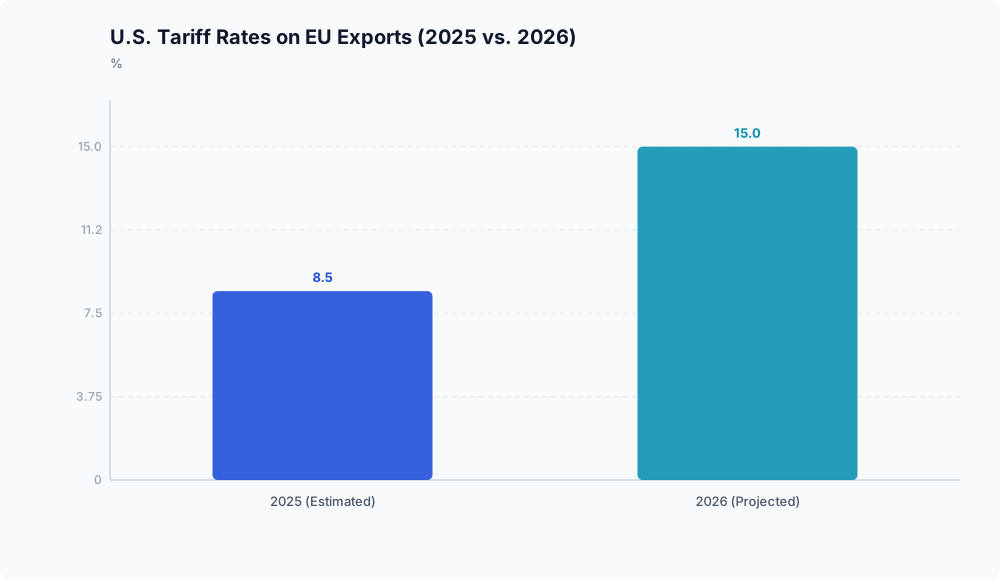
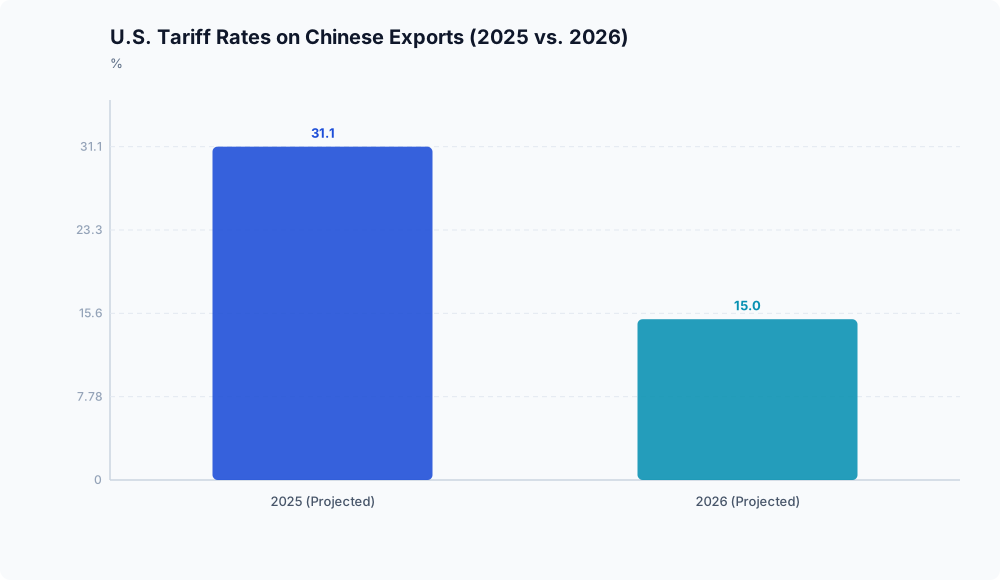
To understand the mechanics of this fracturing market, investors must trace the transmission chain from geopolitical projections directly to corporate equity fundamentals. The catalyst for this shift is the projected restructuring of the global trade landscape. Forecasts suggest a potential fixed 15% tariff rate for European Union exports to the United States. This represents a significant jump from the EU’s estimated 8.5% effective rate in 2025, according to the report The US tariff shock in 2025 vs 2026. Simultaneously, tariffs on competing nations like China, India, and Indonesia are projected to converge toward this exact same 15% baseline in 2026, dropping from their punitive 2025 highs, where China is projected to face a staggering 31.1% rate, as noted in The US tariff shock in 2025 vs 2026.
The mechanism triggered by these projections is the establishment of a high, uniform cost floor for imported goods across major trading partners. For U.S. importers heavily reliant on European manufacturing and intermediate goods, this near-doubling of the EU tariff rate would guarantee a rigid floor for supply chain input costs. The analytical implication is clear: the era of optimizing global supply chains purely for geographic cost efficiency is ending. Because the 15% rate is projected to be universally applied across major hubsfrom Europe to Southeast Asia to Chinacompanies can no longer arbitrage costs by simply shifting manufacturing across borders, as noted in the report The US tariff shock in 2025 vs 2026. They face a mandate to absorb structurally higher import taxes.
This mechanism collides directly with a domestic macroeconomic environment that is projected to lose its momentum. U.S. real GDP growth, which is forecast to post resilient year-over-year gains of 2.1% in the second quarter of 2025 and 2.3% in the third quarter, is expected to decelerate toward a projected 1.9% in 2026, according to the 2026 U.S. Economic Outlook by the WSJ. This deceleration indicates that consumer and business end-markets are becoming increasingly price-sensitive.
The resulting market effect can be visualized as a sequential flowchart of economic pressure:
- The Catalyst: Global tariff convergence projections push average baseline import costs to a rigid 15%.
- The Collision: These rising, inescapable input costs meet a constrained consumer base operating in a sluggish 1.9% projected GDP growth environment.
- The Behavioral Outcome: Corporations, facing a consumer base whose spending growth is expected to moderate to approximately 2.1%, are unable to execute price hikes to offset the new tariffs without destroying demand.
- The Terminal Market Effect: Severe margin compression specifically targeting traditional, non-AI equities that lack secular growth tailwinds to mask their deteriorating unit economics.
This margin squeeze forces traditional industrial, consumer, and manufacturing sectors to divert cash flow away from growth investments just to absorb tariff-induced margin decay. Meanwhile, technology firms aggressively invest in next-generation infrastructure, sustaining growth through dedicated corporate spending. This divergence in capital allocation is what ultimately bifurcates the U.S. equity market.
Highest-Signal Evidence: The Data Driving the Divide
The numerical breakdown of this two-track thesis reveals a stark divergence in forward-looking corporate metrics. The U.S. macroeconomic backdrop is currently defined by a steady, albeit gradually softening, growth trajectory. While the top-line figures suggest a relatively placid macroeconomic surface, the underlying data points to a massive reallocation of corporate resources.
Business investment in 2026 is expected to remain robust, but this strength is primarily due to companies racing to reach the frontier of AI-related technological advancement, as detailed in the 2026 U.S. Economic Outlook by the WSJ. The projected 4% surge in AI-driven business investment stands in stark contrast to the downward pressure anticipated for non-AI capital expenditures. Because companies are compelled to aggressively fund AI initiatives to maintain competitive parity, they appear to be cannibalizing budgets previously earmarked for conventional upgrades.
The following table contrasts the steady macroeconomic facts against this projected divergence in investment trajectories:
| Macroeconomic Indicator / Trend | Verified Data & Projections | Capital Expenditure Trajectory |
|---|---|---|
| U.S. Real GDP Growth (2025) | Projected Q2: +2.1% YoY, Q3: +2.3% YoY | Steady baseline economic expansion masking internal shifts. |
| Federal Reserve Policy (2025) | 3 interest rate cuts projected | Easing cost of capital broadly, though impacts lag. |
| U.S. Real GDP Growth (2026) | Projected +1.9% (Baseline) | Softening overall economic growth. |
| AI Business Investment (2026) | Expected +4% surge | Hyper-focused growth driven by frontier competition. |
| Non-AI Business Investment (2026) | Expected downward pressure | Contraction or deferment of traditional capex to absorb tariffs. |

This data paints a picture of an economy undergoing a profound structural transition beneath the cover of stable GDP prints. The anticipated 1.9% growth rate for 2026 is not a reflection of uniform economic health; rather, it is the mathematical average of booming AI infrastructure masking a struggling traditional economy, according to the 2026 U.S. Economic Outlook by the WSJ.
Mitigating the risk of this non-AI contraction is the Federal Reserve’s substantial remaining monetary ammunition. Assuming the execution of three projected interest rate cuts in 2025 to attempt a soft landing, the Fed would retain the capacity to cut interest rates by an additional 350 basis points if economic conditions deteriorate, according to the 2026 U.S. Economic Outlook by the WSJ. This massive 350-basis-point buffer acts as a powerful macroeconomic put option. However, expectations point toward a gradual pace for any additional cuts, meaning borrowing costs may not fall fast enough to rescue the balance sheets of margin-compressed traditional businesses, as noted in the 2026 U.S. Economic Outlook by the WSJ.

Scenario Analysis: Navigating the 2026 Bifurcation
The baseline outlook for 2026 equities presents a structural tug-of-war between artificial intelligence capital expenditures and traditional macroeconomic headwinds. However, the ultimate path of the market depends heavily on consumer resilience, the timing of AI monetization, and the speed of Federal Reserve intervention.
The Base Case: Concentrated Returns and Traditional Stagnation In the base scenario, U.S. real GDP cools to the projected 1.9% in 2026, according to the 2026 U.S. Economic Outlook by the WSJ. The projected 15% global tariff convergence establishes a permanently higher baseline cost structure for global supply chains compared to the pre-2025 era. Traditional non-AI equities suffer chronic margin compression as they struggle to pass these costs onto a consumer whose spending growth has moderated to 2.1%. Meanwhile, hyperscalers and AI infrastructure providers continue to decouple from traditional economic cycles, sustained by the 4% surge in AI-driven business investment. For U.S. investors, this implies a continuation of highly concentrated equity market returns, where tech-heavy indices mask underlying stagnation in the broader industrial and consumer economy. The premium placed on AI equities is treated not as a speculative frenzy, but as a rational capital retreat toward the only sectors capable of defending their margins.
The Upside Scenario: The Fed Broadens the Rally An upside scenario relies heavily on the Federal Reserve utilizing its projected monetary policy ammunition to offset these structural trade costs. Should traditional corporate margins face severe compression from the 15% global tariff wall, the Fed could aggressively deploy its remaining 350 basis points of rate-cut capacity, as outlined in the 2026 U.S. Economic Outlook by the WSJ. This liquidity lifeline would significantly reduce debt servicing costs, providing immediate relief to capital-intensive, non-AI businesses currently under downward investment pressure. If the Fed cuts rates rapidly enough, traditional businesses could utilize cheaper credit for expansion, offsetting the tariff erosion. For market participants, such an aggressive easing cycle would likely trigger a broadening of the equity rally, allowing small-cap, value, and domestic-centric operators to catch up to their mega-cap technology peers.
The Downside Scenario: The Dual-Shock Contraction A severe downside scenario materializes if the universal tariff burden chokes consumer spending, dragging broader economic growth well below previously projected thresholds. This consumer contraction would be particularly devastating if it coincides with an elongation of the return on investment (ROI) timeline for current AI capital expenditures. It is critical to note that hard evidence regarding the exact timing and magnitude of AI ROI remains extremely thin, making hyperscaler revenue projections highly speculative at this stage. If corporate customers balk at the high costs of AI integration amid a slowing economy, the anticipated productivity gains could take years longer to materialize than current tech valuations imply. The implication for U.S. investors is a severe dual-shock: a sharp multiple contraction in AI market leaders (as monetization lags the massive infrastructure spend) coupled with an earnings recession in the broader, tariff-burdened traditional economy.
What to Watch Next: Leading Indicators for 2026
As the U.S. economy transitions into this bifurcated state, market participants must closely monitor high-frequency leading indicators that could trigger shifts in monetary policy or expose hidden vulnerabilities in the tech sector.
1. Consumer Spending Thresholds and Non-AI Capex: A critical metric for investors will be whether consumer spending indicators dip below the 2.1% growth threshold projected for mid-2025. Because business investment unrelated to the artificial intelligence boom is already facing downward pressure, traditional sectors may soon pull back on hiring and wage expansion, according to the 2026 U.S. Economic Outlook by the WSJ. Market participants should treat capital expenditure reductions in legacy industries as an early warning signal for a retreating U.S. consumer base, as reduced corporate spending inevitably trickles down to household incomes.
2. Earnings Call Scrutiny on Tariff Pass-Through: Corporate earnings reports in the coming quarters will reveal the tangible margin impacts of the newly restructured global trade environment. Investors must heavily scrutinize early earnings calls from non-tech equities to see if domestic importers of EU and Asian goods are absorbing the new 15% costs internally or successfully passing them onto consumers, as discussed in The US tariff shock in 2025 vs 2026. Portfolios will likely need to favor domestic-centric operators or those demonstrating sufficient pricing power and margin buffers to absorb the elevated baseline costs of global trade.
3. Tariff Contagion in AI Hardware Supply Chains: Despite the clear sectoral divergence favoring technology, significant uncertainty remains regarding how the 15% global tariff baseline will ultimately impact the physical hardware supply chains underpinning AI companies. Current evidence lacks specific detail on whether specialized tech components will face the same tariff friction as broader consumer goods. Investors must watch for any indications that trade barriers are inflating the cost of AI infrastructure build-outs, which could accelerate the localized vulnerability within the tech sector if monetization timelines stretch.
4. The Federal Reserve’s Timeline: Finally, watch the Fed’s response to sticky import inflation. If traditional retailers are forced to pass the 15% EU tariff costs onto buyers, it will likely accelerate the consumer spending dip, creating a feedback loop of slowing growth. Such inflationary pressure combined with a slowing economy would severely complicate the Federal Reserve’s timeline, forcing them to weigh tariff-driven inflation against the need to deploy their 350 basis points of rate-cut capacity, according to the 2026 U.S. Economic Outlook by the WSJ. The speed at which companies pass through these costs will dictate both the health of the consumer and the Fed’s monetary response.
Conclusion
The data for 2026 outlines an economy where aggregate stability is an illusion, masking a violent internal rotation of capital. The defining narrative for investors is no longer whether the broader market will rise or fall, but how to position portfolios across a fault line defined by AI Capex and Tariffs. The evidence clearly establishes that traditional businesses are entering a period of structural margin impairment, trapped between a rigid 15% global tariff floor and a cooling consumer base. Conversely, the technology sector is attempting to outrun the macroeconomic cycle entirely, fueled by a 4% surge in dedicated infrastructure spending. For the astute investor, this means broad index funds may offer diminishing utility. Success in this bifurcated environment requires surgical stock selection: identifying technology firms that can actually translate massive capital expenditures into tangible productivity gains before monetization lags, while ruthlessly filtering non-tech equities for domestic-centric supply chains and impenetrable pricing power. The era of easy geographic cost arbitrage is over; the era of technological margin defense has begun.
Disclaimer: This analysis is for informational purposes only and does not constitute investment, financial, real estate, or legal advice. Always consult a licensed financial advisor before making investment decisions.
FAQ
How will the proposed 15% EU tariff directly impact US consumer prices and spending? The 15% EU tariff establishes a structurally higher, rigid floor for supply chain input costs. In an environment where overall economic growth is softening to 1.9% and consumer spending growth is moderating to roughly 2.1%, companies face a difficult choice: absorb the costs and suffer margin compression, or pass the costs onto consumers. If these costs are passed through, it risks destroying demand and accelerating a dip in consumer spending, creating a feedback loop of slowing growth.
Why is AI capex projected to grow while non-AI business investment faces downward pressure in 2026? AI capex is projected to surge by 4% because companies are racing to reach the frontier of AI-related technological advancement to maintain competitive parity. This aggressive funding creates a crowding-out effect, where budgets previously earmarked for conventional upgrades are cannibalized. Consequently, traditional, non-AI business investments face downward pressure as companies divert cash flow away from legacy growth investments to fund AI initiatives and absorb tariff-induced margin decay.
Does the Federal Reserve have enough capacity to cut rates further to offset tariff-driven margin pressures on non-tech equities? Yes, the Federal Reserve retains substantial capacity. Assuming the execution of three projected interest rate cuts in 2025, the central bank still has the ammunition to reduce rates by an additional 350 basis points. However, the pace of these cuts is expected to be gradual, meaning borrowing costs may not fall fast enough to provide immediate relief to the balance sheets of margin-compressed traditional businesses.