
How Migration Drop and Long-Term Yields Impact Real Estate
Navigating the Migration Drop and Long-Term Yields in U.S. Real Estate
The U.S. real estate market is currently navigating a critical inflection point defined by two colliding macroeconomic forces: a sudden Migration Drop and Long-Term Yields that remain stubbornly elevated. For years, the traditional real estate playbook relied on a simple, reliable formula: robust population growth fueled baseline housing demand, while a steady influx of immigrant labor helped cap construction costs. That dynamic is now reversing in real time.
A projected sharp drop in net migration is simultaneously constraining population-driven housing demand and tightening the supply of foundational construction labor. When combined with long-term Treasury yields that remain structurally high despite recent monetary easing, developers and investors face a complex squeeze. The cost of capital remains a formidable barrier, diminishing the traditional benefits of a slowing economy and forcing a revaluation of capital-intensive projects. This is not merely a temporary cyclical dip; it is a fundamental recalibration of real estate investment strategies. The era of relying on steady population influxes to outgrow high construction and financing costs is shifting, demanding a pivot toward operational efficiency and localized demand analytics.
The Transmission Chain: From Labor Scarcity to Reduced Viability
The transmission chain slowing U.S. real estate development begins with a severe contraction in labor supply, driven by shifting demographic and policy trends, and ends with a severe reduction in project viability.
Step 1: The Supply Constraint The chain reaction initiates with a projected “sharp drop in net migration,” which is expected to restrict broader employment growth and fundamentally alter the baseline cost structure for developers, according to the 2026 U.S. Economic Outlook - WSJ. This macro-level demographic shift is expected to materialize on the ground. Immigration enforcement activities are projected to impact 28% of surveyed construction firms by mid-2025, according to US Construction Labor Shortage to Worsen with 349K New Workers. This creates a supply constraint that disproportionately targets the foundational tiers of the construction workforce. Consequently, developers are forced to compete for a shrinking pool of domestic tradespeople, driving up baseline wage costs before construction begins.
Step 2: Operational Friction and Timeline Extension Labor scarcity directly translates into operational friction. A joint survey by the Associated General Contractors of America (AGC) and NCCER revealed that 92% of construction firms experienced difficulty finding workers to hire. The immediate, tangible result of this friction is that 45% of respondents suffered direct project delays, as noted in US Construction Labor Shortage to Worsen with 349K New Workers. When nearly half of all construction firms cannot maintain project timelines, the predictability required to underwrite new real estate development diminishes.
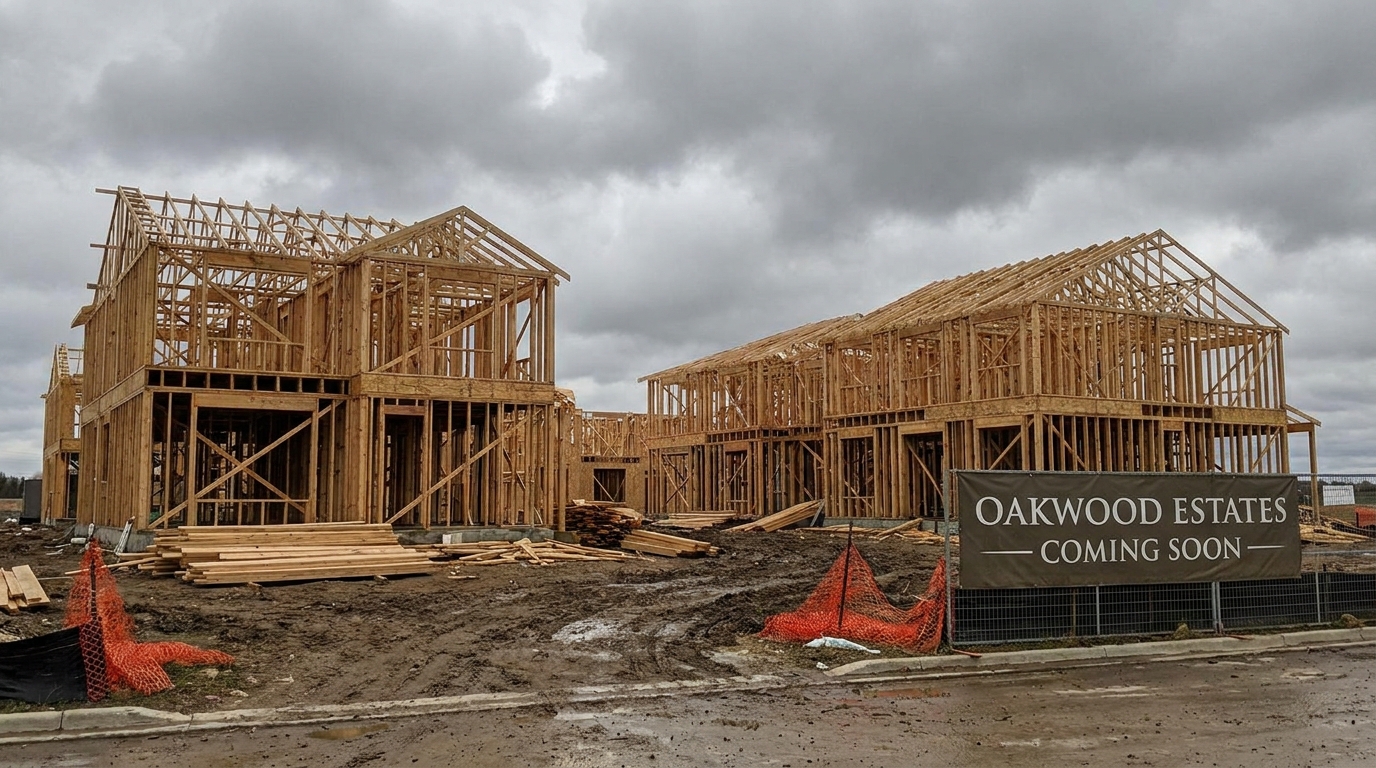
Step 3: The Capital Cost Multiplier These extended timelines ultimately collide with a macroeconomic environment defined by structurally high long-term yields. Although the Federal Reserve is projected to cut interest rates three times in 2025, the expected relief for long-term real estate capital remains noticeably muted. Future rate reductions are expected to occur only gradually as U.S. real GDP growth slows to a projected 1.9% in 2026, according to the 2026 U.S. Economic Outlook - WSJ. In real estate development, time is directly correlated to the cost of capital. When a project’s timeline stretches due to labor shortages, the carrying cost of debt compounds at a significantly higher rate than developers experienced during the previous decade of zero-interest-rate policy.
This dynamic acts as a negative multiplier. Even minor labor delays can rapidly erode a project’s internal rate of return (IRR) and trigger loan covenant breaches. Because developers cannot accurately forecast completion dates or contain debt service costs, the mathematical viability of new projectsor “pro formas”faces critical challenges.
High-Signal Evidence: Decoding the 2026 Labor Deficit
The U.S. economy is expected to demonstrate resilient expansion through the middle of 2025, but this steady macroeconomic performance masks structural bottlenecks in the industrial economy. U.S. real gross domestic product (GDP) is projected to grow by 2.1% in the second quarter and accelerate slightly to 2.3% in the third quarter compared to prior-year figures, per the 2026 U.S. Economic Outlook - WSJ. However, top-line economic growth is increasingly decoupled from the physical labor capacity required to build new infrastructure.
When analyzing the root causes of this labor deficit, industry data presents a complex, sometimes conflicting picture that requires careful investor synthesis.
The Tech Crowding-Out Effect On the demand side, significant infrastructure requirements for artificial intelligence are dominating the narrative. Data centers are projected to account for approximately 85% of the construction industry’s labor needs in 2026, based on US Construction Labor Shortage to Worsen with 349K New Workers. This concentration creates a crowding-out effect. Traditional commercial and residential developers are forced to bid against highly capitalized technology firms for the same limited pool of electricians, pipefitters, and structural engineers.
Because tech giants are largely insensitive to construction wage premiumsgiven the return on investment for digital infrastructuretraditional real estate projects face intense pricing pressure. While the 85% figure appears high and may reflect regional concentrations rather than a uniform national reality, it implies that non-tech development will face elevated execution risks and inflated labor bids over the next several years.
The Uncertainty of Labor Projections Adding to the complexity is a degree of uncertainty in forward-looking labor projections. The Associated Builders and Contractors (ABC) projects the industry will still need 349,000 net new workers in 2026 to balance supply and demand, with the deficit expanding to 456,000 in 2027, according to US Construction Labor Shortage to Worsen with 349K New Workers.
However, the ABC revised its 2026 shortage estimate downward from an initial 499,000 to 349,000. The specific factors prompting this 30% reduction remain unclear. Evidence is thin on whether underlying demand is actually cooling, if developers are preemptively pausing projects due to prohibitive financing costs, or if statistical methodologies simply shifted. With Deloitte projecting baseline GDP growth to moderate to 1.9% in 2026, it is possible that broader economic cooling is expected to naturally alleviate some construction demand. Regardless of the exact baseline, the gap between available labor and project demand remains wide.
| Metric | Mid-2025 to 2026 Projection | Strategic Implication for Developers |
|---|---|---|
| Hiring Difficulty | 92% of firms report difficulty finding workers. | Baseline wage costs will rise; domestic labor pool is tapped out. |
| Project Delays | 45% of firms experience labor-induced delays. | Capital carrying costs will compound; IRR projections are vulnerable. |
| Policy Disruption | 28% of firms projected to be impacted by immigration enforcement. | Supply constraints will exacerbate organic demographic declines. |
| Tech Concentration | 85% of 2026 labor demand driven by data centers. | Traditional real estate will be crowded out by wage-insensitive tech giants. |
The Residential Pincer Movement
U.S. real estate developers and housing investors are facing dual pressures that threaten to constrain new supply. On one flank, builders face the persistent burden of expensive capital, which elevates the baseline cost of financing land and construction. On the opposing flank, they are being squeezed by escalating labor costs directly tied to a shrinking pool of immigrant workers.
This dual pressure challenges the traditional underwriting math for new residential projects. Profit margins are squeezed to points where ground-up development becomes difficult to justify. Furthermore, the contraction in net migration alters the demand calculus for residential real estate. Historically, new arrivals have served as a critical engine for household formation, particularly in the multifamily rental sector. As this demographic tailwind fades, the natural floor for baseline housing demand begins to lower.

Because the migration drop is anticipated to hold down employment growth and slow aggregate wage growth, as noted in the 2026 U.S. Economic Outlook - WSJ, prospective renters and buyers will likely face constrained purchasing power. For real estate investors, this signals a transition from an environment of population-driven absorption to one where organic tenant demand is increasingly scarce and highly competitive.
Second-Order Effects on Existing Assets While ground-up development funds will likely struggle to deploy capital profitably, the resulting lack of new inventory should provide a strong valuation floor for existing, stabilized assets. Homebuyers will likely bear the ultimate cost of this structural deficit, as the inability to deliver new inventory at scale keeps upward pressure on existing home prices and exacerbates affordability challenges. Conversely, institutional investors holding completed properties in high-demand sectors stand to benefit. The replacement cost of housing is rising, and new supply competition is being throttled. The barriers to entry for new competing supply remain high.
Forward Projections: Base, Downside, and Upside Scenarios
The U.S. construction sector enters 2026 facing a bifurcated market where macro-level constraints dictate asset-level performance. To synthesize these divergent trajectories, we must map the core catalysts and market impacts across three distinct scenarios.
The Base Case: Moderate Stalling and Compressed Yields In our base-case scenario, macroeconomic cooling intersects with prolonged labor tightness and sticky yields. Deloitte projects baseline real GDP growth to decelerate to 1.9% in 2026. Although the worker shortage projection was revised downward to 349,000, the deficit remains substantial enough to constrain output. Extended project timelines and elevated carrying costs will remain the baseline expectation. Investors should anticipate moderate project stalling across the industry, depressing internal rates of return for conventional real estate developments.
The Downside Scenario: Severe Workforce Disruption A severe downside scenario materializes if workforce disruptions escalate beyond current baseline projections, primarily driven by strict immigration enforcement. With 28% of construction firms projected to be impacted by immigration enforcement activities by mid-2025, according to US Construction Labor Shortage to Worsen with 349K New Workers, an amplification of this trend could significantly stall new builds. Furthermore, a sharp drop in net migration will restrict broader employment growth, exacerbating the industry’s existing demographic shifts, per the 2026 U.S. Economic Outlook - WSJ. If enforcement heavily impacts the undocumented labor pool, second-order effects will likely include loan defaults on stalled projects and a contraction in housing supply. Heavy reliance on traditional, labor-intensive construction methods is a critical downside vulnerability.
The Upside Scenario: Tech Subsidies and Yield Compression An upside scenario hinges on localized demand booms catalyzing structural efficiencies alongside a more favorable cost of capital. The data center boomaccounting for roughly 85% of projected labor needscould subsidize broader construction technology adoption. Highly capitalized tech developers may invest heavily in automation and modular building to bypass the 349,000-worker deficit. Additionally, if financing costs drop faster than the anticipated gradual cuts in 2026, as outlined in the 2026 U.S. Economic Outlook - WSJ, the resulting margin expansion could offset elevated labor premiums. Cheaper capital would revive stalled commercial and residential pipelines.
| Scenario | Core Catalysts | Market Impact & Investor Implications |
|---|---|---|
| Base Case | Prolonged labor tightness (349k deficit) and sticky yields. | Moderate project stalling; elevated carrying costs compress IRRs. |
| Downside | Escalated immigration enforcement; sharp drop in net migration. | Severe workforce disruption stalling new builds; elevated default risk. |
| Upside | Data center boom subsidizes tech; unexpected yield compression. | Automation offsets labor gaps; cheaper capital revives pipelines. |
Leading Indicators: What to Watch Next
The U.S. economy is entering a transitionary phase where aggregate data may mask localized pressures. Broad economic indicators will be less useful than sector-specific metrics for assessing project viability. Market participants should monitor the following specific convergence of triggers:
- Regional Construction Wage Indices: Industry estimates for the 2026 construction worker shortage hover around 349,000 personnel. If net migration falls sharply as projected, the construction industry could experience wage spikes that diverge significantly from the slowing aggregate national wage trend. Localized wage inflation will serve as a leading indicator for margin compression in upcoming infrastructure and commercial projects.
- Immigration and Border Policy Metrics: Because the projected decline in net migration is expected to hold down overall employment growth, any acceleration in border enforcement or tightening of visa allocations will disproportionately impact labor-intensive sectors. Watch for monthly shifts in net migration figures, border apprehension rates, and temporary worker visa processing times. A tightening in these metrics will likely precede upward revisions in construction worker shortage estimates.
- The Yield Curve Spread: The trajectory of the financing environment remains a paramount concern. The spread between short-term Federal Reserve rates and 10-year Treasury yields is a crucial metric. A steepening yield curve, driven by anchored long-term yields and declining short-term rates, would signal that capital markets are pricing in a sustainable easing cycle. Conversely, if long-term yields remain elevated due to persistent inflation fears or deficit concerns, construction financing will remain expensive despite nominal Fed cuts.
Conclusion
The U.S. real estate market is undergoing a structural transformation, moving away from an era of abundant labor and cheap debt into a constrained environment defined by a Migration Drop and Long-Term Yields. The evidence indicates that top-line economic resilience is masking bottlenecks at the job site. With 92% of firms struggling to hire and 45% facing delays, the physical capacity to build is decoupled from the desire to deploy capital. Furthermore, the concentration of labor demand within the data center sector suggests that capital will increasingly flow toward infrastructure supporting secular technological trends, redirecting vital resources away from traditional commercial and residential real estate.
For investors, navigating this dual threat demands an immediate pivot. Relying on the pre-2020 paradigm of broad macroeconomic tailwinds is no longer a viable underwriting strategy. Instead, market participants must defensively position portfolios by prioritizing developers actively substituting labor with capital through construction technology, or by pivoting to existing, stabilized assets that benefit from the rising barriers to new supply. Ultimately, immigration policy and localized labor availability are now just as critical to real estate valuations as interest rates and zoning laws.
Disclaimer: This analysis is for informational purposes only and does not constitute investment, financial, real estate, or legal advice. Always consult a licensed financial advisor before making investment decisions.
FAQ
How does the sudden migration drop affect construction timelines and development costs? A sharp drop in net migration directly shrinks the pool of available foundational construction labor. This scarcity forces developers to compete for a limited domestic workforce, inherently driving up baseline wage costs. Operationally, this lack of personnel leads to friction on the job site; currently, 45% of construction firms are experiencing project delays due to workforce shortages. These extended timelines compound the carrying costs of debt, inflating overall development costs and compressing project profit margins.
Why are long-term real estate financing costs remaining high even when the Fed cuts rates? While the Federal Reserve executes short-term interest rate cuts, long-term financing costswhich anchor mortgage and development loansare tied to long-term Treasury yields. These yields remain structurally elevated due to broader macroeconomic factors, such as persistent inflation concerns and national deficit levels. Consequently, the anticipated relief for long-term real estate capital has been muted, and future rate reductions are expected to occur only gradually as GDP growth moderates.
Are data center projects or new immigration policies the primary cause of the 2026 construction labor shortage? The shortage is a collision of both factors. On the demand side, data center development is projected to account for 85% of construction labor needs in 2026, creating a crowding-out effect for traditional builders. On the supply side, restrictive immigration policies are actively disrupting the workforce, with 28% of construction firms expected to report impacts from immigration enforcement by mid-2025. Therefore, hyper-concentrated tech demand is surging at the exact moment foundational labor supply is being constrained by policy enforcement.
How will the slowdown in US migration impact population-driven housing demand over the next decade? Historically, new immigrants have been a critical engine for household formation and baseline housing demand, particularly in the multifamily rental sector. As net migration drops, this demographic tailwind fades, lowering the natural floor for housing demand. Additionally, because the migration drop is expected to hold down overall employment and wage growth, prospective renters and buyers will face constrained purchasing power, making organic tenant demand increasingly scarce and highly competitive for investors.