
Data center CRE and grid constraints reshape valuations
Data center CRE and grid constraints: The New Economics of Real Estate
The rapid scaling of artificial intelligence workloads has fundamentally altered the commercial real estate (CRE) landscape. Energy access has transformed from a standard utility requirement into the primary determinant of asset valuation. At the center of this structural shift are Data center CRE and grid constraints, which have collided to rewrite the economics of property development. Driven by hyperscaler demand, the projected addition of nearly 100 gigawatts of global data center capacity this decade is rapidly exhausting local grid infrastructure. Consequently, grid connection timelines for large new loads average nearly five years across major markets, according to JLL. This sudden exhaustion of local grid capacities has fractured the market into two distinct tiers: properties with secured energy access, and traditional developments stalled by infrastructure deficits. For US investors, hyperscaler demand is a macroeconomic force dictating capital allocation across the broader real estate sector.
The Transmission Chain: From AI Demand to Market Disruption
To understand how artificial intelligence requirements reshape valuations across traditional commercial real estate portfolios, market participants must map the ripple effects of a single hyperscaler lease. The transmission chain moves rapidly from a localized technology event to a broad macroeconomic headwind, fundamentally altering project viability for entirely unrelated asset classes.
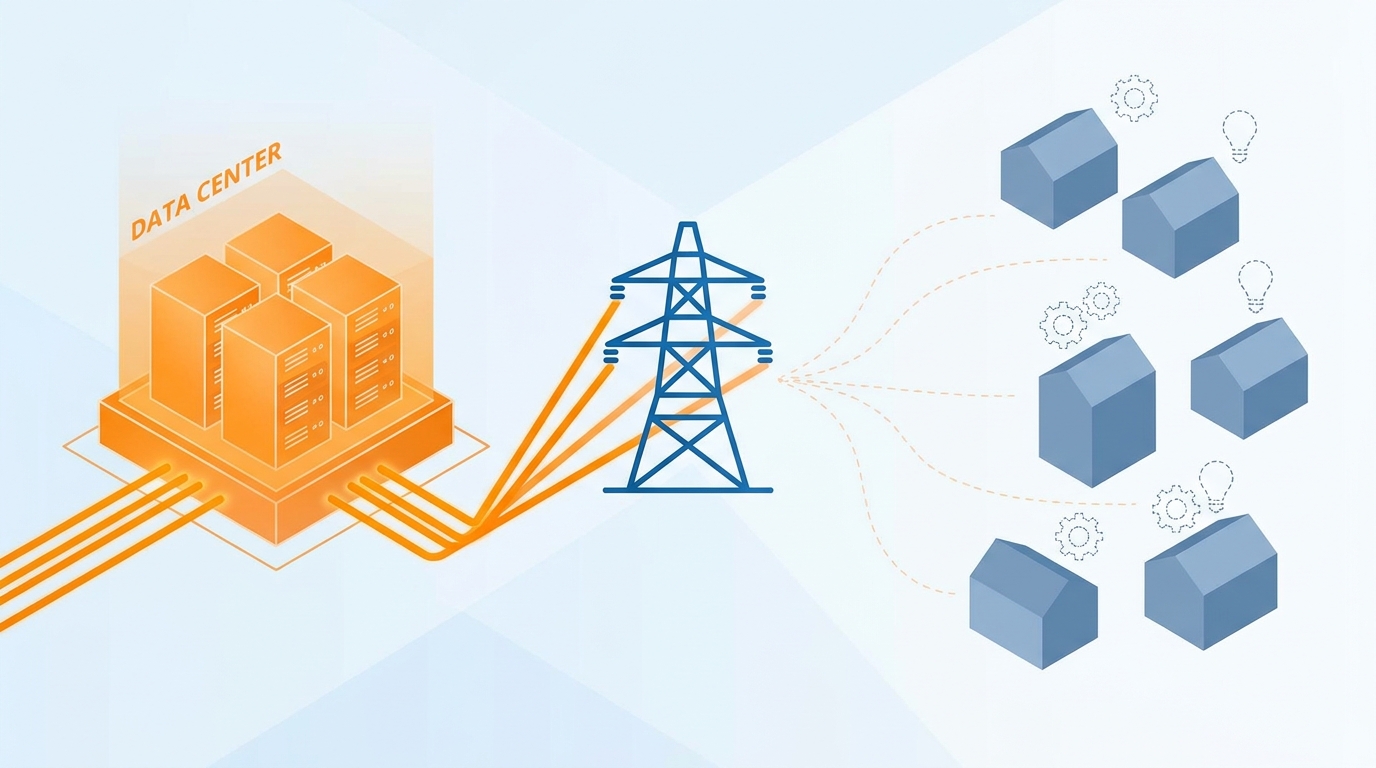
The mechanism begins when a major technology firm secures a massive power commitment for a new AI facility. These facilities require unprecedented electrical loads, meaning a single lease can instantly consume a local utility substation’s entire remaining capacity for the next half-decade. This effectively freezes the regional utility queue.
The immediate market effect is collateral damage to traditional commercial or residential developments. A planned industrial park or multifamily complex suddenly faces multi-year connection delays simply because the local grid cannot support additional loads. JLL notes a 1.5 to 2-year discrepancy in “time-to-power” expectations between utility providers and hyperscalers or colocation operators.
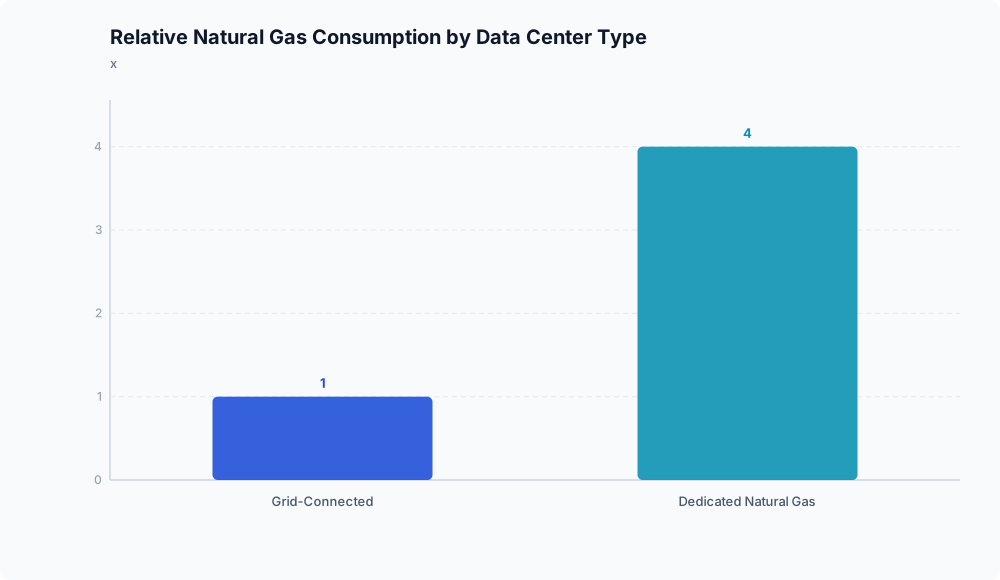
Desperate to bypass these five-year utility bottlenecks, data center developers are pivoting to off-grid or dedicated power solutions. However, this introduces a severe second-order economic effect. Facilities relying on dedicated natural gas supplies consume up to four times the amount of natural gas compared to grid-connected data centers, according to KPMG International. This resource-intensive workaround exacerbates price volatility in local energy markets, squeezing operating margins for traditional manufacturers. Ultimately, this dynamic forces non-data center developers to either halt projects or incur massive costs to engineer alternative off-grid solutions.
High-Signal Evidence: The Valuation Gap and Cost-Push Inflation
The bifurcation of the real estate market has created a stark valuation gap where time-to-market certainty commands massive financial premiums. The underlying value of real estate is increasingly subordinate to the megawatt capacity of its grid connection.
On the revenue side, commercial real estate properties equipped with dependable energy systems are achieving rent premiums of up to 49% in some cases, according to JLL. Investors are effectively pricing in the avoidance of multi-year delays. Because hyperscalers cannot wait half a decade for power, existing properties with pre-secured energy systems command unprecedented leverage in lease negotiations. This scarcity transforms grid access into an economic moat.
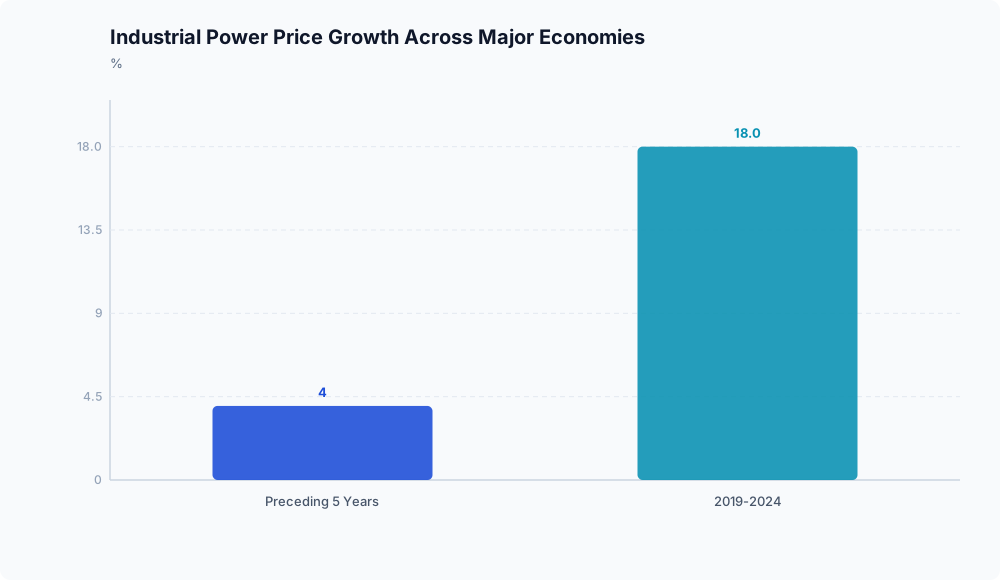
Conversely, standard properties lacking guaranteed power face compounding headwinds. Industrial power prices across major economies surged by approximately 18% between 2019 and 2024, an acceleration from the modest 4% growth seen in the preceding five years, as reported by JLL. This surge in operating expenses directly compresses net operating income for existing industrial and commercial assets.
The divergence between power-secure assets and standard portfolios illustrates a clear paradigm shift:
| Metric | Standard CRE Portfolios | Power-Secure / Data Center CRE |
|---|---|---|
| Power Cost Trend | +18% industrial power price increase (2019-2024) | High willingness to absorb premium rates for reliability |
| Grid Timeline | Subject to standard local utility constraints | Bypassing ~5-year connection delays via existing infrastructure |
| Valuation Impact | Margin compression from rising operational expenses | Rent premiums reaching up to 49% for dependable energy |
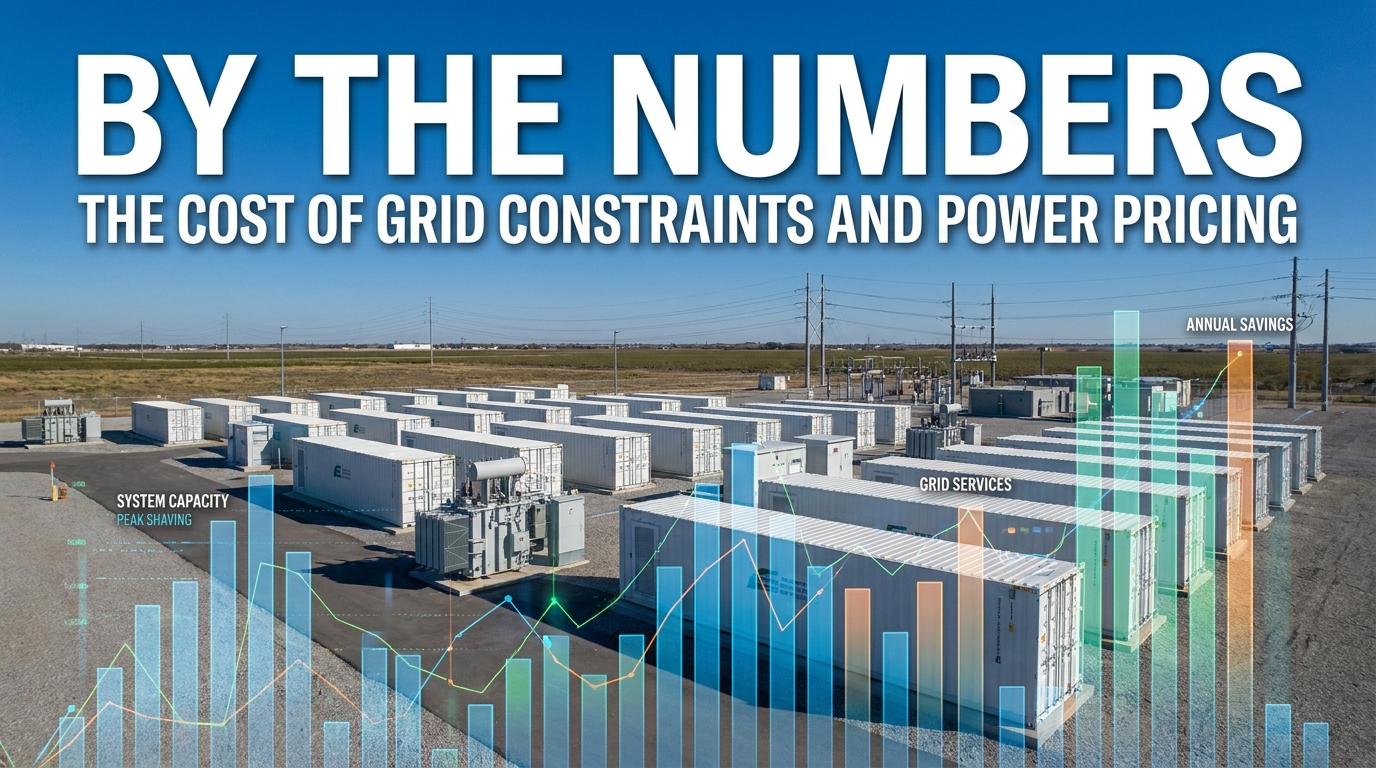
In response to these acute grid constraints, institutional capital is aggressively funding alternative energy infrastructure. Global annual energy transition investment reached a record $2.3 trillion in 2023, more than doubling the capital deployed in 2020, according to JLL. Fortunately for developers, the inflationary environment of grid power is partially offset by deflation in energy storage technology. Battery storage costs have plummeted by 75% over the past decade, falling from $448/kWh in 2015 to just $108/kWh in 2023, per JLL. This cost reduction is critical for CRE owners managing increasingly volatile site loads.
Scenarios for the Power Divide
Looking ahead, the macroeconomic impact of this power grab remains a complex balancing act. Market participants must underwrite utility procurement risk as a foundational element of any new development strategy.
The Base Case: Sustained Bifurcation and Margin Compression Persistent grid delays will continue to bifurcate the CRE market, heavily rewarding existing facilities with secured power while squeezing margins for traditional developments. US investors holding energized assets will likely enjoy sustained pricing power over hyperscalers desperate for capacity, continuing to capture rent premiums up to 49%, according to JLL. Traditional CRE developments will face margin compression as they compete for scarce grid allocations. Capital will rotate away from speculative land banking toward acquiring older properties solely to harvest existing utility interconnects.
The Upside Scenario: Technological Deflation and Decentralization An upside scenario hinges on the accelerated deployment of decentralized energy technologies alleviating grid constraints. If the record $2.3 trillion in global energy transition investments deployed in 2023 successfully integrates cheaper storage and microgrids into commercial properties, developers could bypass utility bottlenecks, according to JLL. Leveraging battery storage that now costs just $108/kWh, property owners could implement behind-the-meter peak shaving to neutralize grid volatility. This would moderate extreme rent premiums and expand the pipeline of developable land.
The Downside Scenario: Utility Rationing and Stagflation A downside scenario involves severe utility rationing that halts new developments and triggers localized inflation. The upfront costs and energy grid stress generated by AI data centers are already contributing to broader inflation, forcing macroeconomic responses such as the Federal Reserve keeping interest rates firmly on hold, according to KPMG International. If data centers continue utilizing dedicated natural gas suppliesconsuming up to four times the normal amountcommodity costs for other users will spike, per KPMG International. Should utility providers respond by rationing power, new construction could stall indefinitely, creating a stagflationary drag on local economies.
What to Watch Next: Indicators and Triggers
To navigate a landscape where power availability dictates commercial real estate viability, US market participants must continuously monitor specific indicators signaling shifting grid dynamics.
- Interconnection Queue Wait Times: The most critical leading indicator for development viability is the utility interconnection queue. With timelines currently averaging nearly five years across major markets, according to JLL, investors must track regional queue expansions. Expanding wait times serve as an early warning signal for constrained future supply.
- Local Industrial Power Price Indices: US investors must track forward power pricing curves. The 18% surge in industrial power prices between 2019 and 2024, according to JLL, directly threatens net operating income. A sustained upward trend signals a deteriorating environment for tenant profitability.
- Capital Flows to Onsite Generation: Tracking the volume of capital flowing into private microgrids provides a reliable proxy for grid unreliability. As global energy transition investments hit $2.3 trillion and battery costs drop to $108/kWh, according to JLL, a spike in these alternative investments indicates that public utilities can no longer meet commercial demand.
- Site-Level Load Management Metrics: Unmanaged Electric Vehicle (EV) charging infrastructure has the potential to more than triple a site’s peak power demand, per JLL. Investors must evaluate whether asset managers are deploying smart load-balancing software and integrated battery buffers to immunize against unexpected capital expenditures.
Conclusion
The rapid scaling of AI infrastructure has forced a permanent repricing of commercial real estate. Energy strategy and real estate strategy are now fundamentally inseparable. The evidence clearly indicates that passive energy consumption is no longer viable; active, integrated power management will dictate future competitiveness. As the market prepares for the addition of 100 GW of global data center capacity, it remains highly uncertain whether the anticipated long-term productivity growth associated with AI will eventually offset the immediate inflationary pressures burdening the market. Until this macroeconomic question is resolved, Data center CRE and grid constraints will continue to act as the primary filter for institutional capital. Investors who successfully underwrite power procurement as a core revenue-generating feature will capture outsized returns, while those who fail to adapt to the realities of localized grid stress risk holding stranded, heavily discounted assets in the coming decade.
Disclaimer: This analysis is for informational purposes only and does not constitute investment, financial, real estate, or legal advice. Always consult a licensed financial advisor before making investment decisions.
FAQ
How do grid connection delays specifically impact the valuation of existing data center CRE? Grid connection delays, currently averaging nearly five years for large loads, act as a massive barrier to entry that heavily restricts new supply. This scarcity allows existing properties with dependable, pre-secured energy systems to command significant leverage, achieving rent premiums of up to 49% as tenants pay for time-to-market certainty.
Why are traditional commercial and residential real estate developments facing utility delays due to AI? When hyperscalers secure massive power commitments for new AI facilities, they can instantly consume a local utility substation’s entire remaining capacity. This effectively freezes the regional utility queue, meaning nearby traditional developments face multi-year connection delays simply because the local grid lacks the capacity to support additional loads.
How are rising industrial power prices affecting the operating costs of non-data center property portfolios? Industrial power prices surged by approximately 18% between 2019 and 2024, a sharp acceleration from the 4% growth seen in the prior five years. This rapid escalation in utility costs directly compresses net operating income for existing industrial and commercial assets, forcing asset managers to underwrite energy inflation as a central operational risk.
Can on-site battery storage or renewable energy effectively offset grid constraints for new CRE developments? Yes, the financial viability of on-site power generation and storage has improved dramatically. Battery storage costs have dropped 75% over the past decade to $108/kWh. By leveraging these cheaper storage solutions, property owners can implement behind-the-meter peak shaving to neutralize grid volatility and manage surges in site-level demand, such as those caused by EV charging.