The Fed Independence Crisis: US Equity Market Impacts
The Fed Independence Crisis: Institutional Friction and Market Impacts
The escalating confrontation between the executive branch and the Federal Reserve has introduced an institutional risk premium into US equity markets, triggering a scenario recognized as a Fed Independence Crisis. On April 15, 2026, President Trump stated his intention to dismiss Fed Chair Jerome Powell if he refuses to resign his board governor position when his term as chair concludes in May, according to CNBC.
This unprecedented standoff at the highest levels of US economic governance has led Powell to firmly reject the demand. He stated he will not vacate his board seatwhich extends to January 2028until a lingering Department of Justice investigation into him is officially dropped.
Although a judge has already found “zero” evidence of wrongdoing by Powell, the DOJ probe remains open, as noted by KPMG International. For equity investors, this political friction alters the market environment. The bedrock assumption of central bank independence is now actively under pressure, prompting global capital allocators to reprice US sovereign risk.
The Transmission Chain: From Political Friction to Portfolio Impacts
To understand how bureaucratic gridlock and executive actions translate into portfolio impacts, investors must trace the exact transmission mechanism from political event to market effect. Market participants rarely price in constitutional issues directly; instead, they reprice the secondary effects of the resulting policy delays.
The pathway operates through a sequential degradation of institutional trust, ultimately repricing the foundational discount rates used across global finance. When monetary policy becomes subordinated to executive or judicial maneuvering, the foundational assumption of a politically insulated Fed begins to fracture.
The following matrix illustrates how legal and political friction at the Federal Reserve cascades down into equity valuations. By mapping this chain, the direct link between Washington’s maneuvers and Wall Street’s multiple compression becomes analytically clear.
| Transmission Stage | Catalyst & Mechanism | Market Impact |
|---|---|---|
| 1. Political Interference | SCOTUS hearing on Lisa Cook; DOJ probe into Powell. | Immediate leadership paralysis and delayed confirmations. |
| 2. Loss of Credibility | Erosion of the Fed’s operational independence. | Diminished trust in long-term monetary stability. |
| 3. Rising Treasury Yields | Demand for a risk premium to compensate for instability. | ‘Risk-free’ 10-year yields forecast to breach 4.29%. |
| 4. Multiple Compression | Higher discount rates applied to future corporate earnings. | Valuation drawdowns for long-duration growth and tech stocks. |
This upward repricing of the risk-free rate acts as the primary catalyst for valuation multiple compression, particularly in equity markets. In corporate finance, the 10-year Treasury yield serves as the baseline discount rate for future cash flows. As this rate increases, the present value of distant earnings mathematically declines.
Second-order effects dictate that long-duration assetsspecifically high-growth technology stocks whose valuations rely heavily on earnings projected years into the futurewill bear the brunt of this contraction. Even if these companies maintain strong fundamental earnings growth, their price-to-earnings multiples must compress to adjust for the higher yield environment. Consequently, the political pressure on the Fed translates directly into valuation declines for growth-oriented equity portfolios.
The Highest-Signal Evidence: Treasury Markets Sound the Alarm
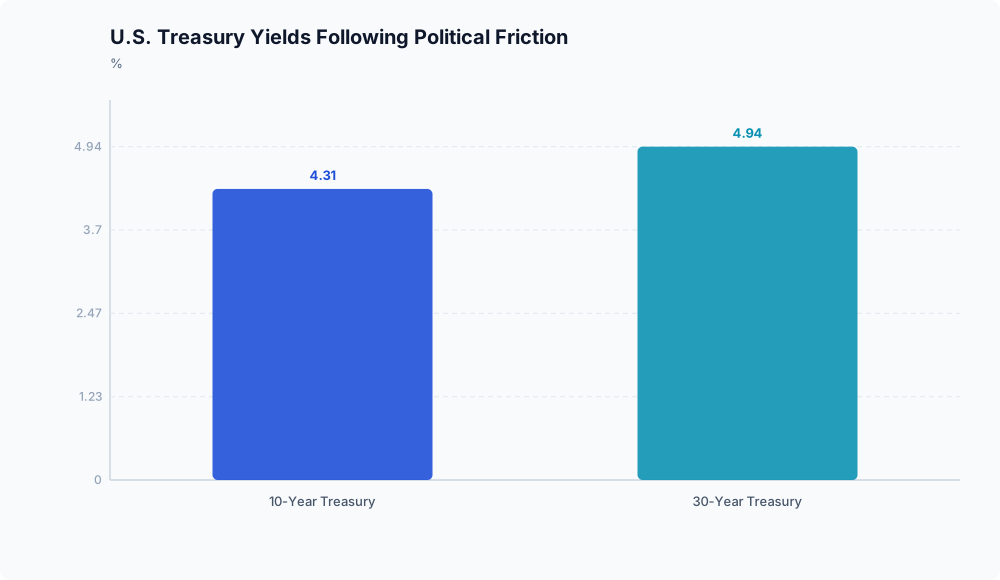
The immediate fallout from this institutional clash is already materializing in the bond market, which serves as the foundational discount mechanism for equity valuations. Following Trump’s statements, the 10-year U.S. Treasury yield climbed to 4.311%, while the 30-year Treasury bond yield reached 4.937% on April 16, reported CNBC.
This upward momentum has already breached the 4.29% threshold that a February Reuters survey forecast the 10-year yield would reach within a year, according to Finance & Commerce. The rapid acceleration beyond these earlier projections suggests that markets are no longer merely pricing in standard inflation expectations. Instead, investors are demanding a higher premium to hold long-duration U.S. debt amid a confluence of geopolitical supply disruptions and challenges to central bank autonomy.
Analytically, this yield expansion suggests that Treasuries are no longer being priced solely on macroeconomic fundamentals like growth and inflation. Bond investors are embedding an institutional instability premium into the so-called risk-free rate. If the market cannot trust the Fed’s independence, it demands higher compensation to hold long-term government debt, effectively tightening financial conditions independent of Federal Open Market Committee (FOMC) policy actions.
Compounding this macroeconomic fragility is a significant supply disruption. New York Fed President John Williams recently warned that the ongoing conflict in Iran could trigger a simultaneous increase in commodity prices and a dampening of economic activity, according to CNBC.
This classic stagflationary dynamic places the FOMC in a difficult bind, effectively forcing policymakers to hold rates steady at their April meeting despite earlier market hopes for easing, as highlighted by KPMG International. Navigating this type of environment requires a central bank with established credibility and the flexibility to make unpopular tightening decisions if necessary. If the Fed’s policy choices are perceived as politically constrained, its ability to combat a sudden inflationary increase will be compromised.
Probabilistic Scenarios: Navigating the Leadership Vacuum
The current operational environment for the Federal Reserve presents a challenge characterized by institutional uncertainty. Compounding this situation is a growing leadership vacuum driven by cascading political gridlock in the Senate. Investors are forced to price in variables that models typically assume as constants. Consequently, asset allocators must navigate a probabilistic landscape defined by three distinct scenarios:
The Base Case: Prolonged Standoff and Elevated Yields In the base case scenario, markets face a prolonged standoff that keeps the risk premium on US assets elevated. President Trump’s nominee to succeed Powell, Kevin Warsh, faces significant confirmation hurdles, with his April 21 hearing delayed by incomplete financial disclosures regarding his substantial assets, according to KPMG International. Furthermore, Republican Senator Tom Tillis has explicitly vowed to block Warsh’s confirmation until the DOJ officially closes its investigation into Powell. With Powell serving as interim chair pro tempore under these conditions, this administrative delay implies that Treasury yields will likely remain elevated as markets demand compensation for the lack of clear, authoritative forward guidance. Tech stocks and other long-duration equities will consequently face steady headwinds.
The Upside Case: Swift Resolution and Relief Rally An upside scenario materializes if the institutional gridlock is swiftly resolved, restoring traditional market dynamics and central bank credibility. A federal judge has already found “zero” evidence of wrongdoing by Powell, establishing a clear legal basis for the DOJ to potentially drop its investigation, according to KPMG International. If the DOJ formally closes the probe, Powell could exit smoothly, allowing Senator Tillis to lift his block and the Senate to confirm Warsh. The immediate second-order effect of this resolution would be a compression of the institutional risk premium currently embedded in the bond market. Rate stability would return, allowing investors to refocus on macroeconomic fundamentals, which would likely trigger a relief rally in rate-sensitive growth sectors.
The Downside Case: Institutional Shift and Market Dislocation The downside scenario hinges on a structural change to Federal Reserve independence, triggering a market dislocation. The Supreme Court is scheduled to rule in June 2026 on whether the president possesses the legal authority to fire Fed Governor Lisa Cook, following hearings held earlier in January, noted KPMG International. If the Court rules in favor of the executive branch, it would establish a legal precedent altering the Federal Reserve’s historical insulation from partisan politics. Market participants would price in the risk of politically motivated monetary policy, triggering a sharp increase in the risk-free rate as foreign and domestic buyers demand a steeper premium for holding US Treasuries. This rapid upward repricing of yields would spark a decline in technology equities.
What to Watch Next: Key Triggers and Indicators

To navigate this complex environment, investors must transition from merely tracking traditional economic data to actively monitoring a specific set of institutional and geopolitical triggers. The immediate trajectory of US monetary policy hinges on the following concrete indicators:
- The DOJ’s Posture Toward Jerome Powell: Any official dismissal of the investigation will unblock Kevin Warsh’s confirmation process, as Senator Tillis has tied his legislative blockade directly to this probe, according to KPMG International.
- The June 2026 Supreme Court Ruling: The impending decision on whether the president holds the authority to unilaterally dismiss Fed Governor Lisa Cook will serve as a bellwether for the future of central bank independence, noted KPMG International.
- The 10-Year Treasury Yield Thresholds: Daily movements in the 10-year yield serve as a critical barometer. Having already breached the 4.29% threshold forecast by a recent Reuters survey reported by Finance & Commerce, tracking its sustained position above 4.3% will reveal how aggressively the bond market is pricing in these combined risks.
- Supply-Side Contagion in CPI and PPI: Investors must scrutinize monthly inflation reports for the specific impact of Middle Eastern supply disruptions on energy and freight costs stemming from the Iran conflict.
Conclusion
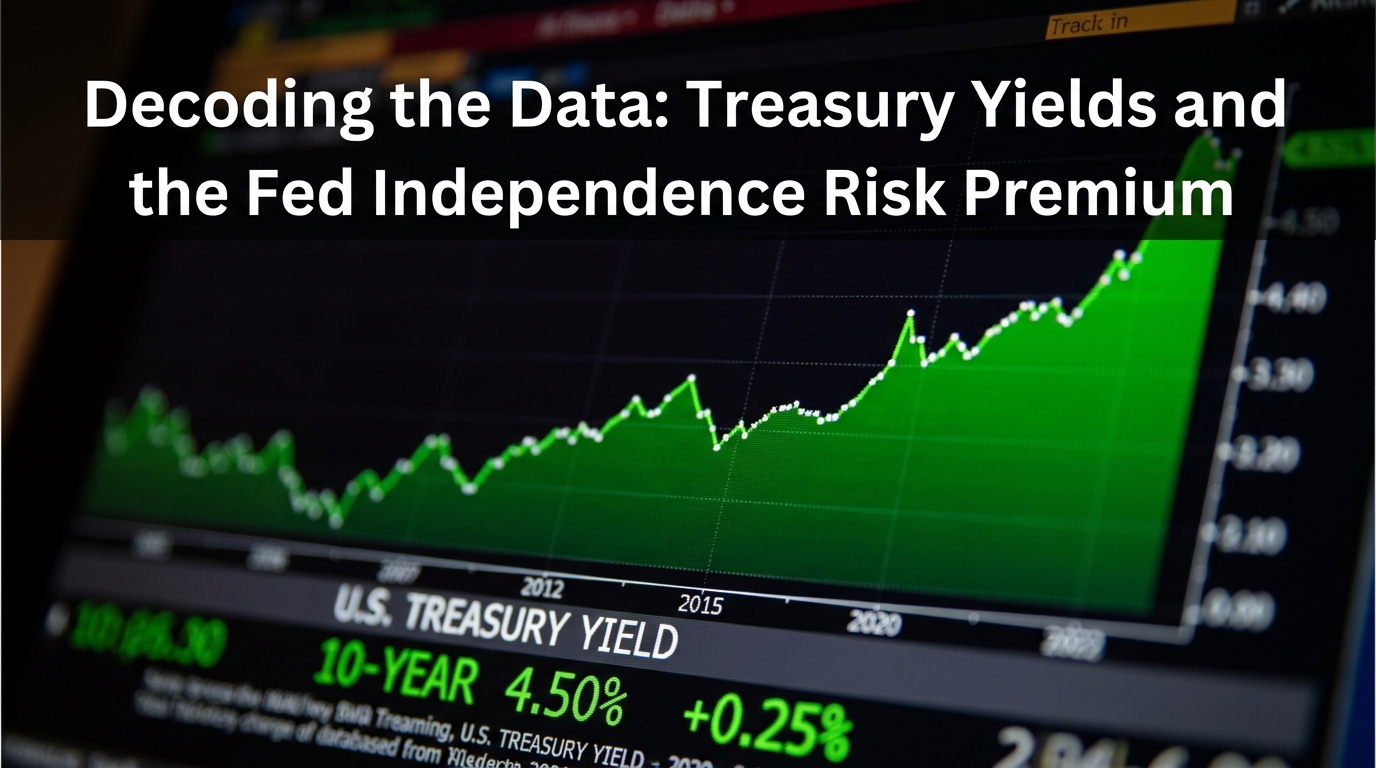
Ultimately, the current standoff is the prologue to a deeper institutional and market transition. The U.S. Treasury market is signaling concern over the erosion of institutional guardrails that have historically insulated monetary policy from partisan volatility. For US investors, this transmission chain implies that traditional macro playbooks must be recalibrated to account for persistent political risk. Until the legal and political conflicts surrounding Powell, Warsh, and Cook are definitively resolved, markets will likely exhibit elevated volatility. A structural shift toward politically motivated monetary policy would introduce persistent volatility into US equities, affecting the safe-haven status of American capital markets. Investors must therefore defensively position their portfolios against a sustained Fed Independence Crisis, prioritizing robust corporate balance sheets over long-duration growth equities while the central bank’s autonomy is debated.
Disclaimer: This analysis is for informational purposes only and does not constitute investment, financial, real estate, or legal advice. Always consult a licensed financial advisor before making investment decisions.
FAQ
How does a threat to Federal Reserve independence directly impact my equity portfolio? A threat to the Fed’s independence causes bond investors to demand a higher risk premium for holding US debt, which drives up Treasury yields. Because these yields act as the baseline discount rate for corporate finance, higher yields mathematically reduce the present value of future corporate earnings, leading to lower equity valuations.
Why are long-duration growth and tech stocks specifically vulnerable to a politicized Fed? Long-duration assets, like high-growth tech stocks, rely heavily on earnings projected many years into the future. When a politicized Fed causes long-term interest rates to rise, the discount rate applied to those distant future earnings increases, causing their current valuation multiples to compress more severely than value stocks with immediate cash flows.
What is the timeline for the Supreme Court ruling on the president’s authority to fire Fed governors? The Supreme Court is scheduled to issue its ruling in June 2026 regarding whether the president has the legal authority to fire Fed Governor Lisa Cook.
Is there any verified legal basis for the DOJ’s investigation into Jerome Powell? Currently, the evidence supporting the investigation appears exceptionally thin. A federal judge has explicitly found “zero” evidence of wrongdoing by Powell, though the Department of Justice probe remains officially open.
How do Iran supply chain disruptions complicate the Fed’s current interest rate strategy? The ongoing conflict in Iran threatens to create a significant supply disruption, driving up commodity prices while simultaneously dampening broader economic activity. This creates a stagflationary environment, forcing the Fed to hold interest rates steady to fight sticky inflation, despite earlier market expectations for rate cuts.