
How the Fed Easing Pause Fractures US Equity Markets
The Great Bifurcation: How the Fed Easing Pause Fractured the US Equity Market
The unexpected Fed Easing Pause on March 18, 2026, has altered the trajectory of US equities, ending the late-2025 optimism that a seamless soft landing was preordained. After delivering three consecutive rate cuts between September and December 2025, the central bank appeared to be charting a clear transition toward accommodative monetary policy, according to Trade Ideas. However, a 0.5% increase in the February 2026 Producer Price Index (PPI) forced a macroeconomic reassessment, indicating that inflationary pressures remain, as noted by Trade Ideas.
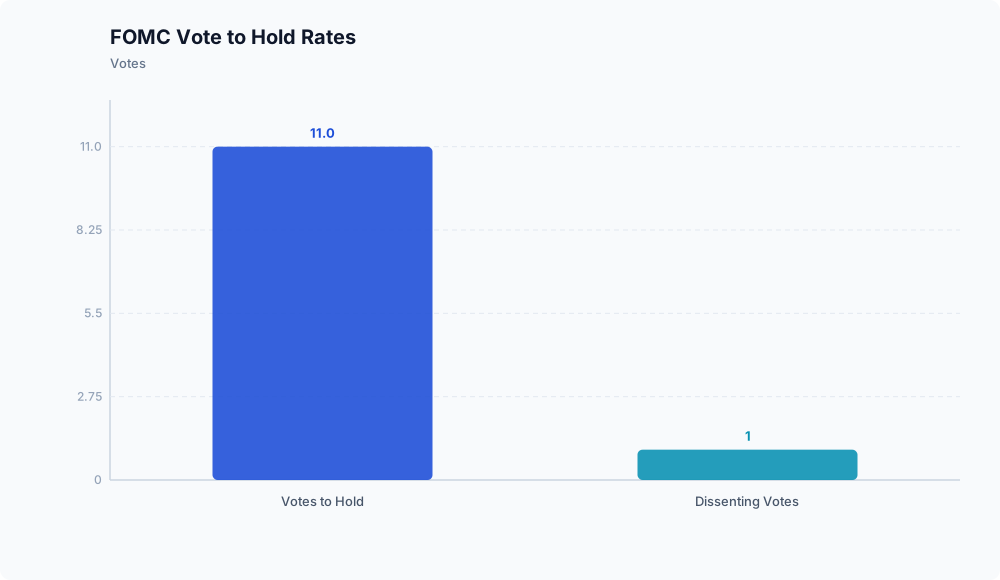
By voting 11-1 to hold the federal funds rate at 3.50% to 3.75% and revising its 2026 PCE inflation outlook upward to 2.7%, the Federal Open Market Committee (FOMC) signaled an end to the easing cycle, per Financial Content. This pivot to a “higher for longer” reality prompts market participants to recalibrate their risk exposures. The immediate consequence of this shift is a divergence in corporate resilience: cash-rich large caps remain largely insulated from elevated borrowing costs, while highly leveraged small-cap stocks face significant refinancing risks.
The Transmission Chain: From Policy Pause to Corporate Margin Compression
To understand why the broader market reacted so sharply to the Fed’s decision, investors must map the direct transmission mechanism from monetary policy to corporate balance sheets. The pathway from a stalled easing cycle to small-cap margin compression operates directly through corporate liability structures.
During the zero-interest-rate era, large corporations utilized favorable conditions to lock in long-term, fixed-rate financing. Conversely, smaller enterprises typically rely on bank loans and revolving credit facilities tied to short-term benchmark rates. Today, floating-rate debt accounts for an estimated 32% to 40% of all small-cap liabilities, according to Financial Content. This structural reality leaves these companies exposed to sustained high borrowing costs. As the Fed maintains elevated policy rates, these floating-rate obligations act as a continuous draw on corporate cash flows.
This dynamic creates a headwind for earnings growth. A company with robust top-line revenue may still see its bottom line erode due to escalating debt servicing costs. The immediate second-order effect of stalled rate cuts is a sustained reduction in free cash flow, occurring when smaller firms need liquidity to navigate an uncertain consumer environment.
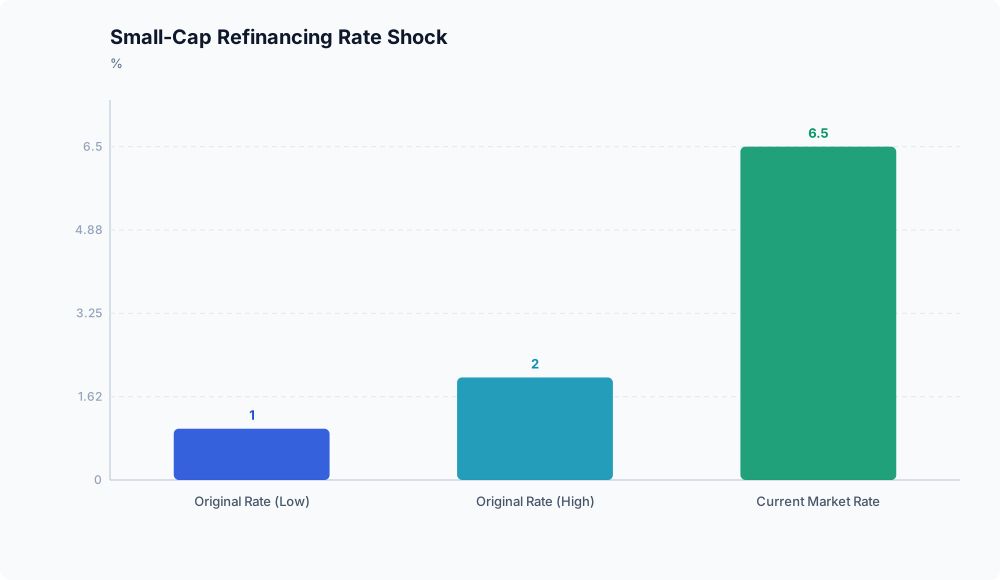
The margin squeeze is compounded by a $368 billion maturity wall facing Russell 2000 companies in 2026. These firms are not merely paying higher interest on floating-rate revolvers; they are being forced to refinance expiring long-term debt at current market rates near 6.5%, as reported by Financial Content. Refinancing obligations that were originally secured at 1% to 2% into a 6.5% environment shifts the focus from margin compression to structural solvency concerns.
This vulnerability stands in contrast to the insulated capital structures of large-cap equities. Mega-cap technology firms utilized the previous cycle to fortify their balance sheets. For instance, Alphabet quadrupled its long-term debt to $46.5 billion in 2025, securing fixed-rate capital that remains largely insulated from the Fed’s current hawkishness, according to Trade Ideas. This structural disparity means large-cap balance sheets effectively act as a hedge against monetary tightening, whereas small-cap balance sheets amplify its effects.
| Metric / Characteristic | Large-Cap Equities (e.g., S&P 500 / Nasdaq 100) | Small-Cap Equities (Russell 2000) |
|---|---|---|
| Primary Debt Structure | Long-term fixed-rate corporate bonds | Short-term & floating-rate bank loans |
| Floating-Rate Exposure | Low (typically insulated from short-term hikes) | High (32% to 40% of total liabilities) |
| Interest Coverage Health | Robust operating cash flows easily cover interest | 41% to 46% “zombie companies” unable to cover interest |
| 2026 Refinancing Risk | Insulated by extended maturity profiles | High ($368 billion maturity wall at ~6.5% rates) |
The March Volatility Shift
The market’s rapid repricing of these intersecting macroeconomic forces became apparent in the trading sessions of March 2026. The data generated during this window provides clear evidence of how institutions are repositioning.
Small-cap equities entered 2026 with fundamental momentum. By late 2025, the Russell 2000 was trading at a 31% forward price-to-earnings discount compared to the S&P 500, and small-cap companies reported a 65% earnings beat rate in the fourth quarter, according to Trade Ideas. Consequently, small caps initially led the 2026 market rotation. By early March, the Russell 2000 was up 6.1% year-to-date, outperforming the S&P 500’s 0.65% return, per Trade Ideas.
However, this valuation-driven optimism was built on the expectation of imminent rate relief. When the FOMC signaled its hawkish pause, the reversal was sharp. After reaching a year-to-date peak of +8.9% on March 10, the Russell 2000’s gains declined rapidly, falling to +0.75% by March 20, as noted by Financial Content.
This decline correlated directly with the bond market’s reaction. As the 10-year Treasury yield climbed to 4.29% by late March, the volatility index for small caps increased 25% in a single week, according to Financial Content. This reversal indicates that debt sustainability has superseded earnings momentum as the primary driver of small-cap equity pricing.
The underlying reason for this shift is the structural impairment within the index. Analysts estimate that 41% to 46% of Russell 2000 constituents are currently operating as “zombie companies,” according to Financial Content. These are firms whose operating profits are insufficient to cover their interest expenses. For investors, this data reveals a bifurcated index where aggregate earnings beats mask localized credit challenges. The 31% forward P/E discount acts as a risk premium pricing in potential debt restructurings and dilutive equity raises.
Scenario Analysis: Navigating the 2026 Equity Landscape
With the cost-of-capital assumptions for the year shifted, investors must strategically reassess their equity exposure across three distinct market scenarios.
The Base Case: Margin Compression and Selective Restructuring
In the most probable scenario, sustained elevated rates lead to margin compression, forcing selective small-cap restructuring while large caps outperform. The $368 billion maturity wall will likely force weaker small-cap entities into defensive corporate actions. This includes dilutive secondary equity offerings, forced asset sales, or distressed mergers and acquisitions.
Consequently, large-cap corporations are positioned to capture market share. Because they benefit from insulated fixed-rate debt structures, they can utilize their free cash flow for strategic acquisitions or share buybacks, extending their performance gap over smaller competitors.
The Upside Scenario: Fiscal Tailwinds Bridge the Gap
An upside scenario hinges on recent fiscal policy providing enough free cash flow to bridge the small-cap refinancing gap. The mid-2025 passage of the One Big Beautiful Bill Act (OBBBA) introduced permanent tax deductions for small and mid-sized enterprises alongside $150 billion in domestic defense modernization contracts, according to Trade Ideas.
If these fiscal injections translate to the bottom line, they could allow well-positioned, defense-adjacent, and industrial small caps to self-fund operations and bypass the 2026 debt markets. For market participants, this implies that active management focused on OBBBA beneficiaries could unlock asymmetric upside, allowing select firms to navigate the credit squeeze without sacrificing their equity base.
The Downside Scenario: Systemic Defaults and Valuation Compression
The downside scenario envisions a dual threat materializing simultaneously: a wave of small-cap defaults colliding with large-cap valuation compression. If borrowing costs remain elevated through the second half of 2026, the 41% to 46% of Russell 2000 constituents classified as zombie companies will face liquidity constraints. Should these defaults materialize, it would likely cause credit market tightening, prompting equity investors to rotate into cash equivalents.
Simultaneously, large-cap equities face their own valuation hurdles. Large-cap momentum throughout 2025 was heavily predicated on future growth expectations in the artificial intelligence sector. Vanguard estimates that the AI industry must generate $3.1 trillion in revenue between 2025 and 2027 to justify its current market valuations, per Trade Ideas. If the Fed maintains elevated rates, the discount rate applied to these future earnings will remain high. If AI adoption slows, large-cap valuations are vulnerable to multiple compression, even without immediate insolvency risks.
What to Watch Next: Leading Indicators of Market Friction
As the 2026 debt maturity cliff approaches, market participants must look beyond backward-looking earnings reports and monitor real-time indicators of macroeconomic friction.
- High-Yield Corporate Credit Spreads: If credit markets begin to price in a higher probability of default for the Russell 2000’s zombie companies, high-yield spreads will widen before actual bankruptcies occur. A sustained widening indicates that capital markets are closing their doors to lower-tier borrowers, transforming a maturity wall into a liquidity constraint.
- Aggregate Interest Coverage Ratios: Monitoring quarterly earnings for downward trends in interest coverage will provide warnings of which specific sectors are closest to structural challenges as they refinance into a 6.5% environment.
- Federal Reserve Dot Plot Revisions: The trajectory of refinancing costs hinges directly on macroeconomic policy. If future FOMC dot plots confirm an entrenched “higher for longer” consensus, the window for small caps to secure favorable refinancing terms will narrow.
- SME Employment and Jobless Claims: Small-cap companies and SMEs are foundational drivers of aggregate US job creation. If management teams are forced into cost-cutting measures to preserve cash flow for debt service, labor will be the first expense trimmed. Investors should watch initial jobless claims and regional manufacturing surveys for early signs of debt-related layoffs.
- Supply Chain Disruptions: Many Russell 2000 constituents supply critical components to large-cap corporations. If insolvencies strike smaller suppliers, the resulting operational disruptions will ripple upward, creating bottlenecks for seemingly insulated mega-cap firms.
Conclusion

The Fed Easing Pause of March 2026 has shifted the calculus of US equity investing. The early-year narrative that small caps offered a value play has been challenged by the mathematical reality of floating-rate debt and a $368 billion maturity wall.
The analytical takeaway for investors is clear: the era of passive, index-wide allocation to small-cap equities faces new headwinds. Aggregate exposure to the Russell 2000 now carries concentrated credit risk tied to structurally impaired zombie companies. Moving forward, outperformance will not be dictated solely by forward P/E discounts, but by balance sheet quality, fixed-rate debt structures, and the ability to generate self-sustaining free cash flow in a restrictive environment.
Disclaimer: This analysis is for informational purposes only and does not constitute investment, financial, real estate, or legal advice. Always consult a licensed financial advisor before making investment decisions.
FAQ
Why are small-cap stocks more vulnerable to a Fed easing pause than large-cap equities? Small-cap stocks are highly vulnerable because 32% to 40% of their total liabilities consist of floating-rate debt, meaning their interest expenses rise mechanically with Fed policy rates. In contrast, large-cap companies typically secured long-term, fixed-rate corporate bonds during the zero-interest-rate era, insulating their balance sheets from immediate rate hikes.
How does the 2025 OBBBA legislation impact Russell 2000 companies facing high interest rates? The One Big Beautiful Bill Act (OBBBA) provides permanent tax deductions and $150 billion in defense contracts, offering a potential fiscal tailwind. However, for leveraged small caps facing elevated debt refinancing costs, these fiscal benefits may be consumed by rising debt service obligations, limiting the legislation’s positive impact to only those companies with healthy balance sheets.
What defines a ‘zombie company,’ and why is the Russell 2000 heavily exposed to them ahead of 2026? A “zombie company” is a firm whose operating profits are insufficient to cover its ongoing interest expenses, requiring it to rely on debt to maintain operations. The Russell 2000 is heavily exposedwith an estimated 41% to 46% of constituents fitting this definitionbecause these firms face a $368 billion maturity wall in 2026, forcing them to refinance existing debt at current, higher market rates near 6.5%.