
How the Fed CRE Stress Test Impacts Commercial Property
The Impact of the Upcoming Fed CRE Stress Test on Commercial Real Estate
The Federal Reserve’s target finalization of its supervisory stress test scenarios represents a critical inflection point for commercial property markets and the broader US financial system. By proposing a regulatory framework that hardcodes a severely adverse economic contraction, regulators are effectively forcing major lenders to prepare for worst-case conditions regardless of current macroeconomic stability. At the center of this regulatory posture is the upcoming Fed CRE Stress Test, which models a 40 percent price decline to commercial property values. This proposal mandates that banks hold thicker capital buffers against their property debt portfolios to absorb hypothetical impairments. For US investors, the implications are profound: over the next two years, regulatory mechanics will dictate credit availability, fundamentally reshaping how commercial real estate is financed, valued, and transacted.
The Transmission Chain: From Regulatory Model to Market Liquidity
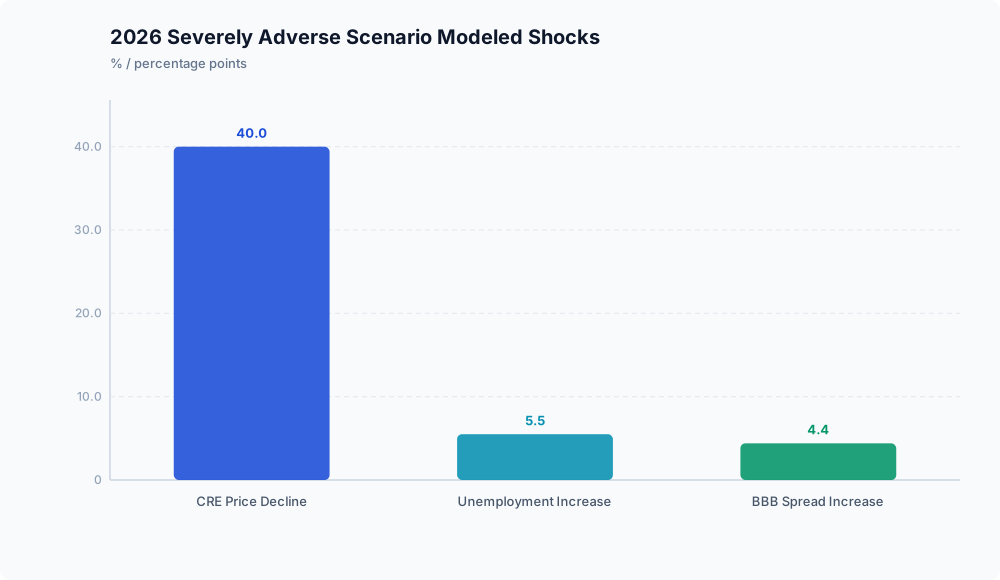
The Federal Reserve’s proposed 2026 supervisory stress test scenarios establish a stringent baseline for evaluating bank resilience. Under the severely adverse scenario, the central bank models a severe economic contraction. This includes a 5.5 percentage point increase in the unemployment rate to 10 percent by the third quarter of 2027, according to bpi.com. Crucially for real estate markets, the proposal features a 40 percent decline in commercial real estate (CRE) prices alongside a 4.4 percentage point increase in the BBB corporate spread, as noted by bpi.com.
For market participants, these metrics act as direct regulatory levers. Because stress test performance dictates capital requirements for large banks, these severe modeled losses mechanically force institutions to hold more equity against their commercial property exposures. The transmission chain begins with how the 40 percent CRE price drop assumption alters bank balance sheet management.
When regulators mandate that banks model a 40 percent decline in collateral values, the projected loss given default on CRE portfolios surges. To absorb these hypothetical shocks, financial institutions must set aside proportional capital reserves. This effectively traps equity that could otherwise be deployed into the economy. The following table illustrates how this regulatory assumption forces higher capital retention and downstream market effects:
| Transmission Stage | Mechanism | Market Consequence |
|---|---|---|
| 1. Regulatory Assumption | Fed models a 40% CRE price decline in the 2026 stress test. | Banks must project severe portfolio losses given default. |
| 2. Capital Retention | Higher projected losses increase the required capital buffers. | Capital is locked up, reducing deployable liquidity. |
| 3. Balance Sheet Optimization | Banks reduce risk-weighted assets to maintain capital ratios. | Institutions halt or severely limit new CRE lending. |
This forced capital retention initiates a structural pullback from CRE originations by traditional depository lenders. As banks optimize their risk-weighted assets to satisfy elevated capital buffers, commercial mortgages become highly capital-intensive liabilities. Consequently, loan committees are incentivized to reject new CRE loan applications and decline extensions on existing debt. The primary artery of commercial property financing constricts due to the regulatory cost of holding the debt.
The retreat of bank capital widens the refinancing gap for maturing commercial real estate loans. Borrowers seeking to refinance existing debt must turn to alternative lenders or broader capital markets. However, the Fed’s modeled 4.4 percentage point increase in the BBB corporate spread indicates that credit conditions in the broader corporate market are also expected to tighten significantly under stress, according to bpi.com. This dynamic creates a structural deficit where the cost of replacement capital is elevated.
Highest-Signal Evidence: Escalating Valuation Haircuts
The highest-signal evidence within the proposed severely adverse scenario is the mandated 40 percent decline in commercial real estate prices. This parameter represents a shift in regulatory focus regarding the structural viability of commercial property valuations. These valuations continue to face headwinds from elevated interest rates and shifting occupancy patterns.
By hardwiring a 40 percent valuation haircut into the stress models, the Federal Reserve forces institutions to recognize substantial hypothetical losses. Regulators view current CRE valuations as potentially fragile and are demanding banks hold sufficient equity to absorb a near-halving of underlying collateral values. This metric is comparable to the stringent tests administered between 2021 and 2024, as noted by bpi.com, but represents a significant step up from more recent baselines.
The severity of these parameters has generated targeted friction from the banking sector. The Federal Reserve Board received exactly 5 public comments regarding the 2026 stress test proposal, according to the official Federal Reserve docket review. Industry associations specifically targeted the CRE parameter. They argued that the 40 percent decline is overly severe when compared to the 30 percent decline utilized in the 2025 tests, as reported by Lexology.
This concentrated pushback reveals a fundamental disconnect between regulators prioritizing systemic safety and bank executives attempting to optimize capital efficiency. If the Fed maintains this parameter, the resulting capital lock-up could depress return on equity (ROE) for institutions with heavy commercial property exposure.
However, it is critical to distinguish these verified regulatory inputs from the exact capital impact on individual banks. The ultimate effect on a specific institution’s Stress Capital Buffer (SCB) remains highly uncertain. A bank’s actual capital shortfall under the test will depend heavily on its unique portfolio composition, existing loan-loss reserves, and specific geographic concentrations. The testing framework will likely widen the valuation gap between highly diversified money-center banks and regional lenders with concentrated, lower-quality commercial property portfolios.
Forward-Looking Scenarios: Refinancing in a Stressed Regime
By forcing institutions to provision for severe modeled losses, the Federal Reserve is effectively increasing the cost of holding commercial property debt. As the finalization date approaches, this regulatory posture sets the stage for three distinct forward-looking market scenarios.
The Base Case: Prolonged Adjustment and Distressed Sales In the base case scenario, stringent capital requirements force regional and major banks to systematically shed their CRE exposure. Because holding these loans becomes highly capital-intensive, banks will likely choose to offload maturing debt rather than refinance it. Investors should expect a steady stream of distressed sales and loan portfolio liquidations. This structural shedding will likely depress property valuations further, creating a prolonged adjustment rather than a sudden market shift.
The Upside Scenario: Private Credit Bridges the Gap An upside scenario emerges if broader macroeconomic stabilization offsets the regulatory capital costs imposed on traditional lenders. The withdrawal of bank capital creates a vacuum that private credit funds and non-bank financial institutions can bridge. Because non-bank lenders are not subject to the Fed’s specific 2026 stress test parameters, they can price risk based on actual market conditions rather than the severely adverse 10 percent unemployment model, according to bpi.com. If borrowing costs moderate, private capital can step in to refinance high-quality assets.
The Downside Scenario: A Self-Fulfilling Liquidity Freeze Conversely, the downside scenario envisions a liquidity freeze in commercial property markets. If the Fed’s modeled 4.4 percentage point increase in BBB corporate spreads materializes in the real economy, borrowing costs for alternative lenders would rise simultaneously with the bank retreat, as noted by bpi.com. Traditional banks would pull back to preserve capital, while private credit would demand higher risk premiums. Ultimately, the Fed’s severely adverse scenario risks becoming a self-fulfilling prophecy by constraining the liquidity required to sustain current valuations.
What to Watch Next: Indicators of Systemic Migration

To navigate this regulatory transition, market participants must monitor a specific checklist of concrete indicators. The finalization of the rules will dictate the pace, but the market’s preemptive reaction will be visible in several key areas.
1. Bank Earnings and Loss Reserve Allocations The first critical item to watch is upcoming bank earnings reports, focusing on CRE loss reserve allocations. Forward-looking bank management teams will likely begin front-loading their provisions to align with the Fed’s modeled 40 percent property value decline. A sudden spike in these reserves will serve as a leading indicator that banks are preparing to absorb actual realized losses.
2. Private Credit Origination Volumes The next crucial element involves tracking shifts in private credit origination volumes. As traditional lenders pull back, private credit funds will likely accelerate their deployment into commercial mortgages. Monitoring the origination volumes of these alternative asset managers in the first half of 2026 will quantify the extent of the bank retreat. A failure of private credit to scale up would signal that a liquidity freeze is materializing.
3. Distressed Transaction Metrics in Mid-2026 Finally, investors must track distressed transaction metrics in the second and third quarters of 2026. Without viable refinancing options, property owners facing maturity defaults will be forced to liquidate assets. Tracking the clearing prices of these sales will reveal whether the Fed’s modeled 40 percent CRE price decline is actualizing in the real world.
Conclusion

The impending finalization of the 2026 supervisory stress test scenarios confirms that the Federal Reserve is actively preparing the US banking system for tightening liquidity conditions. By hardwiring a 40 percent commercial real estate price decline, a 10 percent unemployment rate, and a significant widening of corporate credit spreads into the regulatory baseline, the central bank is structurally increasing the cost of holding property debt. For investors, the analytical takeaway is clear: the Fed CRE Stress Test is not merely an academic exercise, but a catalyst for a forced deleveraging cycle. Traditional banks will be compelled to retreat from commercial property originations, shifting the burden of refinancing onto alternative lenders. Market participants must operate under the assumption that commercial property debt will face regulatory-driven headwinds for the foreseeable future.
Disclaimer: This analysis is for informational purposes only and does not constitute investment, financial, real estate, or legal advice. Always consult a licensed financial advisor before making investment decisions.
FAQ
How does the 40% CRE price drop in the 2026 stress test compare to previous regulatory scenarios? The 40 percent commercial real estate price decline proposed for the 2026 stress test represents a significant escalation in severity compared to the immediate prior year, as the 2025 tests utilized a 30 percent decline parameter. However, the 40 percent metric is comparable to the stringent tests administered by the Federal Reserve between 2021 and 2024.
Why are industry associations pushing back against the Fed’s severely adverse scenario? Industry associations argue that the 40 percent commercial real estate price decline is overly severe, particularly when compared to the 30 percent decline used in 2025. Bank executives are pushing back because this severe modeled shock mechanically forces institutions to project substantial hypothetical losses, requiring them to lock up thicker capital buffers. This forced capital retention restricts their ability to lend and depresses return on equity for shareholders.
Will the new capital buffer requirements force banks to sell off their existing commercial real estate loans? While the regulations do not explicitly mandate asset sales, the new capital buffer requirements make holding commercial real estate debt highly capital-intensive. To optimize their balance sheets and maintain required capital ratios, banks are heavily incentivized to preemptively shed CRE exposure, decline loan extensions, and offload maturing debt, which is expected to result in a steady stream of loan portfolio liquidations and distressed sales.