
How the OBBBA Fiscal Stimulus Impacts U.S. Equity Markets
Analyzing the OBBBA Fiscal Stimulus and Its Market Impact
The July 4, 2025, passage of the One Big Beautiful Bill Act (OBBBA) serves as a defining inflection point for U.S. equities. It acts simultaneously as a powerful earnings backstop and a catalyst for structural market upheaval. For years, market participants modeled the impending expiration of the 2017 Tax Cuts and Jobs Act (TCJA) as a looming fiscal cliff that threatened to severely compress corporate margins and drain consumer liquidity.
By making key provisions of the TCJA permanent, the legislation averts a historic $4 trillion tax increase over the next decade, according to The Economic and Fiscal Benefits of the One Big Beautiful Bill Act. For equity investors, this milestone immediately removes a severe, multi-year overhang on corporate earnings per share (EPS) and consumer spending power. However, the introduction of the OBBBA fiscal stimulus is far from a simple, universally bullish event.
The sheer scale of the foregone tax revenue guarantees a massive expansion of the federal deficit, fundamentally altering the macroeconomic landscape. Consequently, the market must now prepare to absorb a forthcoming flood of Treasury issuance. This dynamic is poised to steepen the yield curve, directly impacting the discount rates used to value equities.
As the cost of capital shifts, the market faces a significant rotation out of long-duration growth stocks and into cyclical value sectors. Understanding this pivot requires moving beyond headline numbers and dissecting the precise mechanisms through which this legislation will rewire capital flows, corporate behavior, and consumer spending patterns over the coming decade.
The Macroeconomic Transmission Chain
The passage of the OBBBA serves as the catalyst for a complex macroeconomic transmission chain that bridges federal fiscal policy directly to specific portfolio reallocations. This chain operates through three distinct, interconnected mechanisms: consumer liquidity injections, corporate capital expenditure incentives, and sovereign debt market absorption. Understanding how these mechanisms interact is essential for navigating the post-OBBBA market environment.
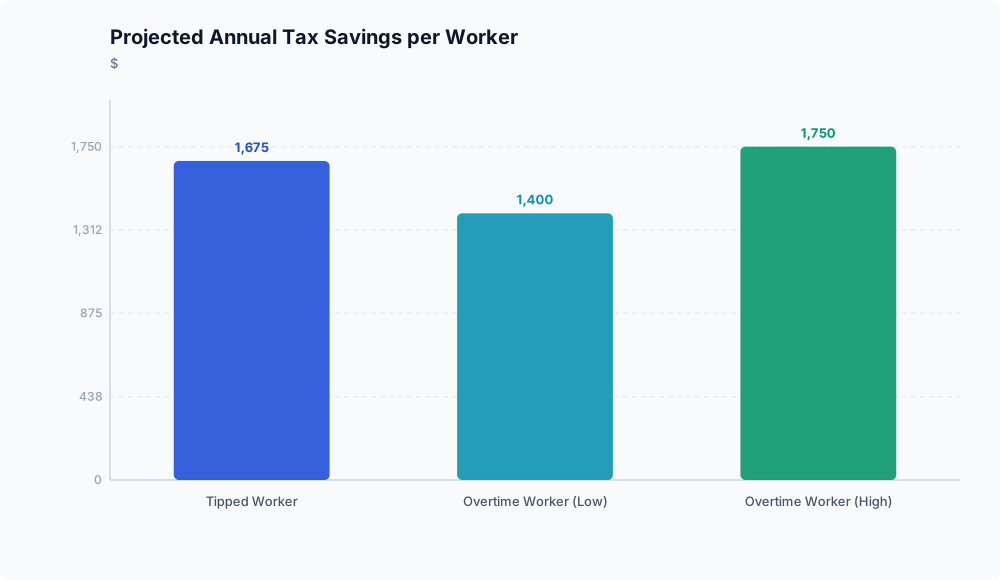
The Consumer Liquidity Mechanism The first mechanism in this transmission chain operates at the consumer level through highly targeted tax relief. The OBBBA eliminates income taxes on tips and overtime pay. The Council of Economic Advisers (CEA) projects that this will save the average tipped worker approximately $1,675 annually. Meanwhile, the average overtime worker will save between $1,400 and $1,750 per year, according to the White House.
These savings accrue primarily to low- and middle-income cohorts. In macroeconomic terms, these demographics exhibit a high marginal propensity to consume. Unlike high-net-worth individuals who might channel tax savings into passive investment accounts or debt reduction, tipped and overtime workers are highly likely to inject this capital directly into the real economy.
For market participants, this translates into a direct, predictable tailwind for the consumer discretionary sector. Retailers, leisure operators, hospitality businesses, and discount chains stand to capture these localized liquidity injections. This dynamic effectively transforms a federal tax policy into unexpected top-line revenue growth for specific equity segments, providing a sustained economic buffer against broader macroeconomic headwinds.
The Corporate Capital Allocation Mechanism Simultaneously, the corporate mechanism of the OBBBA transmission chain incentivizes aggressive, front-loaded capital allocation. The foundation of the corporate stimulus lies in its commitment to sustained capital formation. The legislation guarantees permanent full expensing for both equipment and research and development (R&D), alongside temporary full expensing for new factories, as outlined by the White House.
By allowing immediate write-offs for heavy capital expenditures, the policy structurally alters the net present value (NPV) calculations of corporate infrastructure projects. When a company can fully expense a piece of equipment or a new facility in year one, the internal rate of return on that investment substantially increases. This structurally favors capital-intensive industries and domestic manufacturing.
Furthermore, the legislation deploys targeted geographic stimulus through Enhanced Opportunity Zone incentives. These provisions act as a powerful fiscal multiplier for physical asset development. Investors should interpret this as a multi-year margin support mechanism for industrials, materials, construction suppliers, and cyclical equities. Corporate boards are now heavily incentivized to pull forward infrastructure projects to capture these tax benefits before the temporary provisions expire.
The Sovereign Debt and Yield Curve Mechanism However, these dual engines of consumer and corporate stimulus inevitably collide with the macroeconomic reality of deficit financing. This is the third, and arguably most disruptive, link in the transmission chain. Averting a $4 trillion tax hike inherently means the federal government is foregoing $4 trillion in projected baseline revenue over the next decade. This mathematical reality dictates that the shortfall must be offset by massive Treasury issuance.
While the exact scale of the resulting deficit expansion remains dependent on dynamic economic growth feedback loops, the bond market must absorb a significant surge in debt supply. This supply-demand imbalance in sovereign debt naturally pushes long-term yields higher. As the supply of long-dated Treasuries floods the market, bond prices face downward pressure. Investors will demand greater term premiums to hold long-dated government paper to offset the increased supply and potential inflationary pressures.
Consequently, the fiscal stimulus directly catalyzes a steepening of the Treasury yield curve. This fundamental shift alters the discount rates used in equity valuation models. Elevated discount rates mathematically punish high-multiple growth stocksparticularly in the technology sectorbecause their valuations rely heavily on distant future cash flows. Conversely, a steepening yield curve traditionally expands net interest margins for the financial sector and rewards value stocks with near-term cash flows.
Isolating the Highest-Signal Evidence
To accurately price the macroeconomic baseline established by the OBBBA, investors must separate verified legislative parameters from the administration’s projected secondary economic boosts. Distinguishing concrete tax code adjustments from modeled counterfactuals is essential for accurate asset valuation.
The following table breaks down the primary verified facts and administration estimates stemming from the OBBBA’s passage, isolating the direct legislative claims from the modeled projections provided by the Council of Economic Advisers (CEA).
| Metric / Provision | Verified Legislative Claim / CEA Projection |
|---|---|
| Tax Hike Prevention | Averts a $4 trillion nominal tax increase over 10 years by making TCJA rates and deductions permanent. |
| Macroeconomic Baseline | Prevents an estimated 4% drop in U.S. real GDP and the loss of 6.1 million full-time-equivalent jobs over 4 years. |
| Tipped Worker Savings | Eliminates tax on tips, saving an average tipped worker (earning ~$41,000/year) roughly $1,675 annually. |
| Overtime Worker Savings | Eliminates tax on overtime, saving an average overtime worker (earning ~$73,000/year) between $1,400 and $1,750 annually. |
These figures, sourced directly from The Economic and Fiscal Benefits of the One Big Beautiful Bill Act, form the foundation of the administration’s economic narrative.
Analyzing the Permanent Provisions The prevention of a $4 trillion tax increase over a 10-year horizon is the most consequential structural element for U.S. equities. This is a verified legislative reality, not a modeled projection. By making reduced tax rates and full expensing for equipment and R&D permanent, the OBBBA removes a significant overhang of uncertainty that had paralyzed long-term corporate forecasting.
For U.S. investors, this permanence translates directly into higher baseline EPS estimates. When corporate tax rates are permanently lower, the after-tax cash flow available to equity holders is permanently higher. This supports elevated valuation multiples, particularly in capital-intensive sectors and technology firms reliant on heavy R&D spending. Furthermore, the certainty surrounding capital depreciation schedules allows corporate treasuries to confidently deploy cash reserves into multi-year infrastructure projects.
Evaluating the Targeted Consumer Data The targeted tax eliminations for tipped and overtime workers introduce a highly specific, verifiable liquidity injection into the labor force. The data reveals that an average tipped worker earns approximately $41,000 annually, meaning the $1,675 in savings represents roughly a 4% increase in net take-home pay. Similarly, the $1,400 to $1,750 in savings for an overtime worker earning approximately $73,000 annually represents a meaningful expansion of disposable income.
Because these figures represent direct, localized savings, they are highly likely to flow directly into the real economy. However, analytical rigor requires caution when modeling long-term consumer spending. The administration’s documentation explicitly labels the elimination of income tax on overtime and tips as “temporary.” With exact expiration dates uncertain, analysts must treat this consumer tailwind as a near-term cyclical boost rather than a permanent structural shift.
Discounting the Modeled Projections Beyond the direct tax adjustments, the CEA’s broader macroeconomic projections require a more nuanced, skeptical interpretation. The assertion that the OBBBA prevents a 4% drop in U.S. real GDP and the loss of 6.1 million jobs is a modeled counterfactual, as detailed in The Economic and Fiscal Benefits of the One Big Beautiful Bill Act. It assumes a scenario where the TCJA expired completely and the economy absorbed the full shock of higher taxes. This represents the avoidance of a severe contraction rather than new, additive growth.
Similarly, the projection that Enhanced Opportunity Zones will drive over $100 billion in investment and create over 1 million jobs in distressed communities is a modeled outcome dependent on robust private sector participation, according to The Economic and Fiscal Benefits of the One Big Beautiful Bill Act. These regional investments carry significant execution risk and are highly susceptible to broader credit market conditions.
Furthermore, the temporary full expensing for new factories lacks a definitive timeline in the provided data. This makes it exceedingly difficult for analysts to project the exact duration of the associated industrial construction boom. Prudent analysts should heavily discount these secondary investment projections until tangible capital deployment metrics, such as groundbreakings and permit issuances, emerge in subsequent quarters.
Navigating the Macroeconomic Scenarios
The establishment of this massive fiscal baseline forces investors to model diverging macroeconomic scenarios. By preventing a historic $4 trillion tax increase, the OBBBA secures corporate margins, but the sheer scale of the unfunded tax relief guarantees upward pressure on the long end of the yield curve. Market participants must balance the guaranteed microeconomic benefits of lower taxes against the latent macroeconomic risk of Treasury-induced liquidity constraints.
The Base Case: Cyclical Outperformance and Growth Compression For U.S. investors, the base case scenario points toward a sustained period of cyclical outperformance paired with intense valuation pressure on long-duration growth equities. The mechanics of this cyclical rotation are heavily supported by the targeted consumer tax relief and corporate capex incentives.
Localized savings from tipped and overtime workers rapidly convert into retail, dining, and consumer discretionary spending. Simultaneously, corporations pull forward capital investments to maximize immediate tax advantages under the permanent equipment expensing and temporary factory expensing rules. This translates to a robust, multi-year earnings outlook for industrials, materials, domestic real estate, and regional banks.
However, the deficit expansion cannot be ignored. The market must absorb a steady, heavy supply of new Treasuries, resulting in a persistent steepening of the yield curve. As the 10-year and 30-year yields rise, the increased discount rate mathematically compresses the multiples of long-duration growth stocks. The base case is defined by a “value renaissance,” where near-term cash flows are rewarded, and distant, speculative cash flows are severely punished.
The Upside Scenario: The Fiscal Multiplier Miracle In an upside market scenario, the sheer velocity of corporate and consumer earnings growth outpaces the drag of a steepening yield curve. This scenario relies on the fiscal multiplier of the OBBBA proving significantly higher than historical averages.
If the CEA’s estimates regarding preserved jobs and GDP are accurate reflections of the economic energy maintained by the bill, as projected by the White House, the sustained economic momentum could be substantial. The certainty provided by permanent tax rates unleashes a wave of pent-up corporate investment that vastly exceeds expectations. Meanwhile, Enhanced Opportunity Zones successfully attract the projected $100 billion, sparking localized economic booms.
Crucially, in the upside scenario, the bond market absorbs the new Treasury issuance with relative ease. If borrowing costs rise only modestly, corporate earnings expansions will easily overwhelm the rising cost of capital. The resulting macroeconomic resilience would broaden the equity rally well beyond cyclicals, allowing even growth stocks to participate despite a slightly elevated rate environment.
The Downside Scenario: The Sovereign Debt Shock Conversely, the downside scenario hinges entirely on the mechanics of deficit financing and a failure of sovereign debt absorption. While the $4 trillion in tax relief is explicitly documented, evidence regarding the exact timing, scale, and maturity profile of the corresponding Treasury issuance remains highly uncertain.
If the global bond market balks at the incoming flood of U.S. debt, investors will demand aggressively higher yields to clear the auctions. This could trigger a severe liquidity drain and a sharp, sudden rate shock. A rapid spike in long-term borrowing costs would sharply steepen the yield curve to restrictive levels.
This sudden increase in the cost of capital would choke off corporate credit access, making it prohibitively expensive for companies to finance new factories and equipment. Mortgage rates would rise significantly, pressuring the real estate market. The resulting credit contraction would drag down all equities, effectively neutralizing the stimulus benefits of the tax cuts and triggering a broad market correction.
What to Watch Next: Concrete Indicators

As the market digests the complex realities of the OBBBA, investors must shift their focus away from legislative headlines and toward concrete macroeconomic indicators. Successfully navigating the post-OBBBA landscape requires treating disparate triggers as a unified analytical dashboard.
Monitoring the Long End: Treasury Auctions The most immediate and critical trigger to monitor will be the upcoming 10-year and 30-year Treasury yield auctions. Because the OBBBA introduces significant, unfunded tax reductions, the bond market is the ultimate arbiter of the legislation’s success. Market participants should watch these long-duration auctions closely for bid-to-cover ratios and any signs of buyer indigestion.
If these auctions result in yield spikes or require higher term premiums to clear, it signals that deficit concerns are taking hold. An increase in borrowing costs at the sovereign level will quickly cascade into corporate bond markets, tightening broader financial conditions. This dynamic could rapidly offset the stimulative effects of the fiscal package.
Gauging the Consumer: Q3 Earnings Guidance On the equities side, Q3 earnings guidance from consumer discretionary firms will serve as a critical barometer for the OBBBA’s impact on household spending. The temporary elimination of income tax on overtime and tips directly increases the disposable income of service-sector workers.
Investors should rigorously analyze corporate commentary from retailers, restaurant chains, and leisure operators. The key question is whether corporate boards are forecasting a sustained, multi-quarter uptick in consumer demand, or merely a transient bump. Because the exact expiration date for this temporary tax relief remains uncertain, analysts must cautiously interpret any upward revisions as cyclical opportunities rather than permanent structural shifts.
Tracking the Capex Boom: Industrial Announcements The industrial and manufacturing sectors face a unique set of incentives due to the OBBBA’s temporary full expensing for new factories. Market participants must scrutinize upcoming capital expenditure announcements, groundbreakings, and forward guidance from construction and engineering firms.
Because the expiration date for this full expensing provision is currently undefined, corporate boards are highly likely to front-load factory construction. This behavior could artificially inflate near-term industrial activity, implying a potential boom-and-bust cycle in capital goods. Tracking the velocity of these capex announcements will dictate whether to overweight industrials in the short term.
Preparing for 2026: Wealth Management Shifts Looking further ahead, the timeline for structural portfolio adjustments is accelerating. The 2026 tax season will be the first reporting period fully impacted by the OBBBA, prompting major financial institutions to rapidly outline new tax planning frameworks.
Early research from Morgan Stanley highlights the urgent need for wealth management adaptation ahead of 2026. High-net-worth investors and asset managers must begin evaluating their asset location, loss-harvesting, and income-realization strategies immediately. Waiting until late 2025 to adjust to the permanent TCJA provisions risks suboptimal after-tax outcomes.
Conclusion

The enactment of the OBBBA fiscal stimulus fundamentally rewires the underlying mechanics of the U.S. equity and fixed-income markets. By permanently extending the core provisions of the 2017 Tax Cuts and Jobs Act, the legislation successfully averts a historic $4 trillion contraction in private sector wealth. This secures a robust floor for corporate earnings and injects targeted liquidity directly into the consumer economy.
However, the analytical synthesis of these events reveals that this is not merely a continuation of the status quo; it is a regime change. The mathematical reality of financing this massive revenue shortfall guarantees a flood of Treasury issuance, which will inevitably steepen the yield curve and raise the long-term cost of capital.
For the reader, the strategic takeaway is clear: the era of relying on passive, duration-heavy index exposure driven by secular growth stocks is facing a severe structural challenge. The rising discount rates engineered by the OBBBA’s deficit expansion will relentlessly compress the valuations of long-duration assets. Conversely, the legislation’s aggressive capital expenditure incentives and targeted consumer tax relief create a highly favorable environment for tangible-asset cyclicals, industrials, and value equities. Investors must now actively manage their portfolios to align with these shifting fiscal realities, prioritizing sectors that directly benefit from the immediate stimulus while maintaining strict defensive hedges against looming bond market volatility.
FAQ
How does the OBBBA fiscal stimulus impact long-duration growth stocks? The OBBBA negatively impacts long-duration growth stocks by expanding the federal deficit, which requires massive Treasury issuance. This increased debt supply pushes long-term yields higher, steepening the yield curve. Higher yields increase the discount rate used in valuation models, mathematically compressing the high valuation multiples of growth and technology stocks that rely heavily on distant future cash flows.
When do the OBBBA tax changes, such as the elimination of taxes on tips and overtime, take effect for consumers? While the OBBBA was passed on July 4, 2025, the exact expiration dates and long-term timelines for the temporary consumer provisions remain uncertain based on current legislative data. However, major financial institutions are already advising clients to prepare for the 2026 tax season, which will be the first reporting period fully impacted by the broader OBBBA framework.
Why might the OBBBA cause the Treasury yield curve to steepen despite its benefits to corporate earnings? Although the OBBBA benefits corporate earnings by lowering taxes and allowing full expensing of capital investments, averting a $4 trillion tax hike means the government loses $4 trillion in projected revenue. To fund this massive shortfall, the Treasury must issue a significant amount of new debt. As the market absorbs this flood of long-dated government bonds, investors demand higher yields to hold the debt, causing long-term interest rates to rise and the yield curve to steepen.