
Fed Delayed Rate Cuts Real Estate Market Refinancing Risks
Fed Delayed Rate Cuts Real Estate: The Macroeconomic Shift
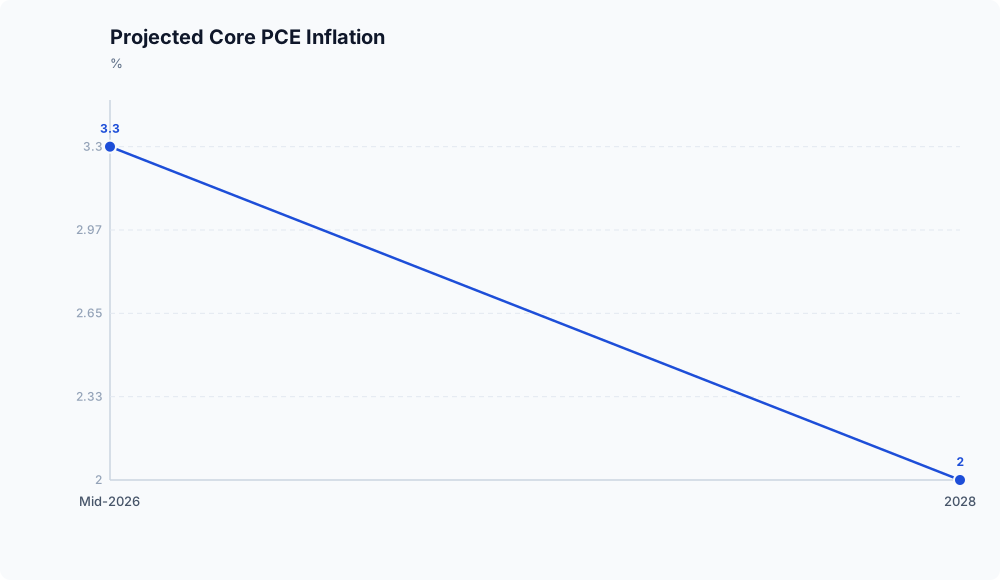
The commercial real estate industry’s prevailing strategy of “survive until rates drop” has been fundamentally broken by a persistently hawkish macroeconomic reality. For market participants navigating the Fed delayed rate cuts real estate landscape, markets are currently absorbing what is no longer just a temporary liquidity squeeze; it has evolved into a structural solvency crisis. Driven by geopolitical uncertainties and sticky oil prices, core Personal Consumption Expenditures (PCE) inflation is now projected to rise to approximately 3.3% by mid-2026. This inflationary persistence is forcing the Federal Reserve to hold its benchmark interest rate steady and delay its first rate cut to December 2026.
According to Monthly Economic Outlook | U.S. Bank, inflation is not expected to return to the Fed’s 2% target until 2028. For investors, developers, and property owners, this timeline shift destroys the foundational assumption that short-term bridge financing or temporary forbearance could safely bridge the gap to a lower-rate environment. The second-order effect is profound: waiting is no longer a viable liquidity strategy. The delay transforms a temporary duration mismatch into a permanent restructuring event for heavily leveraged operators. The era of relying on cap-rate compression to generate real estate returns is definitively over, shifting the focus entirely to net operating income growth and balance sheet resilience.
The Macroeconomic Transmission Chain: From Sticky Inflation to Market Dislocation
The macroeconomic transmission chain restructuring the real estate market begins with a fundamental shift in the cost of capital. While some market participants previously anticipated a rapid return to accommodative monetary policy, the persistence of sticky inflation has forced the Federal Reserve to hold rates structurally higher. This policy stance acts as the initial domino, setting off a sequence of mechanisms that ultimately fracture both commercial and residential markets.
In the commercial sector, this sustained elevated rate environment directly attacks the structural vulnerabilities of short-term financing, particularly bridge loans and Commercial Real Estate Collateralized Loan Obligations (CRE CLOs). During the low-rate era, sponsors heavily utilized these floating-rate instruments to acquire transitional assets, assuming cheap refinancing would be available upon stabilization. That assumption has now broken down.
The mechanism of distress here is the interest rate cap. Borrowers originally purchased these derivative contracts as a temporary shield against rising rates, assuming the Fed would normalize policy before the caps expired. However, with the terminal policy rate now expected to remain elevated through at least mid-2027, the cost to purchase replacement rate caps has become prohibitively expensive. As these hedges burn off, debt service costs spike exponentially. This rapid increase drains property-level reserves, forcing sponsors into acute liquidity crises months or years before their actual loan principal comes due.
For the residential market, the transmission chain operates differently but with equally paralyzing effects. The prolonged Fed pause directly collides with emerging labor market cracks. The combination of contracting employment and elevated borrowing costs cements the existing “lock-in” effect. Homeowners holding legacy sub-4% mortgages are fundamentally disincentivized to sell, severely restricting existing home inventory. Consequently, everyday buyers are forced to navigate a market where organic supply remains artificially constrained by macroeconomic policy, pushing demand entirely onto new construction, which is burdened by its own inflationary pressures.
Highest-Signal Evidence: The Data Driving the Restructuring
The exact point where macroeconomic pressure translates into market-wide distress is visible in the current data. The evidence suggests that the era of “extend and pretend” has already fractured, leaving market participants to navigate a landscape defined by forced recapitalizations and constrained affordability.
The Commercial Real Estate Maturity Wall
The catalyst for the current restructuring wave is the projected $277 billion of securitized CRE loans maturing in 2025, which effectively breaks the dam of forbearance strategies. This initial wave is immediately followed by another massive bottleneck.
| Metric / Strategy | Old 2024 Playbook | New 2026 Reality |
|---|---|---|
| Fed Rate Cuts | Expected aggressive cuts by late 2024 | First cut delayed to December 2026 |
| Inflation Target | Approaching 2% by 2025 | Core PCE rising to 3.3% mid-2026; 2% delayed to 2028 |
| CRE Strategy | ”Extend and pretend” | Forced recapitalization, distressed sales, or default |
| Interest Rate Caps | Bridge to lower rates | Expiring prematurely, triggering immediate DSCR crises |
According to Bridge Loan Time Bomb & The 2026 Maturity Wall - RealVal, $163 billion in securitized CRE loans are scheduled to mature in 2026 across CMBS, CRE CLOs, and agency multifamily debt. Zooming out, the broader market faces an estimated $2 trillion in commercial mortgages maturing over the next three years.
The critical vulnerability lies in the underlying cash flow of these assets:
- Dangerous DSCR Levels: Data indicates that $115 billion of loans maturing by the end of 2026 currently operate with an in-place Debt Service Coverage Ratio (DSCR) below 1.20x. Analytically, a DSCR this low means these properties barely generate enough net operating income to service their existing debt, leaving virtually no margin for error when refinancing at today’s substantially higher interest rates.
- Premature Cap Expirations: Nearly 40% of securitized CRE CLO loans have interest rate caps that expire before the loan’s actual maturity date, according to Bridge Loan Time Bomb & The 2026 Maturity Wall - RealVal.
- Unresolved Defaults: The friction in the system is already visible, with $23 billion in CMBS loans having passed their maturity dates without being paid off or formally extended, as noted by Bridge Loan Time Bomb & The 2026 Maturity Wall - RealVal.
The Residential Squeeze: Jobs, Costs, and Hidden Taxes
On the residential side, the data paints a picture of a market locked in a state of expensive illiquidity. Employment forecasts project a potential loss of 92,000 U.S. payroll jobs by February 2026, according to Churchill Mortgage. This projected labor contraction would occur against a backdrop of severe supply shortages and escalating costs.
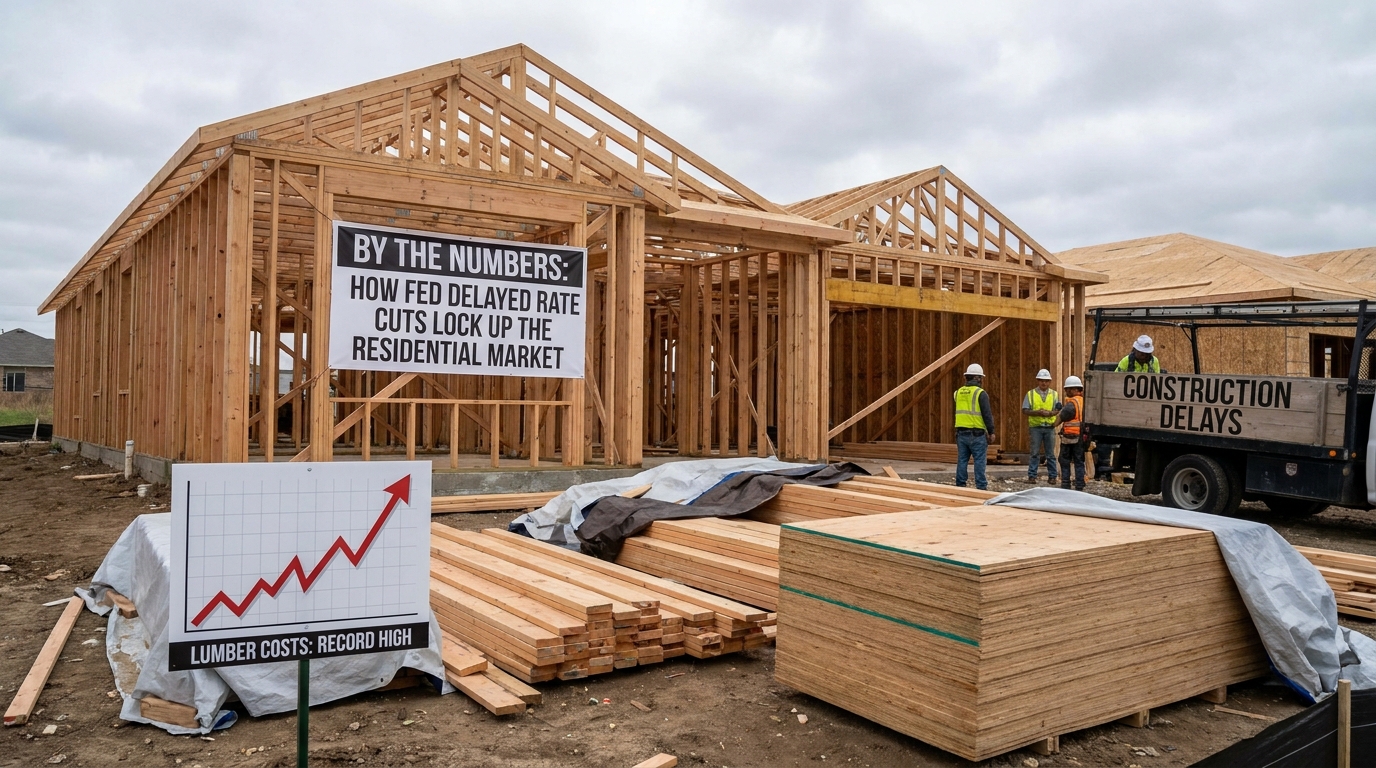
The U.S. housing shortage has now surpassed 4 million homes, a deficit that is increasingly expensive to bridge. Since 2020, construction costs have surged by 34%, adding approximately $10,900 to the baseline cost of a newly built home, as reported by Churchill Mortgage. This cost escalation means homebuilders cannot easily discount properties to meet softening consumer demand without eroding their profit margins, placing a rigid floor under new home prices.
Furthermore, everyday buyers are confronting a rapid escalation in non-mortgage holding costs. The implementation of Risk Rating 2.0 has severely disrupted the flood insurance market, resulting in a 39% drop in new policy purchases and forcing 77% of existing policyholders to pay higher premiums, according to Churchill Mortgage. This reveals a hidden tax on homeownership that disproportionately impacts affordability in climate-exposed regions, signaling that total carrying costs are rising much faster than base inflation.
Forward-Looking Scenarios: Base, Upside, and Downside Risks
The U.S. real estate market is currently navigating a complex macroeconomic environment characterized by conflicting inflation trajectories and softening labor data. While real GDP growth is projected at a moderate 2.3% for 2026, forecasts indicate the March 2026 unemployment rate could push to 4.3%, according to Monthly Economic Outlook | U.S. Bank. This uncertainty requires investors to evaluate real estate survival through distinct forward-looking scenarios.
The Base Case: Prolonged Pain and Forced Adaptation In the base case scenario, the economy sustains moderate GDP growth, but persistent inflation forces the Federal Reserve to delay its first rate cut until December 2026, as noted by Monthly Economic Outlook | U.S. Bank. This “higher-for-longer” environment guarantees a wave of commercial real estate recapitalizations as borrowers fail to secure favorable refinancing terms.
For residential markets, this dynamic implies an ongoing dominance of Adjustable-Rate Mortgages (ARMs) and aggressive builder rate buydowns as buyers seek lower initial monthly payments to offset elevated borrowing costs. Despite these financing headwinds, base-case residential pricing should remain sticky due to the severe national shortage exceeding 4 million homes, according to Churchill Mortgage. Investors should expect a bifurcated market: distressed CRE assets will offer generational buying opportunities for well-capitalized funds, while residential properties will maintain their nominal value through sheer scarcity.
The Upside Scenario: Early Relief and Inventory Unlocking An upside scenario materializes if energy inflation cools abruptly, allowing the Federal Reserve to execute a rate cut before the projected December 2026 timeline. An earlier mid-2026 cut would immediately ease the looming CRE refinancing crisis, reducing the volume of distressed assets forced onto the market at fire-sale prices.
Lower borrowing costs would also unlock existing residential inventory by mitigating the mortgage lock-in effect for current homeowners. This would particularly benefit first-time homebuyers, who are projected to account for 34% of all home purchases by February 2026 despite current affordability constraints, according to Churchill Mortgage. Because wage growth is currently outpacing home price appreciation by nearly 4%, an accelerated rate-cut schedule would rapidly restore purchasing power and drive a robust transaction recovery.
The Downside Risk: Labor Contraction and Systemic Solvency Failure The downside risk centers on the labor market deteriorating into a deeper recession, a threat underscored by U.S. Bank economists revising the 12-month recession probability upward to 35% in the Monthly Economic Outlook | U.S. Bank. If the projected loss of 92,000 jobs in February 2026 accelerates and pushes unemployment significantly past the projected 4.6% year-end target, housing demand could be crushed.
In this scenario, the structural supply shortage of 4 million homes would fail to prop up valuations because widespread income loss would systematically remove qualified buyers from the market. Furthermore, a recessionary environment would severely compound existing CRE stress. The multifamily sector, previously considered a safe haven, is already navigating a challenging convergence of expiring rate caps, a surge in new Sunbelt apartment supply, and escalating operational costs. A severe aggregate demand shock would transform these localized liquidity issues into systemic solvency failures across the sector.
Regardless of which macroeconomic scenario unfolds, real estate participants must account for structural increases in operational and development costs. Rising fixed costsfrom the 34% surge in construction expenses to the escalating insurance premiums under Risk Rating 2.0imply that net operating incomes will remain under pressure even if financing costs eventually decline.
What to Watch Next: Leading Indicators and Market Triggers

Market participants navigating the next housing and commercial shift must closely monitor specific indicators that will signal which scenario is unfolding. The interplay between Federal Reserve policy and labor market resilience will dictate asset valuations over the next 24 months.
- Energy CPI and Core PCE Prints: Inflationary persistence is heavily influenced by geopolitical uncertainties and sticky oil prices. Any upside surprises in monthly energy costs will likely force the Federal Reserve to maintain its restrictive stance even longer. Watch the trajectory toward the projected 3.3% core PCE mark by mid-2026.
- CRE Delinquency and Resolution Rates: Track the $163 billion in securitized CRE loans maturing in 2026. Specifically, monitor how the $23 billion in CMBS loans already past maturity are resolved. If financial institutions opt for private restructuring, market pricing will remain opaque. If regulatory pressure forces open-market liquidations, it will establish new, significantly lower valuation floors.
- Builder Sentiment and Buydown Costs: With the terminal policy rate expected to remain elevated, builders will be forced to continue subsidizing mortgage rates to move inventory. If the cost to buy down a mortgage rate exceeds a builder’s pricing power, profit margins will compress severely. Declining builder sentiment will serve as a leading indicator that new construction starts are stalling.
- Labor Market Contraction: The U.S. unemployment rate is projected to rise from 4.3% in March 2026 to 4.6% by year-end. As corporate debt matures, businesses are likely to accelerate layoffs. Watch monthly payroll data; consecutive months of job losses will inevitably erode the buyer pool and soften residential demand.
Conclusion: The End of Defensive Posturing
The evidence is definitive: the macroeconomic horizon offers no imminent relief for over-leveraged market participants. The convergence of sticky inflation, rising unemployment, and escalating fixed costs has created a gauntlet that will test the structural integrity of both commercial and residential real estate. Due to Fed delayed rate cuts, real estate operators can no longer rely on time as a savior.
For lenders, the growing backlog of defaulted debt indicates an increasing unwillingness to grant unconditional extensions without fresh capital commitments. For everyday homebuyers, the reliance on builder buydowns and ARMs highlights a market forced into creative, potentially fragile financing mechanisms just to maintain baseline transaction volumes.
The analytical takeaway is clear: defensive posturing must be abandoned in favor of proactive restructuring. Investors must pivot toward defensive underwriting, heavily discounting properties in high-risk climate zones and prioritizing assets with predictable, low-volatility operating expenses. Ultimately, well-capitalized institutional investors, private credit funds, and distressed debt buyers are now uniquely positioned to acquire prime, cash-flowing assets at steep discounts from sponsors who simply ran out of time.
Disclaimer: This analysis is for informational purposes only and does not constitute investment, financial, real estate, or legal advice. Always consult a licensed financial advisor before making investment decisions.
FAQ
How do delayed Fed rate cuts impact buyers relying on Adjustable-Rate Mortgages (ARMs)? Delayed rate cuts keep benchmark interest rates elevated for longer, meaning buyers utilizing ARMs face a higher risk of their mortgage rates resetting at expensive levels before broader market rates decline. Because the Fed’s first cut is projected to be delayed to December 2026, buyers using short-term ARMs to artificially lower initial monthly payments may not see the refinancing relief they anticipated, increasing their long-term carrying costs and debt-to-income stress.
Will the commercial real estate ‘maturity wall’ trigger a crash in residential home prices? A direct, immediate crash in residential prices is unlikely due to the structural national shortage of over 4 million homes, which acts as a rigid price floor. However, there is a systemic risk: if the wave of commercial defaults forces regional banks to contract their lending overall, capital for new residential development will be choked off. Furthermore, if CRE distress triggers broader economic instability and accelerates job losses, the resulting drop in consumer demand could soften residential valuations over time.
Are builder rate buydowns still a safe strategy if mortgage rates remain high through 2026? For buyers, builder rate buydowns remain an effective tool to secure lower monthly payments in a high-rate environment. However, for builders and investors, the strategy is becoming increasingly risky. With rates projected to remain elevated through mid-2027, the cost for builders to subsidize these mortgages becomes prohibitively expensive. If buydown costs exceed a builder’s pricing power, profit margins will compress severely, potentially stalling new construction starts.