
Navigating Higher-for-Longer Rates in 2026 Real Estate
Navigating the Higher-for-Longer Rates Environment in 2026 Real Estate
The Federal Reserve’s March 2026 decision to hold the federal funds rate at 3.5%-3.75% has established an urgent, complex environment for real estate professionals and prospective buyers. At the heart of this environment is a striking macroeconomic paradox: an Iran-driven energy inflation shock has forced the central bank into a restrictive monetary posture, yet surprisingly robust U.S. job growth continues to place a firm floor under domestic housing demand. Consequently, market participants must adapt to a verified Higher-for-Longer Rates environment, fundamentally recalibrating their expectations for capital costs and asset yields through the remainder of the year.
Traditional rate-cycle playbooks are no longer sufficient. Investors must now weigh the immediate drag of elevated borrowing costs against the enduring purchasing power generated by a resilient labor market. Ultimately, the housing and commercial real estate sectors are operating in a state of suspended animation, waiting to see which of these opposing forces will dictate the broader market trend.
The Transmission Chain: From Geopolitical Chokepoints to Domestic Capital Constraints
The transmission chain from foreign geopolitics to domestic U.S. real estate markets began with a severe supply-side disruption in the Middle East. Iran’s closure of the Strait of Hormuz fundamentally disrupted global energy markets, immediately pushing up short-term inflation expectations worldwide, according to BENDURA BANK AG.
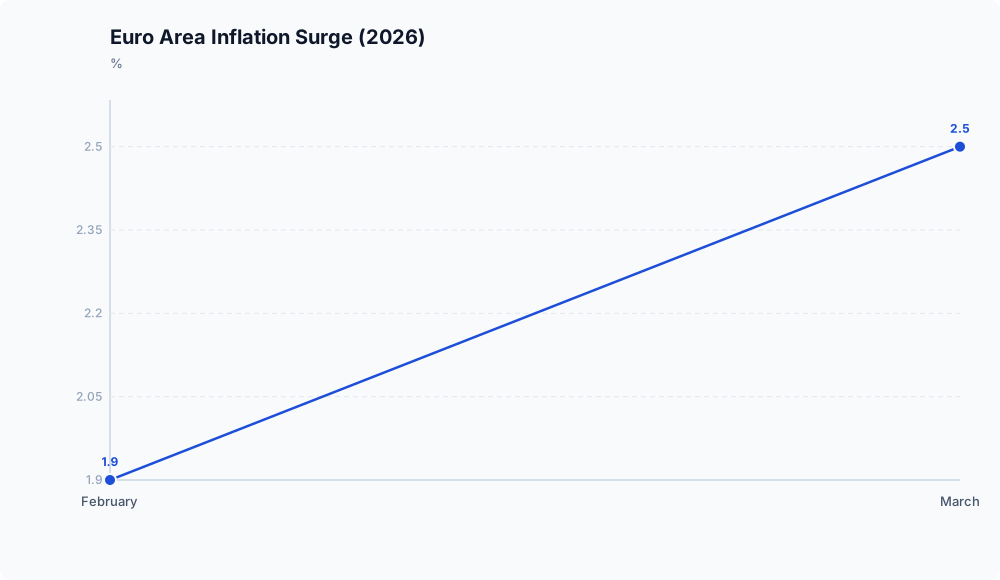
The immediate macroeconomic impact was highly visible in Europe. Euro area inflation surged from 1.9% in February 2026 to 2.5% in March, driven almost entirely by spiking energy prices, as noted by BENDURA BANK AG. For U.S. market participants, this demonstrates how rapidly a localized geopolitical chokepoint can reintroduce systemic inflation risks. The second-order effect of this European inflation surge is an increased risk premium on global energy imports, which threatens to bleed into U.S. headline inflation.
This imported inflation risk collided with an unexpectedly resilient U.S. domestic economy, forcing a reassessment of monetary policy timelines. The Federal Reserve adopted a strictly defensive posture, prioritizing inflation containment over capital market relief. At its March 17-18 meeting, the central bank held the federal funds rate steady in the 3.5%-3.75% range, explicitly citing ongoing inflation risks and geopolitical uncertainty, per BENDURA BANK AG. For U.S. investors, this signals that the central bank is structurally embedding a geopolitical risk premium into domestic borrowing costs.
The final link in this transmission chain terminates directly at U.S. commercial and residential construction sites. Real estate development is highly sensitive to the cost of debt, and sustained rates in the 3.5%-3.75% range drastically alter the calculus for new project underwriting.
(Visual Concept: A segmented bar chart illustrating a builder’s profit margin squeeze, showing rising debt-servicing costs and stagnant end-buyer pricing compressing the thin net-margin layer in the middle.)
As traditional regional banks face commercial real estate balance sheet pressures and tighten their lending standards, developers are experiencing severe constraints on capital access. Developers are forced to clear much higher financial hurdles to secure construction loans, rendering many previously viable projects economically unfeasible. Consequently, developers are increasingly shifting toward alternative private credit markets to fill the funding gap. While private credit offers a vital liquidity lifeline, its higher yield requirements further compress builder margins. Ultimately, a foreign geopolitical event has directly translated into a domestic capital constraint, artificially suppressing future U.S. housing and commercial supply.
Highest-Signal Evidence: The Spring 2026 Macroeconomic Disconnect
The Spring 2026 macroeconomic data presents a complex interplay of resilient domestic growth and persistent global pricing pressures. A breakdown of the latest figures highlights a surprisingly robust U.S. labor market, which added approximately 178,000 jobs in March 2026. Consequently, the domestic unemployment rate edged down to a healthy 4.3%, signaling sustained economic momentum, according to BENDURA BANK AG.
Job growth was notably concentrated in non-cyclical, physical-space-intensive sectors like healthcare, alongside construction and transportation, as reported by BENDURA BANK AG. For U.S. investors, this labor market strength implies that consumer spending will likely remain stable, providing a fundamental backstop for corporate earnings and commercial tenant demand. For real estate markets, this sustained wage-earning capacity acts as a critical shock absorber. Homebuyers are demonstrating an ability to absorb higher financing costs because their employment and income prospects remain secure, effectively decoupling baseline housing demand from the immediate dampening effects of restrictive central bank policy.
Updated Federal Reserve projections also pointed to slightly stronger U.S. GDP growth for 2026 at around 2.4%, per BENDURA BANK AG. This combination of solid labor demand and robust economic growth limits the urgency for monetary easing. Analytically, the data implies that the U.S. economy has the structural strength to absorb higher energy costs, but this very resilience prevents inflation from cooling fast enough to justify near-term rate cuts.
Despite the Federal Reserve’s anchored benchmark rate, a significant anomaly has emerged in the secondary market for U.S. housing finance. By April 9, 2026, the 30-year mortgage rate had fallen to 6.44%, as reported by The Wall Street Journal. This downward trend accelerated through the month, with the average 30-year fixed-rate conforming mortgage dropping further to 6.231% by April 23, while the 15-year fixed rate stood at 5.524%, according to Fortune.
Consumers reacted immediately to this anomalous easing. For the week ending April 17, overall mortgage applications increased by 7.9%, with purchase applications specifically surging by 10% and refinances climbing 6%, as detailed by Fortune. This divergence implies that bond market investors are pricing in future economic cooling or risk-off scenarios, temporarily detaching mortgage yields from the Fed’s stated policy trajectory.
The underlying catalyst for this mortgage rate anomaly rests on conflicting and notably thin geopolitical evidence. Reports suggest financial markets pushed rates lower in response to a Middle East ceasefire and the lower trend in oil prices, according to Fortune. However, this directly contradicts earlier reports of Strait of Hormuz closures and energy-driven inflation spikes. Because the evidence regarding a definitive ceasefire and sustained lower oil prices remains uncertain, investors should treat the April mortgage rate dip with extreme caution. The rapid application spike reveals massive pent-up demand among consumers who have adapted to the 6% rate threshold. If the ceasefire narrative proves premature, secondary market yields will likely snap back upward.
Scenario Analysis: Navigating Geopolitical Uncertainty
Looking ahead, U.S. investors face a highly uncertain landscape marked by conflicting geopolitical signals. To navigate this environment, market participants must weigh divergent paths and their respective impacts on capital markets. Ultimately, the trajectory of the U.S. real estate market hinges disproportionately on overseas geopolitical developments rather than domestic economic weakness.
| Scenario | Macroeconomic Triggers | Real Estate Market Impact |
|---|---|---|
| Base Case | Rates hold steady; US job market remains resilient (4.3% unemployment). | Demand stabilizes via steady job growth; tenant fundamentals remain strong but high debt costs limit transaction volume. |
| Upside | Geopolitical energy shock subsides; inflation cools. | Financing eases; transaction markets unfreeze and cap rates compress as the Federal Reserve pivots. |
| Downside | Energy inflation spikes further; Strait of Hormuz disruptions persist. | Construction lending freezes completely; refinancing failures trigger distressed asset sales and severe illiquidity. |
The Base Case: Interest rates hold steady at current levels (3.5%-3.75%), but real estate demand stabilizes through a surprisingly robust U.S. labor market. Because job growth is concentrated in physical-space-intensive sectors, commercial tenant demand is likely to remain insulated from broader macroeconomic softening. For real estate investors, this implies that while the cost of debt will continue to compress cash flows, strong underlying tenant fundamentals will prevent widespread distress and support steady rent growth.
The Upside Scenario: This materializes if the reported Middle East ceasefire holds, resolving the Strait of Hormuz closure and eliminating associated energy market disruptions. If global oil prices trend downward, imported inflation would rapidly dissipate. This cooling would give the Federal Open Market Committee the necessary cover to abandon its restrictive stance and begin easing the federal funds rate. For the U.S. real estate sector, this translates directly into lower mortgage rates, a thawing of the frozen transaction market, and an immediate unfreezing of construction lending.
The Downside Scenario: This involves a prolonged or escalating geopolitical conflict that causes energy inflation to spike further. If the Strait of Hormuz remains closed, the resulting energy supply shock could force the Federal Reserve to not only maintain current rates but potentially hike them to anchor runaway inflation expectations, according to BENDURA BANK AG. Under these conditions, the cost of capital would become prohibitively expensive, leading to a complete freeze in construction lending. Existing property owners would face insurmountable refinancing hurdles, triggering a wave of distressed asset sales.
What to Watch Next: Key Indicators for Market Liquidity

To navigate this transitional period, market participants must closely monitor a specific checklist of leading indicators that will dictate whether the Fed pivots or maintains its restrictive stance through the second half of the year.
- Energy Sector Volatility Indices and Oil Futures: Investors should track these to gauge whether the Middle East ceasefire has truly resolved the Strait of Hormuz disruptions. If oil prices stabilize downward, the Fed may find the breathing room necessary to soften its restrictive tone.
- Domestic CPI Prints: Upcoming inflation data will be critical. Any energy-driven inflation spikes will force the Federal Open Market Committee to defend its price stability mandate over economic expansion.
- Commercial Construction Starts: This metric will serve as the ultimate barometer for capital deployment. A sharp decline in new starts would signal that the current rate environment has finally broken developer math, potentially serving as the domestic economic trigger the Fed needs to initiate a pivot.
Conclusion

The Spring 2026 macroeconomic landscape requires a fundamental shift in how real estate professionals and investors assess risk. The data clearly illustrates that the U.S. economy possesses the structural labor strength to withstand elevated borrowing costs, effectively preventing a systemic collapse in housing demand. However, this domestic resilience is currently held hostage by external geopolitical fragility.
The recent drop in mortgage rates and the immediate 10% surge in purchase applications prove that immense pent-up capital is waiting on the sidelines, ready to deploy at the slightest hint of affordability. Yet, until the inflationary pressures imported from the Strait of Hormuz disruptions are definitively resolved, the Federal Reserve will prioritize defensive inflation containment over market liquidity. Investors must therefore underwrite their portfolios under the assumption that Higher-for-Longer Rates are a persistent feature of the 2026 market, favoring well-capitalized participants who can bypass traditional debt markets while highly leveraged operators face continued margin compression.
Disclaimer: This analysis is for informational purposes only and does not constitute investment, financial, real estate, or legal advice. Always consult a licensed financial advisor before making investment decisions.
FAQ
Why are US mortgage rates reportedly trending down if the Fed is holding its benchmark rate steady? Mortgage rates are heavily influenced by the bond market, which often prices in future economic expectations rather than strictly mirroring the Fed’s current overnight rate. In April 2026, bond investors reacted to reports of a potential Middle East ceasefire and a downward trend in oil prices. Anticipating that this could cool global inflation and eventually lead to slower economic growth or future Fed cuts, the secondary market temporarily detached from the Fed’s stated policy trajectory, driving 30-year mortgage rates down to the low 6% range.
How does an Iran-driven energy shock directly affect local US commercial real estate financing? The energy shock creates a direct transmission chain of imported inflation. When disruptions like the Strait of Hormuz closure cause global energy prices to spike, inflation expectations rise. To contain this inflation, the Federal Reserve holds benchmark interest rates high (in the 3.5%-3.75% range). These elevated base rates drastically increase the cost of debt for regional banks and developers, squeezing project margins, rendering many developments economically unfeasible, and forcing builders to rely on more expensive private credit markets.
Will the strong US job market be enough to sustain housing demand if rates stay above 3.5% through the end of 2026? Yes, evidence suggests that the resilient labor market acts as a critical shock absorber for the housing sector. With the U.S. adding 178,000 jobs in March 2026 and unemployment dropping to 4.3%, consumers maintain the secure wage-earning capacity needed to absorb higher financing costs. This underlying strength was demonstrated when a slight dip in mortgage rates in April immediately triggered a 10% surge in purchase applications, proving that demand remains vast and intact despite restrictive central bank policy.