
FOMC Division: How a 10-Year Yield Spike Alters Real Estate
The End of Consensus: How a Forecasted April 2026 FOMC Fracture and 10-Year Yield Spike Could Reprice Real Estate Risk
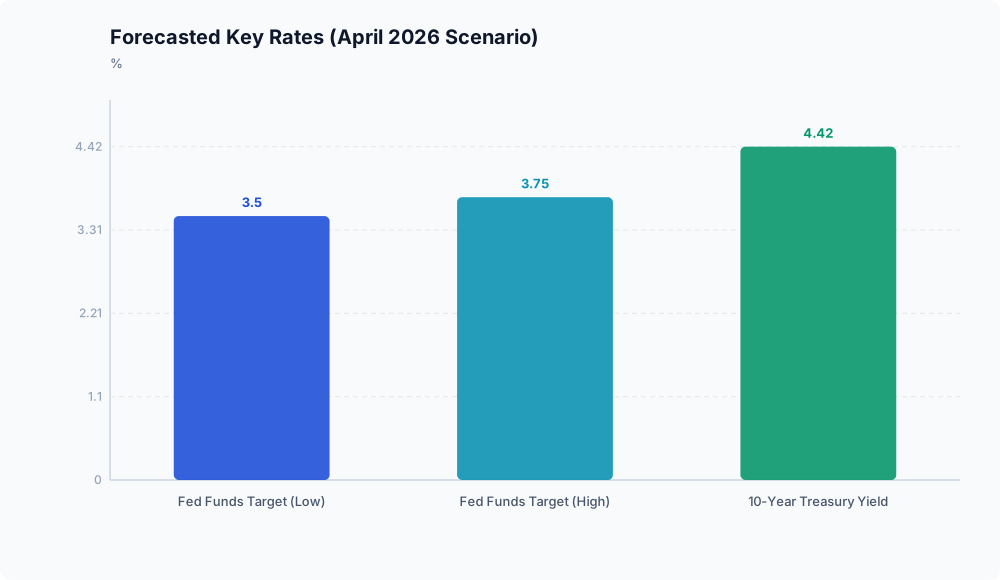
In a hypothetical scenario projecting a historic four-member dissent at an April 29, 2026, Federal Open Market Committee (FOMC) meeting, the perception of monetary consensus alters, fundamentally shifting the calculus for the US real estate market. By forecasting a vote to hold the target federal funds rate at 3.5% to 3.75% amidst internal division, this modeled central bank signals a solidified “higher-for-longer” rate regime. Markets would immediately digest this structural shift, prompting a projected 10-Year Yield Spike to 4.42%, according to Hiring Lab. For real estate investors, this forecasted yield surge is not merely a transient reaction to a single news cycle, but a foundational repricing of long-term debt costs. The unprecedented fracture envisioned within the central bank indicates that the predictable era of unified forward guidance could end, forcing market participants to navigate a significantly more volatile and opaque borrowing environment.
To understand the gravity of this projected policy shift, one must visualize the stark contrast between a traditionally unified Federal Reserve and a hypothetically divided committee. Historically, the FOMC operates as a monolithic entity, projecting unanimous confidence to anchor market expectations and stabilize long-term yields. The forecasted April 2026 meeting departs from that precedent. This visual of a central bank experiencing internal division leaves bond markets without a clear anchor, directly causing the risk premium on long-duration assets like real estate to expand. The modeled events suggest investors could no longer rely on the assumption of an imminent dovish pivot to support over-leveraged portfolios. Instead, the market must adapt to a forecasted environment where policy direction is contested, inflation is resurgent, and the cost of capital remains elevated.
The Transmission Chain of Market Distress
The transmission chain of this simulated market distress begins with an unusually fractured Federal Reserve facing stubborn inflationary pressures, forcing a repricing of risk across all debt-dependent sectors. When a scenario models three FOMC voters openly advocating for monetary tightening while one advocates for a cut, the market recalibrates its forward expectations. This hawkish projection pushes benchmark yields upward, driving the forecasted 10-year Treasury yield to 4.42%, as noted by Hiring Lab, as investors price out the probability of near-term rate cuts.
The rapid repricing of the risk-free rate acts as the primary transmission mechanism for broader market distress. Because the 10-year Treasury yield serves as the foundational baseline for long-term borrowing, any upward shock immediately increases the cost of capital. Consequently, any lingering optimism for a lower-rate environment in 2026 is replaced by defensive posturing across rate-sensitive asset classes.
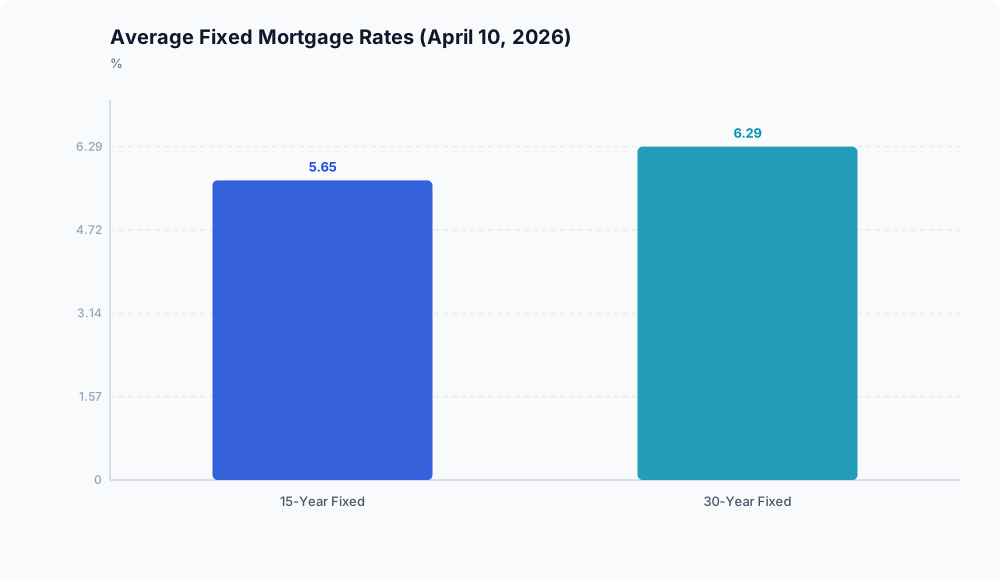
The immediate casualty of this simulated yield spike is the residential housing market, which would already show signs of strain prior to the central bank’s policy meeting. Even before the modeled late-April FOMC shock, the housing sector would be adjusting to sustained borrowing costs and economic uncertainty. In this forecast, Fortune reports that by April 10, 2026, the average 30-year fixed-rate conforming mortgage stands at 6.289%, while the 15-year fixed rate sits at 5.653%.
This elevated rate environment would push mortgage refinancing applications to their lowest pace since December 2025, according to Fortune. Furthermore, Fortune notes that overall mortgage applications would decrease by 0.8% in the first week of April alone, driven by continued macroeconomic hesitation. With the Fed hypothetically signaling potential hikes rather than cuts, mortgage rates are primed to rise further. This mathematically constrains affordability for prospective homebuyers and exacerbates the “lock-in” effect, keeping existing owners tethered to their current properties and stifling inventory.
The financial impact extends well beyond residential homebuyers, transmitting directly into the commercial real estate (CRE) sector. As the 10-year Treasury yield anchors the pricing for commercial debt, the abrupt shift in interest rate expectations places immense pressure on CRE developers and institutional investors.
The mechanics of this transmission are straightforward but significant:
- Higher benchmark yields mechanically force CRE capitalization rates (cap rates) upward.
- Because property values are inversely correlated to cap rates, rising yields drive down underlying asset valuations.
- Developers facing imminent debt maturities are caught in a liquidity trap, forced to refinance at substantially higher rates than originally underwritten.
While specific daily CRE valuation data for a projected late April remains fluid, the macroeconomic transmission from a hawkish Fed to rising cap rates is a fundamental market reality. This dynamic suggests that distress in the commercial sector would likely accelerate as the cost of capital remains elevated, requiring sponsors to inject substantial amounts of fresh equity just to maintain their existing portfolios.
High-Signal Evidence from a Divided Central Bank
The projected upward pressure on the 10-year Treasury yield is rooted in a modeled resurgence of energy-driven inflation. In this 2026 scenario, headline inflation accelerates to 3.3% year-over-year in March, fundamentally driven by a 21% spike in gas prices compared to February, according to Hiring Lab.
This forecasted surge in energy costs disrupts the market’s prevailing disinflationary narrative, forcing investors to reprice long-term inflation expectations. For US market participants, this dynamic illustrates that the path to price stability remains highly vulnerable to commodity shocks. When volatile components like energy dictate headline numbers, the path to a sustainable 2% inflation target becomes highly erratic. Consequently, bond markets demand higher term premiums to compensate for the renewed risk of sustained, above-target headline inflation.
This inflationary bump hypothetically fractures the consensus within the Federal Reserve, creating a highly ambiguous policy environment. During the forecasted April 29, 2026 meeting, the FOMC votes to hold the target federal funds rate at 3.5% to 3.75%, but Hiring Lab notes the decision is accompanied by four dissenting votes.
The nature of this division is particularly telling. The breakdown in consensus is notably severe because it pulls in opposite directions: Hiring Lab details that one Governor prefers an immediate rate cut, while three other voting members signal that the next adjustment could be upward. This multidirectional split indicates that policymakers are struggling to reconcile lagging economic weakness with sticky headline inflation. For investors, this lack of unity removes the forward guidance safety net, leaving fixed-income markets highly sensitive to each incoming macroeconomic data print.
To understand the severity of this internal division, it is necessary to contextualize the projected April 2026 vote against historical precedents. Hiring Lab points out that four dissents would mark the highest number of opposing votes in any single FOMC meeting since October 1992.
| Event Date | Total FOMC Dissents | Federal Funds Rate Target | Dissent Composition |
|---|---|---|---|
| October 1992 | 4 | Not specified | Previous historical record |
| April 2026 (Forecast) | 4 | 3.50% - 3.75% | 3 favoring hike, 1 favoring cut |
While the historical October 1992 dissent count is a verified fact, the scenario’s gas price surge and market inference that this guarantees a prolonged pause or an imminent hike remain highly speculative. Investors must carefully distinguish between confirmed historical breakdowns in committee consensus and speculative projections about long-term monetary policy. In the forecast, the three hawkish dissenters are likely reacting to the threat of these energy costs bleeding into core inflation, justifying their stance that rates may need to rise further. However, the presence of a dovish dissenter highlights that underlying economic fragility remains a profound concern at the highest levels of the central bank.
The macroeconomic uncertainty radiating from the modeled Fed would already generate tangible second-order effects in the credit sectors. As bond yields spike, the contraction in mortgage activity demonstrates how yield curve volatility translates into consumer retrenchment. Elevated borrowing costs would keep many prospective buyers on the sidelines. If the 10-year yield remains elevated due to Fed paralysis, the broader real estate market will likely experience a sustained freeze in both originations and refinancing velocity.
Scenario Analysis for Property Markets
Real estate markets remain acutely sensitive to the trajectory of long-term borrowing costs, creating a complex environment for investors navigating forecasted volatility. The fundamental anchor for housing finance is the 30-year fixed mortgage rate, which closely tracks the yield on the 10-year Treasury, as highlighted by money.usnews.com. Currently, a notable tension exists between projected yield shocks and the consensus among forecasters regarding long-term stabilization. Market participants must reconcile the immediate pressures of elevated yields with broader structural forecasts to accurately price risk.
Consequently, evaluating the real estate outlook requires a rigid scenario analysis that accounts for both the base case of market stabilization and the tail risks of monetary policy divergence.
The Base Case: Stable but Elevated Floors
In the base case scenario, the 10-year Treasury yield stabilizes near 4.4%, establishing a durable, albeit elevated, floor for borrowing costs. Under these conditions, analysts at money.usnews.com project that the 30-year fixed mortgage rate will not move significantly through 2026 and 2027.
This projected stability implies a fundamental shift in the real estate market from a period of rapid rate discovery to one of prolonged adjustment. For US investors, a flat rate environment means that asset appreciation will likely rely on net operating income (NOI) growth rather than capitalization rate compression. Homebuyers and commercial developers would be forced to underwrite projects based on these elevated rates. This effectively caps rapid capital growth while preventing a systemic collapse in property valuations, ushering in an era of muted transaction volumes and defensive asset management.
The Upside Scenario: Structural Cooling and Rate Relief
The upside scenariowhich is inherently bullish for real estatehinges on a structural cooling of energy-driven inflation and a subsequent retreat in Treasury yields. This outcome would require the Federal Reserve to resolve its forecasted internal divisions and signal a unified path toward monetary easing.
If the FOMC coalesces around rate cuts, the resulting drop in the 10-year yield would drag 30-year mortgage rates downward. For the residential market, this would alleviate the persistent lock-in effect, encouraging existing homeowners to list properties and unlocking pent-up transaction volume. In the commercial real estate sector, lower yields would provide immediate relief for sponsors facing looming debt maturities, allowing them to refinance without injecting substantial amounts of fresh equity.
The Downside Scenario: Policy Paralysis and Accelerating Defaults
Conversely, the downside scenario presents severe risks for property markets if inflation proves sticky and yields push even higher. This bearish outlook is amplified by the modeled policy uncertainty, particularly the open question of whether the lack of unity seen in the forecasted April 2026 FOMC meeting foreshadows sharper divisions in future policy decisions.

With four dissenting members hypothetically sending conflicting signals about the next interest rate adjustment, the risk of policy paralysis is non-trivial. If the central bank is forced to maintain or increase rates, borrowing costs will defy the stable consensus and breach new highs. The second-order effects of this scenario would be notable in the commercial space, where persistently high refinancing costs would inevitably accelerate defaults and force distressed asset sales at steep discounts.
Ultimately, the divergence between the forecasted fractured FOMC signals and analyst predictions of long-term rate stability demands a highly cautious approach from market participants. Investors should avoid over-leveraging based on the assumption that borrowing costs will naturally revert to pre-2022 levels. Instead, real estate portfolios must be stress-tested against the downside risk of prolonged inflation and elevated yields.
What to Watch Next: Granular Triggers for Market Direction
As market participants digest the implications of a hypothetical April 2026 FOMC decision, the focus must shift toward high-frequency data and forward-looking indicators. Without a unified forward guidance framework, broad macroeconomic narratives are no longer sufficient for risk management. Instead, bond and real estate investors must monitor a specific set of granular triggers to anticipate the next shifts in Treasury yields and housing valuations.
Central Bank Communications The most immediate variable to track is the schedule of public statements from Federal Reserve officials, particularly the four dissenting members of the modeled meeting. Hiring Lab notes this level of internal disagreement marks the highest number of FOMC dissents in a single meeting since October 1992, highlighting a profound breakdown in policy alignment. For Treasury markets, this deep division implies that short-term yields will become highly sensitive to individual public statements as traders attempt to price in the probability of a hike versus a cut. Investors should scrutinize upcoming speeches to gauge whether the hawkish faction is building a broader coalition, which would likely steepen the yield curve and pressure fixed-income portfolios.
Energy Market Volatility To understand which Fed faction might ultimately prevail, market participants must closely monitor energy price reports. In the forecast, headline inflation accelerates to 3.3% year-over-year in March 2026, an increase Hiring Lab indicates is largely driven by a sharp 21% spike in gas prices from the previous month. Because energy costs flow directly into consumer expectations and broader logistics expenses, gas prices assume an outsized role in the inflation narrative. Investors should treat weekly crude inventory data and retail gasoline price indices as leading indicators for future monetary policy, recognizing that a persistent energy shock could force the Fed’s hand regardless of underlying economic slowing.
Real-Time Consumer Credit Demand In the housing and mortgage sectors, weekly application volumes serve as the primary real-time barometer for consumer endurance. Economic uncertainty and elevated borrowing costs hypothetically stifle demand, with Fortune reporting that modeled mortgage applications decrease by 0.8% for the week ending April 3, 2026. Furthermore, Fortune notes the pace of mortgage refinancing applications falls to a projected low point not seen since December 2025. Tracking these weekly origination and refinancing metrics will be critical for investors in mortgage-backed securities (MBS) and homebuilder equities, as sustained weakness here signals that the interest rate regime is actively restricting capital mobility in the real estate market.
Conclusion

The intersection of energy shocks, central bank infighting, and stalling credit demand paints a highly cautious picture for US asset allocation. The forecasted historic dissent at an April 2026 FOMC meeting illustrates that the era of predictable, unified forward guidance could be over. For the real estate sector, the resulting 10-Year Yield Spike is not merely a technical adjustment; it represents a fundamental repricing of risk in an environment where the central bank’s next move is entirely unpredictable.
While three modeled dissenters favor a rate hike, the presence of a dovish dissenter and weakening mortgage data suggest the broader economy may not easily absorb further tightening. If gas prices stabilize and mortgage demand continues to decline, the dovish argument for rate cuts may gain traction. Conversely, if energy-driven inflation proves sticky, the hawkish push for further tightening could exacerbate the freeze in mortgage applications and drive bond yields higher. Until a definitive trend emerges across these specific data points, US investors should maintain defensive posturing, prioritizing assets with strong cash flows and conservative loan-to-value ratios. Ultimately, policy outcomes currently hinge on a fragile economic equilibrium, demanding that real estate portfolios be rigorously stress-tested for a prolonged period of elevated and unpredictable interest rates.
Disclaimer: This analysis is for informational purposes only and does not constitute investment, financial, real estate, or legal advice. Always consult a licensed financial advisor before making investment decisions.
FAQ
Why would the 10-year Treasury yield spike after a hypothetical April 2026 FOMC meeting? The 10-year Treasury yield is projected to spike to 4.42% because the modeled FOMC meeting reveals a significant breakdown in central bank consensus. Four members dissent from the decision to hold rates, with three specifically signaling that the next policy move should be a rate hike. This hawkish revelation prompts investors to rapidly price out the probability of near-term rate cuts, expanding the risk premium on long-duration assets.
How does a fractured Federal Reserve impact 30-year mortgage rates? A fractured Federal Reserve removes the safety net of unified forward guidance, making bond markets highly volatile. Because 30-year fixed mortgage rates closely track the 10-year Treasury yield, the uncertainty and resulting upward pressure on benchmark yields translate directly into higher, more unpredictable borrowing costs for homebuyers.
Will commercial real estate cap rates increase due to the ‘higher-for-longer’ rate regime? Yes. Capitalization rates are mechanically linked to the risk-free rate provided by the 10-year Treasury yield. As benchmark yields rise, CRE cap rates face upward pressure, which inversely drives down underlying property valuations and increases the cost of refinancing for developers.
Are mortgage rates expected to stay high through 2026 and 2027? Base case forecasts suggest that if the 10-year Treasury yield stabilizes near 4.4%, the 30-year fixed mortgage rate will not move significantly through 2026 and 2027. While this implies a ceiling on rapid rate growth, it also indicates that borrowing costs are expected to remain elevated for a prolonged period.