
Higher for Longer Rates: Impact on US Equity Markets
Navigating the Higher for Longer Interest Rate Environment
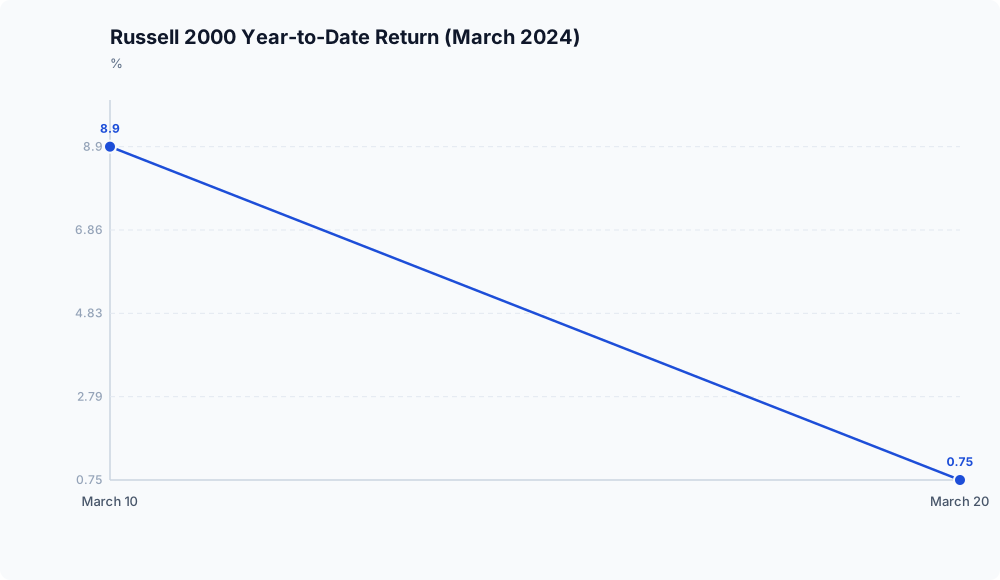
The Federal Reserve’s March 2024 policy decision marks a definitive transition for US equity markets, cementing a Higher for Longer interest rate regime not as a temporary cyclical phase, but as a structural reality. By voting 11-1 to maintain the federal funds rate at 3.50% to 3.75%, the Federal Open Market Committee (FOMC) directly countered market expectations for near-term monetary easing (Wedbush). The primary catalyst for this hawkish pause was a concerning persistence in price pressures, underscored by the central bank revising its 2024 PCE inflation outlook upward to 2.7% (Wedbush). For market participants, this event is a critical inflection point. The foundational assumption of impending monetary reliefwhich had previously buoyed speculative and debt-reliant equitieshas been structurally undermined. The immediate market reaction validates this thesis: within just ten days of its March 10 peak of an 8.9% year-to-date return, the Russell 2000 index saw its gains effectively erased, falling to +0.75% by March 20 (Wedbush). This rapid capital shift from small-cap equities illustrates that investors are actively pricing in a fundamental solvency risk for the most vulnerable segments of the corporate landscape.
The Transmission Chain: From Hawkish Pause to Equity Contraction
The transmission mechanism from the Federal Reserve’s hawkish policy stance to the equity market contraction operates through a clear repricing of risk across the bond market. The Fed’s upward revision of the PCE inflation outlook to 2.7% acted as the immediate event catalyst (Wedbush). This shift in central bank expectations fundamentally reset the bond market’s assumptions regarding the future path of overnight rates, triggering a rapid sell-off in sovereign debt.
The primary mechanism of this transmission was the spike in the 10-year Treasury yield, which surged from the mid-3% range at the start of the year to 4.29% by March 20 (Wedbush). For investors and corporate treasurers alike, this yield spike acts as the central transmission node for tighter financial conditions, elevating the cost of capital across all asset classes.
This mechanism exerts a dual-pronged market effect, impacting both ends of the equity spectrum through different mathematical realities:
- Multiple Compression for Long-Duration Assets: As the risk-free rate anchors at an elevated 4.29%, long-duration assetssuch as high-growth technology stocksface mathematical downward pressure. Equity valuation models rely heavily on discounting future cash flows back to their present value. When the discount rate (driven by the 10-year Treasury) rises, the present value of distant earnings decreases. Consequently, investors are less willing to pay a premium for future growth, forcing a mechanical compression of equity risk premiums and a sustained rotation away from speculative growth toward companies exhibiting immediate cash flow generation.
- Operational Squeeze on Floating-Rate Debt: At the lower end of the market capitalization spectrum, the transmission mechanism impacts the balance sheet directly. Small-cap companies are disproportionately reliant on variable borrowing, with floating-rate debt constituting approximately 32% to 40% of their total liabilities (Wedbush). As the federal funds rate remains pinned at 3.50% to 3.75%, the interest expense on this floating-rate debt remains elevated, directly eroding operating margins before any broader macroeconomic slowdown materializes.
This dual transmission chain transforms a macroeconomic headwind into a direct operational threat, explaining the sharp repricing of the Russell 2000 index in the immediate aftermath of the FOMC decision.
The Highest-Signal Evidence: Profitability and the Maturity Wall
The foundation of the small-cap sector’s current vulnerability is based on a verified, structural decline in corporate profitability that is colliding with a significant debt maturity wall. While market optimism often focuses on forward-looking earnings estimates, the highest-signal data points from the current environment reveal a persistent deterioration in small-cap fundamentals.
As reported by Investing.com, the proportion of unprofitable companies within the Russell 2000 index has surpassed levels seen during the systemic shock of the 2020 pandemic lockdowns.
| Year | Unprofitable Russell 2000 Companies |
|---|---|
| 2020 | 40% |
| 2023 | 35% |
| 2024 | 43% |
This verified baseline of unprofitability highlights that nearly half of the small-cap index is operating at a deficit before addressing upcoming capital structure challenges.
This fundamental weakness intersects with a structural challenge in small-cap debt maturity profiles. Russell 2000 companies are scheduled to roll over $368 billion in debt in 2026, followed by an additional $341 billion in 2027 (Investing.com). This combined $709 billion refinancing test must be executed in an environment where prevailing refinancing rates are hovering near 6.5% (Wedbush).
The analytical synthesis of widespread unprofitability and a $709 billion maturity wall at 6.5% points to a significant margin squeeze. The median free cash flow margin for Russell 2000 companies sits at a low 0.06%, a stark contrast to the 7.78% median free cash flow margin enjoyed by the larger constituents of the Russell 1000 (Investing.com).
Because these smaller enterprises lack the organic cash generation required to absorb higher interest expenses, analysts estimate that between 41% and 46% of Russell 2000 constituents are classified as “zombie companies”entities unable to cover their existing interest expenses with operating profits (Wedbush). For US investors, this data signals that passive, index-wide exposure to the Russell 2000 carries systemic risk, as the index is weighted down by constituents facing financial strain.
Scenarios: Navigating the Capital Scarcity Regime
Given the Federal Reserve’s commitment to managing price pressures, investors must map out potential paths forward. The base case, downside, and upside scenarios hinge on the trajectory of inflation and the resulting cost of capital.
The Base Case: Prolonged Restriction and Corporate Restructuring The base case for US markets involves a prolonged period of restrictive monetary policy, as evidence for an immediate dovish pivot remains thin following the Fed’s upward revision of 2024 PCE inflation to 2.7% (Wedbush). Rates remain restrictive through the near term, forcing vulnerable equities to navigate a high-cost capital environment.
Under this base case, the Russell 2000 faces a liquidity squeeze as it approaches the $709 billion maturity wall across 2026 and 2027 (Investing.com). Because the median small-cap free cash flow margin is 0.06%, companies will need to divert capital away from growth initiatives into debt servicing. The inevitable second-order effect is a wave of dilutive equity offerings, distressed debt exchanges, and operational cost-cutting. Capital scarcity will heavily favor large-cap companies with fixed, long-term debt structures and robust cash flows.
The Downside Scenario: Re-acceleration and Systemic Default A downside scenario emerges if inflation re-accelerates, forcing the Fed into further rate hikes and triggering systemic stress across lower-quality equities. With 32% to 40% of small-cap liabilities consisting of floating-rate debt, these companies are highly sensitive to any additional yield spikes (Wedbush).
If the 10-year Treasury yield climbs significantly beyond its recent 4.29% mark, the 41% to 46% of Russell 2000 constituents classified as “zombie companies” could experience a wave of corporate defaults (Wedbush). Bankruptcies among weaker firms would become more common. Furthermore, this downside shock would exert downward pressure on growth stocks, driving multiple compression as the discount rate on future earnings rises.
The Upside Scenario: Disinflation and Preemptive Relief An upside scenario relies on inflation cooling faster than the Fed’s cautious projections. If macroeconomic data softens sufficiently to allow preemptive rate cuts, the reduction in borrowing costs could support small-cap margins and avert the looming default cycle. Lower benchmark rates would alleviate the interest burden on floating-rate debt, providing room for companies to restructure their 2026 and 2027 obligations.
Beyond small caps, a dovish shift would broadly benefit the technology sector and other growth equities by expanding valuation multiples from their current average of 15-16x (Investing.com). However, given the recent 11-1 FOMC vote and the upward revisions to PCE inflation, evidence for this scenario is currently limited. Investors should treat this optimistic outcome with caution until definitive disinflationary trends materialize.
What to Watch Next: Concrete Indicators for Market Participants
To navigate this restrictive environment and anticipate shifts in the capital structure landscape, market participants must maintain a disciplined focus on actionable metrics. The path forward hinges on whether the Federal Reserve can deliver relief cuts, making the following indicators paramount:
- Core Inflation Prints (CPI and PCE): Following the upward revision of the 2024 PCE outlook to 2.7% (Wedbush), upcoming inflation prints are primary catalysts dictating near-term liquidity. An upside surprise in monthly CPI or PCE data could trigger further upward repricing of the yield curve, exacerbating the small-cap squeeze.
- High-Yield Corporate Credit Spreads: Given that nearly half the Russell 2000 operates unprofitably, high-yield credit spreads serve as a warning mechanism for systemic distress. Investors must specifically track the credit spread between S&P 500 and Russell 2000 debt costs. A widening of this spread indicates that credit markets are demanding a higher premium to absorb small-cap default risk. If this spread accelerates, it will likely precede credit downgrades and restructurings.
- Earnings Call Transcripts (Q2 and Q3): Leading indicators will emerge at the microeconomic level during upcoming corporate reporting periods. Investors should utilize transcript screening to track the frequency of management mentions regarding “refinancing” and “interest expense.” Because Russell 2000 companies operate with 0.06% free cash flow margins, a rhetorical shift toward dedicating significant earnings call time to discussing debt restructuring typically signals that interest coverage ratios have deteriorated. This allows investors to identify insolvency risks before financial statements reflect the damage.
Conclusion: The Structural Reality of Capital Scarcity

The Federal Reserve’s prioritization of inflation control over economic accommodation dictates a defensive pivot for US investors. The era of zero-interest-rate policy subsidizing unprofitable growth and masking weak balance sheets has ended. The data is unequivocal: with the 10-year Treasury yielding 4.29%, 43% of the Russell 2000 operating unprofitably, and a $709 billion refinancing wall looming over the next two years, the fundamental architecture of the small-cap market is under stress.
For the reader, the analytical takeaway is clear: passive, broad-based exposure to lower-quality equities now carries an asymmetric downside risk. The structural divergence between large-cap fortresses generating robust free cash flow and small-cap entities managing a 6.5% cost of capital will accelerate. Until definitive evidence emerges that inflation is returning to target and the central bank can safely ease conditions, a Higher for Longer regime will disproportionately impact reliance on variable debt. Capital allocation in this environment requires active management, prioritizing balance sheet quality, fixed debt structures, and insulated cash flows to navigate the impending maturity wall.
Disclaimer: This analysis is for informational purposes only and does not constitute investment, financial, real estate, or legal advice. Always consult a licensed financial advisor before making investment decisions.
FAQ
How does a ‘higher for longer’ interest rate environment mathematically reduce the valuation of long-duration growth and tech stocks? Valuations for long-duration and tech stocks rely heavily on discounting expected future cash flows back to their present value. When interest rates remain elevated, the risk-free rate (often represented by the 10-year Treasury yield) increases. This higher yield directly increases the discount rate applied in valuation models. Mathematically, dividing future earnings by a larger discount rate reduces the present value of those earnings, forcing a compression of the stock’s valuation multiple.
Why are Russell 2000 companies disproportionately affected by sustained high interest rates compared to large-cap S&P 500 companies? Russell 2000 companies are uniquely vulnerable because they are highly reliant on variable borrowing, with floating-rate debt constituting 32% to 40% of their total liabilities. When overnight rates remain high, their interest expenses rise immediately. Furthermore, these small-cap firms have thin financial buffers, featuring a median free cash flow margin of just 0.06%, compared to the 7.78% margin seen in larger Russell 1000 companies, leaving them without the internal cash generation to absorb higher borrowing costs.
What is the ‘maturity wall’ and why are the years 2026 and 2027 critical for small-cap debt refinancing? The “maturity wall” refers to a concentration of corporate debt that is scheduled to expire and must be paid off or refinanced. For the Russell 2000, this constitutes a $709 billion test, with $368 billion coming due in 2026 and another $341 billion in 2027. These years are critical because companies will be forced to refinance this expiring debt at current prevailing market rates (near 6.5%), which are significantly higher than the rates at which the debt was originally issued, creating an operational squeeze.
How can investors identify which small-cap stocks are at the highest risk of default or significant margin compression? Investors can identify high-risk small caps by looking for “zombie companies”firms that cannot cover their existing interest expenses with operating profits (currently estimated at 41% to 46% of the Russell 2000). Additionally, investors should monitor Q2 and Q3 earnings call transcripts for increased management mentions of “refinancing” and “interest expense,” and track widening credit spreads between large-cap and small-cap debt, which indicate the bond market is pricing in higher default risk.