
Federal Reserve April 2026 Meeting: Rate Hold Scenario
Federal Reserve April 2026 Meeting: Macroeconomic Impact
A projected Federal Reserve April 2026 Meeting marks a potential inflection point for US investors and the broader macroeconomic landscape. In this scenario analysis, by opting to hold the federal funds rate at 3.5% to 3.75% for the third consecutive time that year, as noted in projections by Freedom Mortgage, the Federal Open Market Committee (FOMC) would alter market expectations for an imminent return to a low-rate environment. This envisions a narrative shifting from managing transitional, post-pandemic inflation to battling entrenched, structural economic constraints.
For market participants, this hypothetical reality necessitates an immediate recalibration of expectations. The central bank would be constrained by a complex dual mandate dilemma, forced to weigh sticky, structural inflation driven by global energy markets against unprecedented labor market uncertainty spurred by technological disruption. According to Freedom Mortgage, a projected decision to hold rates would be driven by inflation remaining persistently above the target, alongside complex labor dynamics tied to rapid advances in artificial intelligence (AI). Until these structural constraints resolve, equity valuations would need to be repriced to reflect a fundamentally higher risk-free rate environment, indicating a shift away from reliance on near-term dovish policy.
The Transmission Chain: From Macro Shocks to Market Impact
The FOMC’s modeled decision to maintain rates stems from a complex dual mandate constraint driven by two distinct external shocks: geopolitical conflict in the Middle East and structural shifts in the labor market. This convergence of an energy-driven inflation floor and AI-induced labor opacity would transmit directly into a prolonged higher cost of capital.
In this projection, the primary structural constraint on the Fed’s inflation mandate originates from an ongoing Iran conflict and its direct impact on global energy markets. These energy-linked components would act as a floor under headline inflation, limiting the FOMC’s policy flexibility. Analytically, this means that even if core goods and services cool, exogenous oil shocks could prevent near-term rate cuts. Compounding this inflation floor is a projected complication in the Fed’s employment mandate: labor market uncertainty tied to advances in AI. If AI simultaneously displaces certain roles while masking underlying labor weakness, the Fed could not confidently use traditional employment data to justify easing policy.
This restrictive environment would affect rate-sensitive equity cohorts that rely on predictable debt financing and yield spreads. The projected transmission chain from these macro-level shocks to specific portfolio impacts reveals distinct vulnerabilities across the market.
| Transmission Link | Catalyst / Driver | Market Effect | Impacted Cohorts & Second-Order Effects | Timing of Impact |
|---|---|---|---|---|
| Event | Projected Fed hold at 3.5%-3.75% | Elevated baseline cost of capital | Broad Equities: Re-pricing of risk premiums and delayed capital expenditure across all asset classes. | Immediate (Q2 2026) |
| Mechanism 1 | Iran conflict & oil spikes | Creates an inflation floor | Utilities & REITs: Dividend yields become less competitive against risk-free rates; borrowing costs for capital projects remain high. | Near-term (Next 1-3 months) |
| Mechanism 2 | AI labor unpredictability | Constrains employment mandate | Debt-Heavy Small Caps: Unable to refinance floating-rate debt at lower tiers; margin compression accelerates. | Medium-term (Next 3-6 months) |
For US investors, the implications of this hypothetical transmission chain would require a defensive pivot within rate-sensitive allocations. Real Estate Investment Trusts (REITs) and utilities traditionally function as bond proxies, but with the Fed structurally constrained from cutting rates, these sectors would likely face continued valuation pressure. Their dividend yields would compete poorly against sustained risk-free rates, and their capital-intensive operations would face elevated borrowing costs. Furthermore, debt-heavy small caps would face refinancing challenges; without a rate cut, their floating-rate obligations would accelerate margin compression.
Highest-Signal Evidence: A Shifting Consensus
While the Fed might maintain a cautious easing bias, internal consensus could shift. The highest-signal evidence from this projected meeting is the theoretical emergence of four dissenting votes, which would expose a widening ideological divide within the committee, as noted in scenario analyses by LinkedIn.
In this model, Governor Stephen Miran would dissent in favor of an immediate 25-basis-point cut, signaling a belief that restrictive rates are already causing undue economic harm. Conversely, Presidents Hammack, Logan, and Kashkari would support the rate pause but explicitly oppose the inclusion of an “easing bias” in the official statement, as detailed by J.P. Morgan Asset Management. This projected three-to-one split among dissenters highlights a hawkish undercurrent, suggesting that a substantial faction of the committee might view structural inflation as too severe to hint at future cuts.
The primary anchor keeping rates elevated in this scenario is the persistence of inflation, remaining above the Fed’s target due largely to external geopolitical shocks. The committee would explicitly acknowledge that energy-linked components continue to present a structural constraint on policy flexibility, according to projections by the Federal Reserve Board. Chairman Jerome Powell is projected to indicate that the central bank is closely monitoring the inflationary impacts of an Iran conflict and the corresponding surge in global oil prices, as noted by Freedom Mortgage.
Contrasting the data of energy-driven inflation is the inferred evidence regarding the labor market’s structural evolution. The FOMC would cite “labor market uncertainty amid advances in AI” as a contributing factor in their decision to hold rates steady, according to Freedom Mortgage. However, the specific mechanisms by which artificial intelligence displaces workers or alters wage dynamics remain largely unquantified in current macroeconomic data. The Fed would appear to be acting on forward-looking uncertainty and corporate restructuring rather than realized job-loss data linked directly to AI implementation. This implies policymakers attempting to preemptively manage a technological shift without a historical playbook, introducing a novel risk premium into modern monetary policy.
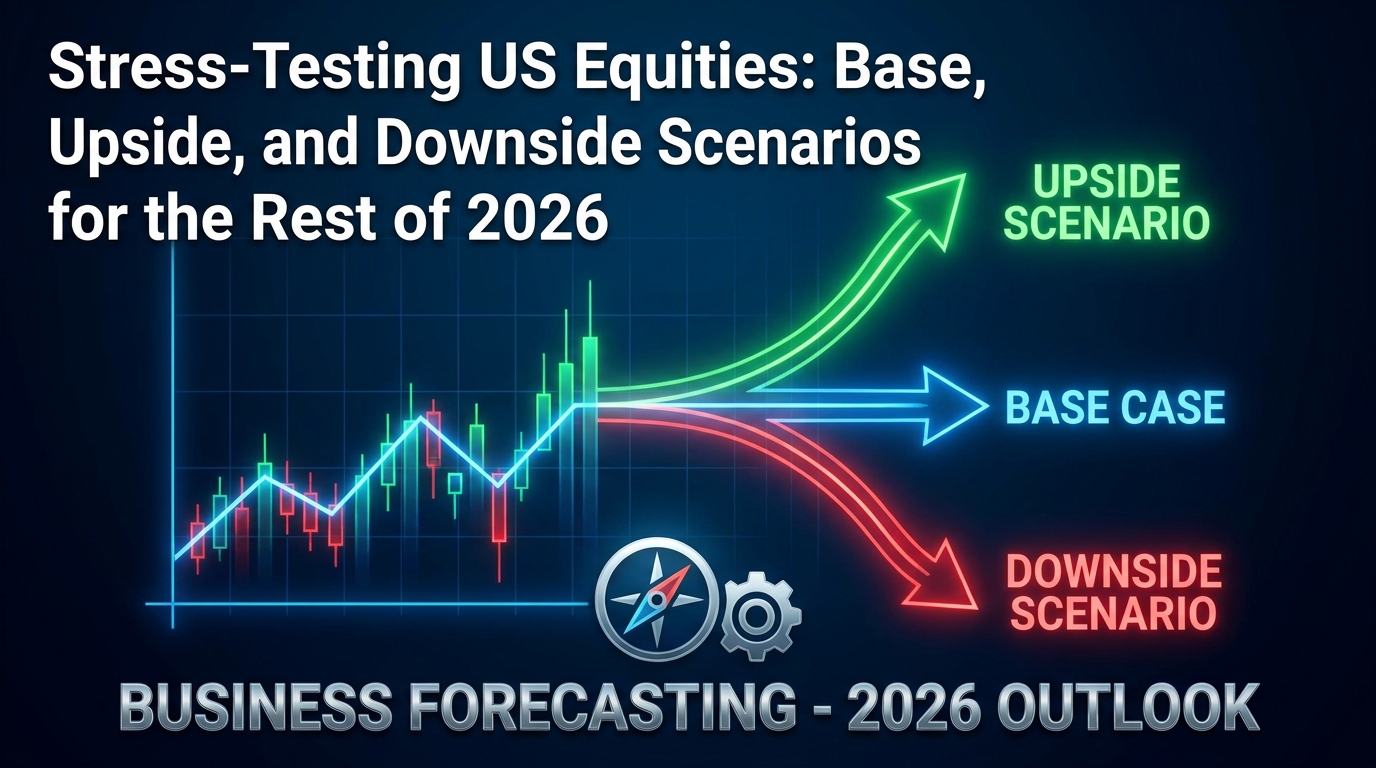
Forward Scenarios: Base Case, Downside, and Upside

Projecting equity performance through the remainder of 2026 requires acknowledging a high degree of uncertainty. Traditional macroeconomic indicators could be influenced by unpredictable variables, prompting investors to prepare for multiple divergent outcomes.
The Base Case: Prolonged Valuation Compression If the modeled holding pattern persists through late 2026, US equity markets would face persistent valuation compression. A prolonged 3.5% to 3.75% rate environment means equity risk premiums would remain compressed. This base case prompts a structural reallocation toward companies with strong balance sheets and robust free cash flow, moving capital away from speculative growth and debt-reliant enterprises.
The Downside Risk: Energy-Driven Stagflation The downside risk for US equities involves an energy-driven stagflationary shock colliding with macroeconomic weakness. Should geopolitical conflicts escalate, the resulting spike in energy costs would likely force the Fed to maintain or even hike rates despite underlying economic fragility. Simultaneously, if AI integration accelerates white-collar layoffs as energy prices surge, consumer spending would significantly decline. This dynamic suggests that any upcoming rate cuts might be framed as “insurance cuts” against labor deterioration rather than a victory over inflation. In this scenario, corporate earnings estimates would face downward revisions while discount rates remain elevated, triggering a broader equity repricing.
The Upside Scenario: A Technologically Driven Soft Landing Conversely, an upside scenario hinges on the resolution of these friction points, paving the way for eventual monetary easing. If geopolitical tensions cool, the subsequent drop in global oil prices would alleviate the persistent energy-linked components of inflation. Furthermore, the AI-driven labor market uncertainty, according to Freedom Mortgage, could resolve positively if the technology proves to be productivity-enhancing without triggering mass worker displacement. Under these conditions, the Fed would have the macroeconomic cover required to initiate rate cuts, prompting market participants to bid up equities in anticipation of a soft landing where technological efficiency bridges the gap between lower inflation and sustained growth.
What to Watch Next: Concrete Triggers and Indicators
Because a cautious easing bias is highly vulnerable to incoming macroeconomic data, as reported by LinkedIn, the path to subsequent FOMC meetings would be dictated by a narrow set of leading indicators. Investors must shift their focus from broad economic aggregates to specific, high-frequency triggers that could influence committee decisions.
- Brent Crude Oil Resistance Levels: The primary geopolitical indicator to monitor is Brent crude oil, serving as a direct market proxy for Middle East conflicts. If Brent crude decisively breaches upper resistance thresholds, it would signal a sustained supply shock rather than a transitory geopolitical risk premium. A sustained breakout would likely accelerate equity repricing, as markets adjust for lower probabilities of near-term rate cuts.
- Core Services CPI Sub-Components: Energy-linked components could act as a structural constraint on the Fed’s policy flexibility, as noted by LinkedIn. However, the analytical focus must extend beyond headline energy inflation to the core services Consumer Price Index (CPI). If rising energy costs begin to affect the services sector, it indicates second-order inflationary effects are taking hold. Should this occur, the hawkish faction of the FOMC could gain ground, prompting a more restrictive posture.
- AI-Vulnerable Initial Jobless Claims: The Fed’s dual mandate requires careful monitoring of employment data, specifically initial jobless claims cross-referenced with AI-vulnerable sectors. Investors should scrutinize weekly jobless claims for disproportionate increases in administrative, technical, and white-collar roles that are currently susceptible to AI automation.
The interplay between these specific indicators will ultimately determine whether the projected equity repricing accelerates or stabilizes. A scenario where oil prices surge alongside an increase in AI-driven job losses would present the FOMC with a stagflationary dilemma, complicating any cautious easing bias, according to LinkedIn.
Conclusion
A projected Federal Reserve April 2026 Meeting indicates how the macroeconomic environment could fundamentally evolve. By hypothetically holding rates at 3.5% to 3.75% amid shifting internal consensus, the FOMC would signal that monetary policy is tied to external forces: Middle Eastern geopolitics and the evolving labor market impacts of artificial intelligence. For investors, the analytical takeaway is clear. The cost of capital could remain elevated until these dual structural constraints are resolved. Portfolios should be evaluated against a higher-for-longer reality, necessitating a defensive pivot away from debt-dependent, rate-sensitive equities and toward assets capable of weathering a persistently restrictive monetary environment.
Disclaimer: This analysis is for informational purposes only and does not constitute investment, financial, real estate, or legal advice. Always consult a licensed financial advisor before making investment decisions.
FAQ
Why would the Federal Reserve hold rates steady at 3.5% to 3.75% at a projected April 2026 meeting? In this scenario, the Federal Reserve would hold rates steady due to a dual mandate challenge. Policymakers would be addressing structural inflation driven by global energy shocks while simultaneously navigating labor market uncertainty caused by rapid advances in artificial intelligence. This combination would lead the Fed to prioritize the known threat of inflation over ambiguous labor market shifts.
How could an Iran conflict impact the FOMC’s inflation targets and rate decisions? An ongoing conflict involving Iran would place upward pressure on global oil prices. These energy-linked components would act as a floor under headline inflation, limiting the FOMC’s policy flexibility. As long as geopolitical tensions influence crude oil pricing, the Fed’s ability to execute rate cuts would be restricted.
Why would artificial intelligence cause labor market uncertainty for the Federal Reserve? AI-driven disruptions could complicate the Fed’s employment mandate because traditional labor metrics might no longer provide a reliable gauge of economic health. The Fed would be uncertain whether AI is displacing workers and masking underlying labor weakness or acting as a productivity enhancer, constraining their ability to ease policy based on current employment data.
Which US equities would be most vulnerable to a prolonged Fed rate pause in 2026? Highly leveraged and rate-sensitive equities would be the most vulnerable. This includes Real Estate Investment Trusts (REITs) and utilities, whose dividend yields would compete poorly against sustained risk-free rates, as well as debt-heavy small-cap companies that would face refinancing challenges and margin compression under elevated borrowing costs.