
Mortgage Rates 2026 Outlook: Navigating the Fed Pause
Mortgage Rates 2026 Outlook: Navigating the Fed’s Pause
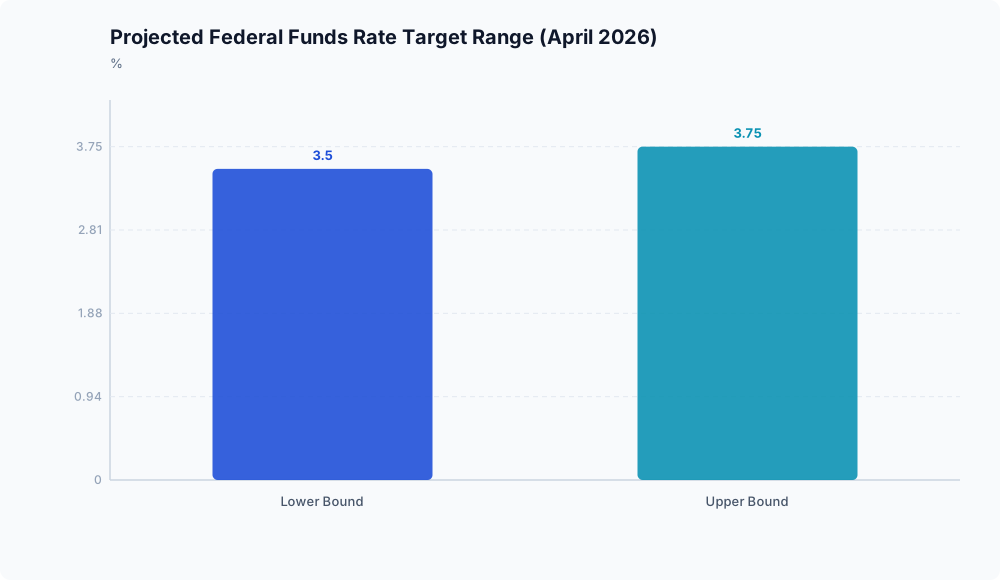
For spring homebuyers and real estate investors banking on a sudden drop in borrowing costs, the Federal Reserve’s projected late April 2026 policy decision serves as a sobering reality check. Anticipated to conclude its third meeting of the year on April 29, 2026, the Federal Open Market Committee (FOMC) is expected to hold the federal funds rate steady within a target range of 3.5% to 3.75%, according to Redfin. This effectively eliminates optimism for near-term rate relief. This forecast fundamentally reshapes the Mortgage Rates 2026 Outlook, signaling that macroeconomic stability and inflation containment take absolute precedence over easing consumer borrowing conditions.
The era of waiting for rates to plummet is functionally over. The central bank’s projected stance delivers a clear message: domestic monetary policy remains on hold, tethering the cost of capital to volatile international forces. Prospective buyers, sellers, and mortgage originators must recalibrate their financial strategies based on entrenched, elevated rates rather than speculative future cuts.
This article breaks down the transmission mechanisms driving these costs, the highest-signal data defining the market, and the critical scenarios dictating housing affordability through the year.
The Transmission Chain: From Geopolitical Shock to Consumer Wallets
To understand why mortgage rates face upward pressure despite the Federal Reserve’s anticipated rate pause, market participants must look beyond domestic borders. The Fed’s projected policy decisions illustrate a cautious balancing act between domestic economic stability and external geopolitical risks.
Federal Reserve Chairman Jerome Powell has explicitly emphasized a wait-and-see approach. He points to the ongoing Iran conflict and its potential to disrupt global oil markets as a primary concern, according to Freedom Mortgage. By pausing rate hikes while acknowledging these external threats, the Fed signals that its restrictive stance is sufficient for baseline conditions but remains highly vulnerable to exogenous shocks.
Despite projected inaction on the overnight lending rate, borrowing costs for consumers are rising due to a complex transmission mechanism rooted in global energy markets. This chain of events connects international conflicts directly to domestic credit:
- The Geopolitical Catalyst: Escalating conflict involving Iran introduces a severe risk premium into global crude oil pricing. Supply chains are threatened, causing the price per barrel of crude to spike.
- The Inflationary Bleed: Energy shocks act as an immediate tax on consumers at the pump while simultaneously driving up the cost of producing and transporting goods. This threatens to reverse recent disinflationary progress.
- The Bond Market Reaction: Bond markets react defensively to inflationary threats long before they appear in official consumer price reports. Anticipating that rising energy costs will erode future purchasing power, institutional investors demand higher yields. This triggers a sell-off in safe-haven assets like 10-year Treasury notes, driving yields upward.
- The Consumer Mortgage Impact: Because mortgage-backed securities are priced at a spread above long-term Treasuries, any increase in Treasury yields immediately forces mortgage lenders to raise rates to attract capital.
Through this direct sequence of financial plumbing, a spike in global crude oil rapidly transforms into a higher monthly payment for a US homebuyer. This geopolitical risk premium effectively acts as a shadow rate hike for the broader economy, bypassing the Federal Reserve’s stationary policy rate.
Highest-Signal Evidence: The Disconnect in the Data
The projected macroeconomic environment is defined by a striking disconnect between a paused Federal Reserve and rising consumer borrowing costs. The table below highlights the highest-signal data points defining the anticipated interest rate environment for US market participants as of late April 2026.
| Metric | Projected Value | Date / Timeline |
|---|---|---|
| Federal Funds Rate Target | 3.5% - 3.75% | April 28-29, 2026 (FOMC Meeting) |
| Average 30-Year Fixed Mortgage Rate | 6.37% | April 29, 2026 |
The prominent gap between the target federal funds rate (3.5% to 3.75%) and the average 30-year fixed mortgage rate (6.37%) illustrates a critical fracture between overnight lending rates and long-term consumer finance.
According to Bankrate, this projected 6.37% average reflects a market where lenders actively price in elevated risk premiums. Market analysts observe that the FOMC’s anticipated decision to maintain its baseline rate is effectively overshadowed by rising global energy prices tied to the Iran conflict, as noted by Bankrate.
This 287-basis-point spread implies that even with the Fed maintaining a neutral posture, the cost of capital for the housing sector remains structurally elevated. Long-term financing costs are currently dictated by geopolitical risk premiums rather than domestic economic fundamentals. As long as energy markets remain volatile, mortgage rates will likely stay elevated regardless of the Fed’s official target range.
Furthermore, predictions for early May 2026 mortgage rates are highly divided. A poll of rate-watchers highlights this fracture in market sentiment: 45% expect an increase, 27% predict a decrease, and 27% anticipate no change, per Bankrate. This lack of consensus highlights deep uncertainty surrounding how bond markets will digest the interplay between steady Fed policy and volatile energy prices.
Market Scenarios: Base Case, Downside, and Upside
Looking ahead, the broader consensus points toward a prolonged period of elevated borrowing costs, though the exact trajectory remains heavily dependent on international developments. Market participants must navigate three potential scenarios for the remainder of 2026.
The Base Case: Prolonged Stagnation and the “Lock-In” Effect
Most economists forecast that interest rates will likely remain steady throughout the majority of 2026, as highlighted by Freedom Mortgage. In this base case, the Federal Reserve maintains its 3.5% to 3.75% target, and mortgage rates hover in the low-to-mid 6% range.
The primary consequence of this scenario is the entrenchment of the housing market “lock-in” effect. Current homeowners, many of whom secured sub-4% mortgages in previous years, are financially disincentivized from selling and taking on a 6.37% replacement rate. US investors should expect prolonged stagnation in housing turnover, keeping the supply of existing homes artificially constrained and suppressing residential investment.
The Downside Risk: Energy-Driven Inflation Resurgence
The primary downside risk to the housing market stems from escalating geopolitical tensions. If the ongoing Iran conflict worsens and oil prices surge further, the inflation premium priced into long-term bonds will expand.
If rising oil prices bleed into broader core inflation metrics, the Fed will have virtually no runway to lower the federal funds rate. Energy-driven inflation could force the Federal Reserve to abandon its wait-and-see posture and resume active rate hikes. Even if the Fed holds steady, surging Treasury yields would push mortgage rates easily beyond current levels, disproportionately threatening first-time homebuyers.
The Upside Potential: Geopolitical Thaw
The upside scenario for prospective buyers requires a definitive de-escalation of international conflicts and a subsequent drop in energy prices. If global energy pressures subside, the inflation premium currently priced into long-term bonds would likely diminish.
This would ease Treasury yields and allow mortgage rates to drift lower, offering immediate relief to the housing market. A modest downward shift in rates could incentivize “locked-in” sellers to finally list their properties, unlocking much-needed housing inventory. However, evidence supporting an imminent geopolitical resolution remains thin, making this upside scenario highly uncertain.
What to Watch Next: Triggers and Indicators

As market participants look beyond the April 2026 FOMC meeting, several critical indicators will serve as the definitive leading metrics for housing affordability and supply.
1. The Powell-Warsh Leadership Transition Beyond immediate monetary policy, the projected April meeting marks a critical juncture in the Federal Reserve’s institutional leadership. This session is slated to serve as Jerome Powell’s final meeting as chair, with Kevin Warsh identified as the incoming chair, according to Redfin.
In an unprecedented anticipated move, Powell is expected to remain on the FOMC as a voting member after his term concludes. Powell’s continued presence signals a strong desire for policy continuity and acts as a stabilizing force. As Redfin notes, the current FOMC members have delivered a “wakeup call” to market participants who prematurely priced in lower rates under Warsh’s upcoming tenure. Market participants should closely monitor the first few FOMC meetings under Warsh for any divergence from Powell’s established voting record.
2. Global Energy Benchmarks Because domestic mortgage rates are currently tethered to Middle Eastern geopolitical outcomes, crude oil indices are primary leading indicators for domestic housing costs. Investors should treat the price of oil and the 10-year Treasury yield as the most accurate real-time gauges of future mortgage rate movements.
3. Mortgage Application Volumes With affordability stretched to its limits, market participants should watch for shifts in mortgage application volumes. A continued drop in applications will signal that the 6.37% rate environment is actively suppressing demand, while any uptick may indicate that buyers are finally capitulating to the “higher-for-longer” reality.
Conclusion
Ultimately, the projected April 2026 FOMC meeting forces a structural shift in how market participants approach the real estate sector. The “wait until rates drop” strategy, which sidelined countless potential buyers over the past year, is no longer a viable financial plan. The definitive Mortgage Rates 2026 Outlook reveals a market where a 3.5% to 3.75% federal funds rate is the entrenched baseline, and consumer borrowing costs are dictated largely by global geopolitical risk premiums.
Until energy markets definitively stabilize and international conflicts de-escalate, US borrowers and investors must navigate a highly reactive environment where international headlines carry more weight than domestic economic data. Real estate professionals, buyers, and sellers must abandon the expectation of a sudden return to historical rate lows and position their portfolios for a prolonged period of constrained inventory and elevated financing costs.
Disclaimer: This analysis is for informational purposes only and does not constitute investment, financial, real estate, or legal advice. Always consult a licensed financial advisor before making investment decisions.
FAQ
Why are mortgage rates facing upward pressure if the Fed paused rate hikes? Mortgage rates are primarily tied to long-term bond yields, such as the 10-year Treasury note, rather than the Federal Reserve’s short-term overnight lending rate. Currently, global geopolitical tensionsspecifically the Iran conflictare driving up oil prices and sparking inflation fears. Bond investors demand higher yields to compensate for this inflationary risk, which directly pushes mortgage rates higher even while the Fed’s baseline rate remains paused.
Will mortgage rates drop later in 2026, or should I lock in a rate now? Most economists project that the Federal Reserve’s benchmark rate will remain stable throughout the majority of 2026. Because near-term rate predictions are highly fractured and heavily dependent on unpredictable international conflicts, the popular “wait until rates drop” strategy is highly risky. Prospective buyers must evaluate their purchasing power based on current rates, as significant relief is unlikely without a major de-escalation in global energy markets.
How does Jerome Powell’s departure as Fed Chair affect future housing affordability? Jerome Powell is expected to step down as Chair, with Kevin Warsh taking over, but Powell is anticipated to remain on the FOMC as a voting member. This signals strong institutional continuity and dampens the likelihood of any sudden, dramatic rate cuts under the new leadership. This structural stability suggests that the Fed’s cautious, “higher-for-longer” stance will persist, keeping housing affordability constrained.
How exactly do international conflicts and global energy prices impact my mortgage rate? International conflicts often disrupt global oil supplies, causing energy prices to spike. Higher energy costs increase the price of producing and transporting goods, driving up broader inflation. When inflation expectations rise, investors sell off long-term government bonds, causing their yields to increase. Because mortgage lenders price their loans based on these bond yields, the increased cost of borrowing is passed directly to the consumer in the form of higher mortgage rates.