
How the 30-Year Treasury 5% Yield Threshold Impacts Stocks
Navigating the Hypothetical 30-Year Treasury 5% Yield Threshold
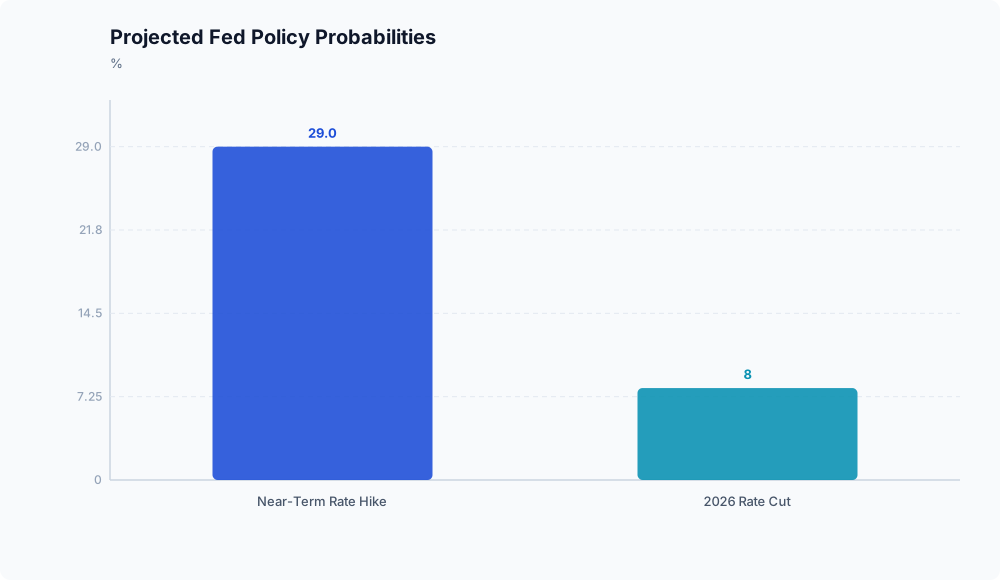
A hypothetical breach of the 30-Year Treasury 5% psychological threshold would fundamentally alter the risk-reward calculus for global equity markets. Projected for early May 2026, this shift would not happen in a vacuum. It would coincide with a violent and sudden hawkish repricing of Federal Reserve policy expectations. In this scenario, if the 30-year yield hovers just above the 5% mark for the first time since the summer of 2025, the market probability of a near-term rate hike could settle at an elevated 29%, a figure based on projections from Business Insider.
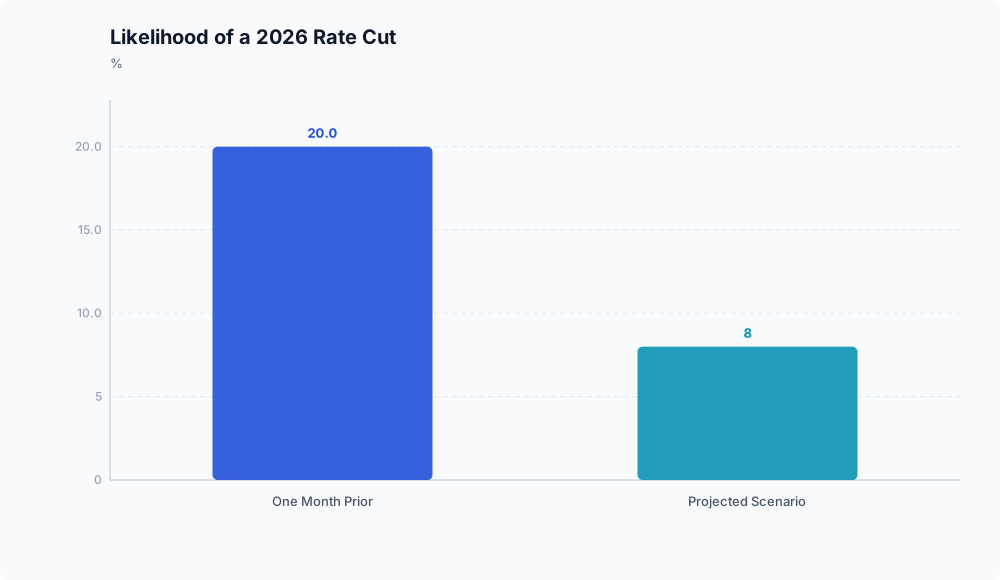
Simultaneously, the likelihood of any rate cut occurring in 2026 would plummet to approximately 8%, a steep decline from 20% just a month prior. For US investors, the “why now” is rooted in this abrupt upward adjustment in the long-term cost of capital. The market is no longer merely pricing in a “higher for longer” scenario; it actively digests the risk of resumed monetary tightening. When the baseline risk-free rate anchors at 5%, the hurdle rate for equities rises commensurately, forcing an immediate, structural reassessment of risk premiums and stripping away speculative froth.
The Transmission Chain: From Yield Shock to Multiple Compression
To understand how this yield threshold transmits to equity markets, investors must examine the mechanics of real interest rates and discount factors. The 30-year yield approaching and breaching 5% acts as a catalyst that directly influences the denominator in standard valuation models.
When real yields reach multi-year highs, the risk-free rate used in discounted cash flow (DCF) models rises correspondingly. Theoretical models dictate that a mere 100 basis point change in the discount rate can alter equity valuations by roughly 17%, as noted by DataTrek Research. This mathematical adjustment fundamentally alters how the market values future corporate earnings, disproportionately affecting companies whose cash flows are heavily weighted toward distant years.
Technology stocks typically trade on the promise of compounding future growth, effectively acting as long-duration assets in this macroeconomic environment. Consequently, as the discount rate increases, the present value of these distant earnings shrinks rapidly, creating a severe gravitational pull on their current market prices.
The compounding penalty of higher discount rates becomes starkly apparent when modeling future cash flows across different time horizons. The following table illustrates the hypothetical present value of $1,000 in future cash flows when subjected to varying discount rates over time.
| Discount Rate | Present Value (Year 1) | Present Value (Year 5) | Present Value (Year 10) |
|---|---|---|---|
| 3.0% | $970.87 | $862.61 | $744.09 |
| 4.0% | $961.54 | $821.93 | $675.56 |
| 5.0% | $952.38 | $783.53 | $613.91 |
As demonstrated, a 200 basis point increase from 3% to 5% reduces the present value of a Year 1 cash flow by less than 2%, but it erodes a Year 10 cash flow by more than 17%. For investors, this dictates that long-duration growth stocks must generate significantly higher nominal earnings just to maintain their current valuations in a 5% yield environment.
The market effect of this mechanism is severe multiple compression across the broader equity market. Major technology companiessuch as Apple, Tesla, and Amazonsaw their price-to-earnings (P/E) ratios peak in late 2021 before experiencing considerable declines throughout 2022 as rates began their upward trajectory, according to YCharts. As the 30-year yield surges past the 5% mark, historical multiple expansion becomes mathematically difficult to justify without corresponding exponential earnings growth.
A critical second-order effect of this transmission chain impacts corporate balance sheets. As the risk-free rate remains elevated, companies burdened with near-term debt maturities face a severe refinancing cliff. This dynamic transforms debt from a cheap tool for leverage into a significant liability that threatens to erode profit margins through higher interest expenses. Consequently, robust free cash flow serves as a critical defensive moat, rewarding companies capable of self-funding their operations.
High-Signal Evidence: The Conflict Between Theory and Empirical Variance
The prevailing market narrative dictates that rising real interest rates disproportionately punish technology stocks. However, the highest-signal data points from historical market behavior reveal a far more nuanced relationship between tech valuations and the broader bond market.
The late-2021 to mid-2022 market cycle serves as the most vivid recent validation of rate-driven multiple compression. By May 2022, the broader trend of falling big tech P/E ratios coincided directly with heightened market focus on rising 30-year mortgage rates and a defensive rotation toward market-neutral funds, according to YCharts. During this period, the Beta for Vanguard’s Market Neutral Fund Investor Shares (VMNFX) historically fluctuated around 0.00, while its Alpha lifted considerably during the broader market pullback. This highlights a broader institutional desire to strip out directional market risk when traditional equity beta falters.
Expanding the timeline beyond the 2022 rate shock reveals a striking contradiction to the accepted narrative. Over a broader 10-year period, the mean correlation of 100-day returns between US large-cap tech stocks and 20-plus-year Treasuries is actually negative 0.32, translating to an r-squared of merely 10%, according to DataTrek Research. Small-cap tech displays a similarly weak relationship, with a mean correlation of negative 0.35 and an r-squared of 12%.
This data indicates that long-term Treasury yields explain only a tiny fraction of the variance in tech stock returns over an extended horizon. The relationship is clearly not static and appears highly dependent on the macroeconomic regime. For instance, DataTrek Research notes that between September 2016 and January 2017, when the 10-year yield rose rapidly, the correlation between large-cap tech and long-term Treasuries temporarily flipped from negative 0.3 to positive 0.3.
This anomaly suggests that rapid, acute movements in the bond market can force a temporary alignment of asset classes, overriding long-term historical averages. However, it also implies that long-term tech outperformance is ultimately tethered to underlying earnings power and secular growth trends rather than purely macroeconomic interest rate cycles.
Furthermore, the 5% threshold itself carries significant historical weight. Market analysts often describe the 5% level as an “electric fence” that reliably attracts institutional bond buyers seeking to lock in high, risk-free, long-term returns, according to Yahoo Finance. When these buyers step in, their demand naturally suppresses yields, relieving downward pressure on equity multiples. The tension between the theoretical 17% valuation hit and the empirical 10% variance explanation forms the crux of the current market debate.
Market Scenarios: Navigating the 5% Threshold
Driven by multi-year highs in real yields, the trajectory of long-duration yields dictates capital allocation and broader market stability. By analyzing historical patterns and current valuation sensitivities, we can model three distinct market scenarios.
The Base Case: Gradual Multiple Compression and Defensive Rotation In the base case, sustained elevated real interest rates lead to a steady, manageable contraction in equity valuations. As real yields rise, the P/E ratios of broader equities typically drop, creating immediate headwinds for growth-oriented sectors, according to Yahoo Finance. Technology stocks lag as their distant future cash flows are discounted at higher rates. However, because historical variance models indicate long-term Treasuries explain only 10% to 12% of tech return variance, the market avoids a sharp, uncontrolled selloff. Investors selectively trim high-multiple exposures and pivot toward companies with robust immediate free cash flow.
The Upside Case: The “Electric Fence” Holds The upside scenario hinges on the 30-year yield hitting a firm ceiling at 5%, triggering a reflexive wave of institutional bond purchasing. Historically, whenever the 30-year yield touches this “electric 5% fence,” bond buyers aggressively step into the market to lock in returns, as cited by Yahoo Finance. This influx of capital drives bond prices up and yields down, effectively relieving valuation pressure on the broader equity market. The 5% mark serves as a self-correcting mechanism, where fixed-income value hunters inadvertently provide a catalyst for a stock market rally.
The Downside Case: Sustained Breakout and Systemic Reset The downside scenario materializes if underlying macroeconomic pressures force the 30-year yield decisively above the 5% threshold. With the probability of a near-term Fed rate hike hovering near 30%, lingering rate hike risks would invalidate historical support levels. In this environment, the negative impact of rising real interest rates on technology stock valuations accelerates into a severe, broad-based selloff, according to Yahoo Finance. Without the reliable influx of bond buyers to cap yields, market participants aggressively liquidate long-duration equities as corporate capital costs structurally reset higher.
What to Watch Next
To navigate this precarious environment, market participants must shift their focus from lagging economic data to forward-looking market triggers. Relying solely on historical reflexivity carries risks, as the macroeconomic backdrop has fundamentally shifted. Investors should monitor the following concrete indicators:
- Fed Funds Futures: Continuously monitor market probabilities for Federal Reserve policy. In our projected scenario for May 2026, the probability of a rate hike spikes past 35% before settling at 29% the next day, according to Business Insider. An upward trend signals an imminent tightening shock that could push the 30-year yield definitively past the 5% mark.
- Long-Duration Treasury Auction Bid-to-Cover Ratios: These metrics serve as the ultimate litmus test for the “5% electric fence” theory. Robust demand at these auctions confirms institutional buyers are capping yields. Conversely, weak demand indicates traditional bond buyers are stepping away.
- Corporate Credit Spreads: Watch for widening spreads, particularly in the high-yield sector. If rising risk-free rates stress corporate balance sheets facing near-term debt maturities, widening spreads will serve as the definitive warning of a systemic credit event.
Conclusion

The confluence of a stubbornly hawkish Federal Reserve and a hypothetical 30-Year Treasury 5% yield forces market participants into a fundamentally more defensive, cash-flow-oriented posture. The collapse in rate cut probabilities for 2026 indicates that the market is finally digesting a sustained monetary regime that penalizes distant profitability promises. While the historical tendency for bond buyers to intervene at the 5% “electric fence” offers tactical optimism for equity valuations, empirical data suggests relying solely on yield movements to time market exposure is an incomplete strategy.
Ultimately, the second-order effect of this yield shock is a permanent repricing of risk. For US investors, this implies that future equity returns must be driven by robust corporate fundamentals, organic earnings growth, and margin resilience, rather than multiple expansion subsidized by cheap debt. Portfolios must be stress-tested against a persistently high-rate regime by prioritizing balance sheet resilience over speculative growth. By focusing on companies that generate excess free cash flow, investors can navigate the structural headwinds of elevated capital costs as the economic cycle matures.
Disclaimer: This analysis is for informational purposes only and does not constitute investment, financial, real estate, or legal advice. Always consult a licensed financial advisor before making investment decisions.
FAQ

Why does the 30-year Treasury yield crossing 5% matter so much for tech stocks? The 30-year Treasury yield acts as the risk-free rate in valuation models. When it rises to 5%, the discount rate applied to future earnings increases, mathematically reducing their present value. Because tech stocks typically rely on distant future earnings to justify their valuations, higher yields disproportionately compress their price-to-earnings multiples.
What is a ‘long-duration’ equity, and why is it sensitive to long-term interest rates? A “long-duration” equity refers to a companyoften in the technology or growth sectorswhose cash flows and profitability are expected to materialize far in the future. They are sensitive to long-term interest rates because, under discounted cash flow models, earnings projected many years out lose significant present value when the discount rate (driven by long-term yields) increases.
If Treasury yields hit 5%, will bond buyers automatically step in and lower rates? Historically, the 5% level has acted as an “electric fence” that reliably attracts institutional bond buyers looking to lock in high returns, which in turn drives yields back down. However, with the market currently pricing in a nearly 30% probability of a near-term Fed rate hike, it is uncertain whether this historical pattern of price-insensitive buying will hold in the current macroeconomic cycle.
How do rising rate hike odds affect companies with high near-term debt? Rising rate hike odds keep the risk-free rate elevated, creating a severe refinancing cliff for companies with near-term debt maturities. When these companies are forced to refinance their expiring debt, they must do so at significantly higher interest rates, which increases their interest expenses and directly erodes their profit margins.