
S&P 500 Q1 2026 Earnings: Analyzing Corporate Resilience
S&P 500 Q1 2026 Earnings: Analyzing Corporate Resilience and Macroeconomic Trends
The recent data showing that approximately 84% of reporting companies beat consensus earnings expectations in April 2026 represents a notable shift for equity investors, redefining how markets interact with monetary policy. The S&P 500 Q1 2026 Earnings season has provided evidence that bottom-up corporate fundamentals have decoupled from the effects of the Federal Reserve’s “higher-for-longer” interest rate regime. Rather than contracting under sustained borrowing costs, corporate America has optimized operations, protected profit margins, and leveraged next-generation technology to drive growth. This fundamental strength catalyzed a broad equity rally, driving the S&P 500 Index up 10.42% in April. This marks its largest monthly percentage gain since November 2020, according to fp.thriventfunds.com. For market participants, this confirms a strategic shift: earnings execution, rather than anticipated central bank rate cuts, has become a primary engine of equity returns.
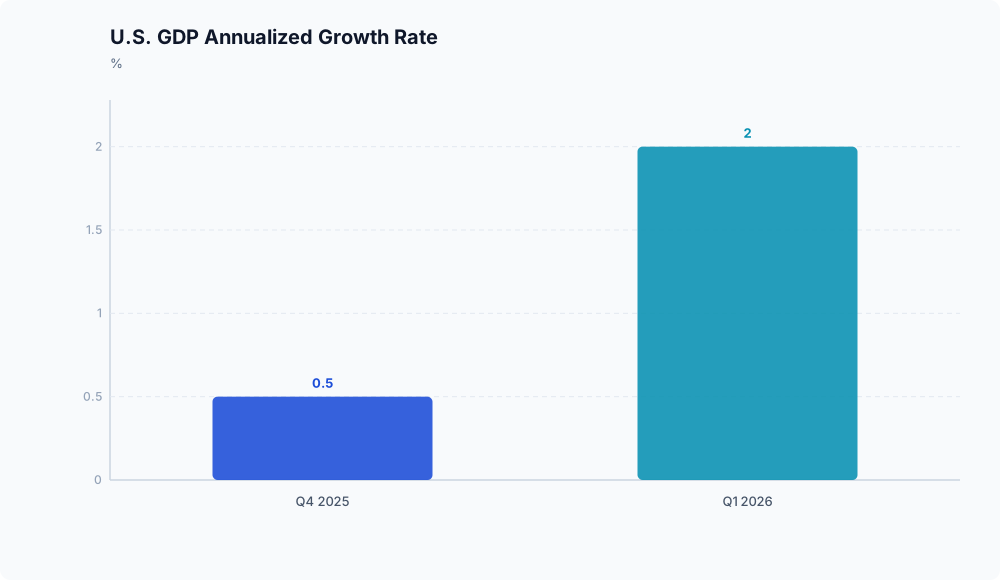
To understand this acceleration, investors must examine the macroeconomic pivot between the end of 2025 and the first quarter of 2026. In the fourth quarter of 2025, U.S. GDP grew at a 0.5% annualized rate, sparking concerns among analysts of an impending economic stall. However, the narrative shifted as U.S. first-quarter 2026 GDP rebounded to an estimated 2.0% annualized rate, according to fp.thriventfunds.com. This reacceleration provided the demand bedrock for companies to exceed lowered first-quarter earnings targets. The second-order effect of this GDP rebound is renewed confidence among institutional investors that the U.S. economy can sustain growth without triggering a recessionary contraction, setting the stage for a market environment where microeconomic execution offsets macroeconomic friction.
The Transmission Chain: From AI Capital Expenditures to Broad Margin Expansion
The primary catalyst bridging the gap between restrictive macroeconomic conditions and strong microeconomic performance is a broad wave of corporate investment. The transmission of artificial intelligence from a thematic investment concept to a fundamental driver of corporate profitability is visible in aggregate market data. For the first quarter of 2026, the S&P 500 is projected to deliver a 12.6% year-over-year increase in earnings per share, alongside revenue growth of 9.8%, according to the Q1 2026 Earnings Preview: Double-Digit Growth and the Visibility Gap. If realized, this would mark the highest top-line expansion rate since the third quarter of 2022 and the sixth consecutive quarter of double-digit earnings growth. Initial technology investments are successfully converting into operational efficiencies and sustained revenue growth across the broader index.
At the epicenter of this earnings growth is the Information Technology sector, which continues to capture the direct financial benefits of the AI infrastructure build-out. Analysts expect the IT sector to lead the broader market, posting a substantial 45.0% year-over-year earnings expansion for the first quarter of 2026, based on the Q1 2026 Earnings Preview: Double-Digit Growth and the Visibility Gap. This performance reflects the sector’s role as the primary supplier of the hardware, software, and cloud infrastructure required to train and operate advanced machine learning models. The magnitude of this growth implies that enterprise demand for AI capabilities remains inelastic, allowing the IT sector to transition into a structural anchor for the S&P 500.
Beyond the immediate technology providers, the second-order effects of this capital spending are materializing in sectors deploying AI to drive operational efficiency. The Financials sector exemplifies this adoption phase, serving as a proof of concept that AI-driven margin expansion is viable for traditional, non-technology businesses. The sector is projected to achieve year-over-year earnings growth of 15.1% for the first quarter of 2026, according to the S&P 500 Financials Sector Earnings Preview: Q1 2026. Within this sector, the Insurance industry is expected to report a notable 34% earnings growth rate, followed closely by Consumer Finance at 30%. This outperformance is linked to technological integration, as investments in AI produce operational expense reductions for labor-intensive claims and underwriting functions shifting toward automation.
Further down the transmission chain, the physical requirements of this technological shift are driving gains in foundational industries. The Materials sector is projected to post strong first-quarter EPS gains of 24.2%, likely reflecting the demand for the physical commodities and infrastructure inputs required to construct data centers and power grids. However, this capital spending is distinctly separating the beneficiaries of the AI ecosystem from sectors facing structural headwinds. Sectors decoupled from this transmission chain are struggling, with Energy, Communication Services, and Health Care expected to post negative earnings growth of -0.1%, -3.3%, and -9.8%, respectively, as highlighted in the Q1 2026 Earnings Preview: Double-Digit Growth and the Visibility Gap.
The Highest-Signal Evidence: Micro Resilience vs. Macro Friction
To visualize this current market environment, one must acknowledge a macro-micro divergence. The U.S. equity market currently presents a tension between verified corporate earnings successes and stubborn macroeconomic data. This corporate performance is notable because it occurred against a backdrop of sticky inflation and a cautious Federal Reserve.
The table below illustrates the contrast between Q1 2026 micro-level execution and March 2026 macro-level inflation metrics:
| Metric Category | Key Indicator | Latest Data Point | Analytical Implication |
|---|---|---|---|
| Corporate Resilience | Earnings Beat Rate | 84% of reporting companies | Strong near-term execution and pricing power. |
| Corporate Resilience | Q1 Financials EPS Growth | 15.1% (Predicted) | Elevated rates benefit specific financial sub-sectors. |
| Macro Headwinds | March Headline CPI | 3.3% YoY | Broad inflation remains stubbornly above target. |
| Macro Headwinds | March Core PCE | 3.2% YoY | Underlying consumer price pressures persist. |
In March 2026, the headline Consumer Price Index (CPI) rose 3.3% year-over-year, while the Core Personal Consumption Expenditures (PCE) Price Index climbed 3.2%. Consequently, the Federal Reserve kept interest rates unchanged at its April meeting, revealing internal disagreement over the appropriate rate path given the conflicting pressures of rising inflation and stable employment, according to fp.thriventfunds.com.
The implication for investors is significant: the market has digested the “higher-for-longer” interest rate regime. Equities are no longer strictly bound by the timeline of Fed rate cuts, as companies are demonstrating they can generate real earnings growth even when the cost of capital remains elevated. The 10.42% gain in the S&P 500 reflects a consensus belief that enterprise AI adoption and operational efficiency will shield bottom lines from 3.2% Core PCE inflation. Yet, as the Federal Reserve grapples with conflicting pressures, investors must carefully separate trailing earnings facts from forward-looking assumptions. Companies that beat Q1 expectations via cost-cutting rather than volume growth may struggle to replicate those beats in subsequent quarters if consumer demand wanes.
Scenario Analysis: Navigating the “Higher-for-Longer” Regime
For U.S. investors, the lack of monetary consensus at the Federal Reserve requires navigating portfolios through three distinct S&P 500 trajectories based on how corporate earnings interact with prolonged restrictive policy.
The Base Case: Steady, Moderating Gains In the base case scenario, artificial intelligence-driven earnings growth continues to offset the headwinds of elevated interest rates. Corporate fundamentals have demonstrated durability, evidenced by the 84% beat rate in April 2026, according to the May 2026 Market Update: Optimism inflates equities. If a rise in AI capital spending continues to propel macroeconomic growth, corporate profits should remain insulated from the immediate drag of higher borrowing costs. Analysts expect overall S&P 500 EPS growth to reach 17.6% for the full year of 2026, supported by 9.0% revenue growth, per the Q1 2026 Earnings Preview: Double-Digit Growth and the Visibility Gap. This implies that projected full-year earnings growth could materialize, rewarding investors who maintain exposure to high-quality equities with strong balance sheets.
The Upside Scenario: Technological Leverage Drives Multiple Expansion The upside trajectory assumes that AI-driven operational efficiencies accelerate profit margins faster than debt servicing costs rise. While the current interest rate environment increases the cost of capital, technological integration has the potential to structurally lower operating expenses across multiple sectors. If companies successfully translate recent AI capital expenditures into sustained productivity gains, equity multiples could expand further despite the restrictive monetary backdrop. U.S. investors positioned in sectors actively deploying these efficiencies would likely capture returns as margin expansion outpaces the pull of higher bond yields.
The Downside Scenario: Hawkish Shock and Valuation Compression Conversely, the downside scenario centers on rising inflation triggering a hawkish shock that pressures equity valuations. The Federal Reserve’s current pause masks uncertainty regarding its internal consensus, with policymakers disagreeing on the correct rate levels given stable employment and persistent inflation, as noted in the May 2026 Market Update: Optimism inflates equities. If persistent inflation forces the central bank to abandon its holding pattern and resume rate hikes, the capital-intensive nature of supplying and integrating AI technology could compress future margins. Because current equity valuations are dependent on projected 2026 earnings growth, any unexpected increase in the discount rate would compress price-to-earnings multiples.
What to Watch Next: Leading Indicators and Triggers

The U.S. economic landscape exiting the first quarter of 2026 presents a complex duality. With traditional scenarios of high growth and low inflation fracturing, investors must shift their focus from backward-looking earnings beats to leading indicators that will dictate the durability of the current market rally.
1. Federal Reserve Communications and the Hawkish-Dovish Divide The most immediate trigger for broader market volatility lies in the evolving communications from the U.S. Federal Reserve. During their April 2026 meeting, discussions revealed internal disagreement over the appropriate policy path. Investors should monitor upcoming speeches from regional Fed presidents and the release of meeting minutes to gauge the depth of this divide. If a consensus emerges that inflation is re-accelerating rather than plateauing, the market will likely be forced to reprice rate expectations, as noted in Federal Reserve keeps interest rates steady as inflation uncertainty rises | U.S. Bank.
2. Revisions to Core PCE Data and Corporate Margin Commentary Upcoming revisions to the Core PCE data will serve as a vital macroeconomic leading indicator. Forward-looking evidence regarding exactly when and how sustained 3%+ inflation might erode corporate margins remains thin. Investors must watch for shifts in corporate commentary regarding cost pressures, as the breaking point for margin compression is uncertain. Until definitive data emerges showing either a cooling of PCE or a deterioration in corporate profitability, market participants should remain cautious about assuming linear earnings expansion.
3. Q2 Corporate Guidance and the Pace of AI Monetization On the microeconomic front, Q2 corporate guidanceparticularly from the technology and financials sectorswill be essential to determining if the current earnings momentum holds. Investors must scrutinize upcoming guidance to ensure that planned AI expenditures are translating into deployed capital. The Financials sector will act as a critical bellwether. While Q1 2026 saw robust 15.1% growth, projections for the sector decelerate to 5.6% in Q2 and 2.6% in Q3, suggesting that the initial wave of operational efficiency gains may be front-loaded, according to the S&P 500 Financials Sector Earnings Preview: Q1 2026. Investors must monitor forward guidance from major consumer finance and capital markets firms to assess whether AI-driven cost savings can sustainably offset macroeconomic headwinds.
Conclusion

The S&P 500 Q1 2026 Earnings season has delivered a clear message: corporate execution is currently offsetting macroeconomic friction. The rapid reacceleration of GDP to 2.0% and the 84% earnings beat rate have validated the thesis that significant capital expenditures in artificial intelligence are yielding tangible operational efficiencies across both tech and traditional sectors. However, the data suggests a market priced for a smooth macroeconomic landing, leaving little room for error. With headline CPI anchored at 3.3% and the Federal Reserve grappling with internal disagreements over interest rate policy, the durability of this rally faces tests. Investors must carefully separate trailing earnings facts from forward-looking assumptions. Moving forward, portfolio allocators should maintain a defensive posture, prioritizing bottom-up stock selection focused on companies with strong balance sheets, verifiable operational efficiencies, and inelastic demand, rather than attempting to time the Federal Reserve’s next move or relying on multiple expansion in a higher-for-longer regime.
Disclaimer: This analysis is for informational purposes only and does not constitute investment, financial, real estate, or legal advice. Always consult a licensed financial advisor before making investment decisions.
FAQ
Why did the S&P 500 rally in Q1 2026 despite inflation rising to 3.3%? The S&P 500 rallied because corporate earnings execution offset macroeconomic concerns. Approximately 84% of reporting companies beat consensus earnings expectations, and U.S. GDP rebounded to a 2.0% annualized rate. Investors rewarded companies that demonstrated operational efficiency and margin protection, proving that businesses could generate real earnings growth even with elevated inflation and a “higher-for-longer” cost of capital.
Which specific sectors drove the double-digit earnings growth in Q1 2026? The Information Technology sector led the market, posting a substantial 45.0% year-over-year earnings expansion due to intense demand for AI infrastructure. The Materials sector followed with 24.2% EPS gains, driven by demand for physical commodities. The Financials sector also contributed significantly with 15.1% EPS growth, led by the Insurance (34%) and Consumer Finance (30%) industries utilizing AI for operational efficiency.
How is the Federal Reserve reacting to the divergence between strong GDP growth and sticky inflation? The Federal Reserve kept interest rates unchanged at its April 2026 meeting, but the divergence has caused internal disagreement among policymakers. The central bank is caught between the competing pressures of a rebounding 2.0% GDP growth rate with stable employment, and persistently sticky inflation (3.3% CPI and 3.2% Core PCE), leaving the future path of interest rates uncertain.
How are AI capital expenditures directly impacting corporate profit margins? AI capital expenditures are impacting margins through a clear transmission chain. In the IT sector, enterprise demand for hardware and cloud infrastructure is driving direct revenue and 45% earnings growth. In traditional sectors like Financials, investments in AI are producing operational expense reductions by automating labor-intensive functions such as claims and underwriting, leading to margin expansion and 15.1% sector earnings growth.