
Private Credit Regulation: The Federal Reserve's 2026 Shift
Private Credit Regulation: The Federal Reserve’s 2026 Shift and Market Impacts
The release of the Federal Reserve’s May 2026 Financial Stability Report marks a pivot in its approach to Private Credit. The central bank is transitioning from passive observation to preparing potential regulatory action. For the past decade, alternative asset managers and Business Development Companies (BDCs) absorbed the corporate lending market share abandoned by traditional banks.
This shift signals new constraints for historical growth models. While specific future Fed mandates remain inferred, the development aligns with a global regulatory tightening cycle driven by the nonbank lending sector’s scale. Consequently, highly levered BDC earnings models face structural changes. For US investors, the ecosystem is becoming a quasi-regulated utility, altering the risk-reward calculus of alternative assets.
This pivot stems from the US Basel III Endgame, which began raising bank capital requirements in July 2025, according to Global Banking Markets. This regulation accelerated risk migration into private markets.
Global counterparts have already implemented new frameworks. The Federal Reserve is now signaling that domestic funds operate with comparatively loose guardrails. This regulatory shift extends beyond compliance costs, potentially exposing structural vulnerabilities in funding models that historically supported high yields.
The Transmission Chain: How Bank Regulation Impacts Nonbank Liquidity
Investors must recognize that nonbank lending relies heavily on traditional banking facilities. The US Basel III Endgame is the primary catalyst for a structural shift in alternative asset funding. By requiring banks to hold more capital against exposures, regulators are restricting the funding channels supplying the nonbank sector.
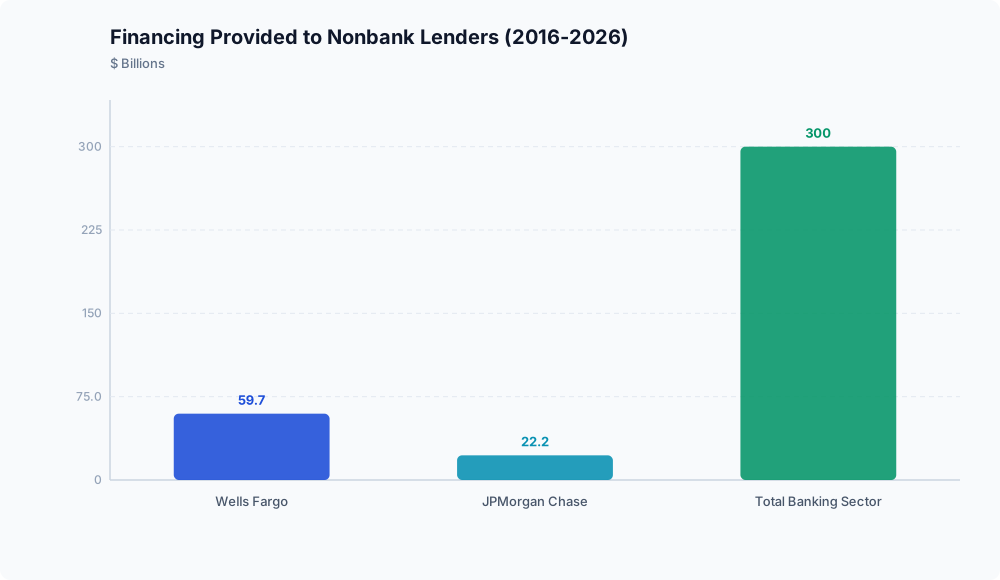
According to a Moody’s report cited by Regions Bank, commercial banks provided nearly $300 billion in financing to nonbank lenders since 2016. This capital pipeline is essential for funds to amplify returns through leverage and bridge financing.
| Major Bank | Financing Provided to Nonbank Lenders (20162026) |
|---|---|
| Wells Fargo | $59.7 billion |
| JPMorgan Chase | $22.2 billion |
| Total Banking Sector | ~$300.0 billion |
As Basel III forces major institutions to reduce exposure, foundational industry leverage decreases. Indirect bank leverage historically lowered the cost of capital, allowing nonbank lenders to offer flexible covenants. These changes transmit sequentially: from regulators to banks, then to asset managers, and finally to middle-market borrowers.
As the $300 billion funding pipeline constricts, nonbank lenders face a higher blended cost of capital. Without abundant bank leverage, BDCs absorb these costs, compressing net interest margins. To maintain mandated distribution yields, funds must either originate higher-yielding loans or reduce lending activity.
Middle-market companies rely on alternative lenders for growth capital and refinancing. Therefore, a reduction in lending equates to tighter financial conditions. Borrowers can anticipate higher capital costs, wider spreads, and stricter covenants on new originations.
Companies previously using nonbank lending as a covenant-lite alternative will likely find those avenues restricted. Ultimately, policies designed to fortify the traditional banking sector may inadvertently increase risks within nonbank lending by reducing liquidity buffers.
Market Evidence: Redemptions, Repricing, and Legal Disputes
The market is witnessing the transmission of capital constraints into active credit tightening. Between late 2025 and early 2026, the sector experienced elevated withdrawal requests from retail and institutional investors, prompting regulatory scrutiny. Data from this period indicates reduced liquidity, collateral repricing, and emerging legal disputes.
1. Elevated Redemption Pressures and Liquidity Limits Increased redemption requests have exceeded the liquidity structures of major funds. Standard practice limits quarterly redemptions to 5% of a fund’s net asset value to protect underlying portfolios. However, BlackRock’s HPS business received redemption requests totaling 9.3%, or roughly $1.2 billion, according to Regions Bank.
This forced the fund to limit withdrawals to the 5% cap, paying out $620 million. Similarly, Regions Bank notes that Blackstone’s BCRED fund faced 7.9% in redemption requests, representing approximately $3.8 billion. This gating mechanism highlights the mismatch between semi-liquid fund structures and illiquid middle-market loans.
2. Asset Liquidations and Valuation Impacts When funds reach liquidity limits and bank leverage retracts, managers may generate internal liquidity through asset liquidations. According to Regions Bank, alternative asset manager Blue Owl executed approximately $1.4 billion in loan sales across its OBDC II, OTIC, and OBDC vehicles following a canceled merger.
Selling private loans into a declining market widens bid-ask spreads and pressures competing fund valuations. A secondary effect is a potential decrease in net asset valuations across the broader ecosystem. As net asset values decline, fund leverage ratios mechanically increase, potentially affecting covenant compliance.
3. Sector-Specific Volatility and Collateral Repricing Market adjustments are visible where public volatility intersects with private collateral. In late January 2026, technology sector repricing drove the iShares Expanded Tech Software Sector ETF (IGV) down by over 13%, as reported by Regions Bank. This prompted traditional banks to reassess loan portfolios concentrated in software.
By early March 2026, Regions Bank noted that JPMorgan tightened loan-to-value standards and applied conservative collateral haircuts. They specifically remarked on private collateral tied to software exposures. This indicates prime brokers are adjusting illiquid collateral values based on public equity declines.
4. Legal Disputes and Counterparty Risk Changing financing relationships are sparking legal disputes. For example, Western Alliance filed a $126.4 million lawsuit against Jefferies over unpaid financing tied to First Brands receivables, according to Regions Bank. These events indicate banks are reducing counterparty exposures to alternative lenders ahead of Basel III. This signals a shift in counterparty risk from nonbank lenders to regulated balance sheets.
5. Rising Default Rates and Reporting Variability Reports of rising borrower defaults are adding to liquidity pressures. According to Amina Bank, default rates jumped from 3-4% to approximately 8-9%. UBS projects a climb toward 15% by the second half of 2026. However, investors must evaluate these figures carefully.
Because these loans are bilaterally negotiated and infrequently traded, managers have flexibility in classifying non-accrual status or executing amend-and-extend modifications. The reported 8-9% default rate may obscure underlying stress through payment-in-kind interest structures. Until standardized reporting emerges, exact impairment levels remain difficult to quantify.
Scenario Analysis: Evaluating the Maturity Wall
Evaluating alternative asset manager resilience requires scenario analysis amidst data variability. The scale of systemic risk remains uncertain. Estimates for the global market range from roughly $1.2 trillion, cited by Regions Bank, to nearly $2.5 trillion, according to Global Banking Markets.
This lack of consensus means scenario planning carries a margin of error. However, all scenarios must account for a massive refinancing pipeline. More than $620 billion in private debt is approaching maturity between 2026 and 2028, according to Amina Bank.
The Base Case: Gradual Compression and Utility Transition In the base case, alternative asset managers face persistent global oversight that structurally compresses BDC multiples. Regulators are tightening controls, as noted by Global Banking Markets. This is evidenced by the EU’s AIFMD II implementation, which mandates liquidity management tools, explicit leverage caps, and risk concentration limits for loan-originating funds.
Simultaneously, Global Banking Markets reports the UK Financial Conduct Authority (FCA) is targeting valuation conflicts where fund managers internally set asset marks. In the US, the National Association of Insurance Commissioners (NAIC) is revisiting Risk-Based Capital rules for private assets. According to Global Banking Markets, this may impact institutional funding pipelines.
The secondary effect of this global regulatory alignment is increased compliance costs and reduced permissible leverage. By observing international frameworks, the Fed and other US agencies are noting loose domestic guardrails, implying a likely convergence toward tighter standards. Market participants may see return on equity decline, prompting a downward repricing of BDC multiples as the asset class transitions into a quasi-regulated utility.
The Downside Scenario: Severe Liquidity Constraints The downside scenario envisions capital constraints intersecting with rising defaults, leading to significant liquidity restrictions. This risk is anchored by the $620 billion debt maturity wall. If borrowers cannot absorb higher refinancing costs, the projected UBS default rate of 15% could materialize.
If these defaults occur while managers simultaneously face elevated redemption requestssuch as the withdrawals Blackstone’s BCRED facedfunds will severely test their liquidity limits.
If alternative asset managers cannot access bank credit lines to bridge this gap, they may need to sell assets into a declining market. This implies a cycle of forced illiquid loan sales, disrupting internal valuation models that historically shielded these assets from public volatility. Ultimately, the inability to refinance existing debt could cause severe financial distress among levered middle-market borrowers.
The Upside Scenario: Central Bank Delay and Digital Deleveraging Conversely, the upside scenario involves central banks delaying restrictive actions or easing macroeconomic policy. This provides alternative asset managers time for organic deleveraging. If macroeconomic conditions stabilize, the $620 billion refinancing wall could be absorbed without triggering widespread defaults, allowing managers to negotiate amendments and extensions.
Furthermore, emerging alternative liquidity sources could alleviate traditional redemption pressures. According to Amina Bank, tokenised real-world assets excluding stablecoins reached $27.05 billion by March 2026, with on-chain private lending crossing $20 billion.
While this digital infrastructure remains nascent, its expansion could provide a decentralized capital base to offset institutional redemptions. Managers diversifying their liability structures into these emerging channels may successfully navigate the maturity wall and preserve their capital bases.
What to Watch Next: Leading Indicators of Market Stress

To navigate these compounding liquidity and regulatory risks, investors should monitor specific leading indicators. The boundary between traditional banking and nonbank lending has become porous, creating hidden systemic linkages that require active monitoring.
- Bank-to-Nonbank Lending Volumes and Haircuts: Track changes in prime brokerage terms, specifically monitoring JPMorgan and Wells Fargo for signs of broader credit contraction. Further tightening of loan-to-value standards or collateral haircuts will indicate that banks are reducing risk.
- Regulatory Policy Drafts: Evaluate upcoming SEC and Federal Reserve policy drafts regarding nonbank lending oversight. Additionally, monitor the NAIC’s finalized Risk-Based Capital rules, as these will influence the institutional capital pipelines that fund BDCs.
- Q2 2026 BDC Earnings Reports: Review upcoming earnings for elevated non-accrual rates and asset sales. Patterns similar to Blue Owl’s recent $1.4 billion liquidation may indicate that internal liquidity generation is a growing priority.
- Legal Precedents in Counterparty Liability: Monitor the resolution of Western Alliance’s $126.4 million unpaid financing lawsuit against Jefferies. The outcome of this case may establish legal precedents for counterparty liability in financing disputes.
Conclusion

The release of the Federal Reserve’s May 2026 Financial Stability Report is a definitive signal that the regulatory environment for alternative lending is changing. As the July 2025 Basel III Endgame prompts traditional banks to reduce exposure, the $300 billion funding pipeline supporting the nonbank sector is constricting.
For investors, the analytical takeaway is that the historical yield premium associated with Private Credit must be weighed against new liquidity constraints. The combination of tightening global regulations, elevated redemption requests, and a $620 billion debt maturity wall means alternative asset managers can no longer rely on traditional bank financing as a guaranteed backstop.
Market participants must re-evaluate allocations, favoring funds with locked-up capital and robust collateral. The industry must now digest this structural shift and prepare for a period of capital constraints and adjusted secondary valuations.
Disclaimer: This analysis is for informational purposes only and does not constitute investment, financial, real estate, or legal advice. Always consult a licensed financial advisor before making investment decisions.
FAQ
How will the Fed’s May 2026 Financial Stability Report impact the valuation of Business Development Companies (BDCs)? While specific mandates are still inferred, the Fed’s pivot signals a likely convergence toward tighter international regulatory standards, such as the EU’s AIFMD II. This may require BDCs to hold more unencumbered capital and adhere to stricter leverage caps. These changes can compress net interest margins and lower return on equity, potentially leading to downward revisions in net asset values and multiple compression.
What happens to middle-market corporate borrowers if bank funding to nonbank lenders is restricted? If the $300 billion bank-to-nonbank funding pipeline constricts, alternative asset managers will face higher borrowing costs and restricted leverage. They may pass these expenses onto middle-market borrowers, resulting in a higher cost of capital, wider credit spreads, and stricter covenants on new loan origination, effectively tightening financial conditions.
Are private credit funds currently facing liquidity challenges due to recent redemption pressures? Funds are facing localized liquidity challenges, though broader systemic impacts remain dependent on upcoming debt maturities. Recent evidence shows major funds reaching their liquidity limits. For example, BlackRock’s HPS business received 9.3% in redemption requests, capping payouts at 5% or $620 million. Similarly, Blackstone’s BCRED faced $3.8 billion in withdrawal requests, which can prompt asset liquidations, such as Blue Owl’s $1.4 billion loan sale.
How does the US Basel III Endgame intersect with the Federal Reserve’s new stance on nonbank lending? The Basel III Endgame, which began raising bank capital requirements in July 2025, acts as a catalyst for the Fed’s new stance. By making traditional corporate lending more capital-intensive for banks, Basel III accelerated risk migration into the nonbank lending sector. The Fed is now pivoting to active oversight to address the shift of liquidity pressures and leverage risks into alternative markets.