
How the Lock-In Effect Shapes the Spring 2026 Housing Market
The Spring 2026 Housing Market: How the Lock-In Effect Shapes Real Estate
The macroeconomic data emerging from the first quarter of 2026 has effectively set the trajectory for the spring housing market, dashing earlier hopes for a rapid normalization of real estate turnover. The catalyst for this reality is a resurgence of sticky, energy-driven inflation that has forced the Federal Reserve to maintain a restrictive monetary posture. By anchoring mortgage rates in the mid-6% range, this macroeconomic environment cements the Lock-In Effect, a behavioral and financial phenomenon wherein existing homeowners refuse to trade their historically low mortgage rates for current, elevated market realities. For US investors, homebuyers, and industry participants, the spring season will be defined by a severely bifurcated market. Traditional mortgage lenders face compressed origination volumes, while homebuilders secure a distinct structural advantage by providing the only reliable source of housing inventory.
This analysis unpacks the critical data from March and April 2026, mapping the transmission mechanism from global energy shocks to localized housing gridlock. By examining the shifting distribution of outstanding mortgage rates, the divergence between new construction and existing home sales, and the potential scenarios for the remainder of the year, market participants can better navigate a real estate landscape defined by stubborn price support and historically constrained liquidity.
The Transmission Chain: From Energy Markets to Housing Gridlock
To understand the current state of the U.S. residential real estate market, investors must look beyond traditional housing metrics and visualize a sequential transmission chain. This chain begins in global commodity markets and ends at the American front door. The current housing gridlock is the final output of a macroeconomic feedback loop driven by geopolitical uncertainty and defensive monetary policy.
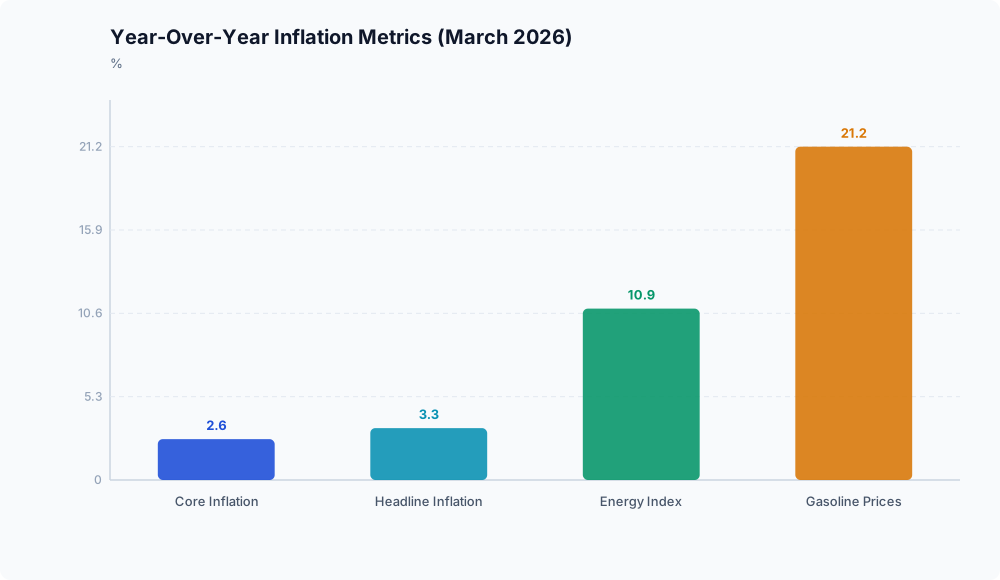
Node 1: The Energy Catalyst and Headline Inflation The transmission chain begins with a supply-driven spike in the energy index. In March 2026, U.S. headline inflation rose 3.3% year-over-year. However, this figure was heavily distorted by a 10.9% surge in the energy index, driven primarily by a staggering 21.2% jump in gasoline prices, as reported by Freedom Mortgage. While core inflation remained relatively subdued at 2.6% according to Freedom Mortgage, the headline energy shock created an immediate problem for central bankers.
Node 2: The Federal Reserve’s Policy Trap The divergence between core and headline inflation creates a restrictive policy trap. The Federal Reserve cannot easily cut interest rates while energy prices threaten to unanchor broader consumer inflation expectations. Consequently, during its April 28 and 29 meeting, the Federal Open Market Committee held the federal funds rate steady at a range of 3.5% to 3.75%. Policymakers explicitly noted that developments in the Middle East are contributing to high economic uncertainty, ensuring a defensive, higher-for-longer monetary posture.
Node 3: The Mortgage Rate Floor This prolonged holding pattern at the Federal Reserve directly transmits into the secondary mortgage market. By late April 2026, the 30-year fixed-rate mortgage averaged 6.23% according to Freddie Mac. While this represents a decline from previous cyclical peaks, a rate floor above 6% remains highly restrictive for the vast majority of existing homeowners who secured financing during the pandemic-era easing cycle.
Node 4: The Inventory Freeze and the “Golden Handcuffs” The sustained 6.23% rate environment triggers the psychological and financial paralysis of the existing home market. A Coldwell Banker survey revealed that 35% of current spring sellers still hold mortgage rates below 5%. The financial penalty of abandoning a sub-5% rate for a 6.23% mortgage paralyzes discretionary sellers, starving the market of organic inventory turnover. Existing homeowners are effectively wearing “golden handcuffs,” financially disincentivized to list their properties unless forced by non-discretionary life events.
Node 5: The Homebuilder Monopoly on Marginal Supply The final node in this transmission chain is the redirection of buyer demand. With existing inventory frozen, desperate buyers are funneled toward the new construction sector. Because large-cap homebuilders are not constrained by existing low-rate mortgages, they possess the unique ability to offer margin-funded mortgage rate buy-downs. By subsidizing the buyer’s interest rate, builders effectively bypass the Fed’s restrictive policy. This structural deficit of existing inventory hands homebuilders a quasi-monopoly on marginal housing supply.
High-Signal Evidence: Decoding the Spring 2026 Housing Data
The macroeconomic data emerging from March 2026 presents a complex, often contradictory backdrop for financial markets. Distinguishing between verified macroeconomic facts and premature industry narratives is critical for accurate capital allocation.
| Metric | March 2026 Data | Key Driver / Analytical Context |
|---|---|---|
| Headline CPI (YoY) | 3.3% | Driven by 10.9% energy spike (per Freedom Mortgage) |
| Core CPI (YoY) | 2.6% | Indicates underlying inflation is relatively contained (per Freedom Mortgage) |
| Unemployment Rate | 4.3% | Labor market stabilizing; prevents forced selling (per Freedom Mortgage) |
| Nonfarm Payrolls | +178,000 | Steady hiring pace supports baseline housing demand (per Freedom Mortgage) |
| 30-Year Mortgage | 6.23% | Restrictive floor sustaining the lock-in effect (per Freddie Mac) |
Against this restrictive monetary backdrop, conflicting narratives have emerged regarding the trajectory of the US housing market. Optimistic market observers argue that the lock-in effect is finally easing. This claim is mathematically bolstered by Realtor.com data showing that in the third quarter of 2025, the share of outstanding mortgages at 6% or higher surpassed those below 3% for the first time. Some industry commentators suggest this shifting distribution will drive a noticeable increase in early spring sales.
However, analytical synthesis of the broader data suggests this optimism is premature. National active listings remain stubbornly depressed, sitting 13.6% below March 2019 levels despite an 8.1% year-over-year increase, according to Realtor.com. The mathematical erosion of the lock-in effect is occurring by attrition, not via a sudden release of pent-up supply.
The existing home market is currently experiencing a structural contraction in transaction volume alongside stubborn price support. According to the National Association of Realtors, existing home sales fell 3.6% month-over-month in March to a seasonally adjusted annual rate of just 3.98 million units. This contraction occurred even as unsold housing inventory climbed to 1.36 million units, representing 4.1 months of supply.
Despite this drop in sales velocity and incremental inventory build, the median sales price still climbed 1.4% year-over-year to $408,800, according to the National Association of Realtors. For investors, this signals a deeply inefficient market where constrained supply entirely neutralizes downward pricing pressure. Recognizing this gridlock, NAR drastically downgraded its 2026 existing home sales forecast from a robust 14% annual increase to a mere 4%. Although early spring data from NAR shows a 1.5% month-over-month rise in pending home sales, it remains highly uncertain whether this slight uptick will translate into actual closed transactions.
Crucially, looking beyond the aggregate national data reveals a highly fragmented housing market. While national inventory remains well below pre-pandemic norms, 66 major metro areas out of the 200 largest US housing markets have now seen active inventory levels exceed their 2019 thresholds, according to Fast Company. This divergence highlights a critical second-order effect: the US housing market is no longer moving as a single macroeconomic monolith. Institutional investors and homebuilders must pivot their capital allocation strategies from broad national trends to hyper-local supply dynamics.
Market Scenarios: Base Case, Upside, and Downside Risks
Entering the core of the spring 2026 buying season, the trajectory of the housing market hinges almost entirely on the path of inflation and the resulting cost of capital. Market participants should weigh three distinct scenarios to guide their strategic positioning.
The Base Case: Stagnation and Builder Dominance (Rates at 6.25% - 6.75%) In the most probable scenario, sticky energy inflation keeps the Federal Reserve cautious, anchoring the 30-year fixed mortgage rate between 6.25% and 6.75%. Under these conditions, the lock-in effect remains the dominant market force. Existing home sales continue to stagnate near the 4 million unit annualized pace, and traditional mortgage originations remain severely compressed.
Large-cap homebuilders will maintain their distinct structural advantage. By continuing to offer aggressive mortgage rate buy-downs that traditional sellers cannot match, builders will effectively manufacture their own buyer demand. For equity investors, this implies that capital will continue flowing toward homebuilder equities. Traditional brokerages and retail lenders will struggle, with any localized recovery concentrated only in the 66 major metro areas identified by Fast Company where inventory has normalized.
The Upside Scenario: The Great Thaw (Rates approaching 5.5%) An upside scenario for traditional lenders and prospective buyers requires a rapid cooling of geopolitical tensions and a subsequent drop in global energy prices. If the 10.9% surge in the energy index reported by Freedom Mortgage reverses, headline CPI will quickly realign with the tamer 2.6% core inflation rate. Given the steady labor market (4.3% unemployment per Freedom Mortgage), the Fed would gain the economic cover necessary to aggressively lower the federal funds rate.
If mortgage rates drop toward the 5.5% threshold, it would serve as a critical psychological and financial catalyst. Because 35% of current spring sellers (per Coldwell Banker) hold a mortgage rate below 5%, a prevailing rate of 5.5% narrows the spread sufficiently to incentivize homeowner mobility. This thawing of existing inventory would strip homebuilders of their primary competitive advantage, shifting market momentum and profitability back toward traditional mortgage originators, real estate brokerages, and title insurers.
However, this transition carries hidden second-order risks for firms heavily reliant on mortgage servicing rights (MSRs). A sudden drop in rates would trigger accelerated prepayment speeds and portfolio runoff from higher-rate mortgage vintages. This would force lenders to capture a massive share of new purchase originations just to offset MSR write-downs.
The Downside Scenario: The Inflationary Freeze (Rates above 7%) The downside scenario presents a severe risk to the entire housing ecosystem. If unpredictable geopolitical shocks cause sustained energy price spikes that bleed into core inflation metrics, the Federal Reserve may be forced to resume rate hikes, pushing mortgage rates back above the 7% threshold.
At 7%, affordability evaporates entirely. The 1.36 million units of unsold existing inventory would freeze on the market as buyer demand is destroyed. More critically, rates above 7% would make it prohibitively expensive for homebuilders to subsidize rate buy-downs, crushing their profit margins and halting new construction demand. In this high-rate, low-liquidity environment, market participants should expect a sharp contraction in housing-adjacent equities and a broader recessionary drag.
Conclusion: What to Watch Next

The macroeconomic data emerging from early 2026 confirms that the U.S. housing market is undergoing a painful, protracted transition. The structural foundation of the Lock-In Effect is mathematically beginning to show fracturesevidenced by the growing share of outstanding mortgages above 6%but it continues to exert a profound psychological and financial hold on the majority of potential sellers. Until the spread between current market rates and existing effective mortgage rates narrows significantly, the spring season will not deliver the traditional inventory flush buyers desperately need.
For investors, lenders, and homebuyers, the analytical takeaway is clear: the current dynamics of depressed existing sales, struggling traditional lenders, and highly leveraged homebuilder dominance are not temporary anomalies. They are the baseline reality for the foreseeable duration of 2026. Capital allocation strategies must pivot from anticipating a broad national recovery to identifying hyper-local supply dynamics and recognizing the structural advantages of new construction.
To gauge when a definitive market shift will occur, market participants must closely monitor a specific set of leading indicators:
- Energy and Gasoline Indices within the CPI: Because core inflation is relatively contained, volatile energy costs will dictate the Federal Reserve’s timeline for further rate reductions. A stabilization here is the prerequisite for cheaper mortgages.
- Mortgage Bankers Association (MBA) Purchase Applications: This high-frequency data will indicate whether marginal drops in weekly mortgage rates are successfully converting pent-up demand into actual buyer activity.
- Monthly Active Listing Counts: This serves as the ultimate barometer for seller capitulation. If the slight inventory increases observed in early spring gain compounding momentum, it will confirm the market is finally absorbing the rate shock.
Disclaimer: This analysis is for informational purposes only and does not constitute investment, financial, real estate, or legal advice. Always consult a licensed financial advisor before making investment decisions.
Frequently Asked Questions (FAQ)

What is the mortgage lock-in effect and how does it impact home prices? The mortgage lock-in effect occurs when existing homeowners refuse to sell their properties because doing so requires trading historically low, pandemic-era mortgage rates for current, much higher market rates. This phenomenon severely constrains the supply of existing homes for sale. Because housing inventory remains artificially low, it neutralizes the downward pricing pressure normally caused by falling buyer demand, resulting in stubborn price support and continued median sales price increases.
Why are homebuilders benefiting while traditional mortgage lenders struggle? Traditional mortgage lenders rely on the turnover of existing homes and refinancing activity, both of which are currently frozen by high rates. Homebuilders, however, are not constrained by the lock-in effect. They hold a distinct structural advantage because they can offer margin-funded mortgage rate buy-downs to prospective buyers. By subsidizing the buyer’s interest rate, builders bypass restrictive lending conditions and capture a disproportionate share of the active buyer pool.
How does rising energy inflation directly affect my ability to get a lower mortgage rate? Rising energy inflation, such as the 10.9% surge in the energy index seen in March 2026, pushes up headline inflation. Even if underlying core inflation is low, the Federal Reserve must hold its benchmark interest rates high to prevent these energy shocks from causing broader economic inflation. Because mortgage rates are heavily influenced by the Fed’s monetary policy posture, sustained energy inflation directly prevents borrowing costs from falling.
Is the housing supply increasing, and when will it return to pre-pandemic levels? Housing supply is increasing slightly, with unsold inventory reaching 1.36 million units in March 2026, but national active listings remain 13.6% below March 2019 levels. A full return to pre-pandemic levels is highly localized rather than national; currently, only 66 of the 200 largest US housing markets have seen active inventory levels exceed their 2019 thresholds.
What mortgage rate is required to convince current homeowners to sell? Evidence suggests a prevailing market rate approaching 5.5% would serve as a critical catalyst to convince homeowners to sell. Currently, 35% of spring sellers hold a rate below 5%. If market rates drop to 5.5%, the financial spread between a seller’s current rate and their prospective new rate narrows sufficiently to incentivize mobility and break the psychological hold of the lock-in effect.