
Navigating the Corporate Debt Wall in Equity Markets
Navigating the Looming Corporate Debt Wall
The Federal Open Market Committee’s decision to hold the federal funds rate steady at 5.25% to 5.50% in April 2024, as reported by Freedom Mortgage, is a notable macroeconomic development. This prolonged monetary pause serves as a primary catalyst for an encounter with a looming Corporate Debt Wall. The Federal Reserve’s options are constrained by energy-driven inflation, prompting the central bank to maintain a restrictive stance while leveraged companies seek liquidity. This dynamic is segmenting the US equity landscape, creating a divergence between cash-rich mega-cap corporations and smaller companies requiring capital. For market participants, the April 2024 rate decision marks a shift from speculative growth to a period of microeconomic adjustment, where balance sheet resilience will influence market performance.
The Transmission Chain: From Macro Policy to Micro Margin Compression
The Federal Reserve’s commitment to a restrictive monetary policy initiates a transmission chain from macroeconomic interest rates to microeconomic margin compression. By holding rates elevated for an extended duration, the central bank ensures the cost of capital remains a structural factor. This environment shifts the primary driver of equity performance from operational revenue growth to capital structure viability.
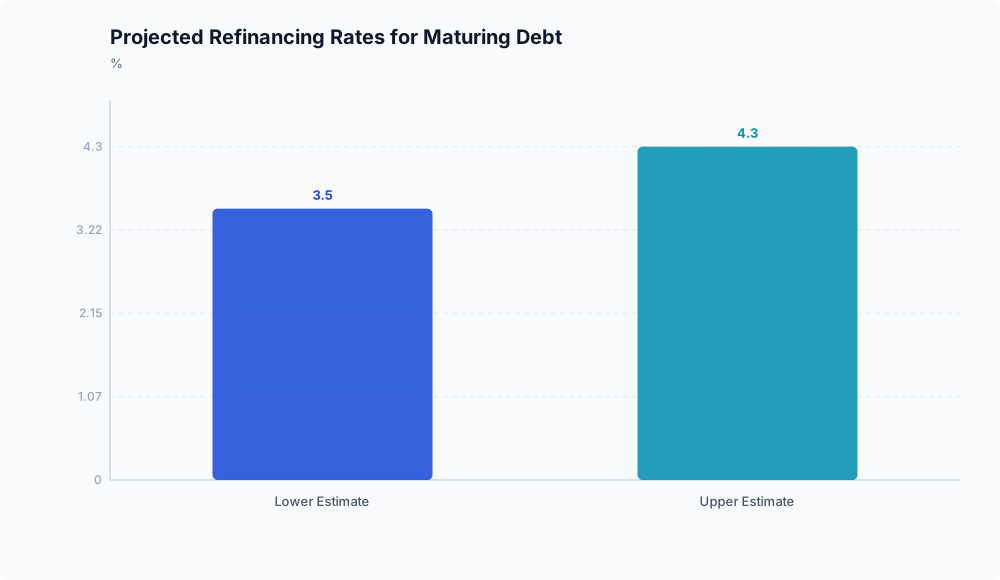
The core of this transmission mechanism is an upcoming wave of refinancing. Currently, over $3 trillion of short-duration debt faces a 270 to 380 basis point rate increase upon maturity, according to Seeking Alpha. Companies attempting to roll over these liabilities will encounter projected refinancing rates between 3.5% and 4.3%, an increase from the near-zero rates they previously experienced, as noted by Seeking Alpha.
This represents an immediate increase in baseline interest expense rather than a gradual amortization of higher costs. This repricing affects free cash flow, altering the valuation models for indebted equities. When interest expenses rise due to a 380 basis point increase, net income margins decline even if operational revenue remains stable.
This refinancing mechanism creates a bifurcated market, affecting smaller companies more than larger corporations. Mega-cap companies generally secured long-duration, fixed-rate debt during the previous low-interest-rate era, locking in their cost of capital. Conversely, smaller companies, particularly those in the Russell 2000, rely on floating-rate bank loans and shorter-maturity debt instruments that reprice or mature quickly.
| Feature | S&P 500 Mega-Caps | Russell 2000 Small-Caps |
|---|---|---|
| Primary Debt Type | Fixed-rate corporate bonds | Floating-rate bank loans & short-term notes |
| Duration Profile | Long-duration (often 10+ years) | Short-duration (1 to 5 years) |
| Refinancing Risk | Low (locked in low rates pre-2022) | High (exposure to current rates) |
| Margin Impact | Insulated; interest income may exceed expense | Compression via interest expense increases |
This structural disparity means the Fed’s restrictive policy transmits to small-cap income statements while having less impact on the balance sheets of mega-cap leaders. For small-cap investors, traditional valuation metrics like forward price-to-earnings ratios may be misleading if they do not account for debt service increases. This environment shifts focus within the small-cap index toward refinancing capacity rather than traditional growth fundamentals.
The Hard Data: Economic Signals and Policy Constraints
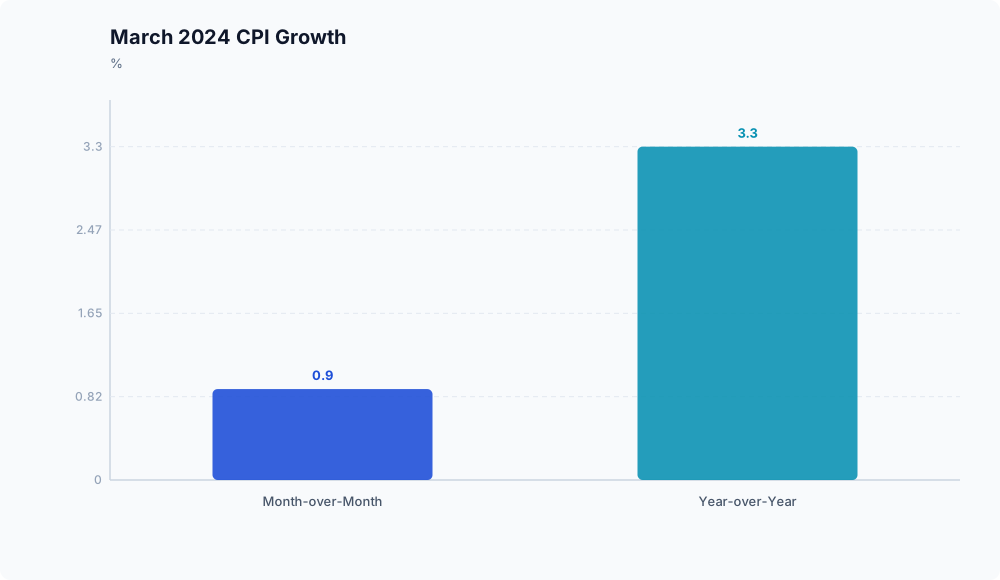
The underlying economic data from March 2024 reveals a complex environment where the Fed’s dual mandate presents mixed signals, constraining monetary policy. The macroeconomic data shows a divergence between headline inflation and core metrics. Consumer Price Index (CPI) figures increased by 0.9% month-over-month and 3.3% year-over-year, according to Freedom Mortgage.
This increase was primarily driven by external supply factors rather than broad domestic demand. The energy index climbed 10.9%, with a 21.2% increase in gasoline prices accounting for nearly three-quarters of the monthly inflation rise, as reported by Freedom Mortgage. In contrast, core inflation remained at 2.6%, suggesting domestic pricing pressures are moderating. For investors, this data implies headline inflation is sensitive to external geopolitical risks, particularly developments in the Middle East, complicating the Fed’s reliance on core metrics for policy decisions.
Alongside rising energy costs, the labor market is exhibiting signs of deceleration. The economy added 178,000 nonfarm payrolls and the unemployment rate was 3.8%, but wage growth has lost momentum, according to Freedom Mortgage. Average hourly earnings expanded by 0.2% in March 2024, marking the slowest pace of wage growth since May 2021, Freedom Mortgage notes.
This deceleration creates an environment where consumer incomes are not keeping pace with energy costs. A secondary effect is a potential contraction in discretionary consumer spending, as households absorb higher non-discretionary expenses without matching income gains. Furthermore, the slower wage growth indicates corporations may face challenges passing higher financing costs onto consumers.
Faced with this mixed data, the FOMC opted to maintain the federal funds rate at a range of 5.25% to 5.50% through its March and April 2024 meetings, per Freedom Mortgage. The Fed cited developments in the Middle East as a source of uncertainty, noting risks to both sides of its dual mandate. This highlights a central bank balancing the need to manage energy-driven headline inflation with the goal of supporting wage growth. Consequently, market participants anticipate a prolonged period of restrictive monetary policy, leading to the expected rate increase for the $3 trillion short-duration debt wall, according to Seeking Alpha.
Scenarios for the 2026 Maturity Cliff
As the corporate debt maturity wall approaches, US markets face a structural hurdle. The exact month-to-month maturity schedule of this $3 trillion debt wall remains uncertain, making it challenging to time potential equity impacts. However, the aggregate effect on corporate cash flows is highly probable, leading to three potential scenarios for market participants.
The Base Case: Staggered Margin Compression In the Base Case scenario, the Federal Reserve maintains rates near the 5.25% to 5.50% range, leading to a staggered refinancing cycle. This outcome is supported by mixed economic data, such as the 3.8% unemployment rate and the addition of 178,000 nonfarm payrolls in March 2024, as cited by Freedom Mortgage. Companies will gradually roll over their obligations at higher costs, which will erode profit margins and direct capital toward debt servicing rather than growth initiatives. Secondary effects may include reduced corporate stock buybacks and slower dividend growth. Equity investors can anticipate a period where free cash flow generation outperforms debt-reliant growth strategies.
The Upside Scenario: Disinflation and Rate Reductions An Upside scenario involves a deceleration in energy inflation, allowing the Federal Reserve to execute rate cuts before mass maturities occur. Underlying economic indicators provide some foundation for this path, notably the 2.6% core inflation rate and wage growth of 0.2%, according to Freedom Mortgage. If these trends continue and energy markets stabilize, the Fed could lower rates to alleviate the 270 to 380 basis point refinancing increase. However, evidence for immediate rate reductions remains limited, as headline inflation is influenced by external factors. Until energy markets cool, pricing in near-term monetary relief remains speculative.
The Downside Scenario: Persistent Inflation and Credit Stress The Downside scenario envisions persistent inflation, where headline inflation prevents the Fed from lowering rates as the $3 trillion debt wall matures. This risk is supported by March 2024 data, where headline CPI increased 3.3% year-over-year, driven by a 21.2% increase in gasoline prices, as reported by Freedom Mortgage. If geopolitical tensions keep energy prices elevated, the Fed may hold rates steady despite a cooling labor market. Under these conditions, projected refinancing rates of 3.5% to 4.3% could lead to short-duration defaults, distressed debt exchanges, and downward earnings revisions among lower-tier high-yield issuers and Russell 2000 companies, according to Seeking Alpha.
What to Watch Next: Early Warning Indicators of Credit Stress
With the FOMC holding the federal funds rate steady at 5.25% to 5.50%, investors may need to look beyond broad index performance. Portfolio allocation should shift toward analyzing individual corporate leverage and monitoring early warning indicators in the credit and labor markets.
Core vs. Headline CPI Convergence The trajectory of core versus headline CPI will influence the Federal Reserve’s ability to offer rate relief. With energy costs accounting for nearly three-quarters of the monthly all-items increase in March 2024, a key indicator is whether energy prices affect core CPI, as noted by Freedom Mortgage. If higher fuel prices increase transportation and production costs, core inflation could accelerate from 2.6%. This would encourage the Fed to maintain elevated rates, increasing refinancing risks for indebted corporations.
High-Yield Credit Spreads High-yield credit spreads serve as a real-time indicator for refinancing stress as maturities come due. A widening in high-yield spreads would indicate credit markets are pricing in a higher probability of default. Companies at the lower end of the credit spectrum often lack the cash reserves to absorb significant increases in interest expenses. An expansion in the spread between high-yield corporate bonds and risk-free Treasuries may precede default events, reflecting tightening financial conditions before equity markets price in the fundamental changes.
Russell 2000 Earnings Revisions and Interest Coverage Russell 2000 earnings revisions offer a view of how the debt wall impacts corporate balance sheets. Market participants should analyze upcoming earnings reports, focusing on interest coverage ratios in addition to traditional earnings multiples. Attention should be paid to upward revisions in interest expense. If interest coverage ratios compress across the small-cap index, it signals that debt servicing is reducing operational cash flow, which can precede covenant breaches.
Labor Market Feedback Loops Secondary effects of corporate debt pressure may appear in the labor market. With unemployment at 3.8% and wage growth at 0.2%, labor momentum is decelerating, according to Freedom Mortgage. If small-cap companies pursue cost-cutting measures to service expanding debt burdens, payroll reductions are a likely option. The 178,000 nonfarm payrolls added in March could reverse if refinancing costs prompt corporate austerity. Investors can view rising high-yield spreads as an indicator for potential employment weakness.
Conclusion

The Federal Reserve’s management of energy-driven inflation has shifted from a macroeconomic balancing act to a period of microeconomic adjustment. By holding rates steady at 5.25% to 5.50%, the central bank ensures the impending Corporate Debt Wall will act as a dividing line in the US equity landscape. The structural advantage of holding long-duration debt insulates cash-rich mega-caps while exposing smaller firms to a 270 to 380 basis point rate increase. The timeline for rate relief depends on global energy markets. Until stabilization occurs, investors should recognize that operational revenue growth must be paired with defensive positioning, scrutiny of debt maturity schedules, and a focus on balance sheet resilience.
Disclaimer: This analysis is for informational purposes only and does not constitute investment, financial, real estate, or legal advice. Always consult a licensed financial advisor before making investment decisions.
FAQ

Why does the 2026 corporate debt wall disproportionately threaten Russell 2000 companies? Russell 2000 companies rely heavily on floating-rate bank loans and shorter-maturity debt instruments that reprice or mature quickly. Unlike mega-cap companies that locked in long-duration, fixed-rate debt during the low-interest-rate era, small-caps face exposure to current elevated rates, resulting in margin compression when refinancing.
How does ‘higher for longer’ monetary policy impact floating-rate corporate debt? A “higher for longer” policy ensures the cost of capital remains a structural factor. For floating-rate debt, elevated central bank rates translate into an immediate increase in baseline interest expense. This affects free cash flow, directing capital away from growth initiatives and into debt servicing, which impacts a company’s earnings power.
What specific economic data is keeping the Fed from cutting rates ahead of the maturity wall? The Federal Reserve is constrained by headline inflation, which rose 3.3% year-over-year in March 2024. This increase was driven by a 21.2% rise in gasoline prices and a 10.9% climb in the broader energy index. Additionally, the Fed cited ongoing developments and uncertainty in the Middle East as key risks influencing their rate decisions.
How are cash-rich mega-cap companies avoiding the refinancing shock facing small-caps? Mega-cap companies generally secured long-duration, fixed-rate corporate bonds prior to 2022, locking in a low cost of capital. Furthermore, their cash reserves allow them to generate yield in the current high-rate environment. In many cases, their interest income may exceed their interest expenses, insulating their operating margins from the refinancing increase.