
Evaluating the $200 Billion Agency MBS Purchase Impact
The Proposed Agency MBS Purchase: Market Mechanics and Implications
The proposed $200 billion Agency MBS Purchase, as analyzed by Fannie Mae, represents a profound shift in US monetary mechanics. It effectively functions as a targeted relief valve specifically for the housing market. By directing federal or agency balance sheets to absorb Mortgage-Backed Securities (MBS) supply, policymakers are executing what amounts to “backdoor quantitative easing” (QE).
This maneuver arrives at a critical juncture. From January 2022 through November 2024, the absence of a central, price-insensitive buyer exposed the housing market to severe pricing pressures. This dynamic drove mortgage spreads to cycle highs.
This intervention directly counteracts the Federal Reserve’s broader “higher for longer” macroeconomic posture. It artificially suppresses mortgage borrowing costs without requiring a formal cut to the baseline federal funds rate. For US investors, this signals a deliberate policy effort to decouple the interest-rate-sensitive housing sector from restrictive, economy-wide monetary conditions. Ultimately, this localized easing allows shelter costs to decline while the central bank maintains its broader fight against inflation.
The Transmission Chain: From Intervention to Market Reality
Visualizing the transmission chain of this $200 billion intervention reveals a deliberate mechanism designed to bypass broader credit market gridlock. The catalyst at the top of this economic flowchart is the injection of capital directly into the secondary mortgage market.
According to Fannie Mae, intervening agencies operate as “non-economic buyers.” This means their purchasing decisions are entirely divorced from yield sensitivity. By acting without regard for relative value, these entities systematically absorb available secondary market supply. This action displaces private, rate-sensitive investors. The resulting artificial scarcity forces remaining private capital to bid aggressively on a shrinking pool of bonds.
The second node in this sequence is the forced compression of the secondary mortgage spread. This spreadthe gap between MBS yields and the 10-year Treasury noteserves as a primary barometer for private market risk appetite. When the non-economic buyer absorbs duration risk, the premium that private investors demand for holding prepayment risk collapses.
This spread compression represents the critical bridge to lower retail mortgage rates for consumers. The mechanical relationship between agency buying and retail rates is starkly evident in recent market extremes. By compressing the spread, targeted MBS purchases can artificially suppress retail borrowing costs even if baseline Treasury yields remain elevated.
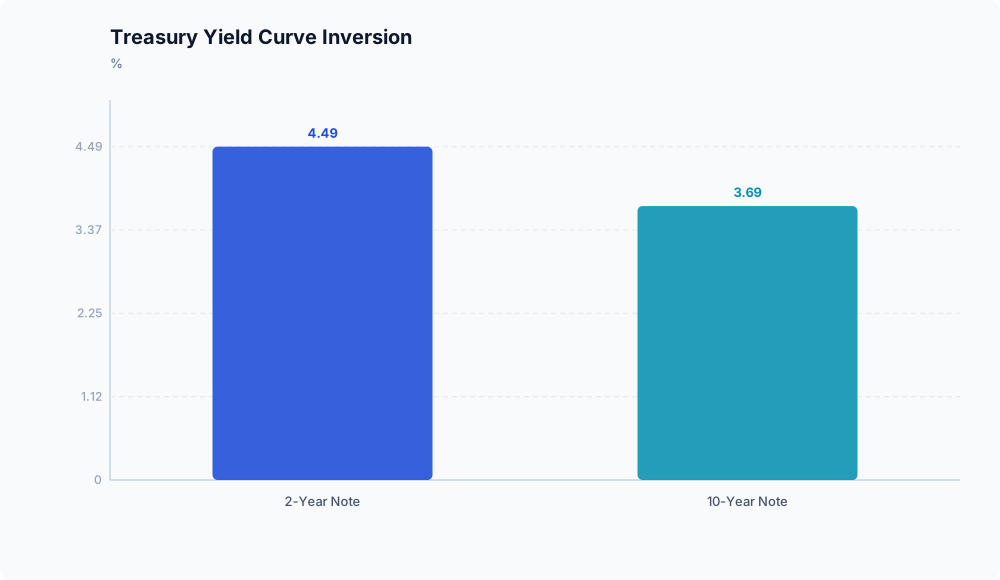
However, this targeted easing mechanism is currently fighting against severe macroeconomic headwinds. While liquidity is engineered in the mortgage sector, the broader bond market is flashing profound distress signals. Contemporaneous market reports from Chandler Asset Management highlight a deeply inverted Treasury yield curve, with the 2-year Treasury yield rising to 4.49% while the 10-year yield sits at 3.69%.
This 80 basis point inversion physically maps a market environment where short-term liquidity is exceptionally tight, yet long-term growth and inflation expectations are declining. The collision of these two forces creates complex second-order effects. Policymakers can successfully isolate the housing market, but the inverted yield curve indicates that corporate borrowers and consumer credit markets outside of housing will continue to face restrictive short-term rates.
The Data: Structural Shifts and the Secondary Spread
To understand the magnitude and potential efficacy of this market intervention, it is essential to examine the structural shifts in mortgage spreads across different economic epochs. The relationship between 30-year mortgage rates and 10-year Treasury yields is primarily dictated by the secondary mortgage spread.
Prior to the Great Financial Crisis (GFC), the mortgage market operated largely on private capital dynamics with standard risk pricing. Following the crisis, regulatory changes and central bank interventions permanently altered the baseline metrics for both origination costs and secondary market premiums.
The table below, based on data from Fannie Mae, illustrates the historical evolution of both the primary-secondary spread (the cost of originating and servicing the loan) and the secondary spread.
| Time Period | Primary-Secondary Spread | Secondary Spread |
|---|---|---|
| 1995 to 2005 | 0.50 pp | 1.17 pp |
| Post-GFC | 1.01 pp | N/A |
| 2012 to 2019 | N/A | 0.71 pp |
The data reveals a profound structural break in mortgage pricing. The primary-secondary spread structurally doubled to 1.01 percentage points due to heightened regulatory and servicing burdens post-GFC. Conversely, the secondary spread experienced massive compression during the 2012-2019 period of Quantitative Easing. During this era of aggressive central bank intervention, the secondary spread averaged just 0.71 percentage points, according to Fannie Mae.
This compression reached its absolute zenith in December 2020. During that month, according to Fannie Mae, the 10-year Treasury note fell to 0.93%, and aggressive purchasing significantly compressed the secondary spread to a mere 0.45 percentage points. This historical fact demonstrates that aggressive non-economic intervention can temporarily suppress the risk premium of MBS to near-zero levels.
Conversely, the withdrawal of non-economic buyers exposes the market to severe whiplash. From January 2022 through November 2024, as the Federal Reserve transitioned to Quantitative Tightening, the secondary spread widened dramatically. According to Fannie Mae, it reached an average of 1.4 percentage points.
This volatility peaked in October 2023. During that month, Fannie Mae data shows the 10-year Treasury averaged 4.8% and the secondary spread widened to an elevated 1.73 percentage points. This combination drove mortgage rates to a cycle-high of 7.8%. Without a central buyer to absorb duration risk, private capital demands a steep liquidity premium, exacerbating the tightening of financial conditions.
While the historical record proves that central or agency purchases compress secondary spreads, applying this mechanism to future interventions requires analytical caution. The elasticity of the secondary spread depends heavily on the prevailing macroeconomic environment, the total outstanding supply of MBS, and the concurrent risk appetite of private fixed-income investors.
Market Scenarios: Mapping the Uncertainty
The trajectory of the US housing market currently hinges on the volatile dynamics between Treasury yields and mortgage spreads. Evidence regarding the exact timing and market absorption rate of this $200 billion capital injection remains exceptionally thin. It is unclear if this limited balance sheet capacity will be sufficient to permanently anchor spreads if private investors aggressively sell into the agency bids. Investors must therefore weigh potential market impacts through distinct scenario analyses.
The Base Case: Gradual Compression and Stabilization In a base case scenario, gradual spread compression sparks localized refinancing waves and stabilizes homebuilder pipelines. If secondary spreads normalize from their recent 1.4 percentage point highs toward historical post-GFC averages, mortgage rates could ease marginally even if Treasury yields remain static.
For homebuilders, this incremental relief translates directly into pipeline stability. It allows them to rely less on expensive, margin-reducing mortgage rate buydowns to move inventory. Investors in homebuilder equities might see profit margins stabilize as the cost of incentivizing buyers declines. Furthermore, homeowners sitting on the margins of affordability could execute localized refinancings, providing steady origination volume for lenders.
The Upside Case: A Broader Housing Thaw The upside scenario envisions a broader housing market thaw that outpaces current macroeconomic expectations. This would likely require the secondary mortgage spread to revert closer to the 0.71 percentage point average observed between 2012 and 2019, according to Fannie Mae.
If a structural shift compresses the spread to this degree, the resulting drop in consumer mortgage rates would dramatically alter housing affordability metrics. This could trigger a sudden unlocking of the “golden handcuff” effectwhere existing homeowners currently refuse to abandon sub-4% pandemic-era mortgages. Unlocking this inventory would flood the market with existing homes, disproportionately benefiting title insurers, real estate brokerages, and home improvement retailers.
The Downside Case: Macroeconomic Gravity Takes Over The downside scenario materializes if persistent inflationary pressures force a hawkish Federal Reserve reaction, neutralizing any benefits from spread compression. The market witnessed a severe version of this in October 2023, when the 10-year Treasury note averaged 4.8% and the secondary spread widened to 1.73 percentage points, as reported by Fannie Mae.
If inflation remains sticky, rising underlying Treasury yields will easily overpower the downward pressure of a compressing MBS spread. Homebuilders would be forced to aggressively resume rate buydowns, severely compressing their gross margins and stalling future construction pipelines. For US investors, this scenario dictates a defensive posture, as prolonged elevated rates would continuously suppress mortgage origination volumes.
What to Watch Next: Key Indicators for Investors

To gauge the success of these targeted MBS interventions, market participants must monitor specific indicators that confirm a decoupling of mortgage rates from the broader Treasury market. The primary signal of success will be whether mortgage rates stabilize or decline even if benchmark Treasury yields remain volatile.
- The Secondary Mortgage Spread: The most immediate metric to track is the weekly secondary spread. If the current intervention is effective, investors should see this spread compress from its recent 1.4 percentage point average back toward pre-pandemic averages (closer to 0.71 percentage points).
- Yield Curve Inversion Dynamics: Monitoring spreads requires contextualizing them against the shape of the Treasury yield curve. The current 80 basis point inversion presents a challenging backdrop, according to Chandler Asset Management. A successful MBS purchase program would force mortgage spreads to tighten despite this yield curve inversion.
- Localized Refinancing Data: The second-order effects of this intervention must materialize in localized mortgage application volumes. Investors should monitor weekly refinancing indices as a real-time barometer of policy transmission. If secondary spreads compress but primary-secondary spreads remain stubbornly high, it implies originators are hoarding the premium rather than passing lower costs to homeowners.
- Homebuilder Sentiment Indices: Market participants should track homebuilder sentiment to confirm whether financial market decoupling translates into real economic activity. A divergence between rising homebuilder sentiment and a stagnant Treasury yield curve would serve as a strong confirmation of localized stimulus.
Conclusion

The proposed Agency MBS Purchase establishes a new precedent for targeted sector bailouts. By deploying a price-insensitive buyer to absorb mortgage bond supply, policymakers are attempting to artificially compress the secondary mortgage spread, driving a wedge between general fixed-income yields and consumer housing costs. This maneuver acknowledges that the broader economy may require restrictive short-term rates to combat inflation, but the housing market requires immediate liquidity to function.
For investors, the analytical takeaway is clear: the success of this “backdoor QE” hinges entirely on the elasticity of the secondary mortgage spread. If the $200 billion intervention can successfully override the macroeconomic gravity of an inverted yield curve and elevated Treasury yields, it will trigger a highly localized real estate recovery. However, because this intervention fragments monetary policy, market participants must recognize that a stabilized housing market will not necessarily translate into broader economic expansion. Investors must closely monitor spread metrics and refinancing volumes to determine if this targeted relief valve is actually reaching the consumer, or if it is simply being absorbed by a distressed fixed-income market.
Disclaimer: This analysis is for informational purposes only and does not constitute investment, financial, real estate, or legal advice. Always consult a licensed financial advisor before making investment decisions.
FAQ
How does an Agency MBS purchase actually lower consumer mortgage rates? An Agency MBS purchase lowers consumer rates by introducing a “non-economic buyer” into the secondary mortgage market. Because this buyer purchases Mortgage-Backed Securities without sensitivity to the underlying yield, it absorbs excess bond supply and displaces private, rate-sensitive investors. This artificial scarcity forces the secondary mortgage spread to compress, which directly reduces the risk premium that end-borrowers must pay over risk-free Treasury rates.
Why is this intervention called ‘backdoor QE’ if the Federal Reserve isn’t the one buying? It is considered “backdoor QE” because it mimics the exact mechanical effects of the Federal Reserve’s Quantitative Easing programs. By using federal or agency balance sheets to absorb MBS supply, policymakers are artificially suppressing localized borrowing costs and injecting liquidity into a specific sector. This achieves the same market-easing results for the housing industry without requiring the central bank to cut the baseline federal funds rate.
Will this $200 billion purchase be enough to trigger a nationwide refinancing boom? The exact market impact remains highly uncertain. While historical data shows that multi-trillion-dollar QE programs successfully triggered massive refinancing waves by significantly compressing the secondary spread to 0.45 percentage points in 2020, a $200 billion intervention is significantly smaller. Its ability to trigger a nationwide boom depends heavily on whether this limited capacity can permanently anchor spreads if private investors aggressively sell into the agency bids.
How does the inverted Treasury yield curve impact the effectiveness of this MBS purchase? The inverted Treasury yield curvehighlighted by a 2-year yield of 4.49% and a 10-year yield of 3.69%creates a highly bifurcated fixed-income landscape. While the MBS purchase attempts to engineer localized liquidity and lower long-term borrowing costs for housing, the inverted curve indicates that short-term capital remains exceptionally tight and expensive. This means that even if mortgage rates fall, the broader economy and corporate borrowers will continue to face restrictive macroeconomic headwinds.