
How a Kevin Warsh Fed Chair Impacts Commercial Real Estate
The End of Extend and Pretend: How the Fed’s Hawkish Shift Collides with the Commercial Real Estate Maturity Wall
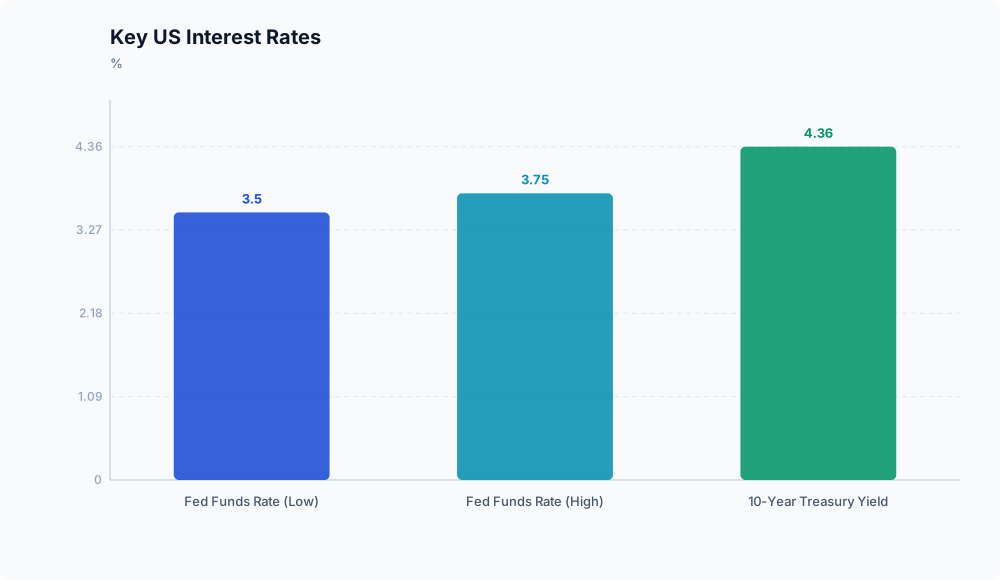
The anticipated nomination of Kevin Warsh as Fed Chair, paired with the Federal Open Market Committee’s (FOMC) January 28 decision to hold the federal funds rate steady at 3.5% to 3.75%, marks a definitive and hawkish regime shift for the US economy, according to Multi-Housing News. For the commercial real estate (CRE) market, this pivot effectively signals the conclusion of the “extend and pretend” survival strategy that borrowers and lenders have relied upon over the past cycle to navigate the looming Commercial Real Estate Maturity Wall.
By cementing a higher-for-longer monetary policy, this leadership change wipes out lingering market expectations for aggressive 2026 rate cuts and introduces the distinct, albeit uncertain, tail risk of 2027 rate hikes. Property owners who have been relying on short-term forbearance to bridge the gap to a lower interest rate environment now face a stark mathematical reality: systemic relief is no longer guaranteed. The market is transitioning rapidly from a state of administrative delay to one of structural reckoning.
The Transmission Chain: From Hawkish Policy to Market Paralysis
The transmission of this hawkish policy into the broader economy operates through a direct and unforgiving mechanism, fundamentally altering the US yield curve. Market expectations now reflect a central bank that is highly hesitant to ease monetary policy, with mixed economic data reinforcing the likelihood that the Federal Reserve will maintain its restrictive stance, as reported by Bloomberg.
This policy anchor at the short end of the curve pushes up the long end, evidenced by benchmark 10-year Treasury yields closing at an elevated 4.36%, according to Bloomberg. For US investors, this establishes a higher permanent floor for borrowing costs, effectively ending the era of cheap capital. Sustained high yields immediately reprice risk across all capital-intensive sectors, bifurcating the real estate landscape into two distinct crises: a liquidity and valuation crisis in commercial property, and a transaction freeze in residential housing.
The most immediate victim of this permanently higher cost of capital is the commercial real estate sector. Previously, many CRE borrowers employed delay tactics, hoping that a dovish Fed pivot would lower rates in time for their debt renewals. However, a Warsh-led Fed essentially invalidates these borrower survival strategies by ensuring that rescue cuts will not materialize. Refinancing maturing obligations is now severely complicated by the dual headwinds of higher interest rates and falling underlying property values, as noted by PBMares.
Beyond commercial properties, the transmission chain extends directly into the residential real estate market. Elevated 10-year Treasury yields dictate higher 30-year fixed mortgage rates. Because millions of existing homeowners secured ultra-low mortgage rates prior to the current hiking cycle, sustained high borrowing costs severely disincentivize them from selling and taking on new, expensive debt. This “lock-in” effect effectively freezes the existing home sales market, artificially suppressing inventory levels. Consequently, the residential sector faces a volume decline, where transaction velocity drops even if nominal home prices remain sticky due to constrained supply.
Highest-Signal Evidence: The Mathematical Breakdown of Refinancing
The sheer volume of maturing debt makes this hawkish policy stance particularly perilous. The market is currently navigating a significant structural bottleneck, highlighted by an unprecedented concentration of maturing debt. To visualize the impending collision, picture a chart where a flat, elevated yield curve stretches across the top, while a massive, vertical bar chart of maturing CRE debt increases sharply from the bottom. As Bloomberg highlights, the space between these linesrepresenting the borrower’s margin of safetyis eliminated.
In 2025, an unprecedented $957 billion in CRE loans maturednearly triple the 20-year average, according to Multi-Housing News. A granular look at this data reveals concentrated risks across specific asset classes and debt structures, severely testing the liquidity of the US financial system.
| CRE Sector / Debt Type | 2025 Maturing Volume |
|---|---|
| Multifamily | $310 Billion |
| Securitized Loans | $277 Billion |
| Office | $187 Billion |
This composition is highly problematic for broader market stability. The multifamily sector exemplifies the severity of this structural break. With multifamily capitalization rates currently hovering between 5.4% and 5.7%, the spread against the 4.36% risk-free rate is exceptionally tight, based on data from Multi-Housing News and Bloomberg. This narrow premium implies that nearly half of apartment properties may struggle to secure refinancing at sustainable terms, as the underlying asset yields barely cover the prevailing cost of debt service, according to Multi-Housing News.
The friction in refinancing these obligations is driven by visibly deteriorating fundamental metrics. More than $1.5 trillion in total CRE loans are scheduled to mature by the end of 2026, as reported by PBMares. Trepp data highlights that $115 billion of loans maturing by the end of 2026 currently operate with an in-place Debt Service Coverage Ratio (DSCR) below 1.20x, according to RealVal. Analytically, a DSCR below this threshold leaves borrowers with virtually no margin to absorb higher interest expenses or minor revenue dips. Consequently, lenders will likely require substantial cash-in refinancing, forcing sponsors to inject fresh equity simply to retain control of their properties.
The securitized debt market presents an even more acute vulnerability due to structural rigidities and expiring interest rate hedges. According to CRED iQ data cited by RealVal, nearly 40% of securitized CRE collateralized loan obligation (CLO) loans have interest rate caps expiring before their actual maturity dates. This creates a severe embedded default risk: as hedges roll off, borrowers are suddenly exposed to unhedged, floating-rate debt, accelerating cash flow insolvency before the loan term even concludes. The market is already exhibiting signs of failure, with $23 billion in commercial mortgage-backed securities (CMBS) loans currently past their maturity dates without a payoff or formal extension, as noted by RealVal.
Scenario Analysis: Pricing in the Duration of the Fed’s Pause
To effectively navigate this landscape, investors must stress-test their portfolios against distinct macroeconomic trajectories. The structural imbalance between elevated capital costs and maturing debt means that passive real estate allocations will likely underperform historical averages. The coming years will heavily reward those who accurately price the duration of the Fed’s pause against the rising tide of maturities.
| Scenario | Fed Policy Outlook | CRE Market Impact | Broader Economic Effect |
|---|---|---|---|
| Base Case | Rates remain unchanged (3.5% - 3.75%) | Steadily accelerating defaults as the maturity wall hits | Sustained drag on valuations; regional bank write-downs |
| Downside | Inflation stickiness forces 2027 rate hikes | Systemic CRE distress and mass foreclosures | Deep, multi-year housing freeze and credit contraction |
| Upside | Macro weakness forces late-2026 cuts | Distressed operators successfully recapitalize | Avoidance of systemic crisis (Note: Evidence currently thin) |
The Base Case: The assumption that rates remain unchanged leads to steadily accelerating defaults as borrowers fail to refinance at sustainable terms. Borrowers who managed to secure temporary extensions on their 2025 obligations are now rolling that debt directly into subsequent wallsan estimated $539 billion in 2026 and another $550 billion looming in 2027, according to Multi-Housing News. For US investors, this implies a prolonged period of capital destruction in the multifamily and office sectors, forcing regional banks and private credit lenders to absorb significant write-downs.
The Downside Scenario: If inflation proves stickier than anticipated, the downside introduces severe systemic risk. Should the Federal Reserve be forced to resume rate hikes by 2027, the resulting shock would likely trigger cascading CRE distress, as reported by Multi-Housing News. The second-order effect of this downside would be a deep, multi-year housing freeze, as capital completely retreats from development and transaction volumes plummet. Such a credit contraction would severely constrain broader economic growth.
The Upside Scenario: An upside scenario exists where macroeconomic weakness forces the Federal Reserve into a dovish pivot, leading to late-2026 rate cuts. If this pivot were to materialize, it would lower the cost of capital just in time to rescue the 2026 maturity wall. However, evidence supporting this bullish outcome is currently thin, as monetary policy remains firmly anchored by the January FOMC decision, according to Multi-Housing News. Allocating capital based on this dovish pivot remains highly speculative.
What to Watch Next: Triggers and Leading Indicators

The market is already exhibiting signs of structural failure at the maturity wall, manifesting in a growing shadow inventory of unresolved debt. To navigate this precarious environment, investors must monitor a specific set of leading indicators that will signal whether this distress is accelerating into a broader systemic event.
- CMBS Delinquency Rates: The primary metric to track is the monthly CMBS delinquency rate, with a hyper-focus on the $277 billion in securitized loans that matured throughout 2025. A sharp uptick in delinquencies within this specific cohort will indicate that informal forbearance is failing and forced liquidations are beginning.
- Resolution of Shadow Inventory: Market participants must monitor the resolution strategies for the $23 billion in CMBS loans already past their maturity dates without a successful payoff or formal extension, as tracked by RealVal. How special servicers handle this backlog will provide critical insight into whether capital providers are finally capitulating to market clearing prices.
- FOMC Dot Plot Adjustments: Broader macroeconomic indicators will dictate the trajectory of both CRE defaults and the ongoing residential housing freeze. Investors must closely watch upcoming FOMC dot plot adjustments to gauge the Federal Reserve’s long-term tolerance for elevated baseline rates.
- Treasury and Mortgage Spreads: Investors should continuously monitor the spread between the 10-year Treasury yield (currently anchored at 4.36%) and 30-year fixed mortgage rates. A persistently wide spread will signal that mortgage market volatility and risk premiums remain high, ensuring the residential housing market stays frozen.
Conclusion

The intersection of an elevated cost of capital and a relentless Commercial Real Estate Maturity Wall has fundamentally altered the underlying math of property refinancing. Without a downward-sloping rate trajectory, lenders have no mathematical incentive to grant further forbearance, marking the end of the extend and pretend era. The anticipation of Kevin Warsh as Fed Chair confirms that market participants must underwrite a protracted period of capital scarcity.
For US investors, this dictates a transition from a liquidity-driven market to one dictated by operational fundamentals, harsh debt restructuring, and forced deleveraging. The removal of the CRE refinancing bridge means private credit and distressed debt funds may find generational deployment opportunities as traditional lenders retreat. Conversely, the residential sales paralysis suggests long-term headwinds for mortgage originators, real estate brokerages, and home improvement retailers reliant on housing turnover. The era of passive real estate appreciation has concluded; the next decade will heavily reward active managers capable of navigating rigorous price discovery and distressed asset turnover.
Disclaimer: This analysis is for informational purposes only and does not constitute investment, financial, real estate, or legal advice. Always consult a licensed financial advisor before making investment decisions.
FAQ
How will Kevin Warsh’s nomination as Fed Chair impact commercial real estate refinancing? The anticipated nomination introduces a structurally hawkish bias that keeps interest rates higher for longer. This permanently higher cost of capital eliminates the “extend and pretend” strategy, making it mathematically unviable for many borrowers to refinance maturing debt, likely leading to forced asset sales and distressed debt restructuring.
Why are 2026 rate cuts no longer expected under the new Federal Reserve regime? The FOMC’s January 28 decision to hold the federal funds rate at 3.5% to 3.75%, combined with mixed economic data and the hawkish leadership shift, signals a reluctance to provide monetary easing. This restrictive stance anchors short-term rates and effectively revokes previous market expectations for aggressive rate cuts in 2026.
What happens to residential mortgage rates if the Fed holds the federal funds rate steady at 3.5% to 3.75%? Holding the federal funds rate steady keeps the 10-year Treasury yield elevated (recently at 4.36%), which directly dictates higher 30-year fixed mortgage rates. This sustains the “lock-in” effect, where existing homeowners refuse to sell and take on new, expensive debt, resulting in a deep freeze in residential transaction volumes.
Which commercial real estate sectors are most at risk of default in the 2025 maturity wall? The multifamily and office sectors face the highest risk. Of the $957 billion in CRE loans that matured in 2025, $310 billion was concentrated in multifamily debt and $187 billion in the office sector. Securitized loans are also highly vulnerable, accounting for $277 billion of the 2025 maturities.