
How Rising Treasury Yields Impact U.S. Capital Markets
The Impact of Rising Treasury Yields on U.S. Capital Markets
The recent breach of the 5% yield threshold on long-term government debt marks a structural regime change for U.S. capital markets. On May 15, 2026, the U.S. Treasury auctioned $25 billion of 30-year bonds at a yield of 5.05%, marking the first time this duration has priced above 5% since 2007, according to Treasury bond yields spike to 5.05% on inflation reports - UPI.com. This increase serves as a critical inflection point, fundamentally altering the discount rates used by analysts to value risk assets. For investors, a risk-free rate exceeding 5% on a 30-year timeline competes with the equity risk premium. Consequently, the era of abundant, cheap capital that historically subsidized high-duration growth equities has paused. As Treasury Yields recalibrate the baseline cost of capital, market participants are reallocating portfolio assets, shifting away from speculative growth and toward defensive, cash-flowing value.
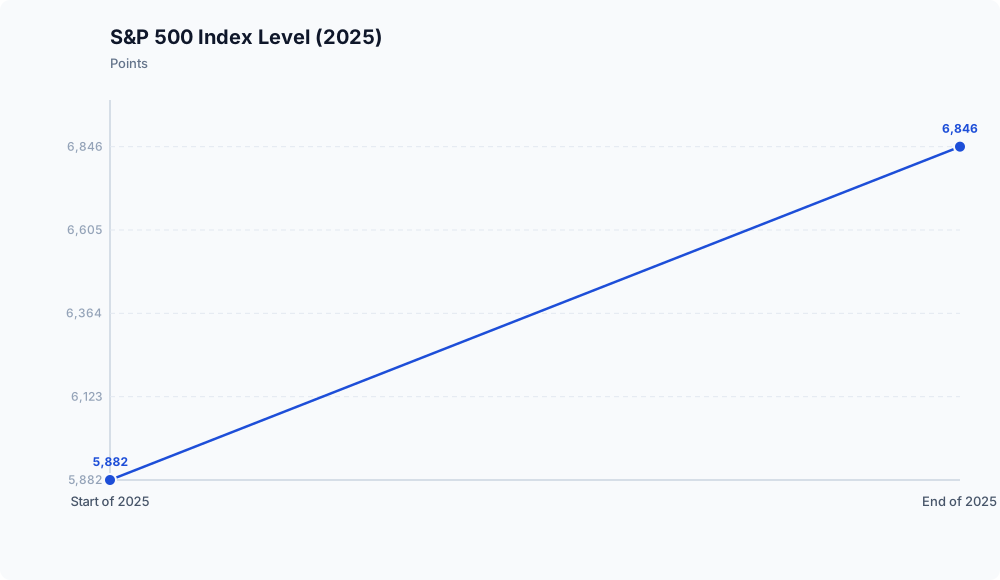
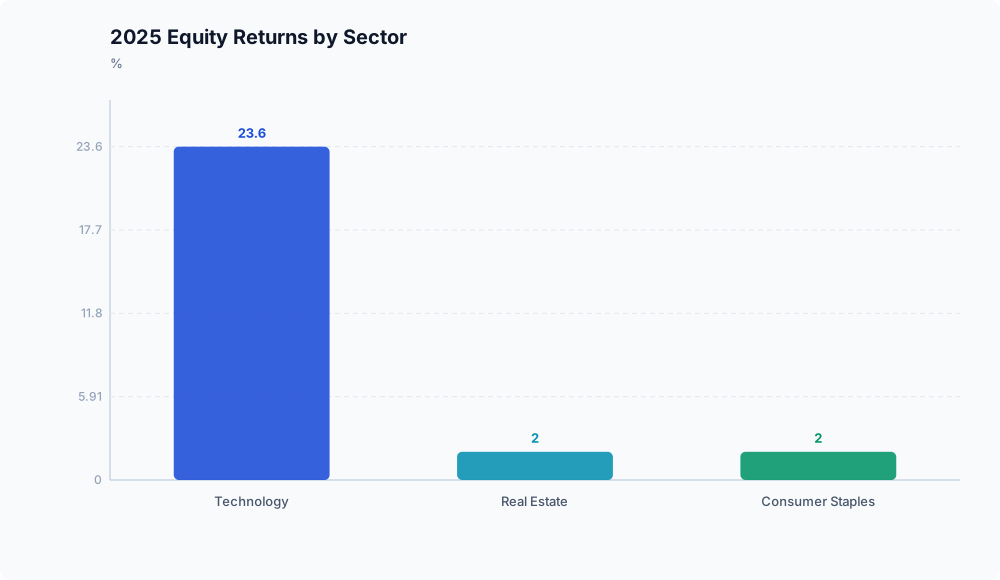
To understand the magnitude of this shift, one must contrast it with the equity expansion witnessed just a year prior. In 2025, the S&P 500 delivered a total return of 17.72%, climbing from 5881.6 to 6845.5, driven by a $4.17 trillion market capitalization increase in the technology sector, as noted by Data Update 2 for 2026: A Testing Year (2025) for US Equities. Technology companies returned 23.65% during that period, while rate-sensitive sectors like real estate and consumer staples recorded returns of approximately 2%. High-growth technology valuations are sensitive to rising long-term yields because their cash flows are projected far into the future. As the 30-year yield crosses 5%, the mathematical present value of those distant earnings compresses, altering the trajectory of the 2025 tech rally and setting the stage for a more restrictive macroeconomic environment.
The Transmission Chain: From Geopolitical Shock to Market Repricing
The recent escalation of geopolitical tensions has triggered a repricing of risk across U.S. financial markets. What began as a localized geopolitical conflict has developed into a macroeconomic headwind, transmitting energy shocks into broad-based inflation and subsequent bond market volatility. For investors, understanding this progression is critical, as it highlights how external supply constraints can lead to a devaluation of financial assets. The transmission chain follows a sequential path that alters the cost of capital.
Step 1: The Geopolitical Energy Shock The catalyst for this market regime shift stems from escalating geopolitical tensions, which have disrupted global energy dynamics. While the exact scope and broader geopolitical trajectory of this conflict remain uncertain, the immediate economic symptom is a supply-side energy shock. According to recent data, gasoline prices have increased by 28% on an annual basis, acting as a regressive tax on consumers and a direct input cost increase for industrial producers (Treasury bond yields spike to 5.05% on inflation reports - UPI.com). This initial energy increase serves as a primary factor indicating that elevated input costs will move down the supply chain into broader goods and services.
Step 2: The Inflationary Resurgence The energy shock materialized in official U.S. inflation metrics by early 2026. Overall consumer prices rose 0.6% in April 2026 alone, but the deeper concern for corporate margins emerged in the wholesale data (Treasury bond yields spike to 5.05% on inflation reports - UPI.com). The Producer Price Index (PPI) Final Demand rose to 6%, marking its highest level since January 2023 (Treasury bond yields spike to 5.05% on inflation reports - UPI.com). This elevated PPI indicates that businesses are facing significant cost pressures before goods reach the retail shelf. Companies must now either absorb these costs, compressing their profit margins, or pass them onto consumers.
Step 3: The Bond Market Selloff Faced with supply-driven inflation, fixed-income markets reacted by demanding higher compensation for holding long-term debt. On May 15, 2026, the U.S. Treasury sold $25 billion of 30-year bonds yielding 5.05%, alongside a 10-year Treasury note yield that rose over 11 basis points to 4.57%, and a 2-year yield that increased to 4.08% (Treasury bond yields spike to 5.05% on inflation reports - UPI.com). As market analysts noted, long end rates are now in control of monetary policy, implying that bond investors, rather than the Federal Reserve, are currently influencing the tightening of financial conditions by driving up long-term yields (Treasury bond yields spike to 5.05% on inflation reports - UPI.com).
Step 4: Valuations and Corporate Strain The second-order effects of this yield increase are negative for corporate financial health and equity valuations. Rising Treasury yields mechanically increase the risk-free rate, which serves as the foundational discount rate in standard equity valuation models. For long-duration growth stocks, whose cash flows are weighted in the distant future, a 5% discount rate reduces the present value of those expected earnings. Concurrently, these rising borrowing costs affect the balance sheets of debt-reliant businesses, creating a dual headwind of contracting valuation multiples and lowering fundamental credit quality (Treasury bond yields spike to 5.05% on inflation reports - UPI.com).
The Highest-Signal Evidence: Unpacking the Data Behind the Yield Spike
The U.S. Treasury market’s threshold crossing on May 15, 2026, is a notable event for the year. Issuing $25 billion of 30-year bonds at a yield of 5.05% indicates a repricing of long-term risk by investors (Treasury bond yields spike to 5.05% on inflation reports - UPI.com). The adjustments extending across the yield curvewith the 10-year rising to 4.57% and the 2-year to 4.08%imply that the market is demanding a higher term premium to absorb long-duration government debt. It suggests a structural reset in the baseline cost of capital after years of lower rates.
The contrast between the previous year’s economic environment and the current reality highlights the severity of this macroeconomic pivot. In 2025, markets were largely defined by technology sector dominance and a low-inflation baseline that supported elevated equity multiples. By April 2026, the landscape had shifted considerably.
| Metric / Theme | 2025 Baseline | April 2026 Reality |
|---|---|---|
| Market Dominance | Technology sector leadership | Yield-generating and defensive assets |
| Inflation (PPI) | Subdued and trending downward | 6% (Highest level since Jan 2023) |
| Monthly CPI Growth | Near target stabilization | 0.6% monthly surge |
| 30-Year Treasury Yield | Comfortably below 4.5% | 5.05% (First issuance >5% since 2007) |
The mechanics of this yield increase suggest that organic market forces are influencing borrowing costs alongside official central bank targets. Furthermore, broader sovereign debt concerns are compounding the issue. Analysts point out that debts and deficits matter globally, referencing fiscal pressures in Britain and the reliance on foreign-owned sovereign bonds as funding sources (Treasury bond yields spike to 5.05% on inflation reports - UPI.com). While the specific cross-border contagion effects from British deficits remain opaque, the overarching implication is clear: global capital pools are shrinking relative to the large issuance of government debt. U.S. Treasuries must therefore offer higher yields to attract foreign buyers facing their own domestic fiscal limitations.
Ultimately, these rising yields transmit pressure directly into the real economy by steadily increasing corporate borrowing costs. Higher benchmarks at the long end of the curve are tightening the financial conditions of businesses, particularly those reliant on rolling over debt (Treasury bond yields spike to 5.05% on inflation reports - UPI.com). For U.S. market participants, this dynamic introduces a refinancing challenge where companies previously accustomed to cheap capital will face higher interest expenses.
Forward Scenarios: Navigating Uncertainty in a High-Yield Regime
The U.S. equity market is currently transitioning from a period of steady growth into a tighter macroeconomic regime defined by rising borrowing costs. Because energy markets are highly reactive to geopolitical headlines, the trajectory of U.S. equities will largely depend on whether Middle Eastern conflicts escalate or stabilize.
Base Case: Sustained Yields and Sector Rotation Under a base-case scenario, sustained long-term yields above 5% will trigger a valuation adjustment for growth equities and prompt a sector rotation. Technology stocks, which led 2025 with a 23.65% return, are sensitive to discount rate adjustments, making their recently expanded multiples difficult to justify as risk-free rates rise (Data Update 2 for 2026: A Testing Year (2025) for US Equities). As capital rotates away from these long-duration equities, it is likely to move toward sectors offering immediate cash flows and inflation protection, particularly the energy sector. This rotation aligns with early signs from 2025, where small-cap and low price-to-book value stocks began returning to market favor (Data Update 2 for 2026: A Testing Year (2025) for US Equities). Market participants should prepare for a period where traditional value metrics may outperform growth.
Upside Scenario: Geopolitical De-escalation In an upside scenario, a diplomatic or military de-escalation in the Middle East would lower global energy prices and alleviate inflationary pressures. If the 28% increase in gasoline prices reverses, the Producer Price Index would likely retreat from its 6% peak, giving bond markets the necessary relief to bid down yields (Treasury bond yields spike to 5.05% on inflation reports - UPI.com). A retreat from the 5% threshold on the 30-year bond would prevent growth stocks from severe multiple compression. Under these conditions, the technology sector could maintain its $4.17 trillion market cap gains from 2025, and the broader S&P 500 could resume its upward trajectory (Data Update 2 for 2026: A Testing Year (2025) for US Equities). For investors, this outcome implies that current yield increases might be a transient geopolitical shock rather than a permanent structural shift.
Downside Scenario: Broadening Conflict and Stagflation Conversely, a downside scenario materializes if geopolitical conflicts broaden, causing rising energy prices that entrench a stagflationary environment. Rising yields are already increasing borrowing costs, which tightens the financial conditions of businesses across the broader economy (Treasury bond yields spike to 5.05% on inflation reports - UPI.com). If input costs continue to rise while consumer demand falters, corporate margins will decline. Highly leveraged companies and capital-intensive industries, such as real estatewhich recorded a 2% return in 2025would face liquidity challenges (Data Update 2 for 2026: A Testing Year (2025) for US Equities). In this environment, investors would face a contraction in both equity valuations and corporate earnings.
What to Watch Next: Key Indicators for Market Participants
To navigate this macroeconomic environment, market participants must shift their focus from lagging economic data to forward-looking market signals. The interplay between geopolitical shocks, fiscal supply, and corporate refinancing creates an environment where isolated disruptions can trigger broad repricing. Investors should establish a monitoring framework centered on three specific forward indicators.
- Upcoming Treasury Auctions: The volume of sovereign debt issuance is testing market absorption. If foreign appetite for U.S. debt wanes amid global geopolitical realignment or domestic fiscal concerns, domestic investors will need to absorb the supply, potentially driving yields higher. Watch upcoming Treasury auctionsspecifically 10-year and 30-year notesto gauge whether the market can absorb new supply without demanding further yield increases. Weak bid-to-cover ratios would indicate that the market demands a higher term premium.
- Crude Oil Futures: Because the exact scope of regional geopolitical conflicts remains uncertain, U.S. investors should view crude oil futures as a proxy for geopolitical risk and forward inflation expectations. Track these futures as a driver of the recent producer price increases. If energy markets remain elevated, structural inflation will likely force long-term yields higher regardless of domestic economic slowing.
- Q2 Corporate Debt Refinancing Metrics: As elevated yields transmit through the broader economy, the immediate second-order effect is a tightening of corporate financial conditions. Companies that previously relied on lower-cost debt are now facing a challenging refinancing environment. Monitoring Q2 corporate debt refinancing metrics will be essential to measure this negative impact on business financial health. An increase in refinancing rates or a widening of corporate credit spreads would signal that sovereign stress is migrating into the private sector.
Conclusion

The return of 5% long-term government debt alters the strategies for modern portfolio management. Driven by a geopolitical energy shock and a subsequent 6% increase in wholesale inflation, the bond market has influenced financial conditions alongside central bankers. This is not merely a temporary fluctuation; it is a structural repricing of risk that negatively impacts the high-duration growth assets that led in 2025. As borrowing costs compress corporate margins and discount rates lower future earnings valuations, capital is directed toward defensive, cash-flowing assets that can operate in an era of constrained liquidity. For investors, the analytical takeaway is that the historical subsidy of cheap capital has ended. Navigating this new regime requires acknowledging that elevated Treasury Yields are now a primary factor influencing asset valuations, requiring a shift toward intrinsic value, robust balance sheets, and tangible inflation protection.
Disclaimer: This analysis is for informational purposes only and does not constitute investment, financial, real estate, or legal advice. Always consult a licensed financial advisor before making investment decisions.
FAQ

Why do rising Treasury yields disproportionately hurt technology and growth stocks? High-growth technology valuations rely heavily on cash flows that are projected far into the future. Rising Treasury yields increase the “risk-free rate,” which is used as the discount rate in financial models. When this discount rate rises (such as crossing the 5% threshold), the mathematical present value of those distant future earnings compresses, lowering the stock’s current valuation.
How do escalating geopolitical tensions directly influence U.S. bond markets and inflation? Escalating geopolitical tensions have caused a supply-side energy shock, evidenced by a 28% annual increase in gasoline prices. This energy increase acts as a direct input cost increase for businesses, which drove the Producer Price Index up to 6%. Bond markets react to this supply-driven inflation by selling off and demanding higher yields to compensate for the decreasing purchasing power of future fixed-income payouts.
Are 5% yields on 30-year Treasury bonds historically unusual? While common in previous decades, a 5% yield on a 30-year Treasury bond is unusual in recent history. The U.S. Treasury’s auction of 30-year bonds at 5.05% on May 15, 2026, marked the first time this duration has priced above the 5% threshold since 2007.
What does a defensive rotation into the energy sector mean for my portfolio? A defensive rotation means shifting capital away from long-duration growth assets and toward sectors that offer immediate cash flows and intrinsic inflation protection. In the current environment, the energy sector benefits directly from the commodity price adjustments driving inflation, making it an option for capital seeking to preserve value amid rising borrowing costs and geopolitical instability.