
How the Treasury Yield Spike Impacts Real Estate Valuations
Treasury Yield Spike: How Geopolitics and Inflation Shifted the Bond Market
A sudden Treasury Yield Spike has altered the macroeconomic landscape, indicating a shift that impacts real estate valuations and broader financial conditions. On May 15, 2026, the U.S. Treasury auctioned $25 billion in 30-year bonds at a 5.05% yield. According to UPI, this marks the first time since 2007 that a 30-year issuance cleared the 5% threshold at auction. Driven by a hotter-than-expected Producer Price Index (PPI) print of 6%, linked to the inflationary effects of the war with Iran, this rate environment creates an affordability barrier for residential buyers and a refinancing hurdle for commercial real estate. The monetary transmission mechanism has shifted, with long-end rates now influencing financial conditions ahead of newly confirmed Federal Reserve Chair Kevin Warsh. For market participants, the auction results indicate that the elevated cost of capital has changed the baseline metrics of property and asset investment.
The Transmission Chain: From Geopolitical Shock to Market Repricing
To understand current market conditions, investors can map the transmission chain from overseas conflict to domestic borrowing costs. The catalyst is an exogenous geopolitical shockspecifically, the war with Iranwhich has disrupted global supply chains. This disruption manifested in the May 2026 PPI Final Demand reaching 6%, a level unseen since January 2023, as noted by UPI.
This data reveals a return to supply-side inflation. Unlike demand-driven inflation, which central banks address by raising short-term rates to slow economic activity, supply-side inflation is less responsive to traditional monetary interventions. The Federal Reserve cannot resolve Middle Eastern conflicts or repair supply chains. This introduces a stagflationary dilemma: tightening policy risks economic contraction without resolving the underlying price pressures.
In response, the bond market adjusted. The mechanism of this reaction is a steepening at the long end of the yield curve. Investors, anticipating structural inflation, began demanding a higher term premium to hold long-duration government debt. This fixed-income adjustment means that bond markets, rather than central bankers, are currently setting the baseline for borrowing costs. Long-end Treasury rates are moving independently of traditional Federal Reserve short-term controls.
The market effect of this shift is a repricing in real estate. Because the 10-year Treasury note serves as the primary benchmark for U.S. consumer borrowing, its increase has moved mortgage rates upward in tandem. This rise acts as a barrier to entry for homebuyers. Simultaneously, commercial property valuations, which are anchored to capitalization rates, must maintain a risk premium over risk-free Treasury yields to attract institutional capital. As the 10-year yield rises, cap rates follow, compressing property valuations and increasing the cost of capital for existing properties financed during the sub-4% era.
Highest-Signal Evidence: The May 15 Auction and the 5% Threshold
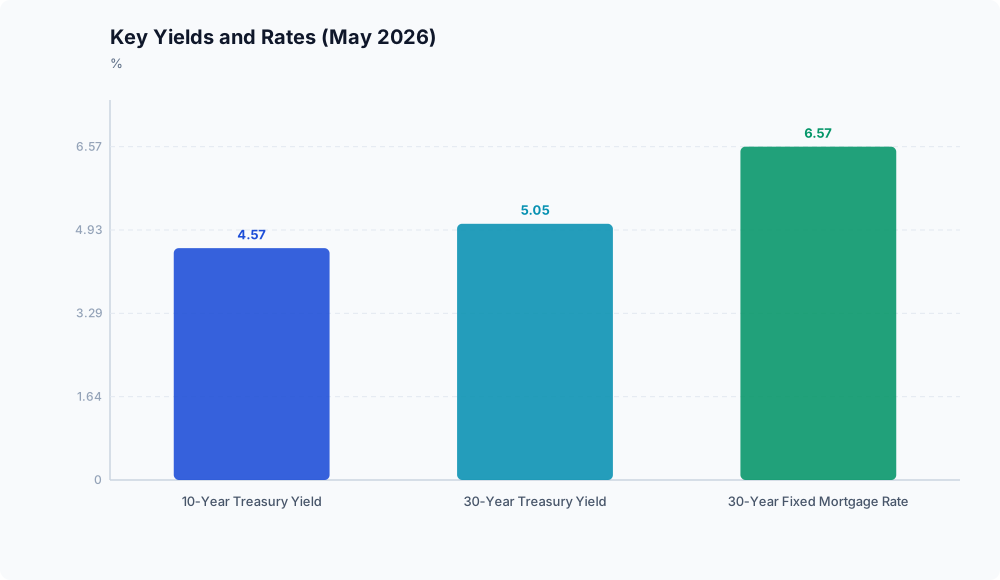
A key indicator of the bond market’s repricing is the U.S. Treasury’s May 15, 2026, auction. The government issued $25 billion of 30-year bonds at a yield of 5.05%, according to UPI. Crossing the 5% threshold at auction for the first time in nearly two decades alters the financial models that have underpinned recent real estate expansion.
In the secondary market, yields also increased. As reported by UPI, the 30-year yield reached 5.12%, a level last recorded on May 22, 2025. The benchmark 10-year note rose more than 11 basis points to 4.57%, and the two-year note increased to 4.08%.
These sovereign debt movements affected consumer credit. By mid-May 2026, the 30-year fixed mortgage rate climbed to approximately 6.57%, offsetting roughly 50 basis points of rate reductions buyers had seen since late February, according to Better.
Tracking this shift involves navigating varying data sources, as market volatility can lead to reporting discrepancies. Point-in-time quotes from different financial institutions reveal a fragmented data landscape. For example, while UPI reported the 10-year yield at 4.57%, Better cited a weekly peak range of 4.45% to 4.47%. Similarly, mortgage rates were quoted between 6.497% and 6.57%. These variances highlight the fluctuations of intraday trading during macroeconomic events, indicating that investors may need to treat these figures as directional indicators.
| Period | 30-Year Fixed Mortgage Rate | Volatility & Source Conflicts |
|---|---|---|
| Late February 2026 | Early-year low | Baseline borrowing costs before inflation data reversed the trend. |
| Mid-May 2026 | 6.57% (Six-week high) | Better reports 6.57% while others cite 6.497%; source timelines occasionally conflict and data remains volatile. |
The convergence of 6% wholesale inflation, 5% long-term government borrowing costs, and 6.5% mortgage rates presents a restrictive environment for U.S. economic growth, suggesting the market is pricing in structural inflation rather than transient demand fluctuations.
Scenarios: Navigating the Affordability Cliff and Refinancing Wall
The trajectory of domestic real estate capital markets now depends less on traditional housing policy and almost entirely on global inflation dynamics. Market participants must prepare for three distinct scenarios.
The Base Case: A Sustained “Higher-for-Longer” Environment If current geopolitical tensions continue, the base case involves a sustained high-yield baseline. In the residential market, average 30-year fixed mortgage rates near 6.57% will limit residential mobility. Existing homeowners may retain their older, lower-rate mortgages, constraining available housing supply and lowering transaction volumes. For Commercial Real Estate (CRE), this scenario presents broad refinancing challenges. Property owners facing debt maturities will need to inject equity to secure refinancing, as debt service coverage ratios decline under higher interest expenses. Those unable to bridge this capital gap may transfer assets to lenders, increasing distressed sales.
The Downside Scenario: Escalation and Asset Repricing The duration and economic impact of the conflict with Iran remain uncertain, as noted by UPI. If geopolitical tensions accelerate inflation further, bond yields may rise to compensate for the changing purchasing power of the dollar. A move toward 6% on the long end of the curve would lead to systemic asset repricing. Highly leveraged real estate investment trusts (REITs) and private portfolios could face liquidations if this structural shift alters their supporting capital structures.
The Upside Scenario: De-escalation and Yield Curve Stabilization An upside scenario depends on the resolution of overseas conflicts. If inflationary pressures from the Middle East subside and global supply chains normalize, the producer price index would cool. According to UPI, this would provide newly confirmed Federal Reserve Chair Kevin Warsh the latitude needed to stabilize the yield curve. If the 10-year and 30-year Treasury yields retreat from their mid-2026 peaks, it could increase activity in the residential housing market and provide a window for CRE operators to restructure debt.
What to Watch Next: Leading Indicators for the New Regime

Market participants are shifting focus from traditional Fed dot plots to real-time inflation and geopolitical indicators. The mechanics of the next rate move are increasingly influenced by the long end of the yield curve, making specific data points relevant for forecasting.
- Energy Futures and Upcoming CPI/PPI Releases: Because the drivers of inflation have shifted to geopolitical supply factors, energy futures serve as a leading indicator for inflation reports. Further military escalation will likely affect future prints, influencing the near-term ceiling for interest rates.
- Federal Reserve Commentary: With Kevin Warsh newly confirmed as Fed Chair on May 13, 2026, his upcoming commentary is a key indicator, as reported by UPI. Investors will monitor how Warsh addresses the long end of the curve. If he signals tolerance for 5% long-term yields, it may implicitly tighten financial conditions without requiring a formal hike to the federal funds rate.
- Mortgage Rate Stability: Sustained mortgage rates above 6.5% risk limiting housing inventory and prompting localized price corrections. Monitoring weekly averages will indicate whether consumer affordability constraints are worsening.
- Regional Bank Earnings and CRE Loan Performance: The higher rate environment poses challenges to CRE debt maturity schedules. Specific data regarding impending CRE defaults in this immediate cycle remains limited. Investors monitor regional bank earnings, as these entities hold much of the maturing commercial debt, serving as an early indicator for broader sector performance.
Conclusion
The recent Treasury Yield Spike indicates that real estate markets face an extended adjustment period. Current data demonstrates that long-end rates, influenced by exogenous geopolitical events and 6% wholesale inflation, are operating independently of the Federal Reserve’s primary policy levers. This shift suggests that capital is structurally more expensive. Market participants may need to prioritize short-duration, cash-flowing assets over growth equities or highly leveraged real estate that rely on lower-cost debt. Until the drivers of supply-side inflation are resolved, investors should account for potential asset repricing as the market adjusts to a 5% long-term yield environment.
Disclaimer: This analysis is for informational purposes only and does not constitute investment, financial, real estate, or legal advice. Always consult a licensed financial advisor before making investment decisions.
FAQ
How does the 30-year Treasury bond crossing 5% directly affect my mortgage rate? Mortgage rates are linked to long-term Treasury yields, primarily the 10-year note, which moves in tandem with the 30-year bond. When bond investors demand higher yields to compensate for inflation and risk, lenders correspondingly raise mortgage rates to maintain their margins. This dynamic recently moved 30-year fixed mortgage rates up by roughly 50 basis points to approximately 6.57%.
Why are long-end Treasury rates currently driving market conditions instead of the Federal Reserve? The current inflation increase is driven by geopolitical supply factors, such as the war with Iran, rather than an overheated domestic economy. Because the Federal Reserve’s traditional tooladjusting short-term overnight ratescannot address global supply chains, bond investors are demanding higher term premiums on long-term debt to protect against inflation. This steepens the yield curve and sets borrowing costs independently of the Fed’s short-term rate decisions.
What does the increase in borrowing costs mean for commercial real estate refinancing this year? It introduces a refinancing hurdle. Commercial property valuations are anchored to capitalization rates, which must maintain a risk premium over Treasury yields. With the 10-year Treasury rising to 4.57%, properties financed during the sub-4% era face higher capital costs upon maturity. Property owners may need to inject equity to meet lower debt service coverage ratios or risk transferring their assets to lenders.