
2026 Equities: Consumer Spending & Inflation Outlook
Navigating the 2026 Macroeconomic Tightrope: Consumer Spending & Inflation, Tariffs, and AI Concentration Risk
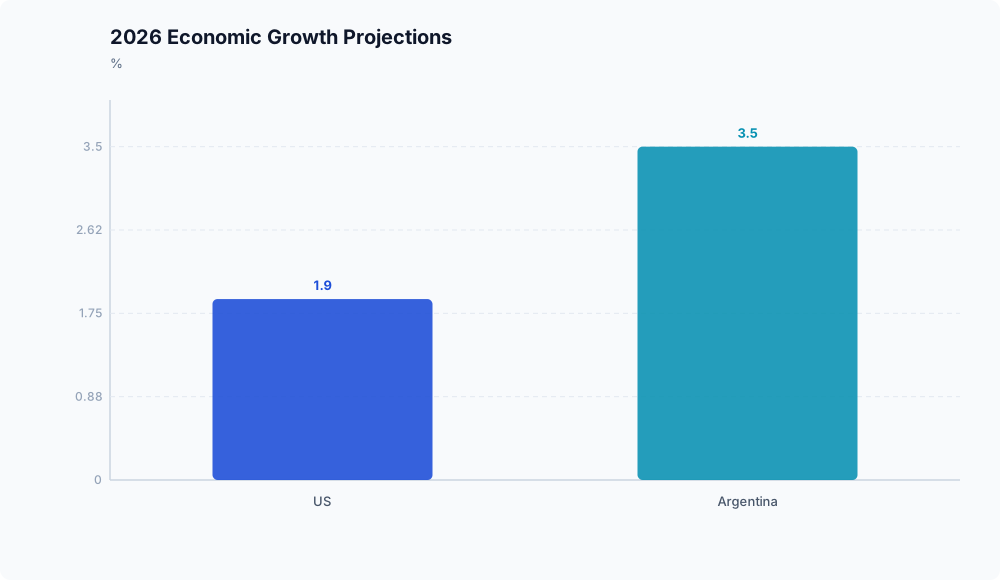
The trajectory of US equity markets in the coming year hinges on a delicate macroeconomic balancing act, rather than on broader international stabilization. At the core of this equilibrium is the complex interplay between Consumer Spending & Inflation, which will ultimately dictate whether the US economy achieves a soft landing or faces structural headwinds. Investors are currently forced to navigate an environment where domestic resilience depends on sustaining a 1.9% US economic growth rate in 2026, as projected by the Deloitte Global Economic Outlook 2026.
However, this growth is concentrated in specific driversnamely, retail consumption and artificial intelligence capital expenditureswhile being actively threatened by emerging policy frictions. As the delayed impacts of recent protectionist trade policies begin to materialize, the thesis for continued equity outperformance relies on whether these targeted growth engines can outpace newly introduced inflationary pressures. The era of passive, broad-market momentum may be concluding; the market appears to be entering a regime that demands rigorous fundamental analysis and highly selective capital allocation.
The Tariff Transmission Chain: From Policy to Margin Compression
The implementation of US tariff policies in 2025 has set the stage for a structural realignment of global trade, with disruptive effects expected to materialize throughout 2026. This is not merely a temporary logistical hurdle; it could act as a catalyst for a distinct macroeconomic regime shift. The transition away from cost-optimized global sourcing toward higher-cost, resilient supply networks introduces a new layer of friction into the production process.
To understand the market impact and the resulting second-order effects, investors should map this transmission chain as a cascading series of economic events:
- The Policy Shock (The Event): The transmission begins with the enactment of the 2025 tariffs. According to macroeconomic projections from the Deloitte Global Economic Outlook 2026, these trade barriers are acutely impacting specific heavy industries, most notably the auto and steel sectors. Companies are pressured to accelerate the diversification of their supply chains and seek non-US trade partnerships.
- The Margin Squeeze (The Mechanism): As companies scramble to reconfigure their supply networks, the immediate second-order effect is a potential surge in raw material and component costs. This strikes the second domino: a squeeze on corporate profit margins. Manufacturers must initially absorb this supply chain price shock, threatening to reverse recent disinflationary trends and alter corporate cost structures.
- The Inflationary Pass-Through (The Market Effect): Unable to sustain compressed margins indefinitely, companies may eventually pass these elevated costs down to the end buyer. This structural reorganization inherently raises input costs, signaling a potential resurgence of localized inflationary pressures, as outlined in the Deloitte Global Economic Outlook 2026.
- The Volume Test (The Ultimate Impact): Finally, this inflationary pressure strikes the last and most critical dominothe US consumer. This tests their willingness and capacity to absorb higher prices without reducing overall purchasing volume. If tariff-driven inflation outpaces wage growth, consumers will likely prioritize essential goods, potentially forcing a volume contraction in discretionary retail sectors.
This transmission chain directly threatens the primary engine of the US economy. If companies choose to absorb the tariff costs to maintain market share rather than passing them on, the resulting earnings recession could trigger corporate cost-cutting measures, including labor reductions. Either scenario presents a headwind for an economy that is expected to see fading momentum from post-shutdown government worker pay.
Verifiable Data vs. Forward Projections: The Global Divergence
Global markets are currently navigating a divergence between institutional stability in Europe and projection-heavy economic narratives in the United States. Recent data highlights a clear contrast: the European Union is producing verified historical metrics of structural consolidation, while the US economic outlook relies heavily on forward-looking estimates centered around technology investments.
For US investors, this creates a complex environment where domestic growth is increasingly dependent on corporate capital expenditures rather than broad-based macroeconomic expansion. Understanding the reliability of these underlying data points becomes essential for asset allocation.
| Metric Category | Data Point | Status / Reliability | Market Implication |
|---|---|---|---|
| EU Border Security | 26% decrease in illegal crossings (2025) | Verified Historical Data | Reduces immediate social/financial strain on member state budgets. |
| EU Immigration | 28% return rate (10-year high) | Verified Historical Data | Signals structural stabilization and administrative efficiency. |
| EU Climate Resilience | 144M disaster recovery mobilization | Verified Historical Data | Shifts capital from crisis management to predictable fiscal deployment. |
| US Economic Growth | 1.9% GDP growth projected for 2026 | Forward-Looking Projection | Highly dependent on uninterrupted consumer spending and AI capex. |
| US Consumer Trend | H2 2026 slowdown due to fading stimulus | Forward-Looking Projection | Vulnerable to stretched equity valuations and wealth effect contraction. |
The European Union is demonstrating measurable macro stability. According to the 2026 State of Schengen Report by the European Commission, the EU achieved a 26% decrease in illegal border crossings in 2025 alongside a 10-year high return rate of 28% for individuals without a right to stay. This structural stabilization allows European institutions to redirect capital toward long-term resilience. For example, the European Commission proposed a 144 million European Union Solidarity Fund mobilization for climate disaster recovery in Spain, Romania, and Cyprus. While these developments offer little direct insulation for US indices, they signal a European environment that is transitioning to predictable fiscal deployment, offering a stable foundation for European equities.
Conversely, the United States economic narrative reveals underlying vulnerabilities. The foundation of the 1.9% growth projection rests on artificial intelligence investments and consumer spending, as noted in the Deloitte Global Economic Outlook 2026. However, the underlying data remains opaque. Specific, verifiable economic indicators detailing the exact health of the US consumer for the critical April-May 2026 period are currently limited, requiring analysts to treat baseline spending projections with caution.
Furthermore, while the full effects of the 2025 US tariff moves are expected to materialize in 2026, the Deloitte Global Economic Outlook 2026 indicates that hard evidence regarding their immediate inflationary impact remains limited. Projecting the exact pricing pressure on the US consumer without verifiable inflation data for the current period is speculative.
Macroeconomic Scenarios for 2026: Navigating a Narrowing Window
As 2026 progresses, the macroeconomic environment could become increasingly restrictive for equity valuations. Elevated valuations inherently assume flawless macroeconomic execution, leaving the broader market vulnerable to the margin compression generated by the tariff transmission chain.
The Base Case: Deceleration and Active Rotation The baseline trajectory assumes the US economy achieves its 1.9% growth rate, sustained by consumer resilience and AI investments. However, the Deloitte Global Economic Outlook 2026 forecasts US economic growth to slow notably in the second half of the year as temporary catalysts, including the boost from post-shutdown government worker pay, begin to fade. Furthermore, the same outlook anticipates historically high stock valuations will limit broader equity market gains going forward. This convergence of slowing baseline growth and stretched multiples suggests that passive, broad-market index investing may yield diminishing returns. Investors might need to pivot toward rigorous sector rotation, focusing on companies with pricing power capable of withstanding margin compression.
The Upside Scenario: Rapid Disinflation and Broadening Rallies An upside scenario centers on the potential for inflation to cool more rapidly than consensus estimates, despite the frictions associated with tariff disruptions. If supply chain diversification proves efficient and domestic price pressures subside, real consumer purchasing power could experience a meaningful boost. This would directly reinforce the consumer spending pillar of the 2026 forecast, potentially offsetting the anticipated second-half economic slowdown. For the equity market, such an environment could broaden the rally beyond the technology sector, lifting mid-cap stocks and consumer cyclicals that have been historically constrained by higher interest rates.
The Downside Scenario: The AI Capex Contraction The concentration of global business capital in AI and related technologies introduces a structural vulnerability to the market. A slowdown or correction in this specific spending poses a downside risk to overall US economic growth, according to the Deloitte Global Economic Outlook 2026. If corporate adoption of AI fails to generate the near-term productivity gains required to justify massive infrastructure investments, capital expenditures could contract. Because the exact timing and likelihood of an AI investment plateau remain uncertain, market participants should recognize that any tech sector contraction could drag down broader index performance.
To mitigate this risk, US investors might need to look beyond domestic borders for portfolio stabilization. Allocating capital to regions with uncorrelated growth drivers could provide downside protection if the US AI narrative falters. As highlighted in the Deloitte Global Economic Outlook 2026, such regions include Argentina, with a projected 3.5% expansion fueled by falling inflation and energy investments, or China, which is seeing a moderating 4.5% growth amid property market corrections.
What to Watch Next: Concrete Indicators for H2 2026

Navigating this environment requires a pivot from broad index reliance to targeted, fundamental analysis. Investors should preemptively position their portfolios for the anticipated second-half slowdown in 2026 by monitoring the following indicators:
- Forward Guidance on AI Capital Expenditures: Investors should closely monitor upcoming corporate earnings reports, specifically scrutinizing forward guidance on AI budgets. Any downward revision in corporate capex budgets could disproportionately impact tech hardware firms and semiconductor manufacturers. Hesitation in tech spending may serve as a leading indicator for a broader macroeconomic deceleration.
- Producer Price Index (PPI) for Raw Materials: To measure the second-order effects of tariff disruptions, investors should track sector-specific price indices. Companies operating directly in the auto and steel sectors, or those heavily reliant on imported intermediate goods, will likely be the first to experience a margin squeeze. A rising PPI may signal that the friction of supply chain transition is actively compressing corporate margins.
- High-Frequency Retail Sales Data: Because specific economic indicators for the critical April-May 2026 period are unverified, investors must rely on high-frequency retail sales and consumer confidence metrics. A sustained miss in retail sales could signal that the consumer pillar of the 1.9% growth projection is beginning to fracture under the weight of tariff-induced inflation and a cooling labor market.
- Global Growth Divergence: Monitor international baseline metrics to contextualize broader supply chain and demand trends. Key markers include China’s ability to maintain its 4.5% growth target amid property market stabilization, and Argentina’s execution of its projected 3.5% expansion, both detailed in the Deloitte Global Economic Outlook 2026.
Conclusion

The macroeconomic narrative for 2026 is defined by a reliance on concentrated growth engines operating against a backdrop of structural frictions. The protective buffer of post-pandemic government spending is fading, and the underlying strength of corporate profit margins is being exposed to the friction of a deglobalizing economy. Ultimately, the linchpin holding this equilibrium together is the US consumer.
If the dual pillars of Consumer Spending & Inflation fall out of balancewhether through tariff-driven price shocks outpacing wage growth or a contraction in the wealth effect driven by stalled AI investmentsthe projected 1.9% growth rate could deteriorate. The margin for error in current equity valuations appears narrow. Investors may no longer be able to rely on passive, broad-market momentum; navigating the 2026 market regime requires scrutiny of corporate pricing power, active sector rotation, and a vigilant watch over real-time consumer data to determine whether the US economy will achieve its anticipated soft landing.
Disclaimer: This analysis is for informational purposes only and does not constitute investment, financial, real estate, or legal advice. Always consult a licensed financial advisor before making investment decisions.
FAQ
How will the newly implemented US tariffs impact consumer spending and inflation in the next 12 months? The 2025 US tariffs are prompting companies to diversify supply chains away from cost-optimized global sourcing toward higher-cost networks, impacting sectors like autos and steel. This raises raw material and component costs. If companies pass these elevated costs onto buyers, it could reignite retail inflation. If this tariff-driven inflation outpaces wage growth, consumers may prioritize essential goods, leading to a contraction in discretionary retail spending.
Why is a potential slowdown in AI business investments considered a major downside risk to global economic growth? Global business capital is currently concentrated in artificial intelligence and related technologies, making it one of the primary pillars supporting the projected 1.9% US economic growth in 2026. Because the broader economy relies heavily on this specific sector, any slowdown or correction in AI spending could disproportionately drag down overall index performance and remove a critical engine of macroeconomic expansion.
How does the projected 1.9% US economic growth for 2026 factor into current equity market valuations? The projected 1.9% growth rate is expected to slow in the second half of 2026 as temporary catalysts, like post-shutdown government worker pay, fade. Currently, stock valuations are historically high, which inherently assumes flawless macroeconomic execution. This convergence of slowing baseline growth and stretched multiples is anticipated to limit broader equity market gains, making the market vulnerable to negative surprises in earnings or consumer retail spending.
What role do global macro events, such as EU border stabilization and climate disaster recovery, play in US market resilience? While global regions are exhibiting signs of structural repairsuch as the EU’s 26% decrease in illegal border crossings and its 144 million mobilization for climate disaster recoverythese developments offer little direct insulation for US indices. However, they do provide a contrast to the projection-heavy US narrative, signaling a potential stable foundation for European equities that US investors might utilize for portfolio stabilization and diversification if domestic growth falters.