
Fed Funds Rate Stabilization: A New Real Estate Baseline
The New Baseline: Navigating the Era of Fed Funds Rate Stabilization
The Federal Reserve’s decision during its late April 2026 meeting to maintain its benchmark federal funds rate at a target range of 3.50% to 3.75% fundamentally alters the strategic landscape for real estate investors. For the past several years, market participants have been trapped in a reactive posture, constantly adjusting financial models for aggressive monetary tightening. Now, the arrival of definitive Fed Funds Rate Stabilization marks a profound psychological and operational shift.
Instead of waiting for aggressive rate cuts to rescue underperforming assets, investors and homebuyers must underwrite deals based on a stabilized, elevated cost of capital. This plateau ends the severe rate volatility of recent years, establishing a predictable baseline as reported by Fortune. For US investors, success now relies on precise, asset-level operational strategies rather than timing macroeconomic swings. The era of relying on falling rates to organically compress capitalization rates is officially on pause.
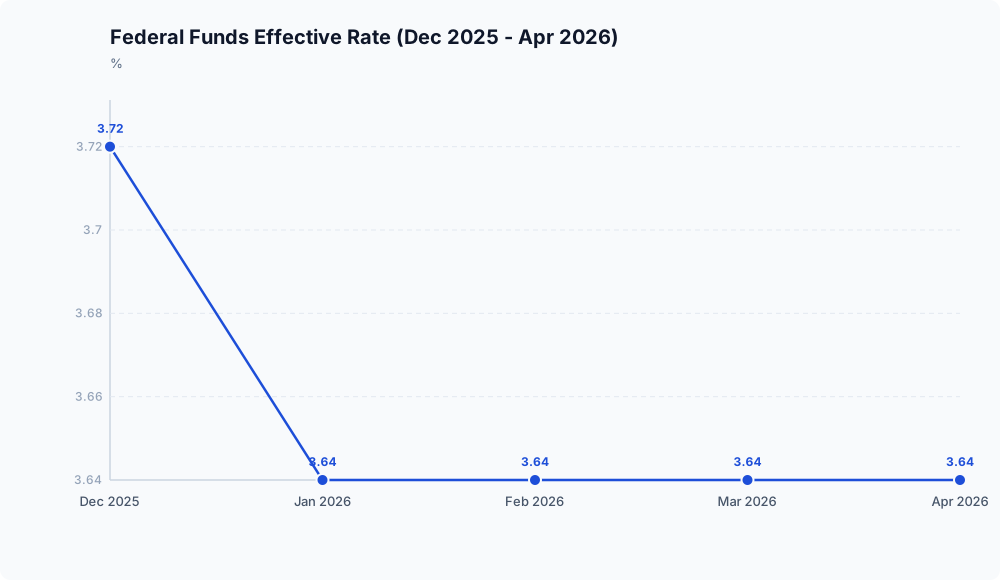
Macroeconomic data firmly supports this transition, stripping away the uncertainty that previously paralyzed transaction volumes. Following a slight dip from 3.72% in December 2025, the Federal Funds Effective Rate held completely flat at 3.64% through January, February, March, and April 2026, according to FRED | St. Louis Fed. This four-month streak of consistency signals the central bank is comfortable with current economic conditions and unwilling to introduce new liquidity prematurely.
To visualize this shift, picture a rugged mountain trail abruptly giving way to a high-altitude plateau. The steep upward slopes represent the aggressive rate hike cycles of previous years. Now, the trail has leveled onto a sustained mesa anchored at the 3.64% effective rate mark. While capital remains relatively expensive compared to the pre-2022 zero-interest-rate environment, the ground is finally flat. This predictability allows market participants to survey the competitive landscape and allocate capital with a clearer line of sight into future borrowing costs.
The Capital Cost Transmission Chain
The Federal Reserve’s decision to hold its benchmark federal funds rate at 3.50% to 3.75% during its April 28-29, 2026 meeting anchors the broader capital cost transmission chain, according to Fortune. By freezing the overnight rate, the central bank has removed the extreme short-term volatility that previously complicated long-term debt underwriting.
This predictable short-term cost of capital is highly consequential. It allows financial institutions to shift focus from guessing the central bank’s next pivot to accurately pricing duration and credit risk. A stable baseline at the short end of the yield curve acts as the foundational variable for pricing everything from consumer housing debt to institutional commercial real estate.
The mechanics of how this policy decision flows through the broader economy can be mapped through a distinct sequence of capital cost adjustments. By tracking the flow of capital from the central bank to the end borrower, investors can better anticipate where pricing pressures will emerge next.
The following table breaks down this step-by-step transmission from the central bank’s overnight rate to consumer pricing and institutional underwriting:
| Transmission Stage | Market Mechanism | Direct Impact on Asset Pricing |
|---|---|---|
| 1. Policy Anchor | Fed maintains overnight rate at 3.50%3.75%. | Stabilizes banks’ short-term borrowing costs at a 3.64% effective rate. |
| 2. Risk Premium Compression | Lenders price long-term debt with less volatility. | Stabilizes 30-year mortgage spreads near the 6.3%6.5% threshold. |
| 3. Consumer Adaptation | Homebuyers accept the predictable rate baseline. | Conventional purchase activity normalizes despite higher absolute costs. |
| 4. Institutional Underwriting | Risk-free baseline dictates minimum required yields. | Establishes a firm, mathematically rigid floor for CRE cap rates. |
The Mechanism of Risk Premium Compression
This stabilization mechanism is immediately visible in the residential mortgage market, where lenders use a predictable baseline to manage risk premiums. Following the Fed’s rate freeze, the average interest rate for a 30-year fixed-rate conforming mortgage stood at 6.348% on May 1, 2026, before drifting upward to 6.46% by May 12, as reported by Fortune and WSJ.
While the absolute rate drifted upward, the underlying spread mechanism remains intact. Lenders no longer need to bake aggressive uncertainty premiums into 30-year products to hedge against surprise Fed hikes. Controlled movement in the 6.3% to 6.5% range suggests capital markets have digested the Fed’s terminal rate trajectory. For secondary market investors, this implies lower prepayment or default risks, stabilizing mortgage-backed securities.
Institutional Underwriting and the Cap Rate Floor
Beyond residential housing, the 3.50% to 3.75% target range establishes a rigid mathematical floor for commercial real estate (CRE) valuations. Standard institutional underwriting dictates that commercial properties must yield a risk premium above this risk-free baseline.
With short-term capital costs frozen at this elevated tier, CRE cap rates are structurally prevented from compressing to pre-tightening lows. Property values must remain suppressed to generate the higher cap rates required by the current environment. Until the Federal Reserve signals a definitive downward shift, this capital cost floor will constrain broad-based appreciation in CRE assets.
Highest-Signal Evidence: Divergence and Demand Destruction
Late April and early May 2026 data reveals a stark divergence between anchored short-term monetary policy and drifting long-term borrowing costs. The Federal Reserve maintained its federal funds target range at 3.50% to 3.75% during its April 2829 meeting. This extended a period where the effective rate held flat at 3.64% from January through April, according to Fortune and FRED | St. Louis Fed.
Despite this stability at the short end of the curve, 30-year fixed mortgage rates trended steadily upward. The average 30-year conforming rate sat at 6.348% on May 1, climbed to 6.46% by May 12, and reached 6.47% by May 15, as reported by Fortune, WSJ, and MSN. This widening spread indicates bond markets are pricing in a higher term premium or persistent inflation risks, tightening consumer financial conditions.
Measuring Demand Destruction in Real Time
This upward drift in mortgage rates is generating measurable demand destruction. For the week ending April 24, total mortgage applications dropped 1.6%, driven by a 1.7% decline in refinance activity, according to Fortune.
The refinance contraction is a mechanical response to rising rates. However, the drop in overall applications signals a broader chilling effect on the housing pipeline. Prospective buyers are hitting an affordability ceiling, forcing them to delay purchases or lower target price ranges. For investors, this implies a persistently constrained housing supply as existing homeowners remain locked into cheaper mortgages.
The Rise of Alternative Financing Structures
As fixed-rate affordability deteriorates, consumers are turning to alternative financing. Adjustable-rate mortgages (ARMs) accounted for 8.3% of total mortgage applications during the week ending April 24, as noted by Fortune.
This rising ARM share serves as a late-cycle affordability valve, allowing buyers to secure lower initial payments while assuming future interest rate risk. While an 8.3% ARM share keeps transaction volumes from stalling entirely, it slowly embeds rate-reset vulnerabilities into household balance sheets.
The Conventional Purchase Anomaly
Despite shifts in application composition, the spring housing market’s trajectory remains ambiguous. A slight anomaly occurred in late April: despite the overall application drop and rising rates, conventional loan purchase activity picked up by almost 2%, according to Fortune.
This suggests a subset of well-capitalized buyers may be rushing to lock in rates out of fear borrowing costs will climb higher, or they are simply accepting the new reality for life-event transactions. Analysts must remain cautious whether this represents temporary capitulation or a durable floor in housing demand.
The Commercial Real Estate Reckoning
Simultaneously, the CRE sector is confronting a harsh reality as it approaches a massive wall of loan maturities scheduled throughout 2026. Previously, many sponsors utilized short-term extensions or floating-rate debt, hoping for deep rate cuts in 2026.
With the Federal Funds rate anchoring at 3.64% through April 2026, this “extend and pretend” playbook is no longer viable. Borrowers facing imminent maturities must underwrite refinancing efforts at elevated rates, often resulting in significant funding gaps. Without aggressive monetary easing, these operators face an immediate liquidity crisis.
This environment creates a stark bifurcation in the CRE market. Over-leveraged owners lacking fresh equity will increasingly face forced sales, foreclosures, or deed-in-lieu transactions. Conversely, well-capitalized operators and private equity funds are the primary beneficiaries. The stabilization of rates at 3.64% provides institutional buyers with the underwriting certainty they have lacked for three years.
Forward-Looking Scenarios: Mapping the Uncertainty

Navigating the remainder of 2026 requires investors to distinguish between verified historical plateaus and forward-looking macroeconomic inferences. Market participants must stress-test their portfolios against three distinct scenarios.
The Base Case: A Sluggish, Bifurcated Plateau
The Fed’s holding pattern defines the base case scenario, characterized by predictable but tight margins for CRE refinancing. For the residential sector, this translates to sluggish overall volume as high capital costs suppress inventory turnover.
The drop in overall applications paired with the 2% rise in conventional purchases suggests life-event buyers are capitulating to the new normal, according to Fortune. This creates a fragile floor on residential transaction volume. However, the 3.64% risk-free floor continues to mandate painful price discovery and equity wipeouts for over-leveraged CRE sponsors.
The Upside Scenario: Cooling Inflation and Rate Relief
An upside scenario emerges if inflation cools faster than anticipated. Even a modest reduction in the federal funds rate could trigger a disproportionate response from sidelined market participants.
The late-April uptick in conventional purchases implies a deep reservoir of latent buyer demand. If 30-year rates retreat below 6%, mortgage applications and refinance activity would likely accelerate. Furthermore, a lower cost of capital would allow CRE operators to recapitalize underwater assets and avoid forced liquidations.
The Downside Scenario: Persistent Inflation and Yield Spikes
Conversely, persistent inflation could force the Federal Reserve to abandon its pause and resume hiking. The recent climb in the 30-year fixed rate to 6.46% by mid-May demonstrates that upward yield pressure remains a credible threat, as noted by WSJ.
If borrowing costs surge further, the fragile floor under residential purchases would likely collapse. A rate spike would severely exacerbate CRE distress, transforming tight refinancing margins into widespread default events. The systemic risk of a CRE credit event remains elevated if the Fed is forced to tighten further.
What to Watch Next: Leading Indicators for the Summer Season
As the market pivots toward the summer buying season, the Fed’s decision to maintain its 3.50% to 3.75% benchmark sets a definitive baseline. Market participants must shift focus to secondary leading indicators to gauge future borrowing costs.
- The 10-Year Treasury vs. 30-Year Mortgage Spread: As of May 1, 2026, the average 30-year fixed-rate conforming mortgage stood at 6.348%, according to Fortune. A wider-than-normal spread against the 10-year Treasury indicates lenders are pricing in higher volatility. A narrowing gap would signal stabilizing conditions.
- ARM Application Percentages: With ARMs accounting for 8.3% of total applications in late April, tracking this share will reveal if the housing market is sustained by creative financing, as reported by Fortune. A spike above 10% would signal severe affordability strain.
- CRE Loan Delinquencies and Cap Rates: Prolonged exposure to a mid-3% federal funds rate places immense refinancing pressure on commercial properties. If CRE delinquencies tick upward, expect upward pressure on cap rates as valuations adjust downward.
- The Next Fed Data Release: Market participants will closely watch the Federal Funds Effective Rate data release scheduled for May 18, 2026, by FRED | St. Louis Fed for the next official pulse check on interbank lending costs.
Conclusion: Synthesizing the New Reality
The fundamental takeaway from the spring 2026 economic data is that the market has crossed a threshold into a durable, elevated steady state. Fed Funds Rate Stabilization is no longer a theoretical projection; it is the verified mathematical reality underpinning the entire real estate capital stack. The strategy of waiting for zero-interest-rate policy to return is obsolete.
In the residential sector, 6.3% to 6.5% mortgage rates are the new baseline. Buyers must prioritize long-term affordability, and sellers must accept reduced purchasing power. In the commercial sector, the 3.64% effective rate acts as a harsh cleansing mechanism. It permanently closes the “extend and pretend” era, forcing a transfer of assets from over-leveraged sponsors to well-capitalized buyers. Ultimately, this stabilized environment purges speculative excess. Moving forward, real estate returns will be generated by operators who excel at property-level management and precise underwriting rather than central bank easing.
Disclaimer: This analysis is for informational purposes only and does not constitute investment, financial, real estate, or legal advice. Always consult a licensed financial advisor before making investment decisions.
Frequently Asked Questions (FAQ)
Why are 30-year mortgage rates rising if the Fed Funds Rate has been flat at 3.64% for four months? While the Federal Reserve controls the short-term overnight borrowing rate, 30-year mortgage rates are tied to long-term bond markets. The upward drift to 6.47% indicates bond investors are pricing in higher term premiums or persistent inflation risks.
How does a stabilized Fed Funds Rate impact commercial real estate cap rates? It establishes a rigid mathematical floor for the “risk-free” cost of capital. Institutional investors require a risk premium above this baseline, meaning cap rates must remain elevated. With the effective rate flat at 3.64%, cap rates are structurally prevented from compressing, forcing property valuations downward.
What does the drop in late April mortgage applications signal for the summer housing market? The 1.6% drop in overall applications signals a chilling effect, indicating buyers are hitting an affordability ceiling. However, a simultaneous 2% increase in conventional purchases points to a bifurcated market where highly motivated buyers are still transacting.
Should I consider an Adjustable-Rate Mortgage (ARM) in a flat interest rate environment? ARMs accounted for 8.3% of applications in late April and offer lower initial payments. However, they introduce significant future interest rate risk in an elevated rate environment. Borrowers should only consider an ARM if they have a clear financial strategy for potential payment shocks or plan to sell before the fixed period expires.