
Consumer Spending & Macro Indicators: Retail Margin Squeeze
Consumer Spending & Macro Indicators: The Mid-May 2026 Retail Margin Squeeze
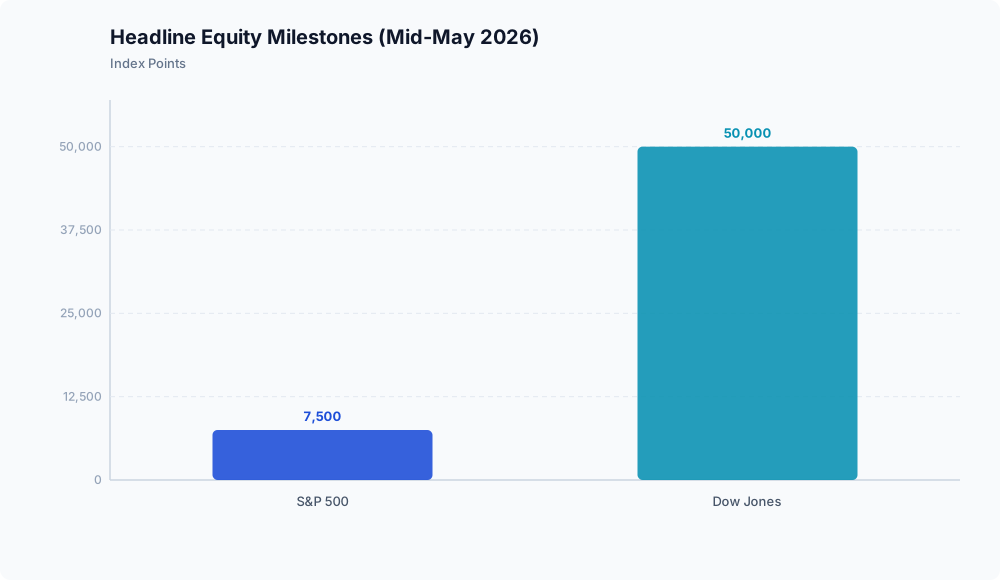
The mid-May 2026 trading environment presents US investors with a stark divergence between headline equity milestones and deteriorating fundamental realities. Broad market indices recently celebrated historic psychological levels. The S&P 500 closed above 7,500 for the first time, and the Dow Jones Industrial Average reclaimed the 50,000 mark, according to May 18, 2026 - Inflation Bites, But Wall Street Bites Back. Beneath this surface-level momentum lies a mounting threat to consumer discretionary and retail equities. A sudden acceleration in consumer and wholesale prices masks a highly challenging operational environment for consumer-facing businesses. To understand the true health of the economy, investors must look past index exuberance and focus on the underlying Consumer Spending & Macro Indicators. These metrics signal an impending margin squeeze that fundamentally alters the retail sector’s earnings outlook.
The primary catalyst for this shifting outlook is the unexpectedly sharp reacceleration of consumer and producer prices in April 2026. This data challenges the prevailing narrative of a smooth disinflationary glide path, forcing market participants to recalibrate corporate profit margin expectations. Investors should view the current economic landscape as a fragile balancing act where rising input costs threaten to overwhelm consumer resilience.
The Transmission Chain: From Wholesale Shock to Retail Margin Squeeze
The recent acceleration in wholesale inflation serves as the primary catalyst for an impending squeeze on retail profitability. The transmission chain from the factory floor to the retail checkout is bound by logistics, where energy costs compound rapidly.
Every product on a store shelf carries an embedded transportation cost highly sensitive to diesel and gasoline prices. As fuel prices surge, freight carriers and delivery services pass increased operating expenses onto retail distributors through aggressive fuel surcharges. Consequently, the massive monthly jump in wholesale prices acts as a leading indicator for the rising cost of goods sold (COGS) retailers will soon face.
This logistical friction means that even if baseline product costs remain stable, the landed cost of acquiring and moving inventory is expanding significantly. This dynamic forces retail executives into a painful binary choice, creating a classic margin squeeze. On one side, retailers face rising wholesale and transportation costs dictated by surging April producer data. On the other side is a rigid consumer price ceiling, constrained by shoppers battling their own rising living costs.
If a retailer absorbs these higher input costs to maintain market share, operating margins will be crushed. Conversely, passing costs onto an inflation-weary consumer risks severe demand destruction and declining sales volumes. For US equity markets, this margin dilemma presents a distinct threat to consumer discretionary valuations, leaving little room for error.
If companies compress margins to clear inventory, the fundamental earnings growth required to support elevated equity multiples will deteriorate. This transmission chain may spark a rotation out of retail equities as analysts downgrade forward earnings estimates.
Highest-Signal Evidence: The April 2026 Inflation Rebound
The April 2026 macroeconomic data reveals a distinct reacceleration of inflationary pressures. This provides the highest-signal evidence that structural price stickiness remains a formidable headwind. Consumer and producer price metrics both surprised to the upside, indicating the base cost to produce physical merchandise has abruptly steepened.
To provide clear context on the magnitude of this shift, the table below contrasts March and April inflation figures, as detailed in May 18, 2026 - Inflation Bites, But Wall Street Bites Back:
| Inflation Metric | March 2026 | April 2026 | Market Context |
|---|---|---|---|
| US CPI (YoY) | 3.3% | 3.8% | Sharp acceleration driven by energy |
| US PPI (YoY) | 6.0% | Reached a 3-year high | |
| US PPI (MoM) | 1.4% | 4-year high, exceeding 0.5% forecast |
The underlying drivers of this inflation rebound are highly concentrated, with energy costs playing a disproportionate role. According to May 18, 2026 - Inflation Bites, But Wall Street Bites Back, energy inflation accounted for over 40% of the 0.6% month-over-month CPI increase in April.
This acceleration was propelled by staggering year-over-year jumps of 54% in fuel oil and 28% in gasoline, as noted in May 18, 2026 - Inflation Bites, But Wall Street Bites Back. For market participants, this energy-driven inflation implies non-discretionary spending will increasingly crowd out discretionary purchases, acting as a direct tax on household balance sheets.
Second-order effects of these energy spikes are already materializing in producer data. The massive 1.4% monthly jump in the Producer Price Index nearly tripled the consensus expectation of a 0.5% rise. This indicates severe pipeline cost pressures, according to May 18, 2026 - Inflation Bites, But Wall Street Bites Back. When PPI growth materially outpaces CPI growth, businesses face acute input cost inflation that must either crush margins or be passed to consumers.
Despite glaring inflationary red flags, equity markets have largely ignored deteriorating price stability. Driven by momentum and structural megatrends, the S&P 500 and Dow Jones reached record highs, even as underlying index performance showed exhaustion. Despite record highs, the S&P 500 managed only a meager 0.13% weekly gain during the mid-May trading week. Meanwhile, the Nasdaq, Dow, and MSCI EAFE Index all recorded declines, as reported by May 18, 2026 - Inflation Bites, But Wall Street Bites Back.
This divergence highlights a market heavily reliant on specific growth engines rather than broad economic health. According to Deloitte Global Economic Outlook 2026: Key Insights, the US economy is projected to achieve a 1.9% growth rate for the year. This forecast assumes AI-related capital expenditures and persistent consumer spending can overpower the drag of rising energy and producer costs.
However, investors must separate the verified facts of the April inflation shock from the uncertain inference that AI investment and consumer resilience will permanently sustain expansion. While the 3.8% CPI and 6% PPI prints are hard data points, the assumption of an unbreakable US consumer remains a forward-looking hypothesis.
Forward Scenarios: Navigating the H2 2026 Retail Landscape
The US macroeconomic environment entering the second half of 2026 presents a complex backdrop for retail equities. Navigating this landscape requires balancing competing macroeconomic forces against historically high market valuations.
The Base Case: Mild Deceleration and Retail Bifurcation In the baseline scenario, overall US economic growth maintains its 1.9% trajectory for the year, but momentum wanes later on. Deloitte Global Economic Outlook 2026: Key Insights forecasts a distinct economic deceleration in H2 2026 as temporary stimulus from post-shutdown government worker pay increases fades.
Furthermore, the wealth effect generated by equity appreciation is likely reaching its natural limits. As consumers adjust to normalized income streams without the psychological buffer of rapidly expanding portfolio wealth, a mild retail earnings contraction is expected.
In this scenario, fundamental performance will bifurcate based on value proposition. Companies positioned to capture trade-down behavior from cost-conscious shoppers, such as Walmart and The TJX Companies, are structurally advantaged. Conversely, big-ticket home improvement retailers like The Home Depot and Lowe’s face higher vulnerability to delayed discretionary spending as budgets tighten. Market participants should anticipate moderate top-line pressure across the broader retail sector, necessitating a selective approach to equity allocation.
The Downside Scenario: Energy-Driven Stagflation The downside scenario hinges on the persistence of elevated energy costs threatening to engineer a damaging stagflationary environment. If volatile inflationary pressuresled by the 54% surge in fuel oil and 28% jump in gasolinepush the CPI above the 4% threshold, consumer discretionary spending could severely fracture.
Under the weight of sustained living costs, acute margin compression would sweep through retail equities. Companies would struggle to pass a 6% year-over-year rise in the Producer Price Index onto exhausted consumers. This dynamic would confirm the energy-driven inflation shock has breached the retail sector’s defensive moats, triggering a negative wealth effect as equity multiples contract.
The Upside Scenario: AI-Driven Margin Preservation An upside scenario for the retail sector relies heavily on the deflationary forces of technological integration. The broader US growth projection of 1.9% is actively powered by robust AI-related investments, as highlighted in Deloitte Global Economic Outlook 2026: Key Insights.
If retailers successfully deploy AI to optimize supply chain logistics, automate inventory management, and enhance targeted marketing, operational efficiencies could offset rising wholesale costs. Should productivity enhancements materialize rapidly enough to counter the 1.4% month-over-month PPI jump, retail margins could hold steady despite top-line deceleration.
What to Watch Next: Critical Triggers for Market Repricing

Moving forward, validating or refuting the H2 economic deceleration thesis requires a disciplined focus on leading indicators. Because the impacts of fading government pay boosts remain difficult to quantify precisely, investors must utilize upcoming consumer spending data and corporate guidance as critical signposts.
- May Retail Sales Data: Investors must monitor upcoming retail sales reports to determine if the April inflation spike has already begun to erode real consumer spending volumes. This will provide the first hard evidence of demand destruction.
- Q2 Forward Guidance: Actual earnings results from mid-May (Walmart, Home Depot, Lowe’s, TJX) serve as backward-looking scorecards. The true analytical value lies in corporate forward guidance. Market participants should scrutinize management commentary for signs of consumer trade-down behavior, shifting inventory dynamics, and the preservation of pricing power. If retail giants indicate an inability to pass along the recent 6% year-over-year PPI surge without sacrificing volume, defensive margin compression is underway.
- Crude Oil and Energy Trends: Tracking broader energy price trends will be vital to ascertain whether the April PPI and CPI spikes were transitory anomalies or the beginning of a structural inflationary wave. Sustained high fuel prices will ensure logistics costs remain a persistent drag on COGS.
Conclusion
The mid-May 2026 trading environment is defined by a precarious illusion: record-breaking equity valuations masking a deteriorating foundation of fundamental corporate profitability. While headline indices celebrate unprecedented milestones, the underlying Consumer Spending & Macro Indicators reveal a retail sector caught in a tightening vise. The severe 1.4% month-over-month surge in wholesale prices, driven by acute energy shocks, guarantees the cost of acquiring and moving inventory is rising. Simultaneously, a 3.8% consumer inflation rate ensures the end shopper has less disposable income to absorb passed-down costs.
Ultimately, broad-based retail index funds may underperform in the near term as margin compression takes hold. Investors can no longer rely solely on the momentum of the broader equity rally. Instead, they must look beyond surface-level revenue and scrutinize the underlying margin architecture of individual companies. The true winners in the second half of 2026 will be those rare enterprises capable of leveraging technological efficiency to absorb wholesale shocks, or those possessing the pricing power to navigate a structurally impaired consumer base.
Disclaimer: This analysis is for informational purposes only and does not constitute investment, financial, real estate, or legal advice. Always consult a licensed financial advisor before making investment decisions.
FAQ
How does the April 2026 PPI spike specifically impact retail equity earnings? The April 2026 Producer Price Index (PPI) surged by 1.4% month-over-month and 6% year-over-year, driven largely by energy costs. This spike increases the cost of goods sold (COGS) and logistical transportation expenses for retailers. If retailers absorb these costs, profit margins compress; if they pass costs onto consumers, they risk demand destruction and lower sales volumes.
Why is US economic growth projected to decelerate in the second half of 2026? According to Deloitte Global Economic Outlook 2026: Key Insights, US economic growth is expected to decelerate in the second half of the year as temporary stimulus from post-shutdown government worker pay increases fades. Additionally, historically high stock valuations may cap future equity gains, limiting the psychological “wealth effect” sustaining consumer spending.
What role are energy costs playing in the current consumer spending environment? Energy costs act as a direct, regressive tax on household balance sheets, crowding out discretionary purchases. In April 2026, energy inflation accounted for over 40% of the 0.6% month-over-month CPI increase, propelled by year-over-year jumps of 54% in fuel oil and 28% in gasoline.
Can AI-related investments offset the margin pressures in the consumer discretionary sector? Potentially. Robust AI-related investments can structurally alter corporate cost profiles. If retailers successfully deploy AI to optimize supply chain logistics, automate inventory management, and enhance targeted marketing, these operational efficiencies could help offset rising wholesale and transportation costs.