Tech Growth Masks US Housing and Commercial Real Estate Risks
The Great Divergence: How Tech-Driven Growth Masks Structural Risks in US Housing and Commercial Real Estate
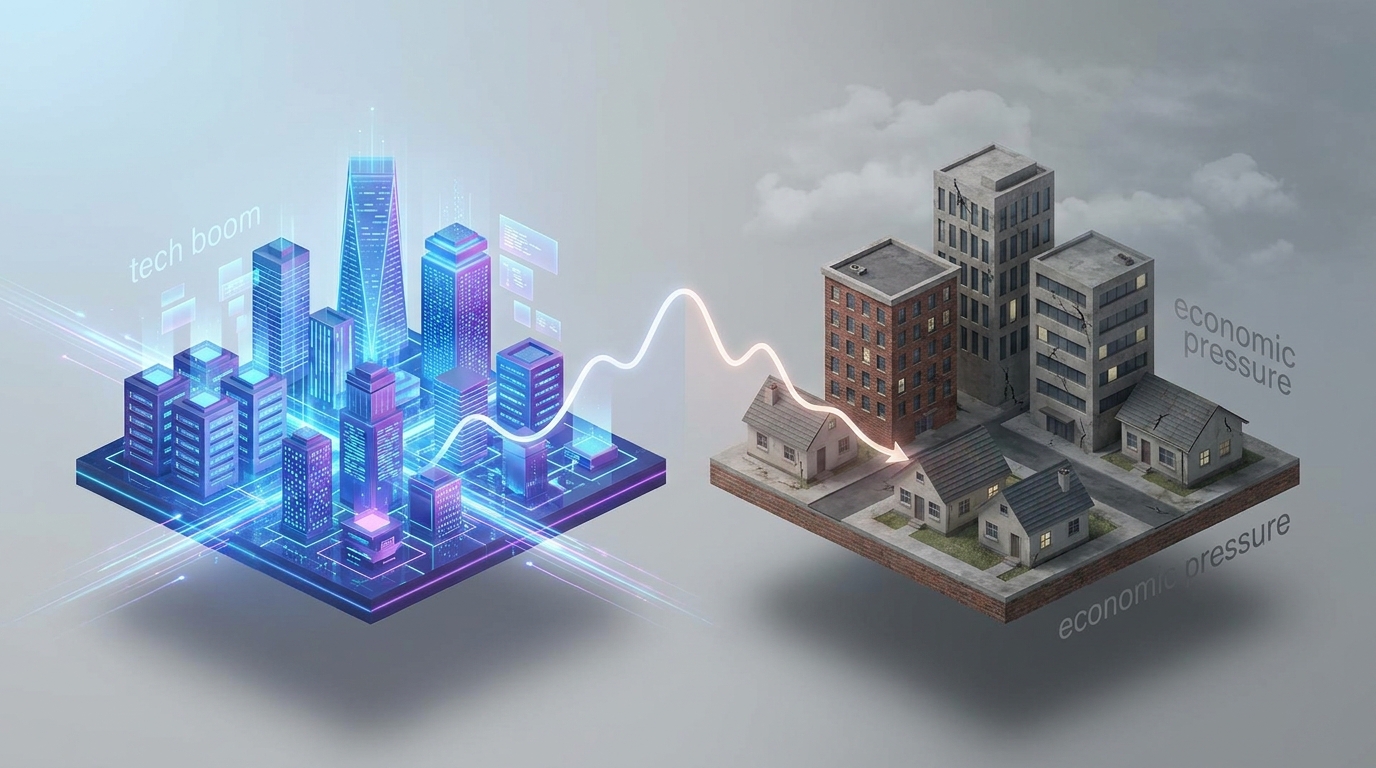
The US economy is currently experiencing a profound and bifurcated reality, one where headline economic strength effectively masks underlying structural fragilities. At the center of this divergence is a technology-driven gross domestic product (GDP) expansion that obscures persistent inflationary pressures from trade tariffs, surging energy costs, and escalating geopolitical conflicts. This recent economic decoupling fundamentally alters the landscape for US Housing and Commercial Real Estate.
Rising inflation expectations directly threaten housing affordability by keeping mortgage rates elevated, while simultaneously squeezing commercial real estate valuations through higher capitalization rates. As headline figures project an illusion of broad economic resilience, the underlying mechanics reveal a harsh new environment: capital is becoming structurally more expensive for physical asset classes. Consequently, investors must navigate a macroeconomy that disproportionately rewards capital-light or tech-adjacent sectors while actively penalizing traditional, debt-reliant real estate.
Picture a sprawling, newly constructed data center humming with the latest servers, standing in stark contrast to a half-empty suburban office park or a stalled residential development. This visual perfectly encapsulates the current economic imbalance. During recent periods, the entirety of the increase in US GDP was attributed exclusively to investment in information-processing equipment and software (Global Weekly Economic Update | Deloitte Insights).
Yet, this technological boom requires immense capital expenditure from the “Magnificent Seven” tech companies. While billions are funneled into artificial intelligence and software infrastructure, traditional real estate fundamentals are stagnating under the weight of capital scarcity. For investors, this signals a massive crowding-out effect where financing flows toward tech-driven growth rather than brick-and-mortar property development, setting the stage for a protracted period of tight liquidity and valuation compression.
The Transmission Chain: From Geopolitical Shock to Valuation Squeeze
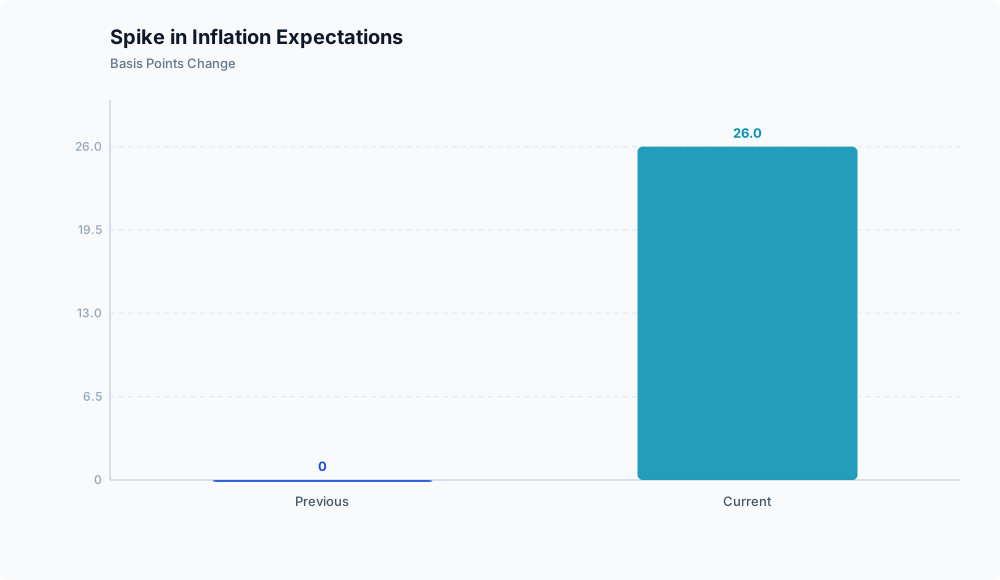
To understand how this macroeconomic shift translates into asset devaluation, we must map the current environment through a sequential, four-step inflation-to-valuation pipeline. The commercial real estate (CRE) sector is currently navigating a severe valuation squeeze triggered by a confluence of geopolitical friction and protectionist trade policies. Escalating conflicts in the Middle East have abruptly reversed the market’s disinflationary narrative, driving the five-year breakeven ratea key measure of bond investor inflation expectationsup 26 basis points to its highest level in recent periods (Weekly Global Economic Update | Deloitte Insights).
Simultaneously, the implementation of new trade barriers has created direct upward pressure on domestic costs, with the effects of tariffs on consumer prices becoming clearly visible in recent data (Global Weekly Economic Update | Deloitte Insights). For market participants, these dual supply-side shocks indicate that inflation is increasingly driven by structural, external factors rather than domestic demand.
The transmission mechanism unfolds as follows:
- Geopolitical and Trade Shocks: External conflicts and new tariffs trigger a spike in inflation expectations, evidenced by the 26-basis-point jump in the five-year breakeven rate (Weekly Global Economic Update | Deloitte Insights).
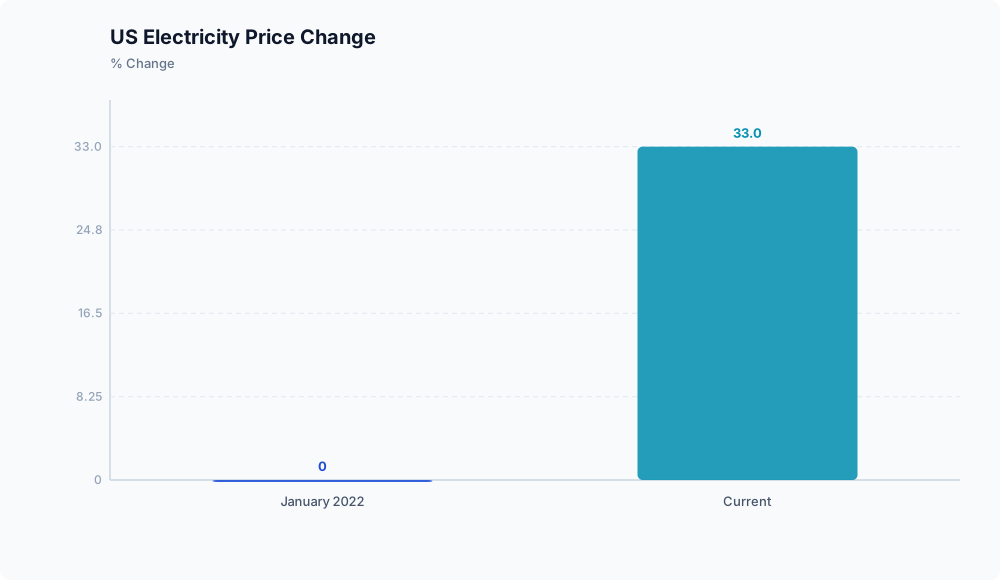
- Operational Costs Surge: This imported inflation compounds the pressure on property margins. For example, US electricity prices have climbed 33% since January 2022 (Global Weekly Economic Update | Deloitte Insights).
- Monetary Policy Hardens: Central banks respond by holding benchmark rates higher for longer. Recently, the US Federal Reserve’s policy committee voted 11 to 1 to keep the benchmark interest rate unchanged (Weekly Global Economic Update | Deloitte Insights).
- Valuations Compress: Sustained high borrowing costs force capitalization (cap) rates to expand. This mechanically lowers property valuations and freezes the debt refinancing pipeline for existing owners.
The second-order effects of this pipeline are particularly punishing for CRE operators facing near-term loan maturities. Because net operating income (NOI) is squeezed by operational expenses at the exact moment refinancing costs peak, property owners are increasingly trapped in a negative leverage scenario. Investors are forced to inject fresh equity to secure refinancing, or alternatively, surrender properties to lenders.
This dynamic implies that the coming quarters will likely see a sharp increase in distressed asset sales, as the math of refinancing simply no longer works for highly leveraged sponsors. The transmission chain from global instability to localized inflation is moving faster than historical norms, leaving investors with little time to adjust their portfolios.
Highest-Signal Evidence: The Affordability and Margin Squeeze
The housing affordability crisis and the CRE margin squeeze are increasingly shaped by the stark macroeconomic divergence between technology-driven capital expenditure and the deteriorating purchasing power of the average consumer. To understand the severity of this divergence, market participants must isolate the verified data points from their broader economic inferences.
| Metric | Verified Data Point (Deloitte Insights) | Economic Inference / Market Impact |
|---|---|---|
| Recent GDP Growth | 100% driven by tech/software investments. | Non-tech sectors are stagnating, capping broad wage growth for average homebuyers. |
| US Electricity Prices | Increased 33% from Jan 2022 to recent months. | Direct reduction in household discretionary income and CRE operating margins. |
| Power Generation | 90% of recently added capacity was wind/solar (Global Weekly Economic Update | Deloitte Insights). | Grid transition costs are likely passing through to end-user utility rates. |
While headline economic growth appears resilient, the underlying mechanics reveal a fragile foundation. The average homebuyer derives no immediate income benefit from corporate software investments, yet they bear the full brunt of significantly higher utility bills. This dynamic fundamentally alters debt-to-income ratios, disqualifying many buyers from mortgages even before factoring in elevated property prices.
The 33% spike in electricity prices extends its damage far beyond individual household budgets, actively threatening the commercial real estate sector. Surging energy costs directly compress NOI for multifamily and commercial properties, forcing landlords to either absorb the losses or pass them onto tenants through higher rents. Furthermore, while 90% of the added electric generating capacity in recent months involved wind or solar energy (Global Weekly Economic Update | Deloitte Insights), this transition has clearly not shielded consumers from utility price shocks. Until grid modernization scales sufficiently to lower end-user costs, energy inflation will remain a structural headwind for both renters and developers.
Compounding these pressures are emerging vulnerabilities within the US labor market. Recent data reveals a marked slowing in both the supply of and demand for workers, creating an unusual balance that suggests downside risks to employment are rising (Global Weekly Economic Update | Deloitte Insights). If the non-tech economy begins shedding jobs, the pool of qualified homebuyers and reliable commercial tenants will shrink further, exacerbating the strain on real estate markets. Interestingly, Federal Reserve Chair Jerome Powell noted in recent remarks that housing services inflation is actually on a downward trend. However, this deceleration in housing costs may reflect weakening consumer demand and affordability exhaustion rather than a healthy normalization of the broader housing market.
Scenario Analysis: Navigating Macroeconomic Ambiguity
The ultimate trajectory for real estate hinges on how the Federal Reserve responds to these conflicting signals of tech-driven growth and persistent inflation. Any capital allocation strategy over the next 12 to 18 months must navigate profound ambiguities regarding tariffs, energy costs, and geopolitical stability.
The Base Case: Sticky Inflation and Frozen Markets The base case for US real estate over the next 12 to 18 months centers on sticky inflation driven by structural shifts, which will keep mortgage and financing rates elevated. Tariffs are now visibly increasing consumer prices, and the energy transition continues to pass costs onto consumers (Global Weekly Economic Update | Deloitte Insights). Consequently, futures markets are currently pricing a 60% probability of zero rate cuts for the entirety of the coming year (Weekly Global Economic Update | Deloitte Insights). Under this sustained “higher-for-longer” rate environment, borrowing costs remain prohibitive. This dynamic will continue to depress CRE transaction volumes as buyers and sellers remain deadlocked on acceptable property valuations, and housing affordability will see no near-term relief.
The Upside Scenario: Tech Productivity Spillover Conversely, an upside scenario exists where massive technology investments translate into broader economic productivity and wage growth without reigniting inflation. If the concentrated capital expenditure in information-processing equipment successfully spills over into general wage growth, it could organically improve housing affordability by raising real consumer incomes. This optimism aligns with Federal Reserve Chair Powell’s recent observation that housing services inflation is already on a downward trend (Global Weekly Economic Update | Deloitte Insights). In this scenario, market participants could see a stabilization in residential real estate, where improved purchasing power absorbs existing inventory without forcing the Fed to aggressively hike rates again. However, evidence for this broad wage spillover remains thin, making this a lower-probability outcome.
The Downside Scenario: Stagflation and Widespread Defaults The most severe downside scenario involves a stagflationary environment triggered by geopolitical escalation and energy shocks, ultimately leading to widespread CRE defaults. If Middle East conflicts cause severe, sustained energy price spikes while the domestic labor market weakens, the US economy will face rising unemployment coupled with intractable inflation. Under these stagflationary conditions, the Federal Reserve would be paralyzedunable to cut interest rates to provide liquidity to struggling property owners due to high inflation. For the CRE market, this toxic combination of prohibitive refinancing costs, falling tenant demand, and sticky operational expenses would likely trigger a wave of defaults, particularly among highly leveraged syndications facing near-term debt maturities. Furthermore, the primary engine of US economic growth could stall abruptly if tech companies curtail investments to preserve cash.
What to Watch Next: Key Indicators and Triggers
Navigating the current real estate market requires investors and homebuyers to abandon historical seasonal patterns and instead monitor a specific set of macroeconomic triggers. The disconnect between hawkish market pricing and cautious central bank projections signals intense volatility ahead.
- Bond Market Inflation Expectations: This is the foremost leading indicator for long-term borrowing costs. Recent geopolitical tensions have driven the five-year breakeven rate up to its highest level in recent periods (Weekly Global Economic Update | Deloitte Insights). Market participants waiting to refinance or purchase should closely track geopolitical developments and their immediate pricing in bond markets, as these factors currently outweigh domestic housing metrics.
- Monthly Electricity CPI Data: Between January 2022 and recent months, US electricity prices surged by 33% (Global Weekly Economic Update | Deloitte Insights). Homebuyers must factor these permanently higher utility costs into their debt-to-income ratios, and CRE investors must underwrite lower net operating incomes. Electricity inflation could act as a stealth headwind against housing demand even if mortgage rates eventually stabilize.
- Tech Sector Capital Expenditures vs. Labor Market Health: Real estate investors should be cautious of markets overly reliant on tech-sector incomes. Any contraction in tech capital expenditures could trigger localized housing downturns (Global Weekly Economic Update | Deloitte Insights). Simultaneously, watch for further slowdowns in worker supply and demand, which raise downside risks to overall employment.
- Federal Reserve Commentary on Tariffs: The Fed has explicitly noted that the effects of tariffs on consumer prices are now clearly visible (Global Weekly Economic Update | Deloitte Insights). Buyers attempting to time the market should watch Fed press conferences specifically for shifts in how policymakers weigh tariff-driven inflation against housing disinflation. If imported inflation offsets domestic housing disinflation, restrictive monetary policy will persist.
- The Fed vs. Futures Market Disconnect: Recently, a majority of Fed committee members still predicted at least one rate cut before year-end, yet the futures market prices in a 60% probability that rates will remain unchanged through the coming year (Weekly Global Economic Update | Deloitte Insights). Investors should not treat future rate cuts as a foregone conclusion when underwriting property investments.
Conclusion

The era of relying on broad economic expansion to lift all physical asset classes has ended. The data clearly illustrates that headline GDP growth is being monopolized by technology and software investments, leaving traditional sectors starved of organic growth and wage expansion. Simultaneously, structural inflation driven by geopolitical instability, grid transition costs, and trade tariffs is keeping the cost of capital restrictively high. For participants in US Housing and Commercial Real Estate, this bifurcated reality means that defensive posturing is no longer optionalit is essential.
The analytical takeaway is clear: investors can no longer rely on central bank rate cuts to bail out compressed margins or rescue highly leveraged assets. Instead, success in this environment requires stress-testing portfolios against a prolonged elevated interest rate regime and structurally higher operating expenses. Capital will likely retreat from speculative value-add projects and float-rate debt, prioritizing assets with immediate, stable cash flows and long-term fixed financing. Until the inflationary pressures from tariffs and energy costs definitively subside, the real estate sector will remain the collateral damage of a tech-heavy, structurally expensive economy.
Disclaimer: This analysis is for informational purposes only and does not constitute investment, financial, real estate, or legal advice. Always consult a licensed financial advisor before making investment decisions.
FAQ
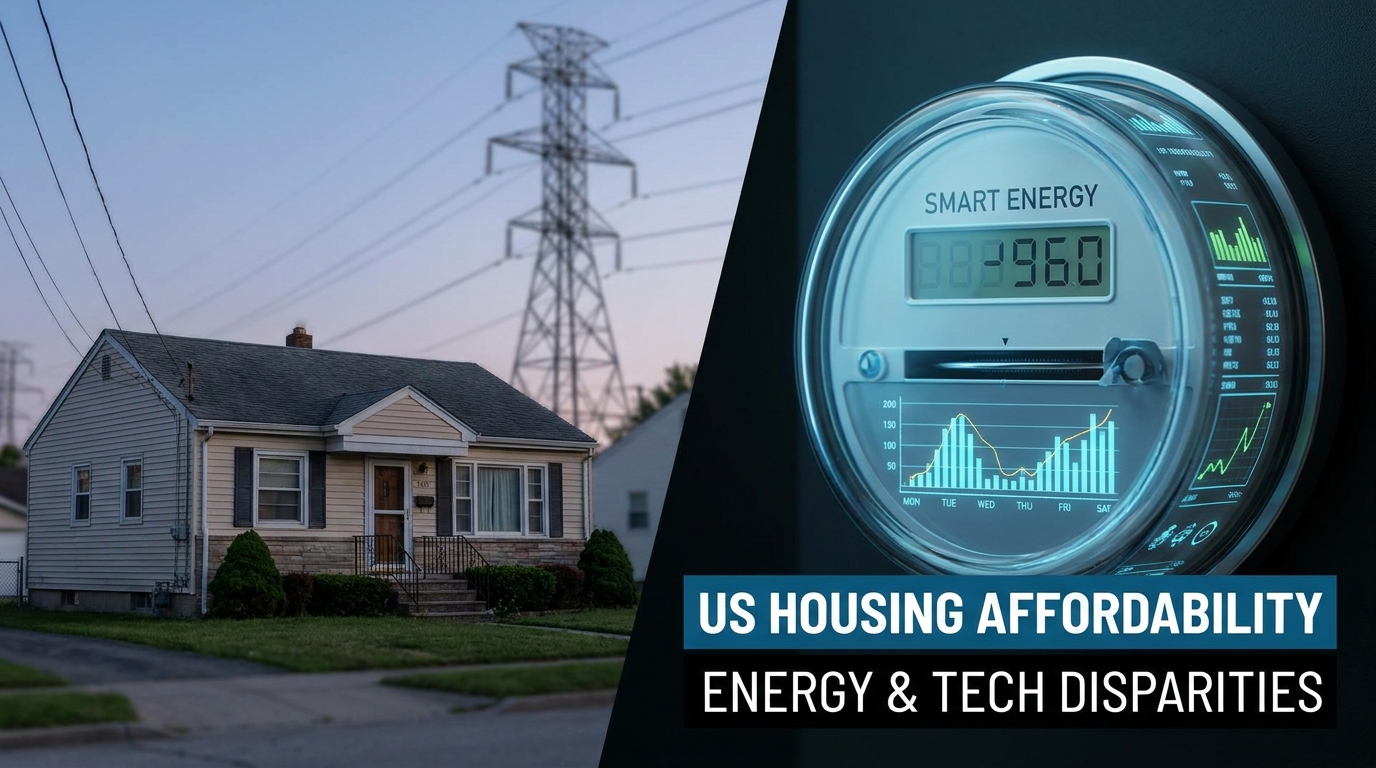
How do rising energy and electricity costs directly impact commercial real estate valuations? Rising electricity costswhich surged 33% between January 2022 and recent monthsdirectly increase the operational expenses of running a commercial property. This increase compresses Net Operating Income (NOI). When NOI falls, the overall valuation of the property decreases, which in turn makes it significantly harder for owners to secure favorable refinancing terms or attract buyers.
Why are mortgage rates and housing affordability remaining strained despite positive US GDP growth? The current GDP growth is highly bifurcated. In recent periods, 100% of the increase in US GDP was driven by investments in technology and software. This means non-tech sectors are stagnating, limiting the broad-based wage growth needed to help average consumers afford homes. Meanwhile, structural inflation from tariffs and energy costs keeps bond yields and mortgage rates elevated, squeezing affordability from both the income and borrowing sides.
Which commercial real estate sectors are most insulated from current tariff and inflation trends? While the provided data indicates broad margin compression across physical asset classes, sectors that are capital-light, tech-adjacent (such as data centers), or capable of passing operational cost increases directly to tenants with minimal friction are generally better insulated. Traditional, highly leveraged brick-and-mortar properties facing near-term debt maturities are the most exposed to current inflation and tariff trends.
How do Middle East conflicts influence US bond markets and local real estate borrowing costs? Geopolitical conflicts in the Middle East create supply-side shocks, particularly in energy markets, which raise global inflation expectations. This is evidenced by the five-year breakeven rate jumping 26 basis points to its highest level in recent periods. As bond investors demand higher yields to compensate for this expected inflation, the 10-year Treasury yield rises, which directly dictates the elevated pricing of local US mortgage rates and commercial real estate borrowing costs.