
Energy Shock Equity Margin Compression: Market Impacts
How surging energy costs squeeze margins and reshape equity valuations
When energy costs rise faster than general consumer prices, corporate profitability faces two pressures: operating margins compress in fuel-intensive industries as input costs outrun pricing power, and persistent headline inflation delays monetary easing, placing downward pressure on long-duration equity multiples.
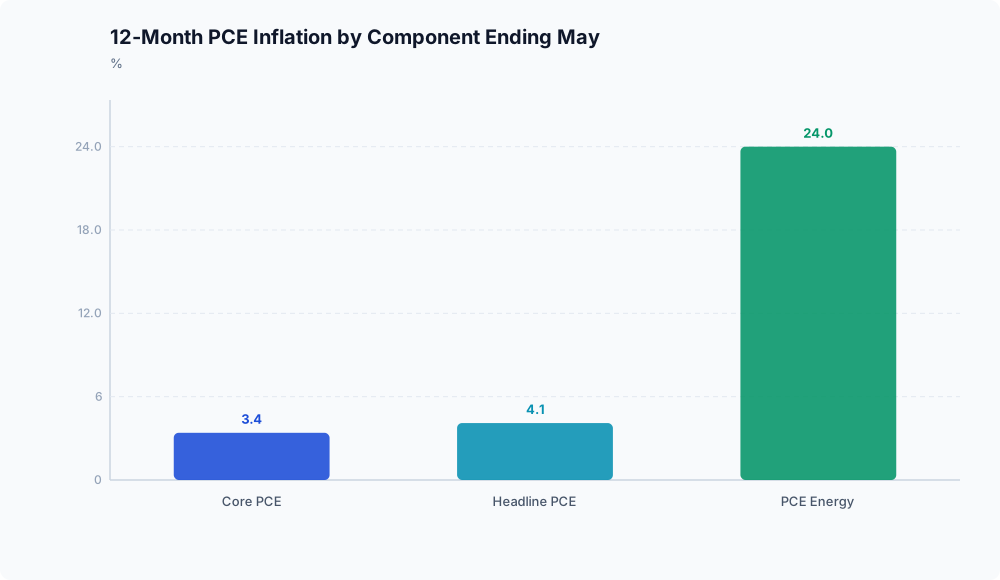
Recent macroeconomic data shows this divergence. According to the Federal Reserve, the U.S. Personal Consumption Expenditures (PCE) price index rose 4.1 percent over the 12 months ending in May, accelerating from 2.5 percent a year earlier. This acceleration was driven largely by energy: PCE energy prices surged 24 percent over that period, while core PCE inflation, which excludes food and energy, stood at 3.4 percent (Federal Reserve). The resulting 0.7 percentage point gap shows that operational fuel and power costs rose faster than broader price levels.
Supply deficits and upstream volatility
Upstream physical inventory constraints continue to drive price volatility across distribution channels. Market reporting by Mark A. Shryock notes that the Energy Information Administration (EIA) estimates global crude inventories declined by an average of 6.3 million barrels per day in the second quarter of 2026. The EIA projects that OECD commercial inventories will fall below 2.3 billion barrels by December 2026, the lowest level recorded since 2003 (Mark A. Shryock).
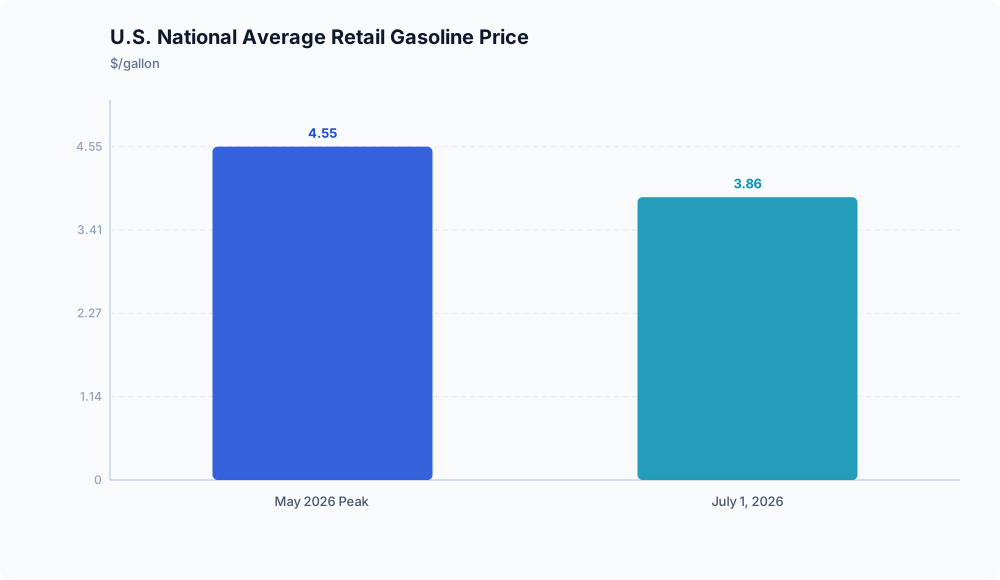
Although the U.S. national average retail gasoline price retreated to $3.86 per gallon as of July 1, 2026, after peaking at $4.55 per gallon in May, sustained inventory deficits mean transport networks and corporate supply chains remain vulnerable to recurrent price spikes (Mark A. Shryock).
Operating margin compression across sectors
Higher fuel prices pass directly into operating expenditures, especially in transportation and logistics. In commercial aviation, an empirical study published in the Undergraduate Economic Review documented that fuel costs averaged 16.29 percent of total operating expenses for major U.S. airlines between 1996 and 2005. During that period, EIA figures cited in the study showed jet fuel rising from $0.62 per gallon in January 1996 to $1.78 per gallon by December 2005 (Undergraduate Economic Review). Because fuel represents such a large share of cash operating costs, rapid price spikes squeeze margins whenever fare adjustments fail to match rising fuel expenses.
Operators also have limited ability to substitute away from petroleum. A techno-economic study published via Washington State University assessed six alternative jet fuel pathways and determined that none would achieve commercial profitability without government subsidies. Even the lowest-cost alternative evaluated, hydroprocessed esters and fatty acids (HEFA) produced from yellow grease, had a mean production cost of $0.91 per liter (ranging from $0.66 to $1.24 per liter), leaving commercial transport operators reliant on conventional petroleum markets (Washington State University).
For manufacturing and general retail distributors, the 24 percent increase in PCE energy costs against a 3.4 percent core inflation baseline points to similar operational pressure (Federal Reserve). When freight, logistics, and plant utility expenses rise faster than core inflation, margins narrow unless firms possess unusual pricing power. Because sector-wide financial statements for manufacturing and retail have not yet provided detailed disclosures on energy expenses for this cycle, the exact dollar magnitude of margin compression across these subsectors remains an analytical estimate rather than a verified figure.
Monetary policy and equity duration

Beyond direct cost pressures on corporate income statements, headline inflation complicates central bank policy. Persistent headline PCE inflation at 4.1 percent leads policymakers to hold interest rates higher for longer, deferring expectations for monetary easing (Federal Reserve).
In discounted cash flow (DCF) models, prolonged higher policy rates weigh on long-duration assets. Equities whose market values depend heavily on earnings projected far into the future face valuation multiple compression as distant cash flows are discounted at higher hurdle rates.
Conversely, valuation theory indicates that these environments favor shorter-duration, cash-generative businesses, particularly upstream energy producers. With energy prices rising 24 percent year-over-year, upstream operators typically experience front-loaded revenue growth and strong current cash flow, providing defensive valuation support against rising discount rates (Federal Reserve).
Macroeconomic indicators differ from realized market movements: while the Federal Reserve documents the 4.1 percent headline PCE rate and the 24 percent energy surge, the report does not track equity flows or subsector multiple compression. The relative outperformance of energy versus growth equities remains an analytical deduction based on valuation theory, pending broad empirical confirmation from quarterly equity earnings reports.
Analytical takeaway
When energy price inflation (24 percent) significantly outpaces core inflation (3.4 percent), the economy absorbs an asymmetrical cost shock (Federal Reserve). For businesses with structural fuel dependencies and limited near-term substitution options, operating margins face pressure. By keeping headline inflation elevated and delaying interest rate cuts, the shock also increases the cost of capital. This shift reduces the margin of safety for long-duration growth assets while favoring short-duration, cash-generative balance sheets.
Disclaimer: This analysis is for informational purposes only and does not constitute investment, financial, real estate, or legal advice. Always consult a licensed financial advisor before making investment decisions.