Shelter Inflation and Multifamily Rent Deceleration
Shelter Inflation and Multifamily Rent Deceleration: What Property Earnings Reveal
How is slowing apartment rent growth affecting multifamily REIT performance and broader shelter inflation dynamics?
The short answer: Multifamily rent deceleration is currently producing a normalization of property-level cash flows rather than systemic operational distress, but its transmission into lower capital costs faces significant macro frictions. While aggressive supply in Sunbelt markets has forced sharp cuts on new leases, coastal portfolios continue to demonstrate pricing power. Furthermore, core operating cash flows across major apartment real estate investment trusts (REITs) remain resilient even as statutory earnings decline and top-line net operating income (NOI) growth slows to low single digits. However, structural single-family unaffordability and commodity volatility prevent localized rent cuts from translating directly into immediate macroeconomic debt relief.
Regional Divergence: Sunbelt Supply Pressures vs. Coastal Stability
The transmission mechanism connecting apartment fundamentals to broader capital markets begins at the lease level. When elevated apartment completions push down market-clearing rents, that softness gradually flows into headline and core inflation measures, where shelter carries substantial weighting.
Operational reporting from major multifamily operators reveals a pronounced geographic split:
- Sunbelt lease pricing under pressure: In high-supply regions, operators face pronounced pricing headwinds. According to the Mid-America Apartment Communities Q1 2026 Earnings Review, MAA’s new lease rates fell 7.0% year-over-year in the first quarter of 2026, even while the company delivered Core Funds From Operations (Core FFO) of $2.13 per share.
- Coastal supply insulation: In coastal markets where construction pipelines are more constrained, pricing held up significantly better. The Q1 2026 Multifamily REIT Earnings Report highlighted that Essex Property Trust achieved Q1 same-property NOI growth of 4.1%, supported by operating expense growth of just 0.2%.
These regional disparities show that rental deceleration is not uniform nationwide; instead, it is concentrated in submarkets absorbing substantial new construction deliveries.
Corporate Cash Flows: Navigating Slower NOI Growth and GAAP Earnings Drops
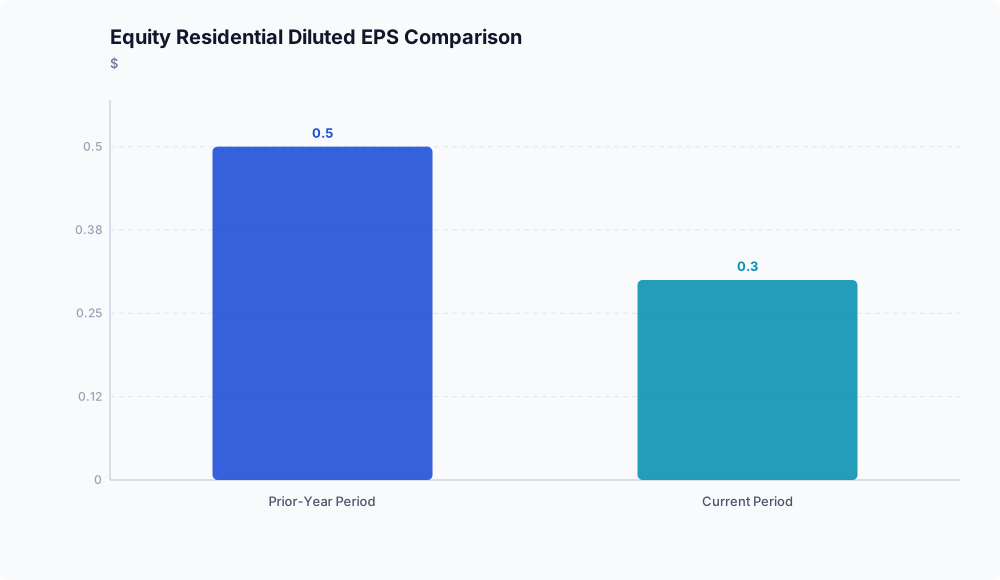
Beyond regional variations, national multifamily operators are reporting restrained top-line growth rather than balance-sheet distress. Corporate reporting from Equity Residential for the second quarter ended June 30, 2026, illustrates this dynamic:
- Diluted Earnings Per Share (EPS): Reported at $0.30 per share, down from $0.50 per share in the prior-year period, according to Equity Residential.
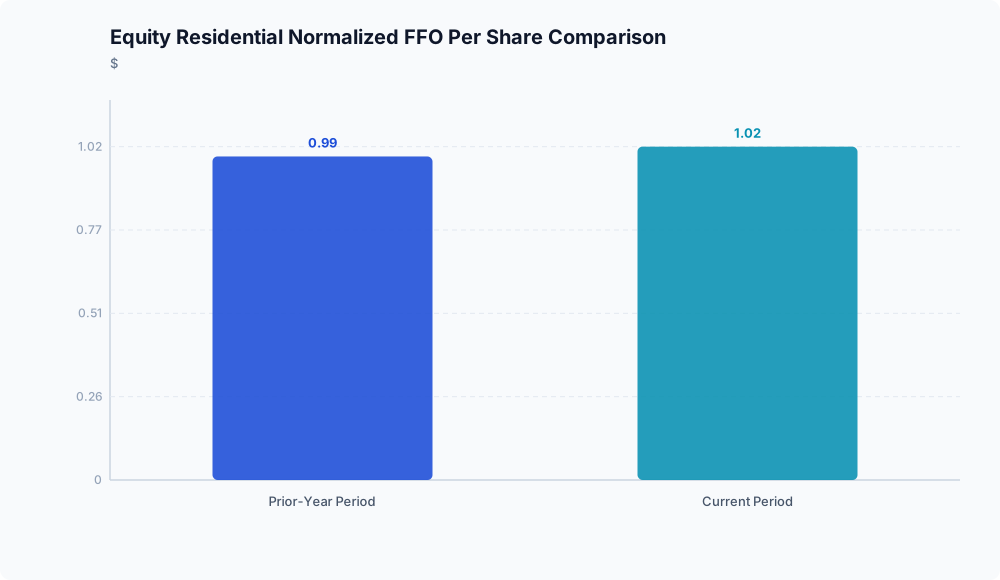
- Normalized Funds From Operations (Normalized FFO): Rose to $1.02 per share, up from $0.99 per share in the second quarter of 2025, as reported by Equity Residential.
- Full-Year 2026 Guidance: Expected same-store NOI growth was revised to a narrow range of 1.5% to 2.1% in guidance from Equity Residential.
From an analytical standpoint, an NOI growth range of 1.5% to 2.1% signals subdued property-level margins consistent with normalized market pricing, contrasting with the rapid rent escalation seen earlier in the post-pandemic recovery.
Financial evidence also warrants caution when interpreting the decline in statutory net income. Diluted EPS captures non-operational portfolio items, sales transactions, and accounting adjustments. By contrast, Normalized FFO isolates core operational cash generation, which continued to expand by $0.03 per share year-over-year at Equity Residential.
Macro Transmission, Housing Frictions, and External Volatility
In economic theory, sustained deceleration in newly signed rents acts as a primary drag on shelter-driven inflation, reducing persistence in core consumer price prints. Cooler core inflation would remove an impediment to monetary easing, which could lower benchmark Treasury yields, compress commercial borrowing spreads, and narrow the negative spread between capitalization rates and debt costs.
However, several market frictions and evidence limitations complicate this transmission:
- Absence of aggregate national data: Current operator reporting does not provide aggregate macroeconomic shelter Consumer Price Index (CPI) metrics or nationwide apartment completion totals. Therefore, whether national shelter inflation has dropped to specific numerical targets (such as 3.0%) cannot be confirmed from corporate disclosures alone.
- Entrenched single-family housing lock-in: Tenant mobility remains constrained by home purchase costs. The Mid-America Apartment Communities Q1 2026 Earnings Review reported that resident turnover fell to an all-time low of 39.9% in Q1 2026. Furthermore, move-outs to purchase a single-family home accounted for just 11.1% of total turnover, demonstrating that single-family unaffordability keeps renter pools captive even where lease rates fall.
- Exogenous commodity shocks: Geopolitical developments inject volatility into overall inflation trajectories. While the Strait of Hormuz has been effectively closed to commercial shipping since February 28, 2026, U.S. retail gasoline averages dropped from a peak of $4.55 per gallon in mid-May 2026 to $3.86 per gallon by July 1, 2026, as market sentiment priced in the June 17 U.S.-Iran ceasefire framework agreement rather than physical barrels—even after an International Energy Agency 400 million barrel reserve release proved insufficient—according to Substack: The Strait of Hormuz Has Been Closed. While lower fuel prices help moderate headline CPI alongside softer rents, persistent geopolitical tensions leave borrowing costs exposed to sudden shifts.
Analytical Takeaway
The available evidence indicates that multifamily rent deceleration is functioning primarily as a margin regularizer rather than a balance-sheet crisis. Operator cash flows—evidenced by steady Normalized and Core FFO metrics—remain stable because renewal demand is anchored by an unaffordable single-family market. For market participants, observing localized rent discounts (such as MAA’s -7.0% new-lease rate reported in the Mid-America Apartment Communities Q1 2026 Earnings Review) is not sufficient evidence to assume imminent macroeconomic interest-rate relief, as underlying shelter CPI transmission lags and external commodity fluctuations continue to cloud the broader monetary horizon.
Disclaimer: This analysis is for informational purposes only and does not constitute investment, financial, real estate, or legal advice. Always consult a licensed financial advisor before making investment decisions.
Frequently Asked Questions
Why does official shelter inflation lag behind real-time apartment rent and concession trends?
Official shelter inflation indices measure the average rent paid across all active leases in the housing stock, including existing tenants on legacy contracts. Real-time operator metrics, such as the 7.0% year-over-year decline in new lease rates reported by the Mid-America Apartment Communities Q1 2026 Earnings Review, apply only to newly executed leases. Because existing leases roll over gradually over 12-month cycles, real-time rent concessions take several quarters to filter fully into broader inflation metrics.

How can apartment REIT normalized FFO increase while diluted EPS and same-store NOI growth decline?
Diluted EPS reflects standard GAAP net income, which incorporates non-operational factors such as property depreciation, asset sales, debt extinguishment charges, and accounting adjustments. In contrast, Normalized FFO adjusts for these items to measure recurring property-level operational cash flow. As demonstrated by Equity Residential in Q2 2026, Normalized FFO can expand ($1.02 vs. $0.99) even as diluted EPS falls ($0.30 vs. $0.50) and same-store NOI growth moderates to a 1.5% to 2.1% pace, driven by lower overhead costs, disciplined expense control, or operational efficiencies.