
Hawkish Fed Pause and Jobless Claims: Equity Valuation Risks
Hawkish Fed Pause: How Sticky Inflation and Internal Dissension Pressure Equity Valuations
Hawkish Fed Pause and Jobless Claims: Equity Valuation Risks
The short answer: Equity multiples face sustained downward pressure because elevated interest rates keep capital discount rates high, directly lowering the present value of future corporate cash flows. While equity markets frequently anticipate rate cuts triggered by an acute labor shock, official reports provide no evidence of a spike in initial or continuing jobless claims. Instead, low headline unemployment and persistent core inflation have led the Federal Reserve to hold policy rates steady, with internal dissension leaning toward rate increases. Without imminent monetary easing, high-multiple equities face valuation hurdles and rising financing costs.
Inflation Realities Overwhelm the Rate-Cut Thesis
Market assumptions that the Federal Reserve would rapidly ease monetary policy have historically relied on expectations of a labor market breakdown. However, central bank statements and reported data show no evidence of an unemployment claims surge; rather, Fed officials noted that the labor market remained stable with payroll gains keeping pace with labor force growth, according to CNBC.
Instead of an acute labor deterioration, macroeconomic data has been characterized by persistent price pressures. Commerce Department figures cited by CNBC revealed that core inflation—excluding food and energy—rose to 3.2% in March 2026, reaching its highest level since November 2023.
This acceleration undermined the case for near-term policy loosening. Consequently, internal consensus eroded: the Federal Open Market Committee (FOMC) post-meeting policy statement in the April/May 2026 period passed by an 8–4 vote, representing the largest number of dissents at a single meeting since 1992, as reported by CNBC. While Governor Stephen Miran voted for an immediate rate reduction, Regional Presidents Neel Kashkari of Minneapolis, Lorie Logan of Dallas, and Beth Hammack of Cleveland dissented against forward guidance implying that the next policy move would be a cut (CNBC).
The Hawkish Revolt Solidifies at the July Meeting
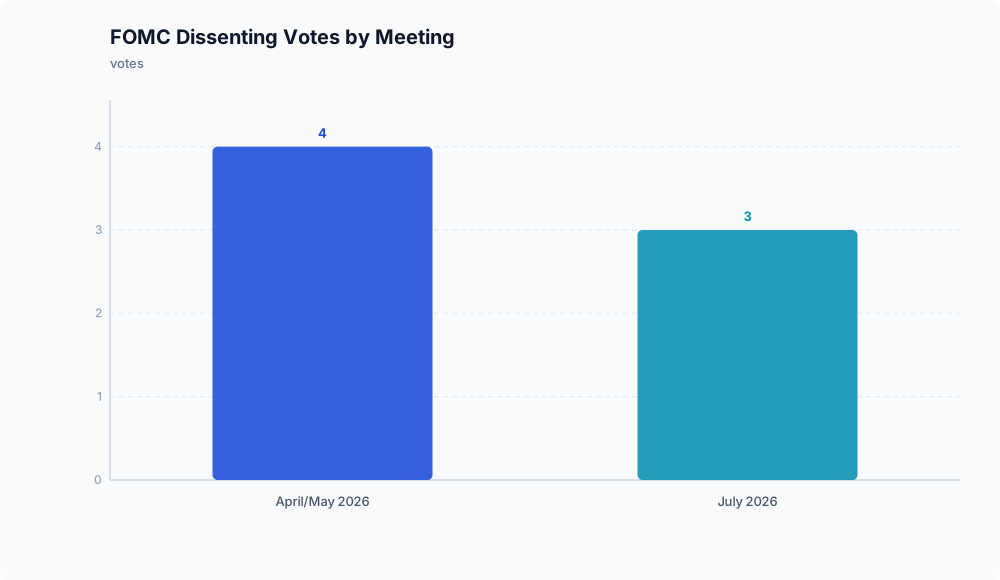
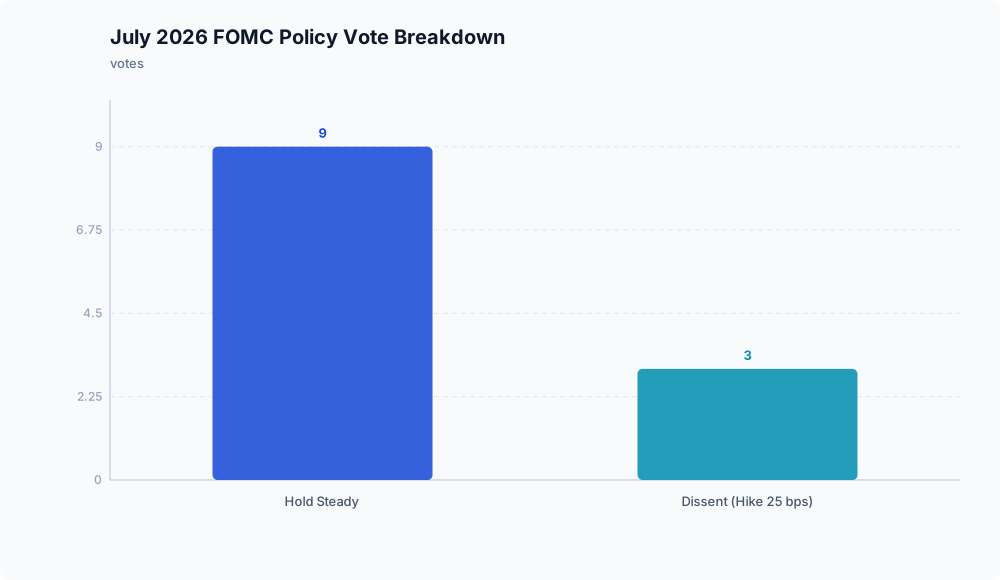
The policy division persisted into the summer. At its July 2026 meeting, the FOMC voted 9 to 3 to maintain the federal funds target range at 3.50% to 3.75%, according to Nuveen. Far from preparing to lower rates, three regional Fed presidents—Hammack, Kashkari, and Logan—dissented in favor of an immediate 25 basis point rate increase (Nuveen).
The macroeconomic backdrop provided these hawkish dissenters with substantial backing:
- Low Headline Unemployment: Macroeconomic data prior to the July gathering saw unemployment fall to 4.2%, though this drop occurred alongside a declining labor force participation rate, according to Nuveen.
- Ultra-Tight Credit Spreads: Investment-grade credit spreads stood at 80 basis points, sitting tighter than historical spreads 96% of the time over the past 25 years (Nuveen).
- Expanding Tech Infrastructure Outlays: Nuveen projected that hyperscaler capital expenditures would exceed $700 billion in 2026, a 34% increase relative to start-of-year estimates, and approach $1 trillion in 2027.
Because broader financial conditions remained accommodating and corporate balance sheets showed little distress, the FOMC faced little pressure to ease borrowing costs.
Transmission to Equity Markets: Multiple Compression and Cost Hurdles

The Fed’s anchored target range of 3.50% to 3.75% carries direct implications for corporate balance sheets and equity valuation models (Nuveen).
Persistent Core Inflation (3.2%)
+
Ultra-Tight Credit Spreads (80 bps)
│
▼
Hawkish FOMC Dissent (9-3 Vote)
│
▼
Benchmark Rate Anchored (3.50%–3.75%)
│
┌───────────┴───────────┐
▼                       ▼
Higher Discount Rates   High Capex Hurdle Rates
(DCF Multiples Compress) ($700B+ Tech Capex)
1. Discount Rates and Valuation Multiples
For equity investors, prolonged policy rates mean the baseline discount rate applied to discounted cash flow (DCF) models remains elevated. Long-duration equities are sensitive to these rates because a significant share of their value lies in distant cash flows. Furthermore, academic research shows that FOMC dissents and policy uncertainty exert downward pressure on stock prices while driving financial market volatility (Apollo Academy). With the S&P 500’s forward price-to-earnings ratio sitting above its long-run average and analysts expecting nearly 25% earnings growth (Nuveen), elevated discount rates leave valuations exposed to multiple compression.
2. Labor Pool Dynamics and Corporate Margins
The combination of a 4.2% unemployment rate and a declining participation rate indicates that workers are exiting the labor force rather than finding jobs (Nuveen). When unemployment falls primarily due to labor force contraction, the available worker pool shrinks without generating additional productive capacity. Alongside negative real income growth noted by Nuveen, these labor supply constraints limit operating flexibility and create operational frictions for businesses.
3. Hurdle Rates on Historic Capital Expenditure
Hyperscalers are projected to deploy over $700 billion in capex in 2026 and near $1 trillion in 2027 (Nuveen). When benchmark rates remain between 3.50% and 3.75% (Nuveen), financing and opportunity costs rise. Higher hurdle rates require projects to generate greater returns on invested capital to deliver net value. In an environment where discount rates suppress terminal valuation multiples, aggressive infrastructure commitments require strong operational execution to avoid return dilution.
Analytical Synthesis

The macroeconomic record shows that expectations of an aggressive rate-cutting cycle are misaligned with central bank voting patterns and price data. Core inflation reached 3.2% (CNBC), and the FOMC has experienced repeated dissents favoring higher interest rates (Nuveen).
With the labor market showing low unemployment rather than crisis conditions (CNBC; Nuveen), monetary policy remains anchored in restrictive territory. For investors, equity valuation expansion cannot rely on prompt rate cuts; corporate earnings delivery and operational execution must support equity pricing as central bank policy remains on hold.
Disclaimer: This analysis is for informational purposes only and does not constitute investment, financial, real estate, or legal advice. Always consult a licensed financial advisor before making investment decisions.