
Unemployment Expectations & Consumer Discretionary Margins
What rising job anxiety means for retail sales and discretionary margins
How will rising household unemployment expectations impact retail sales growth and consumer discretionary margins in 2026?
While corporate earnings are projected to remain steady overall, weakening labor market confidence and decelerating retail sales growth point toward tighter consumer discretionary margins. As households grow more cautious about job stability, retailers selling non-essential goods face more selective shoppers, greater promotional pressure, and limited pricing power.
Deteriorating labor sentiment and precautionary saving
Findings from the August 2026 Survey of Consumer Expectations published by the Federal Reserve Bank of New York show that U.S. household expectations of an increase in unemployment reached their highest level since April 2020. This shift brings consumer outlook to levels of labor market pessimism last seen during the onset of pandemic-era workplace disruptions.
Historically, perceived job insecurity encourages precautionary saving. When workers expect a higher likelihood of displacement or a broader economic slowdown, households typically focus on preserving cash and postponing non-essential purchases.
Measured expectations differ from realized outcomes. While the Federal Reserve Bank of New York survey confirms that unemployment expectations climbed to multi-year highs in August 2026, the report does not track direct quantitative cuts in discretionary purchases or changes in personal saving rates. The shift from rising job anxiety to an actual drop in consumer spending remains an analytical projection rather than an observed fact.
Retail deceleration compared with corporate profits
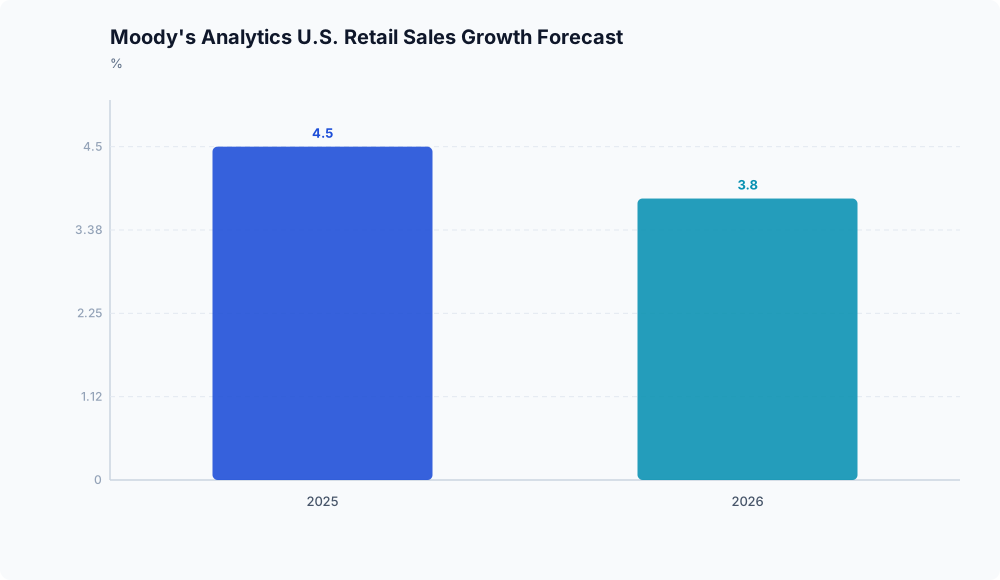
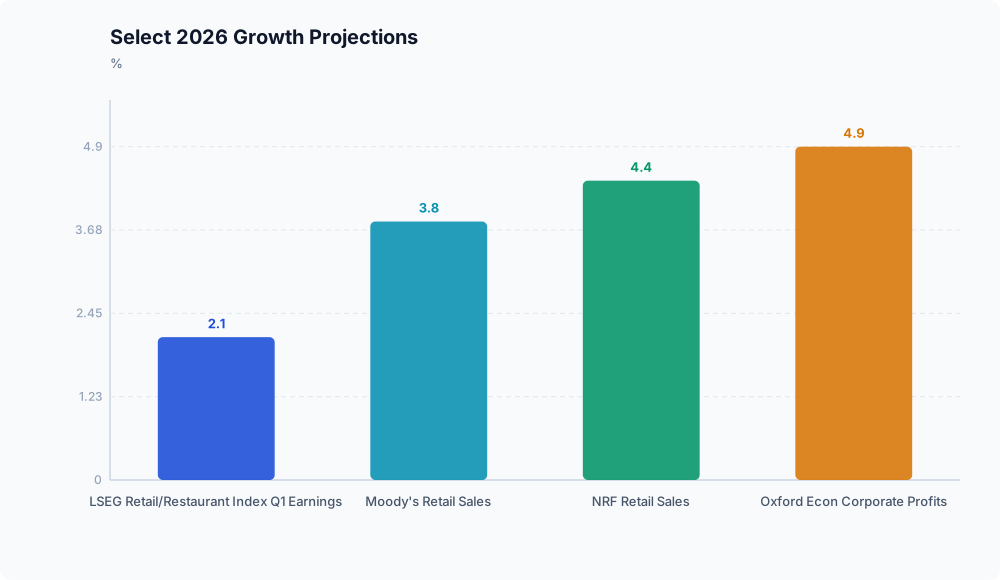
This softening consumer sentiment coincides with projected slower growth in overall consumer spending. Moody’s Analytics forecasts year-over-year U.S. retail sales growth will decelerate to 3.8% in 2026, down from the 4.5% pace projected for 2025, as reported by RV PRO. In contrast, the National Retail Federation projects that 2026 retail sales will expand by 4.4% over 2025.
At the same time, the wider corporate sector is expected to sustain healthier earnings. Oxford Economics projects that aggregate U.S. corporate profits will expand by 4.9% in 2026, as reported by RV PRO. However, retail-specific earnings expectations point toward tighter conditions: for the first quarter of 2026, the LSEG Retail/Restaurant Index projects earnings growth of just 2.1%, according to Lipper Alpha Insight (Refinitiv / LSEG).
This divergence, in which corporate profits outpace retail sales growth (4.9% compared to 3.8%), indicates that retail goods spending is not serving as the economy’s primary earnings driver. For discretionary merchants, slower revenue growth limits pricing power. When sales volume slows, businesses often rely on discounting to clear inventory, exposing operating margins to higher cost structures. Because these projections measure macroeconomic aggregates rather than single company balance sheets, the degree of margin compression across specific discretionary goods categories still depends on broader demand conditions.
Consumer credit risks
Shifts in employment sentiment also present potential risks for consumer finance lenders. When household unemployment expectations reach multi-year highs, as documented by the Federal Reserve Bank of New York, latent credit risks increase. If those expectations translate into job losses or prolonged unemployment, household debt-servicing capacity would weaken, leading to higher delinquency rates and net charge-offs.
For now, this risk remains prospective. The survey documents consumer sentiment, not observed loan defaults or lender write-downs. While consumer-facing balance sheets and retail lenders face headwinds from tightening household budgets, confirming the extent of credit deterioration requires monitoring forthcoming loan performance data.
Outlook for 2026

Macroeconomic data points to diverging trajectories: top-line retail sales growth is slowing while corporate earnings as a whole remain steady. For discretionary retail and consumer finance, household unemployment expectations reaching levels not recorded since April 2020 serve as an early warning. Even without direct confirmation of spending cuts or credit defaults, a more hesitant consumer base leaves discretionary margins exposed to promotional discounting and softer volume throughout 2026.
Disclaimer: This analysis is for informational purposes only and does not constitute investment, financial, real estate, or legal advice. Always consult a licensed financial advisor before making investment decisions.
Frequently asked questions

How does precautionary saving differ from inflation-driven spending adjustments?
Precautionary saving occurs when consumers intentionally hold back spending and build cash reserves because they are uncertain about future employment or income stability. In contrast, inflation-driven spending adjustments occur when rising prices reduce real purchasing power, forcing households to spend a larger share of income on necessities regardless of how secure their jobs feel.
Why might aggregate corporate profit growth outpace retail sales growth in 2026?
Aggregate corporate profits include non-retail sectors, such as industrial production, technology, energy, and business-to-business services, that do not rely directly on domestic retail foot traffic. If non-consumer sectors maintain pricing power or realize productivity gains, aggregate corporate profits can expand at 4.9% even as retail sales growth decelerates to 3.8%.