
10-Year Treasury Yield at 5.00%: Real Estate Impact
What Happens to Real Estate and Borrowing Costs When the 10-Year Treasury Yield Nears 5.00%?
The short answer: When the benchmark 10-year Treasury yield approaches 5.00%—falling slightly to 4.96% after touching 4.983%—residential mortgage rates push above 7.00%, elevating borrowing costs and constraining real estate transaction activity.
Daily market tracking from mid-September 2026 reveals that benchmark sovereign yields near 5.00% established the high-rate foundation that propelled 30-year fixed mortgages back over the 7.00% threshold. While day-to-day fluctuations do not translate into an identical one-to-one movement, sustained pricing at these levels compounds financial friction across residential and commercial property markets.
Mortgage Rates Rebound Above the 7.00% Threshold
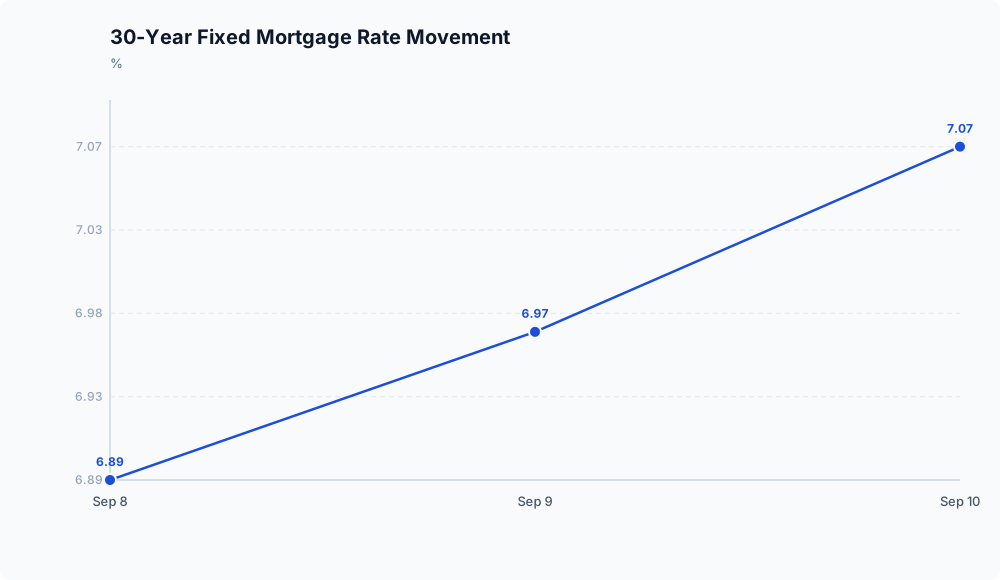
Residential borrowing costs faced renewed pressure in mid-September 2026 as benchmark yields pressed upward. According to daily index tracking from Mortgage News Daily, the 30-year fixed mortgage rate stood at 6.89% on September 8 and 6.97% on September 9 before jumping to 7.07% on September 10.
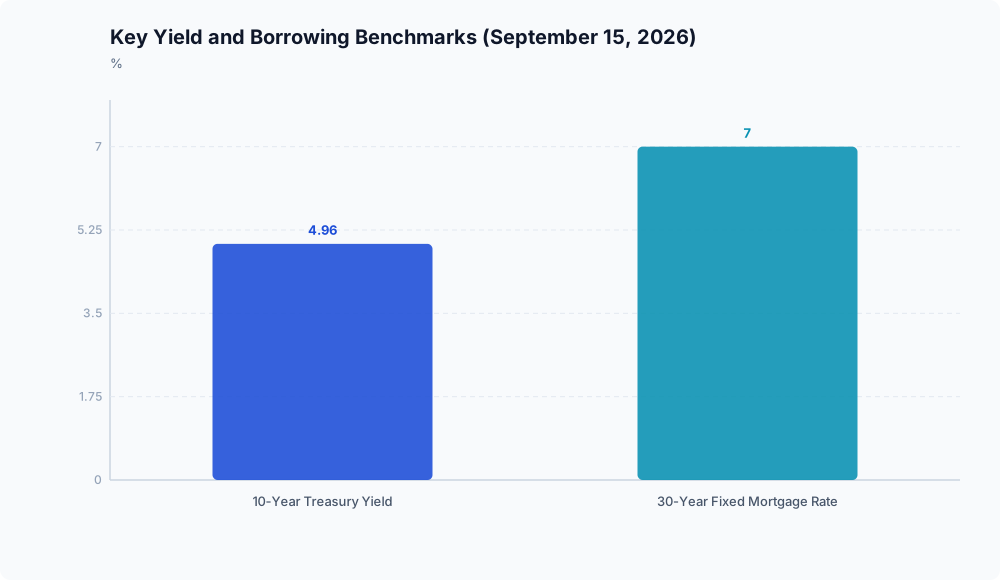
This repricing kept mortgage rates elevated alongside sovereign debt yields. On September 15, 2026, the 10-year Treasury yield slipped by 2.3 basis points—moving from 4.983% to 4.96%—while the average conventional 30-year fixed mortgage rate rose 0.09 percentage points to reach 7.001% (with an APR of 7.065%), according to yfinance and survey data published by The Mortgage Reports.
These daily movements illustrate two key dynamics:
- Threshold alignment: A 10-year Treasury yield hovering between 4.96% and 4.983% creates a debt environment where residential mortgages gravitate above 7.00% The Mortgage Reports.
- Imperfect daily transmission: Marginal bond-market improvements do not immediately translate into lower consumer borrowing offers. Even as the 10-year yield fell 2.3 basis points on September 15, the conventional mortgage average climbed to 7.001% The Mortgage Reports. The broader co-movement holds over time, but intraday swings do not guarantee direct drops for borrowers.
Residential Impacts and Financing Pressures
Mortgage rates crossing back above 7.00% reinforces hesitation across the residential market. Homeowners who financed during historic lows—such as the record weekly low of 2.65% recorded in January 2021 cited by The Mortgage Reports—face substantial disincentives to sell and take on replacement financing near 7.07%, as recorded by Mortgage News Daily.
Industry experts observe that policy uncertainty continues to restrict movement. Ralph DiBugnara, president at Home Qualified, noted that jeopardy surrounding potential Federal Reserve rate cuts will “keep markets frozen some,” keeping rates from dropping without a clear cooling signal The Mortgage Reports.
Affordability hurdles also extend across other loan structures. On September 15, conventional 20-year fixed loans averaged 6.954% (7.043% APR), 15-year fixed loans averaged 6.323% (6.432% APR), and 5/1 adjustable-rate mortgages averaged 6.01% (6.702% APR) The Mortgage Reports. Upcoming economic reports on mortgage applications, retail sales, and housing starts will provide further evidence on how buyer demand and construction activity respond to these borrowing costs The Mortgage Reports.
Capital Stacks and Refinancing Math
A risk-free 10-year Treasury yield approaching 5.00% reshapes broader property underwriting frameworks. When the risk-free rate settles near 4.96% to 4.983%, as documented by The Mortgage Reports, the risk premium between Treasuries and property returns narrows significantly.
Unless property net operating income expands at an equal pace, valuation models dictate that capitalization rates must widen to maintain an appropriate risk premium. For properties facing upcoming loan maturities:
- Proceeds shrink: Higher interest rates require larger debt service allocations, reducing the total loan balance that existing property cash flows can support.
- Equity requirements rise: When replacement debt proceeds decline, sponsors must contribute additional cash equity to bridge the gap.
While validated daily data from The Mortgage Reports verifies high base rates and residential borrowing costs, aggregate commercial transaction cap rates and refinancing volumes are not reported in daily surveys. Mathematical pressure on financing remains evident, but specific commercial cap-rate adjustments take time to appear in periodic market prints.
Analytical Takeaway
A 10-year Treasury yield trading near 5.00%—standing at 4.96% after dipping from 4.983%—keeps consumer mortgage pricing elevated at or above the 7.00% mark The Mortgage Reports. For market participants, modest day-to-day easing in sovereign yields provides little immediate rate relief. As long as benchmark yields remain anchored near these multi-month highs, consumer purchasing power will stay restricted and property balance sheets will face higher financing friction.
Disclaimer: This analysis is for informational purposes only and does not constitute investment, financial, real estate, or legal advice. Always consult a licensed financial advisor before making investment decisions.
Frequently Asked Questions

Why do 30-year fixed mortgage rates follow the 10-year Treasury yield? Mortgage rates often track intermediate-to-long-term sovereign yields, such as the 10-year Treasury note, as their primary benchmark for fixed-income conditions The Mortgage Reports. When investors rebalance portfolios between stocks and bonds, bond demand affects yields, influencing mortgage pricing over time, though daily rate adjustments do not always move in lockstep The Mortgage Reports.
How do Treasury yields approaching 5.00% affect property refinancings? When benchmark borrowing yields approach 5.00%, debt service costs on new loans rise substantially compared to earlier low-rate baselines. Because property earnings must cover higher interest expenses, lenders underwrite smaller loan balances, creating financing gaps that require borrowers to contribute more equity or adjust loan terms.