
10-Year Treasury Yield Above 5 Percent: Market Impact
What a 10-Year Treasury Yield Above 5 Percent Means for Markets
What does the 10-year Treasury yield crossing above 5 percent mean for investors?
In short, it signals that higher interest rates are locked in for an extended multi-year horizon rather than facing an imminent central bank pivot. By establishing a 5 percent baseline risk-free rate, the sovereign bond market directly recalibrates the cost of capital across the broader economy. For bondholders, this environment provides significant nominal yield while capping near-term capital appreciation. For equity investors, it raises the discount rate on future cash flows, leaving market valuations heavily dependent on ambitious corporate earnings growth with minimal room for operational error.
The Drivers Behind the 5 Percent Sovereign Yield
The benchmark 10-year Treasury yield crossed a significant threshold following the Federal Reserve’s September 2026 policy decision, finishing just above 5% for two consecutive trading sessions, according to Enterprise Bank & Trust. At that meeting, the Federal Open Market Committee raised its overnight policy rate by 25 basis points to a target range of 3.75%–4.0%.
This move followed emerging internal policy debates over the summer; at the preceding July meeting, the vote was not unanimous, as three officials dissented in favor of an immediate quarter-point increase, as reported by Revista Influencer.
The push above 5% on the 10-year yield is anchored in the central bank’s significantly elongated timeline for restoring price stability. While the Fed maintains a 2.0% target for Core Personal Consumption Expenditures (PCE) inflation, policymakers do not project Core PCE inflation to fall near target levels until 2029, according to Enterprise Bank & Trust.
Reflecting this multi-year inflation horizon, Fed forward guidance detailed by Enterprise Bank & Trust projects:
- One additional quarter-point rate hike before the conclusion of 2026
- An extended policy pause with no rate adjustments throughout 2027
- The resumption of rate cuts postponed until 2028
Pushing monetary easing out to 2028 strips away near-term pivot expectations, prompting bond investors to demand higher term premiums on intermediate- and long-term sovereign debt.
At the same time, broader economic demand has proven durable enough to endure these financial conditions. Full-year 2026 S&P 500 corporate earnings are projected to expand by more than 30%—more than three times the long-term annual average, according to Enterprise Bank & Trust. These strong earnings expectations provide the Fed leeway to maintain restrictive policy without triggering an immediate downturn.
Equity Valuations and the Thinning Risk Premium
A sovereign yield above 5% fundamentally alters discounted cash flow (DCF) models across the equity market. Because the 10-year Treasury yield acts as the benchmark risk-free rate, an elevated yield increases the discount rate applied across all future cash horizons. Mathematically, this reduces the present value of future corporate earnings—a dynamic that poses particular vulnerability to high-multiple growth stocks whose cash flows reside predominantly in the distant future.
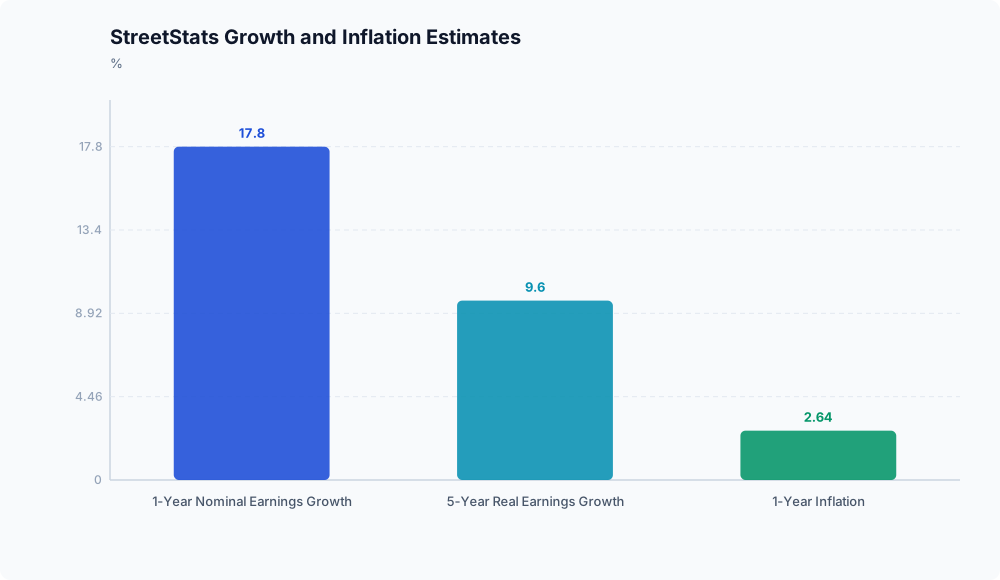
Despite these heightened discount rates, equity markets have traded at elevated levels. At the market close on September 18, 2026, the S&P 500 stood at 7646.04, supported by StreetStats estimates projecting:
- 1-year nominal earnings growth at 17.84%
- 1-year inflation at 2.64%
- 5-year real earnings growth at 9.60%
When sustained 5% sovereign yields coincide with elevated equity benchmarks, the equity risk premium (ERP)—the spread in expected returns investors earn for taking equity risk over holding default-free government debt—inevitably thins. While the available data does not confirm whether current ERP levels have breached historical multi-decade lows, the analytical consequence is clear: prevailing equity valuations leave little margin for disappointment. If corporate earnings growth decelerates from the forecast 30% pace noted by Enterprise Bank & Trust, equity multiples will bear the full, unmitigated pressure of the 5% sovereign discount rate.
Capital Allocation: Income Protection vs. Multiple Risk

The Federal Reserve’s extended timeline creates distinct structural realities for portfolio positioning:
- Fixed Income: Yields hovering just above 5% provide nominal income streams that have not been present during prior zero-rate regimes, as noted by Enterprise Bank & Trust. This offers a reliable yield buffer against lingering price pressures. However, because rate cuts are not projected to materialize until 2028, allocators cannot count on meaningful capital appreciation driven by declining yields over the next several quarters.
- Equity Markets: With the risk-free rate poised to remain elevated through at least 2027, valuation multiples cannot count on monetary stimulus for expansion. Capital allocations in equities must rely almost entirely on fundamental corporate execution and cash-flow durability rather than broad macro liquidity.
Conclusion

The benchmark 10-year Treasury yield holding above 5 percent marks an end to expectations of a quick return to low-rate monetary policy. With the Federal Reserve projecting that Core PCE inflation will remain above the 2.0% target until 2029 and holding rate cuts off until 2028, as reported by Enterprise Bank & Trust, capital allocators face a sustained period of higher capital costs.
While elevated yields restore attractive nominal returns to fixed income, they simultaneously strip equity valuations of their valuation safety net. In an environment where the risk-free hurdle rate sits at 5%, the burden of market performance falls squarely on corporate earnings delivering on historically high growth forecasts.
Disclaimer: This analysis is for informational purposes only and does not constitute investment, financial, real estate, or legal advice. Always consult a licensed financial advisor before making investment decisions.