
Shelter Disinflation and Multifamily Rent Growth Impact
Navigating shelter disinflation: what softening multifamily rent growth means for property operations
How does cooling multifamily rent growth affect property operations and financial performance?
When organic rent appreciation slows, multifamily operators can no longer rely on automatic lease-rate increases to offset rising expenses and drive net operating income (NOI). Instead, property owners turn to internal cost containment and structured ancillary revenue programs to protect operating margins. Meanwhile, recently formed residential real estate investment trusts (REITs) must establish baseline operational performance directly within this lower-growth environment, and the long-term impact of softening market rents on their track records remains to be determined.
Macroeconomic disinflation vs. operational reality
Slowing rent growth provides a recognized disinflationary mechanism across the broader economy. While softer shelter metrics historically ease aggregate price pressures to support central bank rate easing, specific data detailing a 3.0% shelter inflation print or direct Federal Reserve policy responses is absent from the verified record.
Verified evidence confirms a slowdown in leasing fundamentals: multifamily rent growth in 2026 is forecasted to remain below long-term historical averages, according to industry analysis from Foxen. As newly delivered supply dampens pricing power across key markets, the operational focus centers on defending existing asset yields amid slower top-line expansion.
The shift to operational efficiency and ancillary income
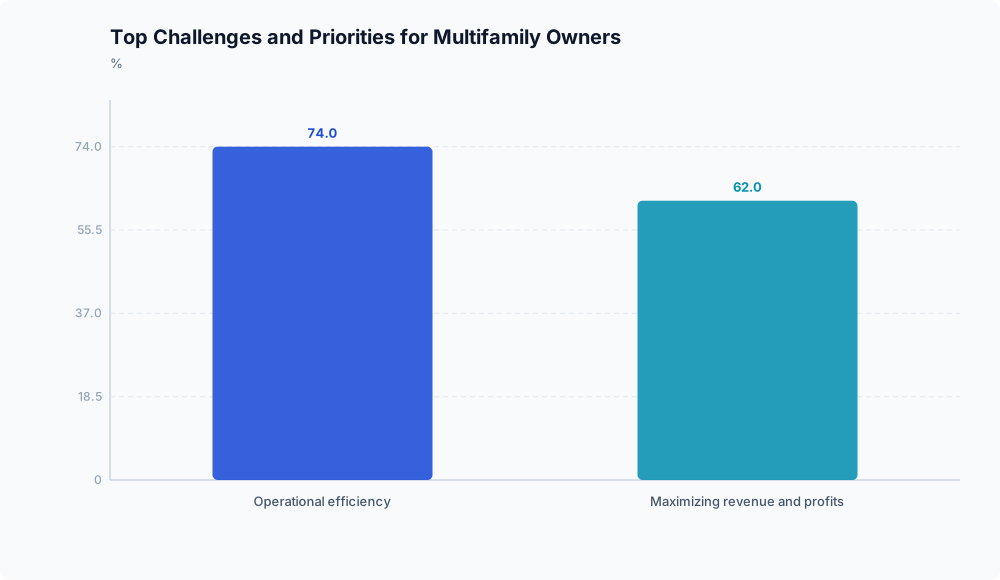
As baseline rent growth cools, property managers face narrower margins for error. According to 2024 survey data reported by Foxen, 74% of multifamily owners ranked operational efficiency as their top challenge, while 62% identified maximizing revenue and profits as a primary priority.
To offset flat or below-average market rent growth, operators have prioritized non-rent revenue sources and administrative automation:
- Multifamily operators generated more than $13 million in ancillary income across service and compliance platforms in 2024, as documented by Foxen. These mechanisms include automated resident compliance tracking, lease waiver programs, and rent reporting platforms.
- Property manager Coastal Ridge generated $630,000 in revenue from an insurance waiver program alone, achieving an 81% resident enrollment rate and zero non-compliant renters, according to Foxen.
Capturing predictable, standardized fee income provides an operational buffer against stagnant baseline rents, supporting property cash flow when lease-rate increases stall.
Measuring the impact on recent residential REIT entrants

Evaluating how softening rental fundamentals influence institutional real estate portfolios requires separating established portfolios from recent market entrants. Comprehensive, sector-wide empirical data measuring net operating income changes across the residential REIT landscape remains limited in the verified record, leaving the overall magnitude of rent deceleration uncertain.
This analytical challenge appears in recently organized vehicles. For example, GO Residential Real Estate Investment Trust was established on June 13, 2025, and conducted no operations prior to the closing of its initial public offering (IPO) on July 31, 2025.
Because the trust began operations concurrently with its IPO, its baseline financial figures, including revenue and NOI generation, formed entirely under the prevailing conditions of mid-2025 and beyond. Without a pre-IPO operating history, newer entities lack multi-year baseline figures to measure period-over-period rent changes against prior peaks. While general real estate fundamentals indicate that sluggish market rents constrain top-line revenue growth, the exact extent to which softening rents affect the performance of newly public residential REITs cannot be definitively verified until longitudinal operating track records are published.
Analytical takeaways

The divergence between macroeconomic shelter disinflation and property-level management points to several operational realities:
- With 2026 rent growth projected below historical averages according to industry forecasts from Foxen, operators cannot depend on standard annual lease increases to outpace operating expenses.
- Protecting property-level NOI increasingly relies on structural fee capture, such as automated compliance programs and ancillary resident services.
- For residential REITs formed during this cooler market, evaluating performance requires tracking operational track records over future reporting cycles rather than comparing results to older market conditions.
Disclaimer: This analysis is for informational purposes only and does not constitute investment, financial, real estate, or legal advice. Always consult a licensed financial advisor before making investment decisions.